BHPH Tax Season: Size the Down Payment to Recover Cost, Not to Grab It
Tax-refund season is the BHPH Super Bowl. Here's how to size the down payment so you recover your cost fast without writing notes that default by spring.
Part of the BHPH, financing & F&I guide: How to Run a Buy Here Pay Here Dealership: The Whole Loop, From Approval to Payoff
Switching from another DMS? Compare DealerVLO to DealerCenter, Frazer, or Lot Wizard.
For a buy-here-pay-here lot, the weeks around tax-refund season are the closest thing the business has to a Super Bowl. Buyers who couldn't put a dime down in November show up with a few thousand dollars in refund money and a hard need for a car. Move the right inventory and you can write a quarter of the year's notes in a few weeks.
Which is exactly why it's the easiest time to hurt yourself. The temptation is to treat the refund as a number to capture — grab the biggest down the check allows, book the gross, move to the next customer. But the refund is a one-time event and the payment is forever, and a note you write in February that defaults in May is worse than one you never wrote. The whole game is sizing the down payment so you get your money back fast without pricing the buyer out of their own note.
14-day free trial, then $29/mo · Cancel anytime
Tax season is the BHPH Super Bowl — and the trap
The trap is thinking the down payment's job is to maximize the cash you pull off the deal. It isn't. On an in-house note, the down payment's real job is to recover your cost in the car — what you paid plus recon — as quickly as possible. Until that cost is back in the drawer, it's your money on the street, at risk to every missed payment. Once it's recovered, everything the note collects after that is margin.
That reframes the whole decision. A bigger down looks like more profit, but if you took it by stripping the buyer's entire refund, you've also removed the cushion that keeps them current when the first paycheck comes up short in April. The bigger down didn't make the deal safer — it made the payment harder to hold. And a note that rolls into a repossession you have to recondition and re-sell costs far more than the extra few hundred dollars looked like it was worth. If you're already thinking about who qualifies, our BHPH underwriting and approval criteria piece is the companion to this one.
Size the down to recover cost, not to maximize it
Here's the mechanic in one deal. Say you're selling a $12,000 car that cost you $6,500 all-in. Take $1,500 down and you've covered about 23% of your cost — you still have $5,000 of your own money out there, and the payments have to bring it back before the note earns a dollar.
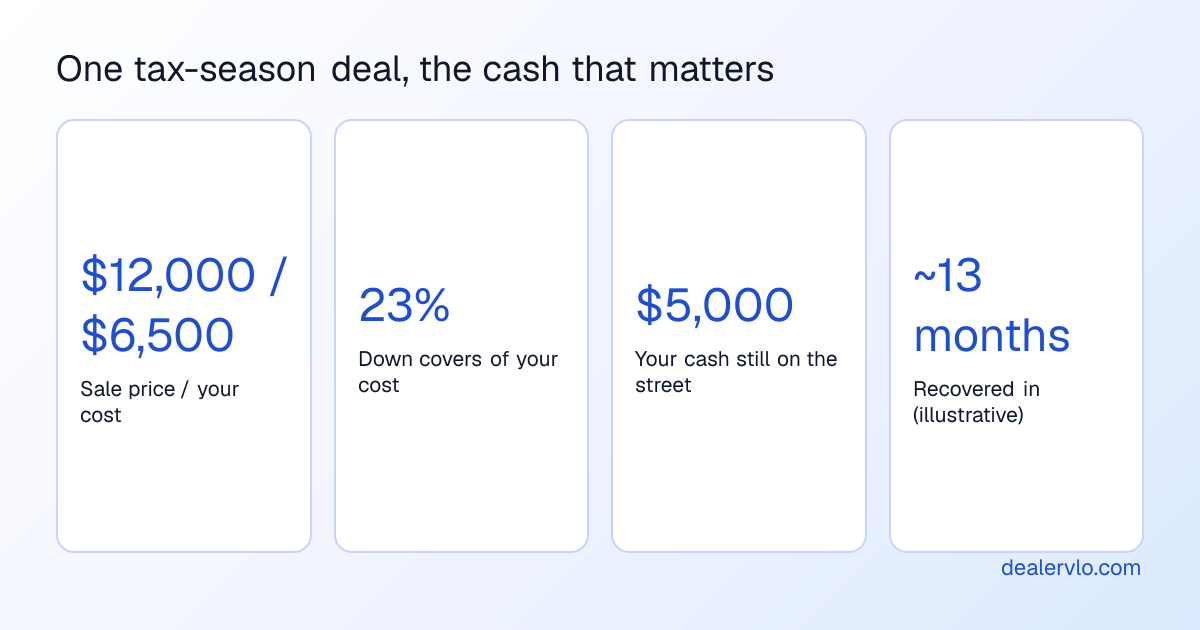
So the useful question during tax season isn't "how much down can I get?" It's "how much down gets my cost back fast while leaving a payment they can keep?" That's a number you can actually compute per deal instead of eyeballing.
Size the down to recover your cost fast — see cash-in-deal, payments to break even, and affordability.
Open the BHPH Down Payment CalculatorRun a few refund scenarios through it before the rush starts and you'll settle on a rule you can hand to whoever's working the desk: a down that recovers cost inside the first stretch of the note, and a payment the buyer's income can carry. Then you're not renegotiating the philosophy on every deal in February.
Underwrite the payment, not just the down
The refund clearing tells you the buyer had money this week. It says nothing about the fifty-two weeks of payments that follow. That's why the second number matters as much as the down: the payment as a share of the buyer's take-home.
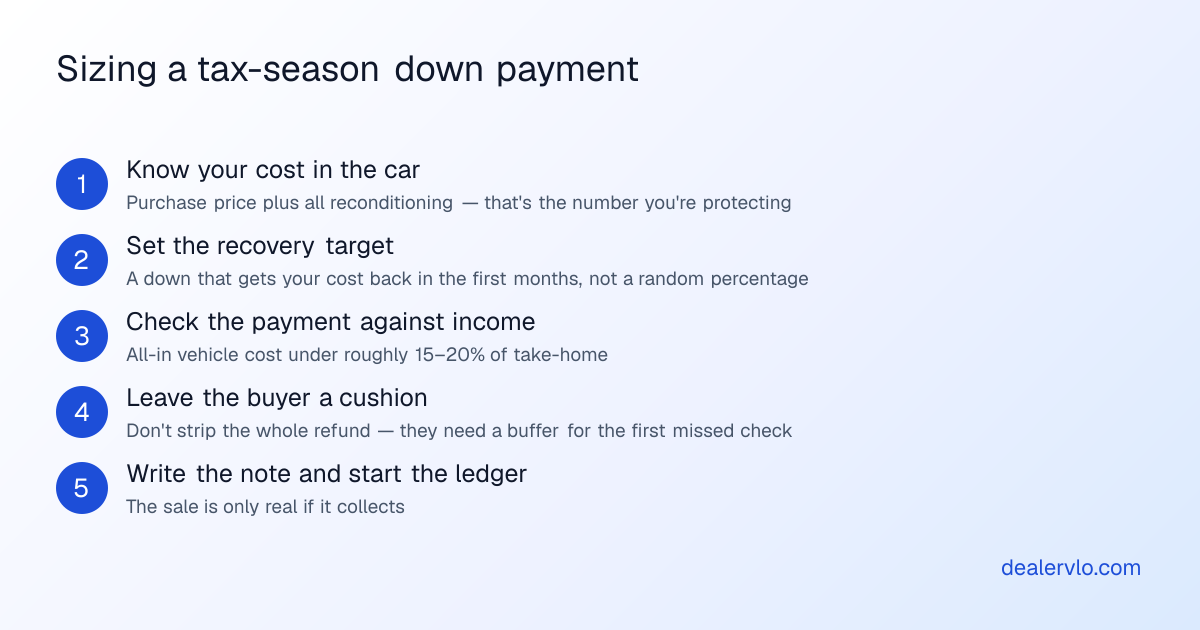
A common budgeting rule of thumb keeps the all-in vehicle cost — the payment plus insurance — under roughly 15 to 20 percent of take-home. It's not a credit-decision formula, but it's a useful gut-check: a note that lands well above that range is the one most likely to go sideways first, refund or no refund. If the payment's too tight, a longer term or a cheaper car helps the buyer far more than a bigger down does — the down protects you, the payment is what they have to live with. Matching payment frequency to their paydays (weekly or bi-weekly) helps too; our BHPH payment calculator compares those side by side.
14-day free trial, then $29/mo · Cancel anytime
Get ready before the rush
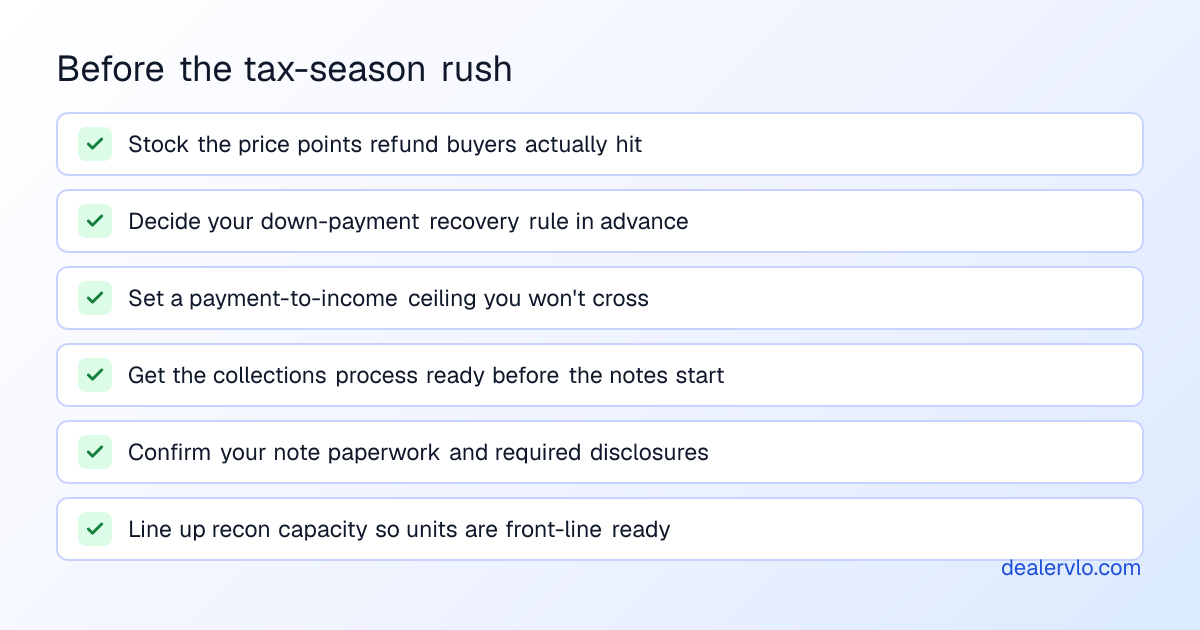
The dealers who win tax season decide all of this in the fall, not at the desk with a customer waiting. That means stocking the price points refund buyers actually reach — reasonable, front-line-ready units, not the aged metal you've been trying to move (if anything, mark that down and clear it to free the floor and the cash for season inventory). It means writing down your down-payment and payment-to-income rules so the whole team applies them the same way. And it means having the collections process ready to go the day the first note is written.
The money's made after the sale — protect it
Here's the part no calculator does: once the note is written, someone has to record every payment against the balance, see who's slipping before it becomes a repo, and actually make the reminder calls. Tax season fills your book fast — and a book you can't watch is a book that quietly bleeds. The gross you booked in February is only real if it collects through the spring.
That's the piece DealerVLO carries after the deal. The note and its running ledger live on the deal, so you can see whose cost you've recovered and who's falling behind; the collections dashboard shows current-versus-past-due at a glance, and a daily email tells you who's past due and who's due today, so you know exactly which calls to make. Structure the down right up front, then let the ledger protect the season — that's the whole business.
Frequently asked questions
How much down payment should I take during tax season? Enough to recover your cost in the car — purchase plus recon — quickly, not the largest amount the refund can cover. A down that gets your cost back in the first few months protects you if the note goes sideways.
Why not take the biggest down a tax refund allows? Because the refund is a one-time event and the payment is forever. Strip out too much of the buyer's cushion and the first short paycheck turns into a repossession you have to recondition and re-sell.
What should I do before the tax-season rush? Stock the price points refund buyers hit, decide your down-payment and payment-to-income rules in advance, and get your collections process ready before the notes start.
How do I know if a tax-season note is affordable? Look at the payment as a share of the buyer's take-home, not just whether the down cleared — a common rule of thumb keeps all-in vehicle cost under roughly 15 to 20 percent of take-home.
Bottom line
Tax season rewards preparation, not aggression. Size the down payment to recover your cost fast, underwrite the payment against real income, leave the buyer a cushion, and have the collections process ready before the first note is written. Do that and you turn a few frantic weeks into a book that pays you all year.
DealerVLO structures the note, generates the schedule, and keeps the collections ledger on the same deal — start a 14-day free trial and go into tax season with the whole thing in one place.
14-day free trial, then $29/mo · Cancel anytime