Used-Car Sales Seasonality: When to Load Up on Inventory and When to Run Lean
Used-car sales seasonality for dealers: why sales peak in March, when wholesale prices rise and fall, and a month-by-month calendar for when to stock up.
Part of the Inventory, pricing & aging guide: Inventory Turn Rate for Used Car Dealers: Benchmarks, Formula & How to Improve
Used-car sales seasonality is simple to state and expensive to ignore: sales peak in March on tax refunds, and wholesale values usually fall fastest in October. A small lot that ignores that shape pays twice. It misses March, the strongest selling month of the year, because the lot is half-empty while cars are still in recon. Then it carries a full lot into October, the month wholesale values usually fall fastest.
This post covers when used-car sales peak, why, what happens to wholesale prices around that peak, and the buying calendar that follows from it. It ends with how to watch your own lot's health through the year, because national averages tell you the shape of the year and your own numbers tell you what to do this week.
The short answer: when used-car sales peak and when to stock up
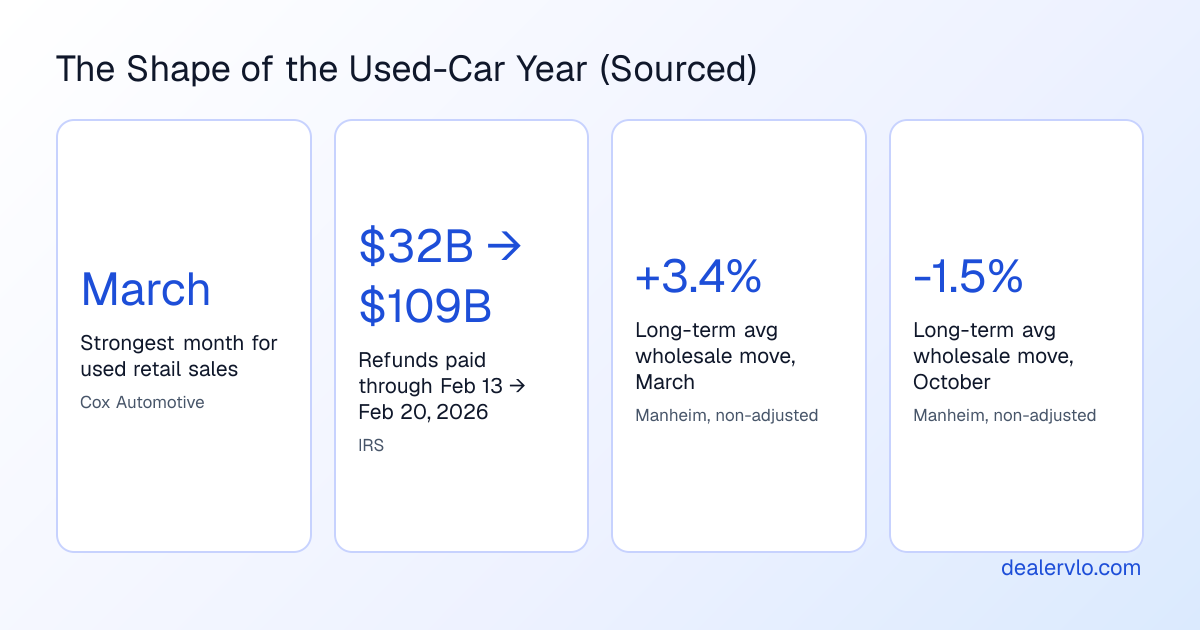
- Peak sales: March. Cox Automotive says March is typically the strongest month of the year for used-vehicle retail sales.
- Why: federal tax refunds. They land in volume from mid-to-late February and become down payments.
- Wholesale cost: rises into spring as every lot restocks at once, and usually softens in the fall.
- Slow season: fall into the holidays. October typically has the year's steepest wholesale depreciation, and December typically sees a retail slowdown.
- So: buy and recondition ahead of the rush, be fully stocked and listed by early February, sell through March and April, and run leaner into the fall.
When is the highest volume of used-car sales?
March, and the drop-off after it is steep. Cox Automotive estimated about 1.64 million used retail sales in March 2026, then about 1.43 million in April as "the tax-refund season eased from its peak" (Cox Automotive, April 2026). In 2025, Cox called March the strongest it had seen since 2021.
February builds into it, March peaks, April is still strong but slowing, and the rest of the year is steadier. The exact timing moves a little from year to year. As Cox Automotive's chief economist Jeremy Robb put it, the spring bounce "can shift from year to year depending on where dealers' inventory levels are at the start of the year and the strength of tax refund season".
Why used-car sales peak in tax season
A lot of used-car buyers, especially credit-challenged ones, don't have a down payment until their refund arrives. And refunds don't trickle in evenly. They arrive in a wave, for a specific legal reason.
Under the PATH Act, the IRS can't issue refunds that include the Earned Income Tax Credit or the Additional Child Tax Credit before mid-February, and that hold covers the entire refund, not just the credit. Many of the households your lot serves claim those credits. When the hold lifts, the money arrives all at once:
- Through February 13, 2026, the IRS had issued about $32 billion in refunds (IRS).
- Through February 20, 2026, about $109 billion, with an average refund of $3,804 (IRS).
That's roughly $77 billion in one week. An average refund of nearly $3,800 is a real down payment on a used car. That week, not the calendar date of tax day, is when your phone starts ringing. If you run buy-here-pay-here, how you size those down payments matters as much as the volume; I covered that in BHPH tax-season down payments.
When used-car wholesale prices rise and fall
Every dealer in the country knows March is coming, and they all restock at the same time. Wholesale values follow.
Cox publishes the long-term average monthly move in Manheim's non-adjusted wholesale values. For March, it's a gain of 3.4% (Manheim, March 2026), the biggest seasonal move of the year. On an illustrative $15,000 unit, a 3.4% move is about $510 between the start and end of the month (15,000 × 0.034). A lot that waits until March to restock pays that on every car it buys.
The other side of the curve is the fall. Manheim's long-term average for October is a decline of 1.5%, and Cox says October typically shows "the highest levels of depreciation in the year". And Cox describes December as a month that typically sees a slowdown in retail sales.
Put the two curves together and the strategy is simple. Don't be the lot buying at the top of the spring market and holding a full lot through the fall decline.
14-day free trial, then $29/mo · Cancel anytime
When to stock up on used-car inventory: a month-by-month calendar
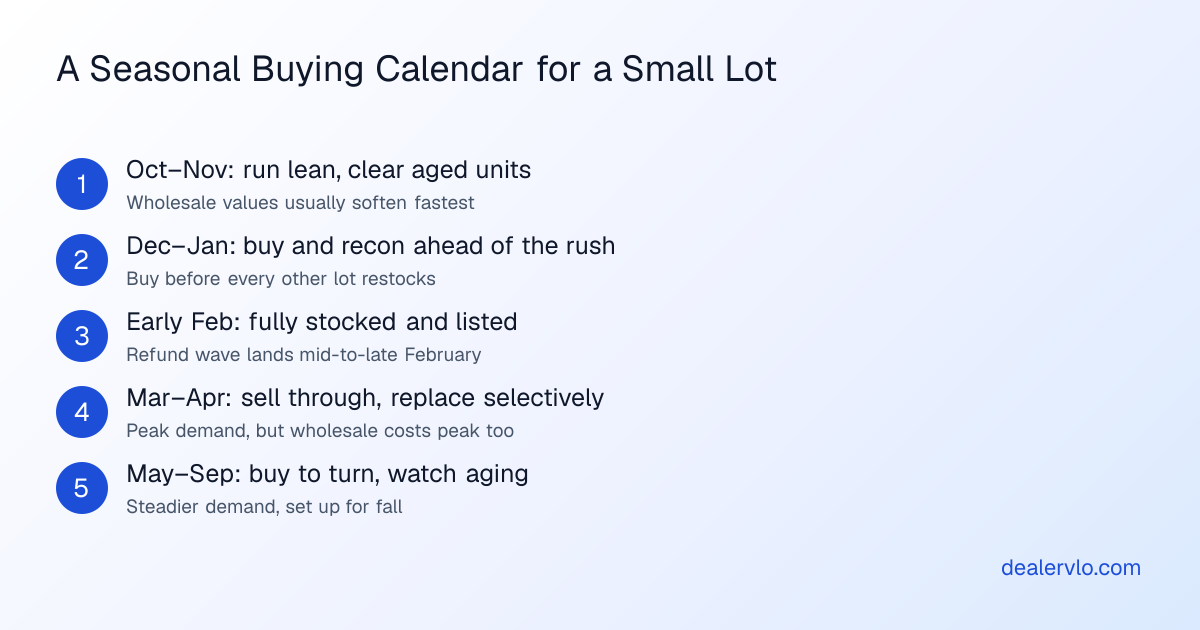
This is the pattern I'd plan around. Shift it to fit your own numbers.
October–November: run lean. Values are usually falling fastest, so don't carry extra inventory. Clear anything past 60 days now, while it still brings a decent wholesale number. Buy only cars you can retail in 30 to 45 days. One exception: if you sell 4WD trucks in a snow state, a soft September lane can be a good time to buy winter stock.
December–January: buy ahead of the rush. This is when you build the tax-season lot. You're buying before every other lot restocks, and you have time to recondition properly instead of rushing cars through the shop in February. Recon takes longer than you think; a car isn't inventory until it's through recon and photographed. In DealerVLO, log each car's recon line by line as it goes through the shop, and its all-in cost is ready before you price it for February.
Early February: fully stocked and listed. The refund wave lands mid-to-late February. Every unit should be reconditioned, photographed, priced, and live on your website and listing sites before it does. A car still in the shop on February 20 misses the best week of the year.
March–April: sell through and replace selectively. Sell hard. Replace what sells, but remember you're now buying in the most expensive part of the wholesale year. Hold your bid ceilings; a hot market makes it easy to overpay.
May–September: buy to turn. Demand is steadier. Keep stock turning and watch aging, so you go into the fall without a backlog of 60-day units.
Grade your lot on turn, aging, and gross in about two minutes.
Open the Lot Health GraderWhy seasonality matters more on a small lot
On a big store the seasonal swing is a line on a chart. On a 20-car lot it's the difference between a good year and a tight one.
Your capital is limited. Every dollar in a car that sits through October is a dollar that isn't in a car you could sell in March. Holding costs are real too. On an illustrative $15,000 unit floored at 8% interest, that's about $3.29 a day in interest alone (15,000 × 0.08 ÷ 365), before insurance, lot space, and depreciation. Ninety days of that is around $296 of interest on one car.
Getting the timing right means two things. You buy more of your tax-season inventory before wholesale prices climb, and you carry less of it through the months when values fall. The ideal inventory count post covers how many cars to carry; this is about when to carry them.
Want the buying side of this every month? The Stocking Report turns current Manheim data into specific units worth buying:
The run list for your lot — current Manheim wholesale data and demand studies turned into specific units to buy, first thing each month. No spam, unsubscribe anytime.
How DealerVLO helps you manage lot health through the year
Seasonal timing only works if you can see your lot clearly. That means knowing what's aging, what each car really cost, and what it should sell for. This is the part DealerVLO handles. I built it to run my own lot in Massachusetts, and the lot runs on it every day.
Aging you can see. Every car shows its days in inventory, gets an "aging, consider repricing" flag at 60 days, and the dashboard counts how many units are 60+ days. The inventory aging report buckets your lot into 0–30, 31–60, 61–90, and 90+ days. Going into October, that's your list of what to clear. Going into February, it should be close to empty past 60. DealerVLO doesn't mark prices down for you; the decision stays yours, with the numbers in front of you.
True cost per car. Reconditioning is tracked line by line on each car and rolls into its all-in cost and margin. When you're recon'ing a batch of units in January, you see what each one actually costs before you price it.
Pricing from the current market. The AI price suggestion shows a price range from live comparable listings plus a target price for selling in about 30 days. That matters most when the market is moving, in March when retail is strong and in the fall when it's softening.
Your own seasonality. National data gives you the shape of the year; your market sets the details. Export your sales report to CSV and line up your own months for the last couple of years. That tells you how early your rush starts.

Get ready for tax season by early February
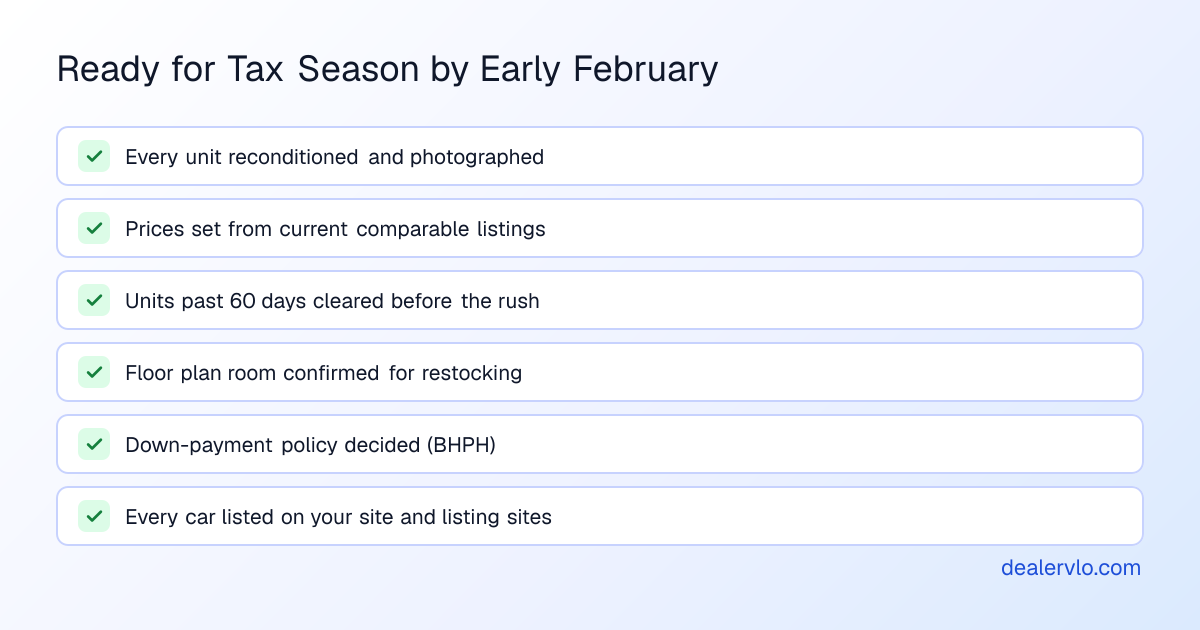
Use this checklist in January, so you aren't working through it in February:
- Every unit reconditioned and photographed. Not "in the shop."
- Prices set from current comparable listings. Not last fall's numbers.
- Units past 60 days cleared before the rush, so the space and cash go to cars that sell.
- Floor plan room confirmed, so you can restock what sells in March. If you're deciding between floor plan and cash, see floor plan vs. cash.
- Down-payment policy decided, if you finance in-house.
- Every car listed on your website and the listing sites you use.
The last item is the one that slips in a rush. In DealerVLO, inventory publishes to your included dealer website automatically, and listing feeds go to CarGurus, Cars.com, and Autotrader once you've enrolled with each (you still pay those sites' own fees). A car you finish on Tuesday is on your own website that day.
14-day free trial, then $29/mo · Cancel anytime
Frequently asked questions
What is the busiest month for used-car sales?
March. Cox Automotive says March is typically the strongest month of the year for used-vehicle retail sales. In 2026 Cox estimated about 1.64 million used retail sales in March, then about 1.43 million in April as tax-refund season eased. The surge is driven largely by federal tax refunds, which arrive in volume from mid-to-late February.
Why do used-car sales go up during tax season?
Because refunds become down payments. Many used-car buyers, especially credit-challenged ones, don't have cash for a down payment until their refund lands. By law the IRS can't issue refunds that include the Earned Income Tax Credit or Additional Child Tax Credit before mid-February, so a large wave of money arrives at once. In 2026, cumulative refunds went from about $32 billion through February 13 to about $109 billion through February 20.
When should a used-car dealer stock up on inventory?
Before the tax-season rush, not during it. Wholesale values typically climb from late February into spring as every dealer restocks at the same time; Manheim's long-term average move in non-adjusted wholesale values is a gain of 3.4% in March alone. A lot that buys and reconditions in the softer late-fall and January market, and is fully stocked and listed by early February, sells into peak demand with cars it bought before prices rose.
When is the slow season for used-car dealers?
Fall into the holidays. Cox notes that October typically shows the highest wholesale depreciation of the year, and that December is a month that typically sees a retail slowdown. That's the time to run leaner, clear aged units, and avoid carrying extra inventory while values are falling.
Should I buy inventory in the fall if prices are falling?
Buy to turn, not to hold. In fall you want inventory you can sell in 30 to 45 days, because a car that sits through October and November loses value while it costs you floor plan interest. The exception is seasonal demand in your market, like 4WD trucks in a snow state, where buying in a soft September lane can make sense.
How can I see my own lot's seasonal pattern?
Look at your own sales by month for the last two or three years. National data tells you the shape of the year, but your market, your customer mix, and how much BHPH you do all change it. In DealerVLO you can export your sales report to CSV and line up your own months side by side.
Bottom line
The used-car year peaks in March because tax refunds become down payments, and wholesale prices climb right along with it. The lots that do best buy before the rush, are fully stocked and listed by early February, sell hard through spring, and run lean into the fall. That only works if you can see which cars are aging and what each one really cost.
If you want days on lot, aging, and true cost per car on one screen before tax season, start a free 14-day DealerVLO trial.
Dump it at auction now or retail it? Compare the two nets and find the break-even day.
Open the Wholesale vs. Retail Calculator