When to Floor Plan vs. Buy Outright: A Cash-Flow Decision Framework for Dealers
Floor plan vs. buying cash, with the math: break-even days to sale, what floor planning really costs, credit-line tactics, and when to protect working capital.
Part of the Floor plan financing guide: How dealer floor plans actually work — and where they quietly eat your gross
Switching from another DMS? Compare DealerVLO to DealerCenter, Frazer, or Lot Wizard, or see what DealerVLO's car dealer management software includes.

The real question isn't whether you can buy a car cash—it's whether you should
Every time you write a check at the auction, you're making a bet: that tying up $12,000 for the next forty-five days is worth avoiding a couple hundred dollars in floor-plan interest. Sometimes that bet pays off. Sometimes it doesn't, and you end up scrambling for recon money or passing on a slam-dunk car the following week because your cash is still sitting on the lot in the form of inventory that hasn't moved yet.
The floor plan vs buy outright question is a cash-flow decision, not a pride issue. Independent dealers who treat it like binary dogma—always floor or never floor—leave money on the table. The ones who stay liquid and profitable work through the math every time, because the right answer changes with the car, the season, and what else is pulling on your working capital that week.
This article walks through what floor planning really costs, the break-even turnover math, and a working decision framework you can apply unit by unit. Rates have moved (the Fed raised its benchmark again on September 16, 2026), so if you haven't revisited this calculation in the last year, the old rule of thumb may no longer hold.
Note: This is operational guidance, not legal or tax advice. Tax treatment of floor-plan interest changed for tax years beginning after December 31, 2024, so confirm the current rules and your own situation with your CPA before you rely on any deduction.
14-day free trial, then $29/mo · Cancel anytime
What floor planning actually costs in 2026
Floor plan providers don't publish standard rates. NextGear Capital, AFC and Westlake Flooring Services each quote a rate on your credit, time in business and volume (here's what each one does publish). Many lines are priced as a benchmark such as prime or SOFR plus a spread, so a variable line moves when the Fed moves. On September 16, 2026, the Fed raised its target range a quarter point to 3.75 to 4 percent. What that does per car is worked out in the September 2026 hike, per floored car.
That headline rate is only part of the expense. Flat per-car floor fees, audit fees and extension fees sit on top, and on a fast-turning car a flat fee can cost more than the interest. Get the complete fee schedule in writing and model a real unit through it with the floor plan calculator.
Franchise-dealer data shows where the cost has been heading: new-vehicle floorplan expense ran $427 per unit in Q3 2025, up 13.2%, and new-vehicle days' supply climbed 24.4% to 105 days in Q1 2026. More days on the line means more interest per car. Used inventory on a floor plan works the same way: every day the car sits, you're paying interest on the outstanding advance, and at the end of each term the lender wants a paydown.
How much of each car the line covers varies by provider. Some finance the full auction purchase (Westlake, for one, advertises 100% auction purchase financing); others advance less, which means you're fronting part of every floored unit in cash. Ask exactly what's covered: the hammer price only, or fees and transport too.
Curtailments come at the end of each term. AFC, for example, describes 30-, 45- and 60-day terms and says an unsold car's term "may be able to be extended for a fee and payment of a predetermined percentage of the loan's principal." Term lengths and paydown percentages differ by provider and are spelled out in your agreement.
Expect the approval conversation to include opening your books, and often a personal guarantee, plus whatever covenants the lender writes into the agreement (liquidity minimums, aging limits). For the full mechanics, see how dealer floor plans work.
Break-even days to sale: the turnover math that decides it
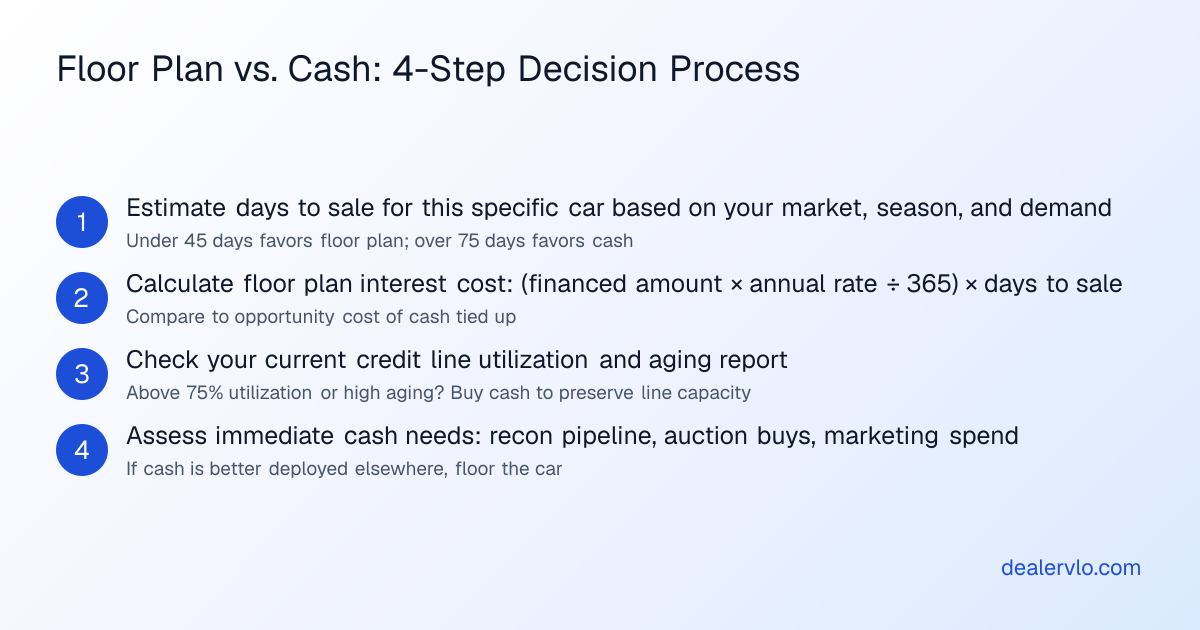
The core calculation is simple: how many days can a car sit before the cumulative floor-plan cost exceeds the opportunity cost of the cash you would have tied up?
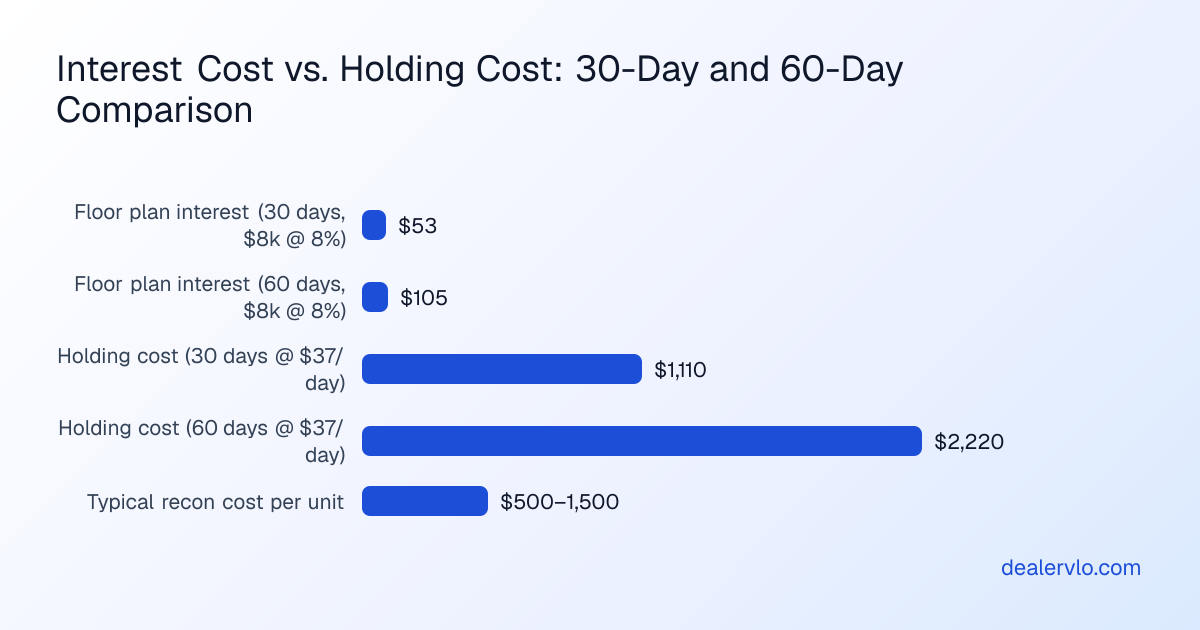
Let's work an example. You buy a car for $10,000. Say your line advances 80 percent, so you put down $2,000 and finance $8,000. At an 8 percent annual rate, you're accruing about $1.75 per day in interest on that $8,000 ($8,000 × 0.08 ÷ 365). If the car sells in 30 days, you've paid roughly $53 in interest. If it sits for 60 days, that doubles to about $105. At 90 days you're at $158, and you've likely hit at least one curtailment along the way.
Compare that to buying the car outright for $10,000. You pay zero interest, but that $10,000 is locked in inventory until the car sells. If reconditioning on your next unit costs $1,200 and you don't have it because your cash is tied up in unsold inventory, you either delay getting that car to the line—losing days of selling opportunity—or you put recon on a credit card, usually at a far higher rate than any floor plan.
The break-even point isn't a fixed number of days—it's the point where the cost of the floor plan for the days you hold the car is higher than what that same cash would earn elsewhere in the business. For most independent dealers, that elsewhere is reconditioning the next unit, paying for marketing that turns inventory faster, or simply having dry powder to jump on the right car when it shows up at auction.
The input that decides it is your own days to sale, by type of car. Pull it from your last few months of sales rather than a national average; your market is what matters. The inventory turn rate guide shows how to measure it.
If you know a car will turn in 30 days—a clean Civic under $15k in a strong market—the roughly $53 in floor-plan interest is trivial, and preserving $8,000 to $10,000 in cash for the next deal is worth every penny of that interest. If the car is a 90-day sit—a higher-mile SUV in a season when your market isn't buying them—you're paying $150-plus in interest, risking curtailment, and tying up credit-line capacity that could be better used elsewhere. That's a cash car, assuming you have the cash and no better use for it that week.
Opportunity cost of cash: recon, marketing, and the next car
A dollar in inventory is a dollar you can't spend anywhere else. That's not philosophical—it's the constraint that kills deals.
Reconditioning costs vary widely with the car and your standards (our reconditioning cost breakdown goes by vehicle type), and every day between purchase and retail-ready is a day the car isn't earning.
If you bought three cars cash this week and spent $30,000, and the following Tuesday a perfect retail unit shows up at the auction for $9,000, you've got a decision: pass on the car, wait until one of your three sells, or floor-plan it. Flooring the full $9,000 at 8 percent costs about $59 in interest if it turns in 30 days. Passing on the car costs you the gross you would have made, because somebody else bought it. Waiting costs you time, and time is depreciation and holding cost.
Interest is also the smallest part of what a car costs to hold. Depreciation, lot overhead and insurance keep running whether the car is floored or paid for. Run your own numbers rather than borrowing someone's "per day" figure: if a $10,000 car loses 1 percent of its value a month, that alone is about $3.29 a day ($100 × 12 ÷ 365), nearly double the $1.75 of interest in the example above. The holding cost calculator adds it all up for your cars. That's why turn speed matters far more than the interest rate.
The dealers who floor-plan strategically keep cash reserve for three things: recon, so cars hit the line fast; marketing, so inventory turns before it ages; and auction buy-money, so they never pass on a car they know they can retail. The cash they free up by floor planning the sure-sellers pays for itself in faster turns and better buy decisions.
For a full breakdown of what it takes to get a dealership off the ground and keep it capitalized, including working capital, see our guide on the cost to open a used car dealership.
Decision framework: which cars to floor, which to buy cash
Here's a playbook for running floored and cash inventory side by side.
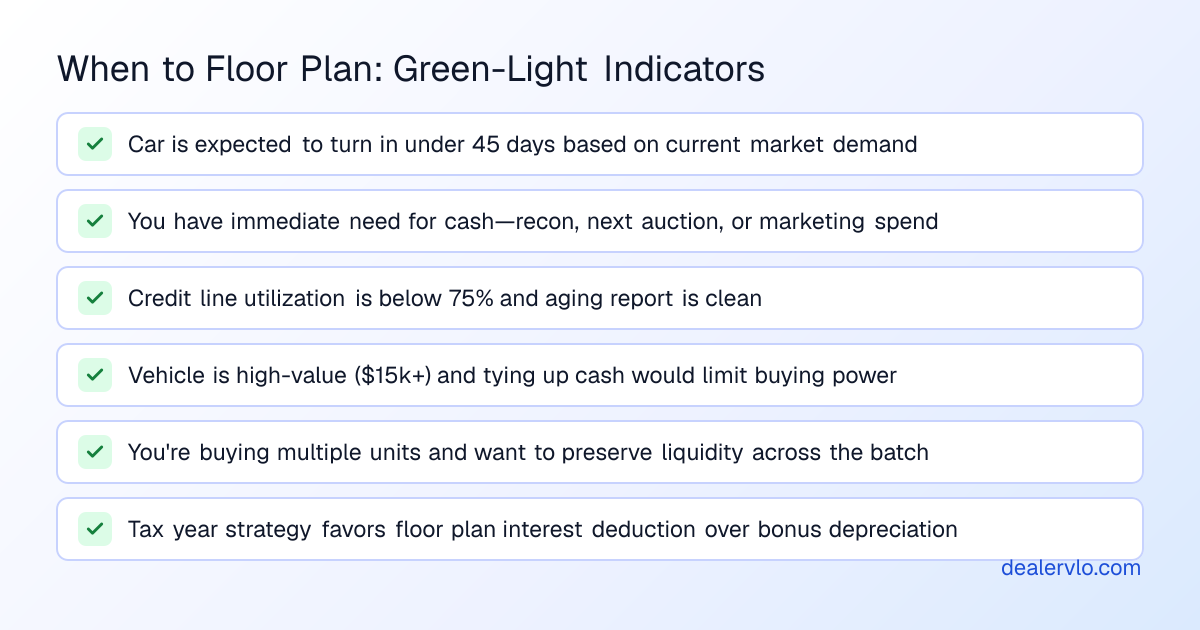
Floor plan these:
- Any car you're confident will turn fast based on your market and current demand—Civics, Corollas, RAV4s, affordable SUVs under $15k in spring and summer.
- High-value units where tying up $15,000 to $25,000 in cash would meaningfully constrain your buying power for the next two weeks.
- Cars you're buying in volume when you want to keep liquidity for the next auction or for reconditioning the batch.
Buy cash if:
- It's a slow-turning specialty car, a high-mile truck in the off season, or anything you expect to sit well past your normal turn—the interest adds up and you'll likely face curtailment pressure or extension fees.
- You're near your credit-line limit and using more of the line would trigger covenants around utilization or aging.
- You have surplus cash that week and no better deployment—rare, but it happens in a strong selling period when you've turned five cars and have $40k sitting in the checking account with no immediate recon or auction spend planned.
- The car was an opportunistic buy—something you picked up cheap but aren't sure on the retail timeline—and you want the freedom to wholesale it fast without a payoff call to the lender.
Hybrid approach—floor the bread-and-butter, cash the question marks:
Plenty of independent dealers run a credit line for their core turn inventory and reserve cash for the weird one-offs, the recon-heavy projects, and the aged stuff they're deliberately slow-playing. The line stays active and the relationship stays healthy, but they're not paying interest on cars that don't deserve it.
One important nuance: your credit line has capacity, and the fuller it gets, the more closely lenders watch aging and turnover. If you floor everything, you lose flexibility. If you buy everything cash, you lose liquidity. The optimal mix depends on your turn rate, your typical days-to-sale by segment, and how much working capital you actually need in reserve. Track it monthly, and adjust when the market or your turn speed shifts.
Estimate your daily floor-plan carrying cost per unit.
Open the Floor Plan CalculatorTax treatment: why floor-plan interest beats almost any other financing
Floor-plan financing interest is interest paid or accrued on debt used to finance the acquisition of motor vehicles held for sale or lease, secured by that inventory. Under the federal business-interest limit (section 163(j)), it gets special treatment, so it generally isn't capped the way other business interest can be.
For tax years beginning after December 31, 2024, the 2025 federal tax law expanded the definition of a motor vehicle for this purpose to include towable trailers and campers, and returned the business-interest limit to an EBITDA-based calculation (Withum's summary for auto dealers). Calendar-year dealers see the change starting with their 2025 returns, filed in 2026.
One trade-off: a dealer that relies on the floor-plan exception to the interest limit can lose bonus depreciation on property placed in service that year. Withum's advice is that dealerships "should still evaluate the Section 163(j) interest limitations to determine if bonus depreciation is allowed for the year." That creates a strategic choice—talk to your CPA about which path saves you more, because it depends on your overall income, asset purchases, and depreciation schedule.
The deduction makes floor planning cheaper than it looks on paper. As an example, an $800 interest expense that saves you $200 to $300 in tax—depending on your bracket—has a net cost of $500 to $600, and if the cash it freed up lets you turn one additional car that month, you've made the money back several times over.
14-day free trial, then $29/mo · Cancel anytime
Credit-line utilization tactics: keeping the relationship healthy and the line available
Lenders watch three things closely: how much of the line you're using, how old your floored units are, and whether you're maintaining the liquidity and net-worth covenants in your agreement.
If your line is $100,000 and you're carrying $95,000 in floored units, you have almost no room to buy, and the lender sees you as fully extended. Even if you're current on every payment, that picture makes them nervous. Set yourself a ceiling well below the limit (say, three-quarters of the line) and buy cash above it, so you have room to move when the right inventory shows up.
Aging is the bigger trip wire. If a large share of your floored units are past 60 days, expect a call. The way to manage that is to floor-plan only the cars you're confident will move quickly, and to wholesale or pay down anything that's heading toward its next curtailment before the lender forces it. Don't let old iron clog the line—it raises your cost and burns your credibility.
Curtailments work like this: when a floored car is still unsold at the end of a term, you pay a fee and a set percentage of the principal to extend it. As an example, if you've financed $8,000 and the paydown is 10 percent, you owe $800 even though the car hasn't sold. That $800 comes out of working capital, exactly the thing you were trying to preserve by floor planning in the first place. The way to avoid them is to floor plan only what you expect to sell inside the first term.
Some dealers rotate their line strategically: they'll pay off two or three older units in cash mid-month to bring utilization and aging back into a clean range, then floor-plan the new auction buys. It keeps the numbers the lender sees looking healthy, and it ensures the line is there when you need it most. For more on managing the documentation and compliance side of your dealership operations efficiently, see our resources on dealer paperwork software and cloud-based DMS for used car dealers.
Real-world scenarios: when the math flips
These use 8 percent and an 80 percent advance as examples. Swap in your own terms.
Scenario 1: Spring auction, hot market, cash reserve low.
You've got $18,000 in the bank. You see three clean SUVs at the auction, $9,000 each. You know they'll turn in 30 days. If you buy all three cash, you can't—and even buying two leaves you at zero, unable to recon or buy next week. Floor all three: your 20 percent down is $5,400, the interest on the $21,600 financed comes to about $142 over 30 days, and you keep $12,600 available for recon, marketing, and the next buy.
Scenario 2: December, slow month, you just turned four cars.
You've got $35,000 in the account and inventory is thin. You find a high-mile pickup truck you can buy right for $11,000, but you know it's a 75-day car—spring sell. Buy it cash. Flooring it would cost about $145 in interest over 75 days on an $8,800 advance, it may hit a curtailment before it sells, and you've got the cash doing nothing otherwise. No reason to pay the lender.
Scenario 3: You're at 80 percent line utilization, aging report is clean, strong car shows up.
You're near your ceiling but turnover is fast and the lender isn't concerned. You've got cash, but using it means you can't recon the two cars you bought yesterday. Floor the new car anyway—it preserves optionality and keeps the cash working where it's needed. Pay it off in 25 days when it sells and you're back under your ceiling.
Scenario 4: Lender just tightened covenants, you need to show discipline.
Say your lender adds a covenant requiring a minimum of operating cash and a limit on average aging. You've been floor planning everything. Time to switch: floor only the fast cars, buy the slow stuff cash, and wholesale anything getting old before it hits the aging report. You're managing to the relationship now, not just the rate.
These aren't edge cases—they're the weekly reality of running a dealership with uneven cash flow, seasonal demand, and a credit line that has rules. The decision framework has to be fluid, because the variables change faster than any written policy can keep up with.
What most dealers get wrong
The biggest mistake is deciding once and never revisiting it. "I always floor" or "I never floor" are both wrong, because the right answer is situational. The second mistake is ignoring opportunity cost and focusing only on interest expense. A $60 interest charge looks expensive until you realize the alternative was passing on an $1,800 gross because you didn't have cash to buy the car.
The third mistake is letting inventory age on the floor plan without a plan. If you're going to floor it, you need to be confident in your turn time, and if the car hasn't sold by day 50, you should already be pricing it to move or planning to wholesale it before the next curtailment. Paying interest on a car that sits 120 days is the worst of both worlds—you've paid the financing cost and suffered the depreciation and holding cost.
Finally, dealers underestimate how much the terms matter. Fees, curtailment schedules, covenants and personal guarantees are all negotiable to some degree and all in the agreement. If you're comparing floor planning today to what it looked like a few years ago, run it again with your current quote before you commit to a strategy.
Frequently asked questions
When does floor plan financing make more sense than paying cash for inventory?
Floor planning makes the most sense when you're confident a car will turn quickly, when tying up cash would limit your ability to buy or recondition other inventory, or when you're buying in volume and need to preserve liquidity. The interest on a 30-day turn is small: about $53 to $66 on an $8,000 advance at 8 to 10 percent ($8,000 × rate ÷ 365 × 30). That's trivial next to the cost of having $10,000 locked in a single car when the next good deal shows up at auction or you need cash for reconditioning.
How do I calculate the break-even point between floor plan interest and buying cash?
Take the amount you'd finance, multiply by your annual interest rate, divide by 365 to get the daily cost, then multiply by your expected days to sale. Add any flat per-car fee. Compare that total to what the same cash would earn elsewhere: reconditioning the next unit faster, buying another car, or marketing that turns stock quicker. There's no universal break-even day. It depends on your rate, your fees, and what your cash would otherwise be doing, which is why it's worth running per car.
What has changed in floor plan financing costs and terms in 2026?
Rates went up again: the Federal Reserve raised its benchmark a quarter point on September 16, 2026, and many floor plan lines are priced as a benchmark such as prime or SOFR plus a spread, so variable lines follow it. Providers don't publish standard rates; yours is quoted on your credit, time in business and volume. On the franchise side, Optimum Info's data shows new-vehicle floorplan expense rose 13.2% to $427 per unit in Q3 2025. Ask for the complete fee schedule, the curtailment terms, and any covenants in writing before you sign.
Can I deduct floor plan interest on my taxes, and are there any trade-offs?
Floor-plan financing interest gets special treatment under the federal business-interest limit (section 163(j)), so it generally isn't capped the way other business interest can be. For tax years beginning after December 31, 2024, the definition expanded to include towable trailers and campers, and the limit calculation went back to an EBITDA-based formula. The main trade-off: a dealer that relies on the floor-plan exception can lose bonus depreciation for that year, so talk to your CPA about which approach saves you more.
How does floor plan utilization affect my credit line and relationship with the lender?
Lenders watch your utilization, the age of your floored units, and covenant compliance. Running the line close to its limit signals that you're fully extended and leaves you no room to buy when opportunity strikes. Aged units trigger curtailments (a fee plus a paydown of part of the principal at the end of a term), and repeated aging problems can lead to stricter terms or a smaller line. Keep headroom, floor only the cars you're confident will turn quickly, and wholesale or pay off anything heading toward its next curtailment before the lender forces it.
Should I floor plan every car or mix floor plan and cash buying?
A hybrid usually works best: floor-plan the bread-and-butter inventory that turns fast, and buy cash for slow-turning specialty vehicles, off-season inventory, or anything you expect to sit. That keeps the credit line active and healthy, preserves cash for reconditioning and opportunistic buys, and avoids paying interest and risking curtailment on cars that don't move quickly. The right mix depends on your turn rate, seasonal demand, and how much working capital you need in reserve, so check it monthly.
Bottom line
The floor plan vs. buy outright decision isn't about which one is "better"—it's about which one makes sense for each car, each week, given your cash position, your turn expectations, and what else is pulling on your working capital. The math is straightforward: if a car will turn fast and you have better uses for the cash, floor it and pay the interest without guilt. If the car is a slow mover or you're sitting on surplus cash with no immediate deployment, buy it outright and skip the financing cost.
What's changed in 2026 is that the cost of getting it wrong is higher—rates went up again in September, and holding costs haven't gone down. The dealers who stay profitable are the ones who run the calculation every time, manage their credit lines like the strategic tools they are, and keep enough liquidity in reserve that they never have to pass on the right car because all their cash is tied up in inventory that hasn't sold yet.
If you haven't stress-tested your own floor-plan strategy against your current quote, your curtailment terms, and your actual days-to-sale by vehicle type, this quarter is the time to do it.
14-day free trial, then $29/mo · Cancel anytime