NextGear vs. AFC vs. Westlake: choosing a floor plan provider in 2026
NextGear, AFC and Westlake don't publish standard floor plan rates. What each one does publish, how fees and terms change your real cost, and which fits how you buy.
Part of the Floor plan financing guide: How dealer floor plans actually work — and where they quietly eat your gross
Switching from another DMS? Compare DealerVLO to DealerCenter, Frazer, or Lot Wizard.
Every independent dealer eventually sits across from this choice: NextGear, AFC, Westlake, or a bank line. You'll go looking for a rate sheet to compare, and you won't find one. None of the three posts a standard floor plan rate on its website. Your rate is quoted on your file: credit, time in business, volume, and line size.
So this comparison sticks to what each provider actually publishes, checked on their own sites in October 2026, and to the things that move your real cost more than the headline rate: fees, terms, curtailments, and where you buy. Confirm everything with the provider before you sign.
14-day free trial, then $29/mo · Cancel anytime
The short version
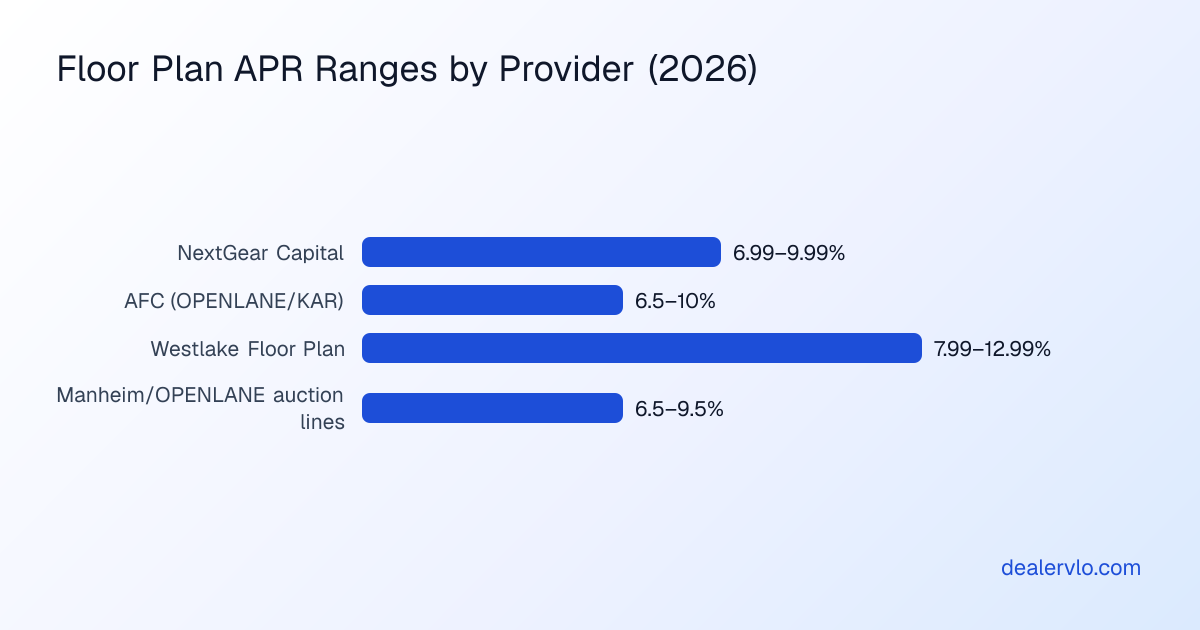
- NextGear Capital (Cox Automotive, the Manheim family). Its finance programs page describes "competitive interest rates" without publishing numbers. One program worth knowing: Flex Pricing, which NextGear says "lets you defer interest, advance-related fees, and principal paydowns until vehicles are due for payoff or an extension is granted." The natural fit if most of your buying happens at Manheim.
- AFC (Automotive Finance Corporation, in the OPENLANE family). AFC describes short-term floor plans with 30-, 45- or 60-day terms and says "the majority of AFC dealers select a term around 60 days." It also offers a "Daily Tab", a flat fee for each day a unit is floored that "includes most everything, even interest."
- Westlake Flooring Services. Its own site says it provides lines to licensed dealers in all 50 states and lists "Flexible Terms up to 200 Days," "100% Auction Purchase Financing," and virtual audits. It also advertises a promotional 0% rate for up to the first six months of a new agreement, which it can end at its discretion. Westlake pairs the line with its retail financing arm, so it's a natural look if you already send deals to Westlake Financial.
Bank lines are the other option. Some local and regional banks offer floor plan or inventory lines to established dealers, often priced off a benchmark plus a spread. Worth a call if you have a banking relationship.
What actually differentiates them (it's not the rate)
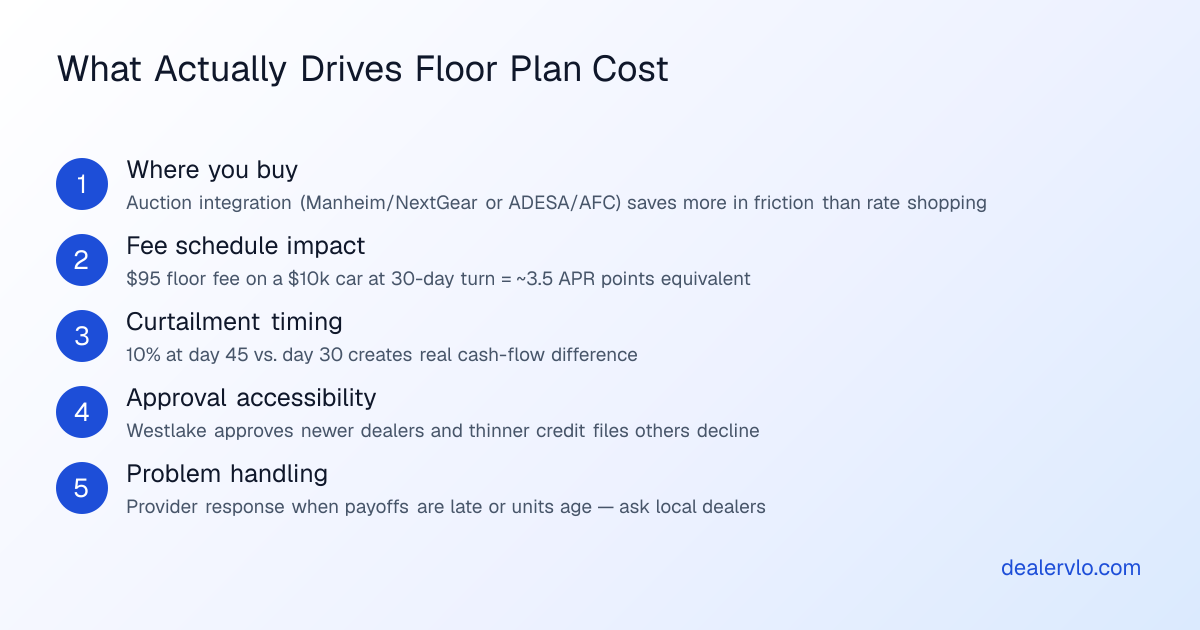
1. Where you buy. The practical decider. If you buy mostly at Manheim, NextGear's integration means titles, payoffs, and floorings move with less friction. Heavy OPENLANE buyers get the same pull toward AFC. Fighting your buying pattern to save a fraction of a point usually costs more in hassle than it saves in interest.
2. The fee schedule. Flat per-car fees can matter more than the rate on fast turns. Here's the math on an illustrative $95 floor fee on a $10,000 car that turns in 30 days: $95 ÷ $10,000 × (365 ÷ 30) ≈ 11.6 points of APR on top of the interest. Stretch the same car to 90 days and the fee works out to about 3.9 points. Fast-turning lots should negotiate fees as hard as rate. Ask every provider for the complete fee list (floor fee, audit fee, title handling, extension fees, NSF) and model a real unit through it. The floor plan calculator does exactly this.
3. Curtailment schedules. At the end of each term, an unsold car usually means a fee plus a paydown of part of the principal. AFC describes it as an extension "for a fee and payment of a predetermined percentage of the loan's principal." How long the first term is and how big the paydown is decides your cash flow in a slow month. Newer dealers with slower turns should weight this above rate.
4. Requirements for your file. Minimum time in business, credit standards, and line sizes aren't all published, and they differ by provider. If you're newly licensed, ask each one directly what it takes to get approved and what the starting line looks like. Getting a line, running clean for a year, and re-shopping it is a normal path.
5. Treatment when something goes wrong. Every dealer eventually has a car that won't sell or a payoff that's a day late. Providers differ in whether that's a phone call or a default letter. Ask other dealers in your market. That reputation is local, and it's the thing no website shows.
Who should pick what
- Manheim-heavy buying: start with NextGear, and negotiate. Volume moves both rate and fees.
- OPENLANE-heavy buying: start with AFC, same negotiation.
- Already financing retail deals with Westlake, or want long terms: get a Westlake quote, and read the promotional terms so you know your rate after the promo ends.
- Low volume (a few floored units at a time): consider whether a floor plan is worth it at all. A bank line of credit or buying cash often beats paying fees for convenience you're not using. The floor plan vs. cash framework walks through it.
Whichever you pick, keep the numbers that decide whether a floored car made money where you can see them. In DealerVLO, every car shows its days in inventory, all-in cost with reconditioning, and margin, and cars past 60 days get an "aging, consider repricing" flag, so you know which floored units are heading toward their next curtailment. DealerVLO isn't a lender and doesn't track your line or curtailment dates; your provider's portal does that.
14-day free trial, then $29/mo · Cancel anytime
The questions to get answered in writing
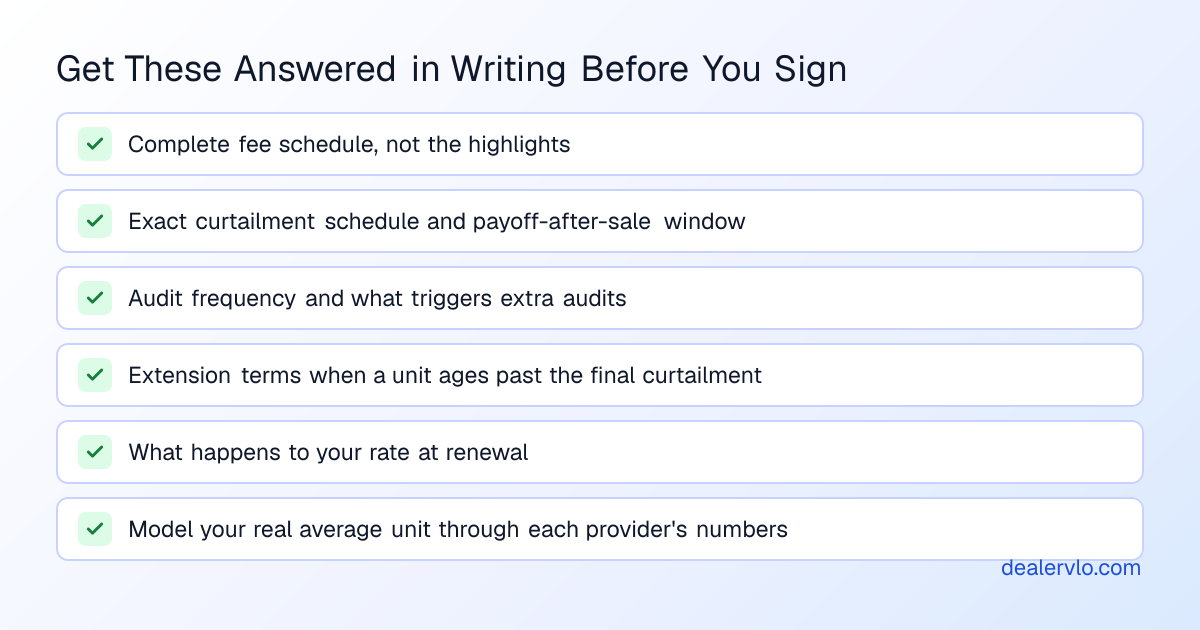
- Your quoted rate, and what benchmark it moves with (it matters when the Fed moves; see what the September 2026 hike costs a floored car)
- Complete fee schedule, not the highlights
- Exact curtailment schedule and payoff-after-sale window
- Audit frequency and what triggers extra audits
- Extension terms when a unit ages past its term
- Your rate after any promotional period ends
Then model your real average unit (your price band, your actual days to turn) through each provider's numbers before signing. That math, not a rate headline, is the decision. How floor plans work walks the full mechanics if you're newer to this.
14-day free trial, then $29/mo · Cancel anytime