How to Switch Floor Plan Lenders (or Add a Second Line) Without a Cash Crunch
Switching floor plan providers? The order that avoids a cash crunch: new line first, read your exit terms, run off the old line, then titles and audits.
Part of the Floor plan financing guide: How dealer floor plans actually work — and where they quietly eat your gross

If you've been on a floor plan for a while, you've probably had the thought: the fees are too high, the curtailments come too early, the auditor is a headache, or the line is too small for how you buy now. So you want to switch floor plan lenders, or at least add a second line. The part nobody explains is how to move without a week where you can't buy cars, or worse, a car that's sold and not paid off.
This post covers the switch itself: when it's worth doing, the order that keeps your cash flowing, and the traps in the middle. It doesn't re-compare providers. For that, read NextGear vs. AFC vs. Westlake. Every agreement is different, so treat this as the questions to ask, then get the answers from your own paperwork and your lenders.
14-day free trial, then $29/mo · Cancel anytime
When it's worth it to switch floor plan lenders
Start with why. The usual reasons are fees, the curtailment schedule, audits, service when something goes wrong, line size, and where you buy. That last one matters more than people expect: a line tied to the auction you actually buy at saves friction on every purchase, and a cheaper line that doesn't fit your buying pattern can cost more in hassle than it saves.
Then put numbers on it. Floor plan providers don't publish standard rates, so you're comparing two quotes made on your file. Take one real car, at your typical price, held for your actual average days to sell, and run it through both quotes: interest, the per-car fee, any audit or title fees, and what happens if it doesn't sell by the end of the first term.
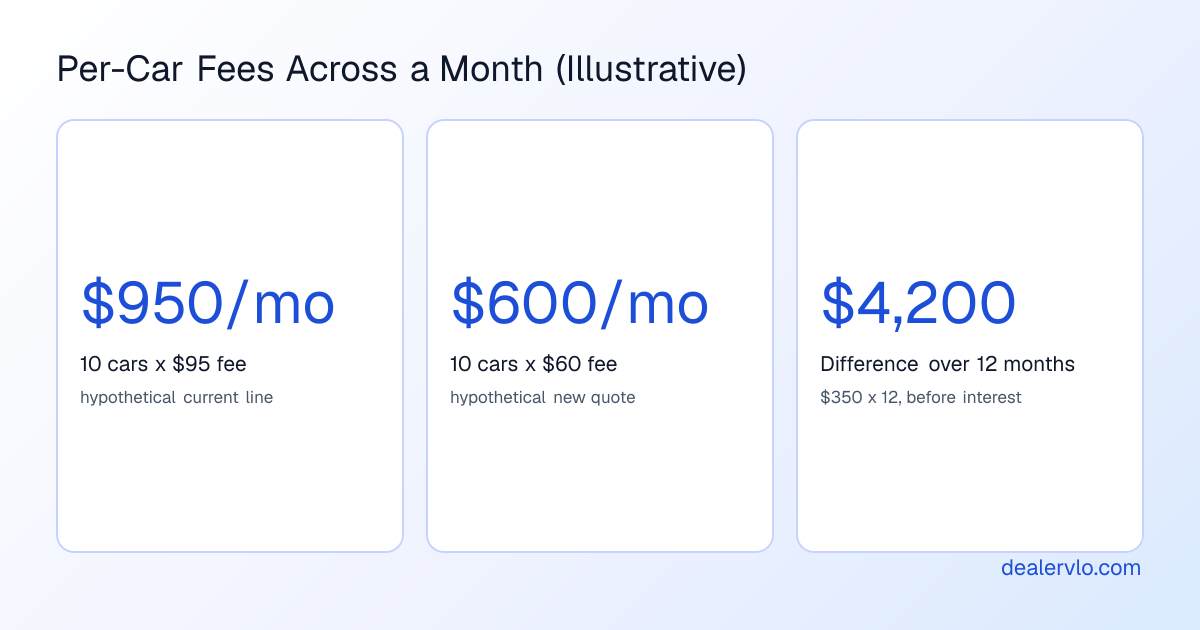
Here's an illustrative version of the fee piece, with made-up numbers, not anyone's pricing. Say your current line charges $95 a car and the new quote is $60. At 10 floored cars a month, that's 10 × $95 = $950 versus 10 × $60 = $600, so $350 a month, or $350 × 12 = $4,200 a year. That's real money, but it's only one line item. If the cheaper line has a shorter first term, your slow cars hit a paydown sooner, and that can eat the savings in a bad month.
The floor plan calculator does the per-unit math for you. Run it twice, once per quote, with the same car.
Estimate your daily floor-plan carrying cost per unit.
Open the Floor Plan CalculatorDays to sell is the input that's easiest to guess at. DealerVLO shows days in inventory on every car, and its aging report buckets the lot into 0-30, 31-60, 61-90 and 90+ days, so you model the quotes with your real turn. Every car also shows its all-in cost with reconditioning, and its margin.
Step 1: get approved for the new line before you touch the old one
The single biggest mistake is closing the old line first. Floor plan underwriting takes time. Expect an application, financial statements, and often a personal guarantee. Westlake, for example, posts a dealer application on its site. Until the new line is approved and you know its size and terms, your old line is the only way you're buying at the next sale.
Get the line size, the full fee schedule and the curtailment schedule in writing. If a promotion is part of the pull, read who qualifies and when it ends. Westlake's site, for example, describes a 0% promotional rate for up to the first six months of a new agreement, which it can end at its discretion and which isn't available to existing dealers who close and then reactivate.
Step 2: read the exit terms in your current agreement
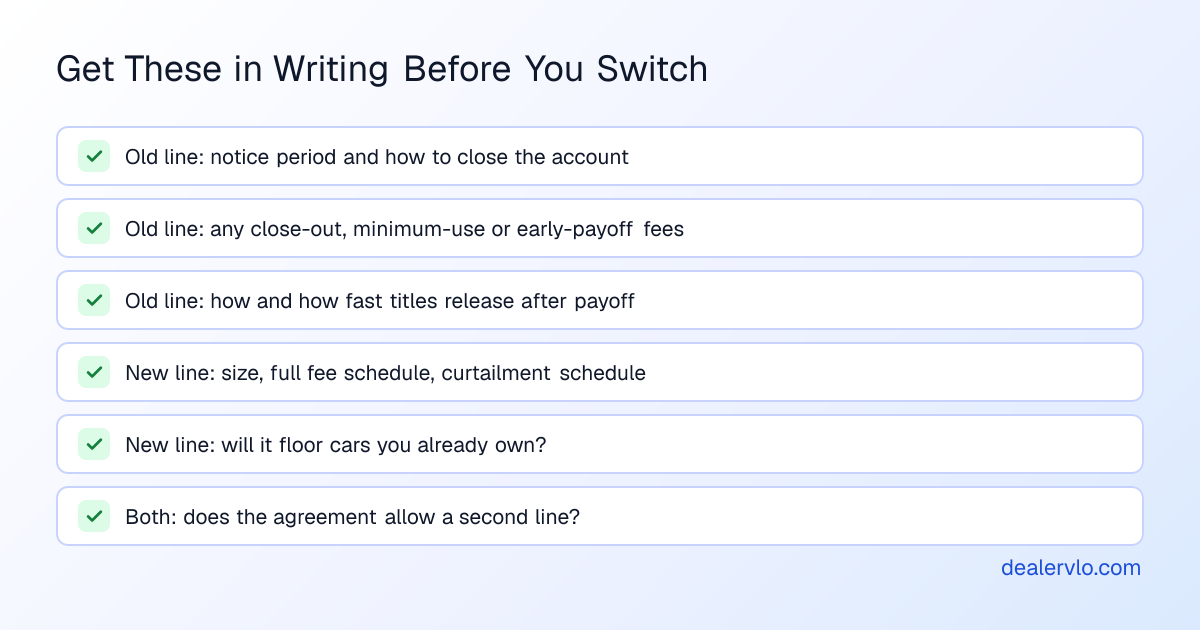
Before you tell your current lender anything, read your agreement for how it ends. I can't tell you what yours says, because there's no standard. Look for:
- Notice. How you close the account, and whether written notice is required.
- Close-out costs. Any termination fee, minimum-usage fee, or charge for paying units off early.
- Titles. How titles are released when a unit pays off, and how long that takes.
- What happens to open units if you stop using the line but still have cars floored.
If anything is unclear, ask your rep and get the answer in an email. The checklist below covers both sides of the move.
Step 3: run off the old line instead of moving cars mid-term
Once the new line is open, the clean way to switch is a run-off. Every new purchase goes on the new line. Cars already on the old line stay there and get paid off as they sell. If most of your cars sell within their first term or two, the old line empties on its own over a few months, and you never have to come up with cash to move a car.
The alternative is refinancing units over: the new lender pays off the old one for cars you already have. Some lenders will add cars bought from other sources to a line; Westlake's site, for example, describes adding third-party vehicles. Whether a new lender will take units sitting on another lender's line, and at what advance, is something to ask directly. If it advances less than your old payoff, you cover the difference in cash.
Two things to watch during a run-off:
- Deferred charges come due at payoff. NextGear says its Flex Pricing lets you "defer interest, advance-related fees, and principal paydowns until vehicles are due for payoff or an extension is granted." If you're on a program like that, expect each unit's deferred amounts at payoff, and budget for them.
- The slow cars hit curtailment on the old line. AFC describes it as an extension "for a fee and payment of a predetermined percentage of the loan's principal." The old line's last few units are usually the ones you'd rather not be paying extensions on.
You can get ahead of the second one. DealerVLO flags every car at 60+ days in inventory with "aging, consider repricing," and the dashboard counts units past 60 days. During a run-off, those are the cars to decide on early: price to sell, wholesale, or plan the cash to pay off. DealerVLO doesn't know your lender's due dates, so check those in the lender portal.
14-day free trial, then $29/mo · Cancel anytime
Step 4: plan the title handoff
On a floor plan, the lender usually holds the title, and paying the car off releases it. In a switch that creates two timing problems. A retail sale of a car still on the old line means paying off the old line and waiting for the title, so know how long that takes before you promise a delivery date. A refinanced unit means the title moves lender to lender, and until it lands, everyone should be clear on who holds it.
Ask each lender how titles are released and received (paper or electronic, to you or lender to lender) and how long it typically takes in your state.
Step 5: audits and out-of-trust risk during the transition
For a few months, two auditors count cars on your lot, each looking for their own units, and each expects every one of them to be on the lot or properly accounted for.
The real risk in a switch isn't the auditor, it's out of trust: a floored car is sold and the lender isn't paid off inside its window. With two lines, it's easy to pay the wrong lender, or assume a car is on the new line when it was bought before the switch.
The fix is boring. Keep one list of every floored car: stock number, VIN, which line it's on, its next due date. Update it the day a car sells, and make paying off the right line part of closing the deal. A spreadsheet column is enough. When the old line shows zero units in its portal, you're done.
DealerVLO doesn't track which line a car is on or its payoff dates; the lender portals and that spreadsheet do. What it adds is each car's days in inventory and all-in cost on one page, for the pay-off-or-extend call on an aged unit.
Running two floor plan lines on purpose
Sometimes the right answer isn't switching, it's adding. One setup is an auction-attached line for buying at the sale plus a bank line or second lender for trades and other sources. Lenders differ in what they offer: Westlake's site lists terms up to 200 days and 100% auction purchase financing, and AFC offers a "Daily Tab", a flat fee for each day a unit is floored that it says includes "most everything, even interest." Different structures suit different cars. Before adding a line, check that both agreements allow it, and accept that the Step 5 discipline is now permanent. Then compare the lines by what they cost you each month, not by the quote.
In DealerVLO, overhead is recorded by category, including floor plan, and the P&L shows gross profit minus that overhead. Enter each line's interest and fees as expenses each month and you can see which line is actually cheaper. The floor plan interest rate post shows why days on the lot usually matter more than the rate.
Where DealerVLO fits
To be plain about the split: DealerVLO is not a lender. It doesn't provide floor plan financing, approve lines, track which line a car is on, or know your payoff and curtailment dates. Your lender portals do that, and during a switch a spreadsheet column covers which car is on which line.
What DealerVLO gives you is the numbers to decide and run the switch:
- Days in inventory and the aging report, so you model quotes with your real turn.
- All-in cost with reconditioning, and margin, so you know what an aged unit is worth before paying to extend it.
- The 60+ day flag and dashboard count, so the old line's slow cars get a decision early.
- A P&L with floor plan as an expense category, to compare lines month over month.
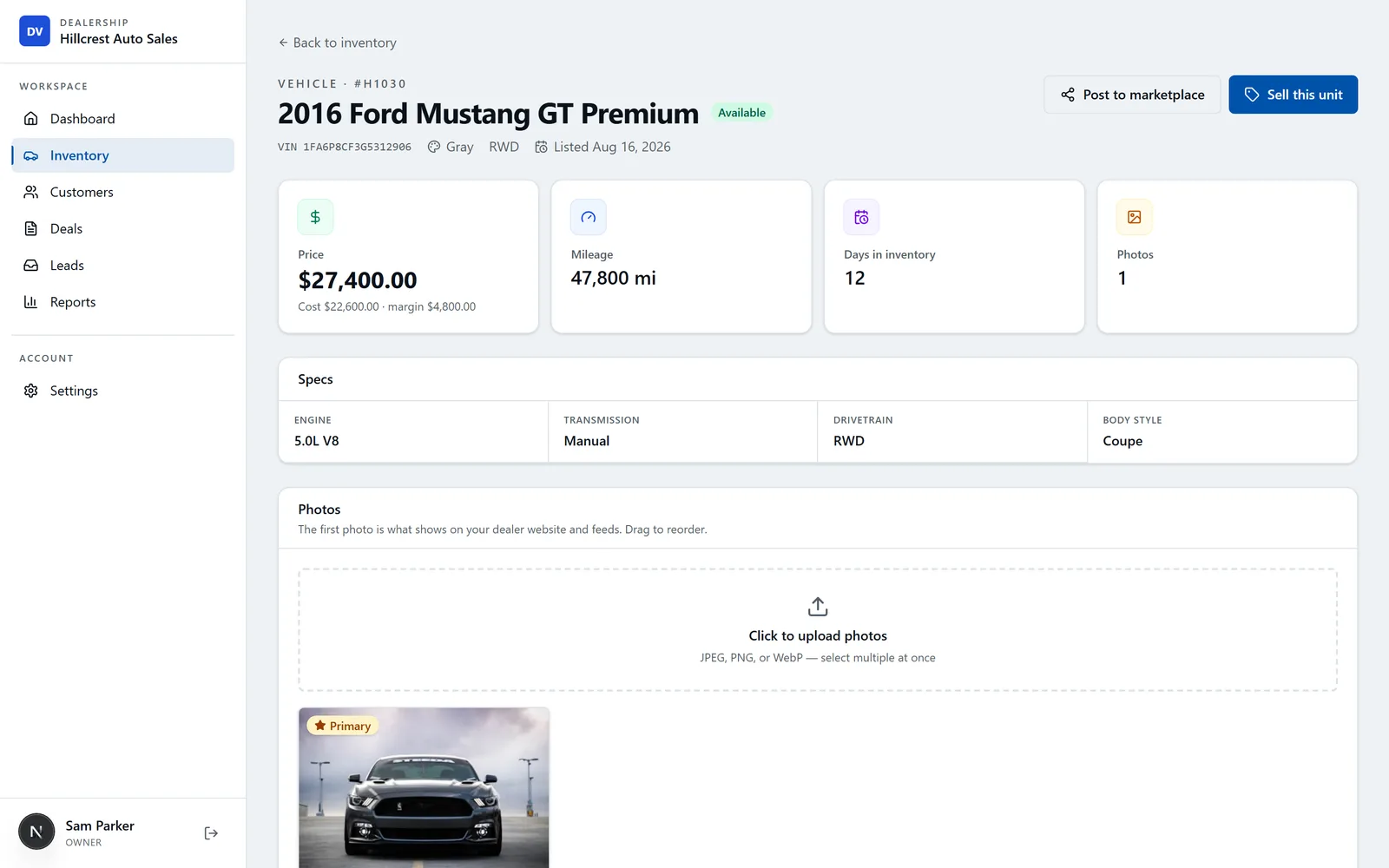
That's the vehicle page: cost, margin and days on lot next to the specs, the numbers behind repricing, wholesaling or paying off a floored car.
It's $29 a month, flat, for unlimited users, and it runs in a browser. If you're newer to how the line itself works, how dealer floor plans work covers the mechanics, and the floor plan vs. cash framework helps if the real question is whether to floor at all.
Frequently asked questions
How does a floor plan line of credit work?
The lender pays for the car when you buy it, usually holds the title, and you pay that advance back when the car sells. While the car sits, you pay interest and fees. If it hasn't sold by the end of its term, the term can often be extended for a fee plus a paydown of part of the principal, which is the curtailment. Your agreement sets the exact numbers.
Can I move cars from one floor plan lender to another?
Sometimes. Some lenders will add cars bought from other sources to a line; Westlake's site, for example, describes adding third-party vehicles. Whether a new lender will take units that are currently on another lender's line, and on what terms, is a question for that lender. For most small lots, letting the old line run off is simpler than moving cars over.
Should I close my old floor plan before opening a new one?
No. Get approved for the new line, with the line size and terms in writing, before you give notice on the old one. Closing first can leave you with no way to buy at the next sale while the new application is still in underwriting.
Can I have two floor plan lines at the same time?
Yes, if both agreements allow it, so read both and ask both lenders. Some operators run an auction-attached line next to a bank line. The cost is discipline: you have to know which car is on which line, pay each one off on its own schedule, and pass two sets of audits.
What happens to my titles when I pay off a floor plan?
The lender typically holds the title while the car is floored and releases it after the payoff clears. How long that takes, and whether it comes as paper or electronically, depends on the lender and your state. Ask before you need a title to deliver a retail deal.
How do I avoid going out of trust while switching lenders?
Pay off every sold car on the line that floored it, inside that line's payoff window, every time. During a switch the risk is paying the wrong lender or assuming a car is on the new line when it isn't. Keep a simple list of every floored car with its stock number, VIN, which line it's on, and its next due date, and update it the day a car sells.
Bottom line
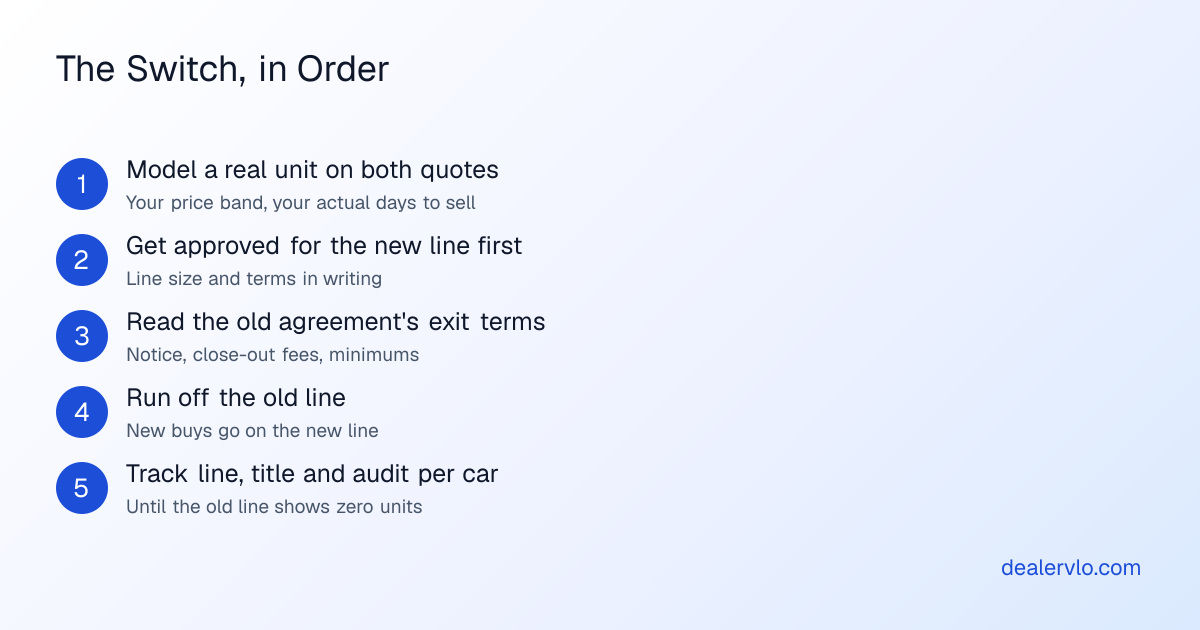
Switching floor plan lenders is mostly a sequencing problem. Model a real car on both quotes, get the new line approved before you touch the old one, read your exit terms, let the old line run off while new buys go on the new one, and track every car's line, title and due date until the old line is empty. Do it in that order and the switch costs you some paperwork, not a cash crunch.
The decision rests on knowing your real turn and what each car actually cost you. I built DealerVLO for my own lot in Tewksbury to keep those numbers on every car. Try it free for 14 days and run your switch with your own numbers.
14-day free trial, then $29/mo · Cancel anytime