Floor Plan Interest Rates Went Up. What the Fed Hike Costs a Floored Car (And What Costs More)
The Fed raised rates a quarter point on Sept. 16, 2026. The per-car math on floor plan interest rates, and why one extra day on the lot costs more.
Part of the Floor plan financing guide: How dealer floor plans actually work — and where they quietly eat your gross
On September 16, 2026, the Fed raised its benchmark rate a quarter point. If you carry a floor plan, you probably wondered what that does to floor plan interest rates, and what it costs on the cars sitting on your lot right now. So I ran the numbers.
The short version: a quarter point is a rounding error per car. The number that actually moves your interest bill is how many days each car sits. Below is the per-car math with the work shown, why your line may or may not reprice, and what I'd do this month.
14-day free trial, then $29/mo · Cancel anytime
What the September 2026 Fed hike actually changed
Here's the decision itself. The Federal Open Market Committee raised the target range for the federal funds rate by 1/4 percentage point to 3-3/4 to 4 percent, up from 3-1/2 to 3-3/4 percent. The vote was 12 to 0. The next scheduled meeting is October 27-28, 2026, so another change is possible before year-end. I won't guess which way.
The fed funds rate isn't what you pay. It's what banks charge each other overnight. But the rates your lender prices off tend to follow it. The prime rate is the clearest example. Commerce Bank, for one, lists its prime at 7.00% effective September 17, 2026, the day after the decision. SOFR, the other common benchmark, is an overnight borrowing rate (the New York Fed describes it as a broad measure of the cost of borrowing cash overnight against Treasuries), so it tends to track the Fed's range too.
So if your line is priced as a benchmark plus a spread, expect your rate to go up about a quarter point. How much is that in dollars?
The per-car math: a quarter point vs. a day on the lot
Floor plan interest cost per day is one formula:
interest per day = amount floored x APR / 365
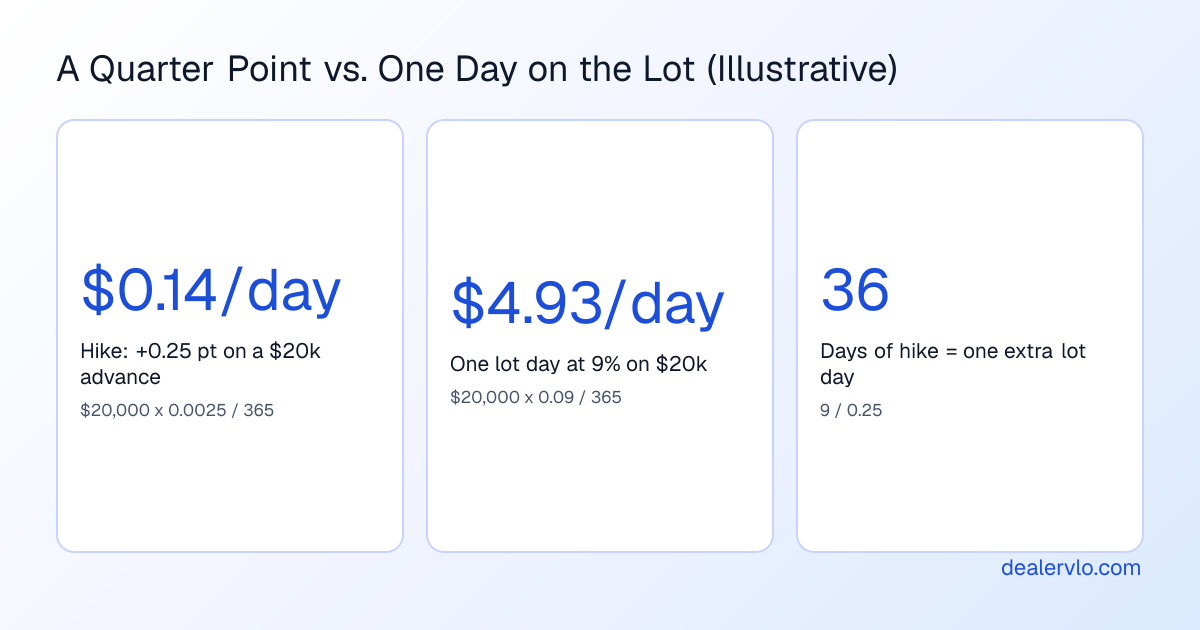
Apply that to just the quarter point. On a $20,000 advance:
$20,000 x 0.0025 / 365 = about $0.14 a day.
On a $28,000 advance it's about $0.19 a day. Over a 60-day turn, the hike adds roughly $8 to $12 per car across that range. That's the whole damage on one car.
Now compare it with one ordinary day of interest. Say your line is at 9%, an example rate inside the published provider ranges I covered in how dealer floor plans work:
$20,000 x 0.09 / 365 = about $4.93 a day.
Divide 9 by 0.25 and you get 36. One extra day on the lot costs as much interest as the hike costs over 36 days.
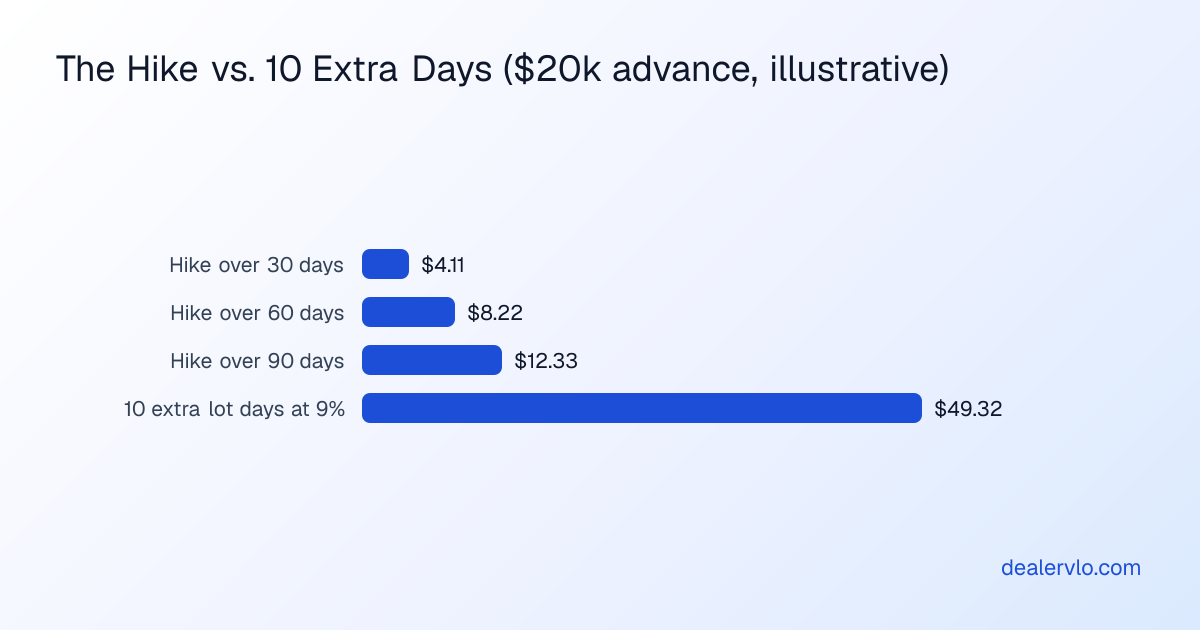
Here's the same math across a few advance sizes. These are illustrative. Plug in your own rate and amounts.
| Amount floored | Hike (+0.25 pt) per day | Hike over 60 days | 10 extra days at 9% |
|---|---|---|---|
| $10,000 | $0.07 | $4.11 | $24.66 |
| $15,000 | $0.10 | $6.16 | $36.99 |
| $20,000 | $0.14 | $8.22 | $49.32 |
| $28,000 | $0.19 | $11.51 | $69.04 |
Across the whole line it isn't nothing. If you have $600,000 floored, a quarter point is $600,000 x 0.0025 = $1,500 a year. But look at the right column: 30 cars at $20,000 each, each sitting 10 extra days at 9%, costs 30 x $49.32, about $1,480. Ten slow days per car costs you what the hike costs in a year.
In DealerVLO, every car shows its days in inventory next to its cost and margin, so you can multiply your own daily rate by the real number of days instead of a guess.
Why your floor plan interest rate may or may not move
Don't assume the hike hit your line, and don't assume it didn't. It depends on how your line is priced:
- Variable, benchmark plus spread. Many floor plan lines are priced as SOFR or prime plus a spread, as I covered in the floor plan vs. cash framework. On a line like that, a Fed move flows through on whatever reset schedule your agreement sets.
- Fixed rate. Some lines quote a fixed APR. A Fed hike doesn't change it today, though the lender can reprice at renewal.
- Rate floors. Some variable lines have a minimum rate. If your benchmark plus spread sat below the floor, a small hike may not change what you pay at all.
- Fees. Flat floor fees, audit fees, and monthly charges don't move with the Fed, but they're part of your all-in cost per car.
The fix is boring: pull your line agreement or open the lender's portal and write down the benchmark, the spread, and any floor. Then you'll know what the next Fed meeting means before it happens. For how the major lenders structure this, see NextGear floor plan explained and NextGear vs. AFC vs. Westlake. I'm not going to tell you what any lender did after September 16. Your statement will.
The cost that swamps the rate: days on the lot
Interest is only one piece of holding cost. While a car sits, it's also losing value and taking up lot space, insurance, and overhead. I won't hand you a "typical" depreciation number, because it depends on the car and your market. But run your own: if a $20,000 car is losing 1% of its value a month, that's $200 a month, about $6.67 a day. On that example, depreciation alone already beats a full day of interest, and a full day of interest is 36 times the hike.
Then there are curtailments. Most plans want a chunk of principal back at set ages, often somewhere between day 30 and day 90 depending on the lender, as I explained in how dealer floor plans work. A curtailment isn't a cost, but it's cash out of your account on a car that hasn't sold. A rate hike doesn't change your curtailment dates. Days on the lot decide whether you hit them.
That's why turn is the lever. Per car, shaving five days off your turn saves more interest (about $24.66 on a $20,000 advance at 9%) than the hike adds over a 60-day turn (about $8.22), and it saves depreciation and curtailment cash on top. The inventory turn rate guide covers how to measure it.
DealerVLO handles the "which cars are getting old" part. Every car shows days in inventory, cars at 60+ days get an "aging, consider repricing" flag, and the dashboard counts how many units you have aged 60+. The inventory aging report buckets your stock into 0-30, 31-60, 61-90, and 90+ days, so you can see where your floored dollars are sitting at a glance.
14-day free trial, then $29/mo · Cancel anytime
What to do this month
Here's the checklist worth running on your own lot after the hike.
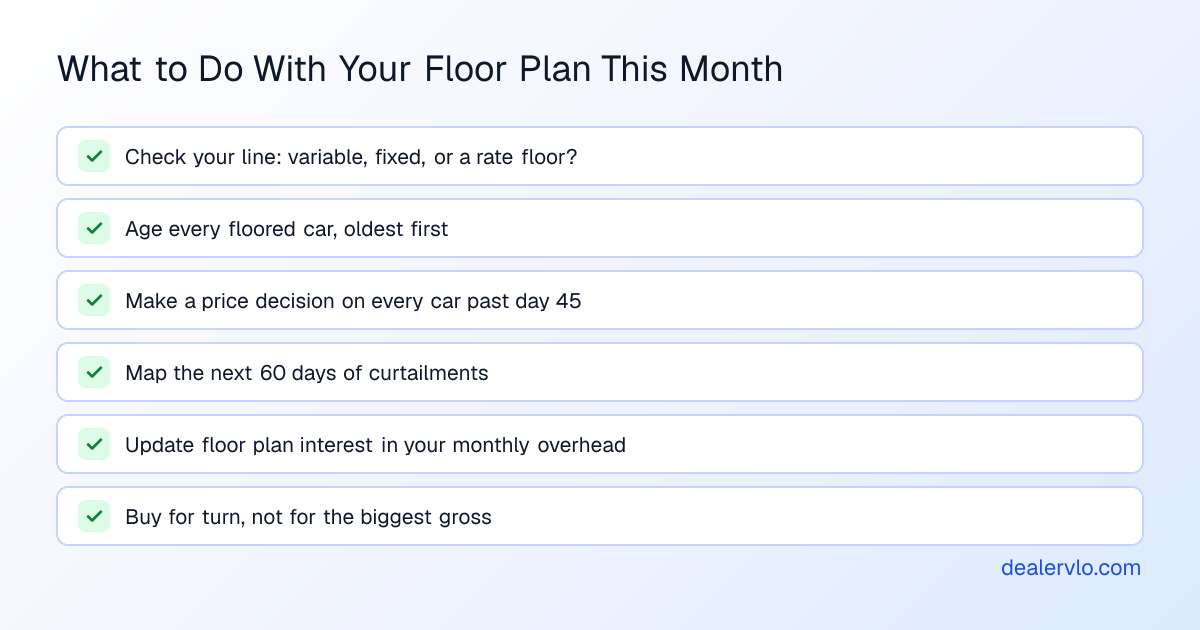
1. Check your line. Benchmark, spread, floor. Five minutes in the lender's portal.
2. Age every floored car, oldest first. Those are the ones charging you daily.
3. Make a price decision on every car past day 45. Not necessarily a cut. A decision: hold with a reason, reprice, or wholesale. My aging and markdown strategy post covers how I time those. In DealerVLO, the AI price suggestion shows a price range from live comparable listings plus a target price for selling in about 30 days, which is the number I want on a car that's already old.
4. Map the next 60 days of curtailments. Your lender's portal has the dates. Put them on a calendar so a stack of them doesn't surprise you in the same week.
5. Update floor plan interest in your monthly overhead. If your rate moved, your monthly interest line moved with it. In DealerVLO's P&L, you can record floor plan interest as a recurring monthly expense, so net profit reflects it.
6. Buy for turn. A smaller gross that turns in 30 days usually beats a big gross that sits for 90. That was true before the hike too.
Before you price an old car, run it through the free holding cost calculator. Its floor mode takes your all-in cost, expected days to sell, and minimum gross, and gives you the lowest price you can take.
Put a real dollar-a-day number on every unit sitting on your lot.
Open the Holding Cost CalculatorIf you only want the interest piece, with per-car and monthly fees broken out, the floor plan calculator does that per unit.
Where DealerVLO fits
To be clear about the split: DealerVLO isn't a lender and doesn't provide floor plan financing. It doesn't track your floor plan line, payoffs, or curtailment dates per car. Your lender's portal does that, and it's the source of truth for what you owe. DealerVLO also doesn't mark prices down automatically or send aging alerts. You make the pricing call.
What it does is put the numbers you need for that call in one place:
- Aging: days in inventory on every car, the 60+ day repricing flag and dashboard count, and the 0-30/31-60/61-90/90+ aging report.
- Cost: per-car recon costs tracked line by line, rolling into each car's all-in cost and margin. That all-in cost is what goes in the calculator's floor mode.
- Price: the AI price suggestion, with a comparable-listings range and a 30-day target price.
- Overhead: a P&L where floor plan interest can be a recurring monthly expense, so net profit is gross profit minus your real overhead.
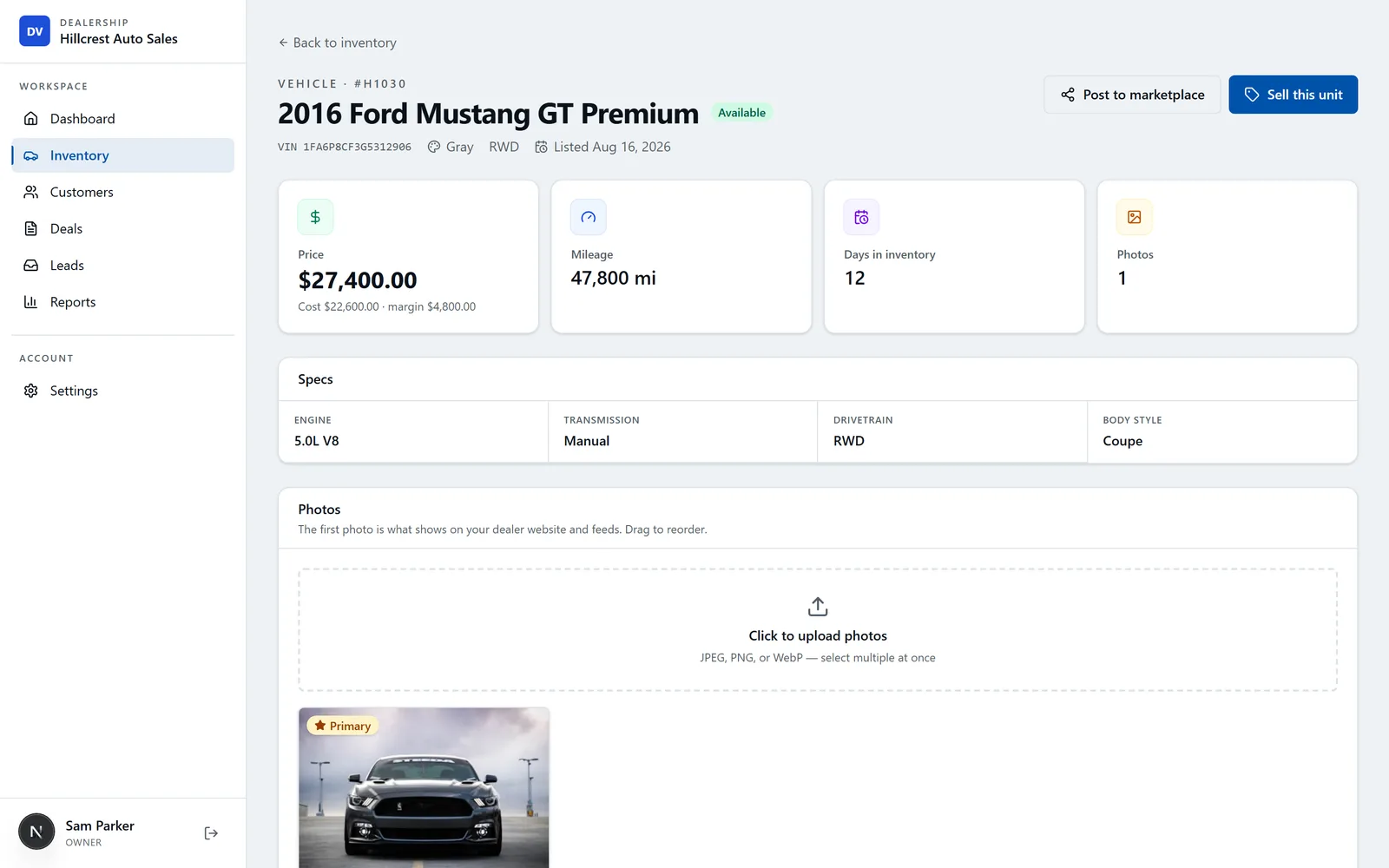
That's the screen I check when a car hits the aging list: cost, margin, and days on lot next to the specs. Multiply the days by your daily rate and you know what the car has cost to hold. It's $29 a month flat, unlimited users, in a browser.
Frequently asked questions
What is floor plan interest expense?
It's the interest you pay your floor plan lender on the money advanced to buy inventory, charged daily on each car's outstanding balance until you pay that car off. The daily figure is the amount floored times the APR divided by 365. It's a real operating cost that belongs on your P&L every month, alongside any flat floor fees, audit fees, and monthly charges your line carries. How it's treated for taxes is a question for your CPA.
How does floor plan financing work for car dealerships?
A lender gives you a credit line for inventory. When you buy a car at auction, the purchase goes on the line, the lender holds the title, and you pay interest daily on the advance. Most plans also require curtailments, which are principal paydowns at set ages, and the lender audits your lot to confirm floored cars are there. When the car sells, you pay off that car's advance. Our post on how dealer floor plans work walks through the full machine.
How much does floor plan interest cost per day for a car?
Multiply the amount floored by your APR and divide by 365. As an example, a $20,000 advance at 9% costs about $4.93 a day ($20,000 x 0.09 / 365). A $10,000 advance at the same rate is about $2.47 a day. Your line may also charge flat per-car and monthly fees, so the all-in daily cost runs higher than interest alone.
Will floor plan rates go down if the Fed cuts rates?
If your line is variable and priced off a benchmark such as SOFR or prime, a Fed cut usually flows through to your rate the same way a hike does, because those benchmarks move with the Fed's target. Retail auto loan rates key off benchmark rates too, but lenders set them with their own spreads, so a cut doesn't guarantee a matching drop for your buyers. If your line is fixed or has a rate floor, a cut may change nothing. Read your line agreement to know which you have.
How long is too long for a used car to be on the lot?
There's no single rule, but every day on a floor plan adds interest, and curtailments commonly start around 30 to 90 days depending on the lender. A reasonable working line is that a car with no real interest by about day 45 needs a price decision, and anything at 60 days gets a hard look: reprice to move it or wholesale it. Your lender's curtailment schedule and your own gross targets set the exact number.
Does a quarter-point rate hike really matter for a small lot?
Per car, barely. A quarter point on a $20,000 advance is about 14 cents a day, or roughly $8 over 60 days. Across a line it adds up: $600,000 floored costs about $1,500 more a year. That's real money, but the same 30 cars each sitting 10 extra days at 9% costs about as much. Turn speed moves your interest bill far more than the Fed does.
Bottom line
If your line is variable and priced off a benchmark, the September 16 hike likely raised your floor plan interest rate by about a quarter point. On a $20,000 car that's 14 cents a day. One extra day on the lot costs 36 times that, before depreciation and curtailments. Check how your line is priced, age your floored cars, and make a price decision on anything past 45 days. That does more for your interest bill than any Fed meeting.
If you want days on lot, all-in cost, margin, and a price suggestion on every car without building a spreadsheet, try DealerVLO free for 14 days.
14-day free trial, then $29/mo · Cancel anytime
Estimate your daily floor-plan carrying cost per unit.
Open the Floor Plan Calculator