Should Your Lot Take Cars on Consignment? A Dealer's Guide to Fees, the Agreement and the Math
Should your used-car lot sell cars on consignment? Three fee structures with worked math, consign vs. buy, what the agreement covers, and the risks to weigh.
Part of the Inventory, pricing & aging guide: Inventory Turn Rate for Used Car Dealers: Benchmarks, Formula & How to Improve
Switching from another DMS? Compare DealerVLO to DealerCenter, Frazer, or Lot Wizard.
Taking a car on consignment means the owner keeps the title and you sell the car for them, keeping a fee: a flat amount, a percentage of the sale, or everything above a net price you agreed on. It puts a car on your lot without tying up cash or floor plan. But you don't own it, so you don't control the price, and the owner can take it back. It's worth doing when your take beats what you'd make buying a similar car outright.
This is the dealer's side of the decision: why lots take consignment cars and why many don't, how to set the fee (with worked math), how to compare consigning against buying, what the agreement should cover, and how to vet the car and the owner. It isn't legal advice, and consignment rules vary by state. (If you're an owner deciding whether to consign your own car, this will still show you how the dealer is thinking.)
14-day free trial, then $29/mo · Cancel anytime
Why a lot takes consignment cars
- No cash tied up. You don't buy the car, so your money and your floor plan line stay free for cars you do own. Our floor plan vs. cash framework covers what that capital costs you.
- No floor plan interest. A consigned car can sit without running up interest on your line.
- Inventory you wouldn't otherwise stock. A clean, higher-priced car that's outside your usual buying range can fill out your front line.
- A way to work with private sellers. Some owners won't sell to you at a wholesale number but will happily let you sell it for them. If you'd rather buy from them, our guide to buying from private sellers covers that.
Why many lots don't
- You don't control the price. The owner has a number in their head, and the market may not agree.
- The owner can pull it. You detail it, photograph it, list it, and three weeks later they decide to keep it or sell it to their neighbor.
- The title and any lien stay with the owner until the sale, which adds a step at closing and a risk if something's wrong with the title.
- Who pays for what. Recon, detail, insurance and damage on a test drive all need an answer before the car arrives. Whether you take consignment cars is one of the questions insurers ask when they quote you, as our dealer insurance guide notes, so tell your agent before the first one arrives.
- You do the selling work without owning the upside.
Setting the fee: three structures, worked out
There's no reliable published average for consignment fees, so don't copy a number. Price it from your own costs to prep, insure, advertise and sell a car. Here's how the three common structures compare on one example car that sells for $18,000.
- Flat fee: you keep a fixed amount. Example: $750.
- Percentage: you keep a share of the sale price. Example: 8% of $18,000 is $1,440.
- Over-net: the owner gets an agreed net, and you keep everything above it. Example: with a $16,500 net, you keep $1,500.
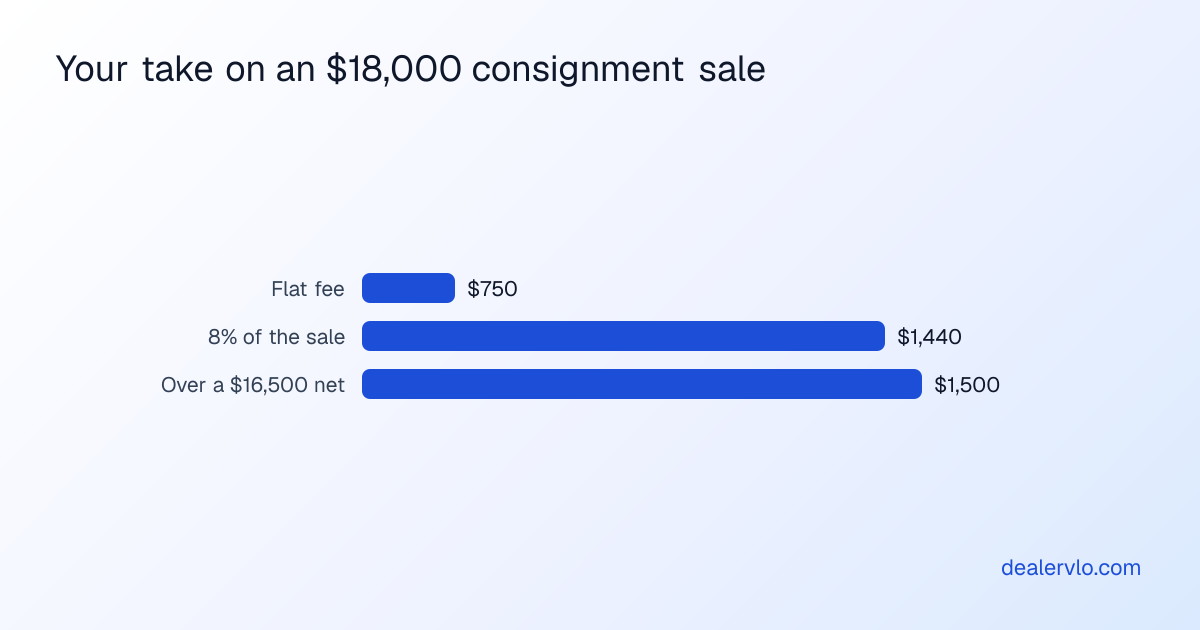
Over-net looks best in that example, and it can be. But read the next part before you default to it.
Over-net puts all the price risk on you
With an over-net deal, the owner's number is fixed and your fee is whatever's left. So every dollar the car sells under your asking price comes straight out of your take. Same example, $16,500 net to the owner:
- Sells for $18,000: you keep $1,500.
- Sells for $17,000: you keep $500.
- Sells for $16,500: you keep nothing, after doing all the work.
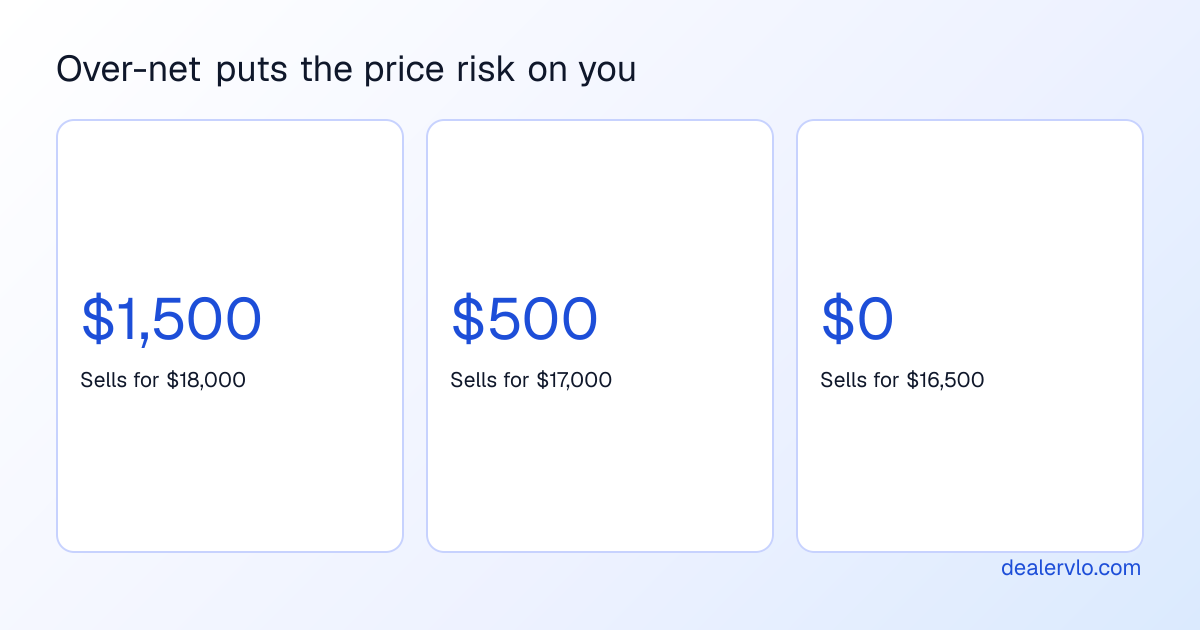
A flat fee or a percentage keeps some of that risk with the owner. If you use over-net, set the net from what comparable cars actually sell for, not from what the owner hopes, and agree on a minimum price in writing. Our guide to pricing from market comps is the place to start.
Consign vs. buy the same car
The real question is never "is consignment good?" It's "what would I make on this car if I bought it instead?"
Example: the same car, if you could buy it for $15,500, put $800 of recon into it and sell it for $18,000, grosses $1,700 before holding costs, and you control the price and keep any upside. Consigning it at 8% earns you $1,440 with no cash tied up and no floor plan interest, but less control.
Neither answer is always right. Buy it when you can get it at a price that leaves a good gross after recon and holding costs. Consign it when buying would tie up cash or floor plan you'd rather use elsewhere, or when the car is outside what you'd normally stock. To run your own numbers on one car, put both versions through the free calculator below.
Punch in cost, recon, holding days, and sale price to see your true net gross and margin.
Open the Profit Margin CalculatorWhat the consignment agreement should spell out
Put all of it in writing, signed by the owner, before the car is on your lot:
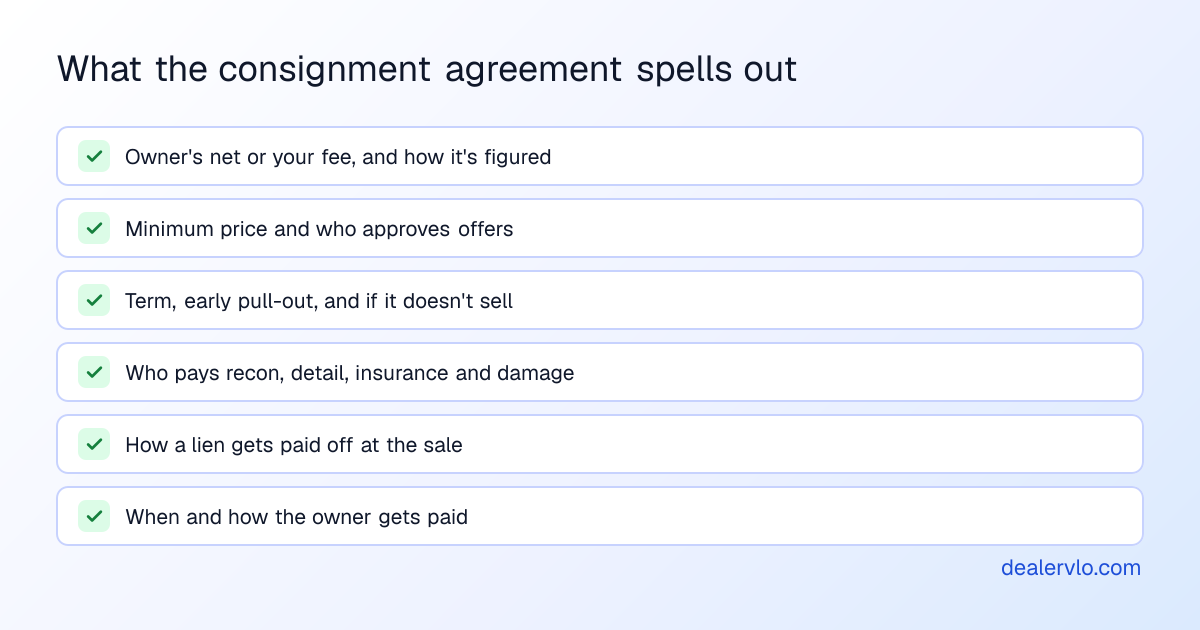
Some states set what a consignment agreement has to say, how fast the owner must be paid after the sale, or whether the money has to sit in a trust account. Check with your state's dealer licensing agency and have an attorney review your form before you use it.
Vetting the car and the owner
You're about to sell a car you don't own, so make sure it's theirs to sell and that it's what they say it is.
- Run the VIN and check the history.
- See the title. The name on it should match the owner's ID.
- Ask about liens. If there's a loan, get a written payoff and agree in the contract how it's paid off at the sale.
- Inspect it like you were buying it. You're putting your lot's name on it.
The Buyers Guide applies to consigned cars too
The FTC's Used Car Rule doesn't care who owns the car. Its Dealer's Guide to the Used Car Rule says dealers must display a Buyers Guide on used vehicles for sale on the lot "through consignment, power of attorney, or other agreement." So a consigned car gets a Buyers Guide on the window like every other car you're selling. Our guide to filling out the FTC Buyers Guide walks through it.
14-day free trial, then $29/mo · Cancel anytime
Starting a consignment-only lot?
Some people come to consignment wanting to open a lot that sells only consigned cars. In many states that's still a licensed dealer business, with the same licensing, bond and lot requirements, plus any state consignment rules. Our guide to starting a used car dealership covers the licensing side, and the free startup cost calculator totals what it takes to open.
Where DealerVLO fits, and what it doesn't do
DealerVLO doesn't have a consignment feature, so here's honestly how a consigned car fits into it:
- Intake: add the car by VIN and the year, make, model and trim decode from NHTSA.
- Your take as gross: enter the owner's net as the car's acquisition cost. Gross on the deal and the sales report is the sale price minus the car's all-in cost, so the gross you see is your take.
- Costs you pay: log any recon or detail you cover as cost lines on the car.
- The asking-price conversation: DealerVLO's AI price suggestion shows a price range from live comparable listings plus a target price for selling in about 30 days, which is a useful thing to put in front of an owner with a big number in mind.
- The window: the FTC Buyers Guide and a window sticker print from the car's page without a deal, and the car posts to your dealer website automatically.
- The sale: the buyer's side runs like any other deal, with the paperwork filled from the deal and e-signatures for the buyer and you.
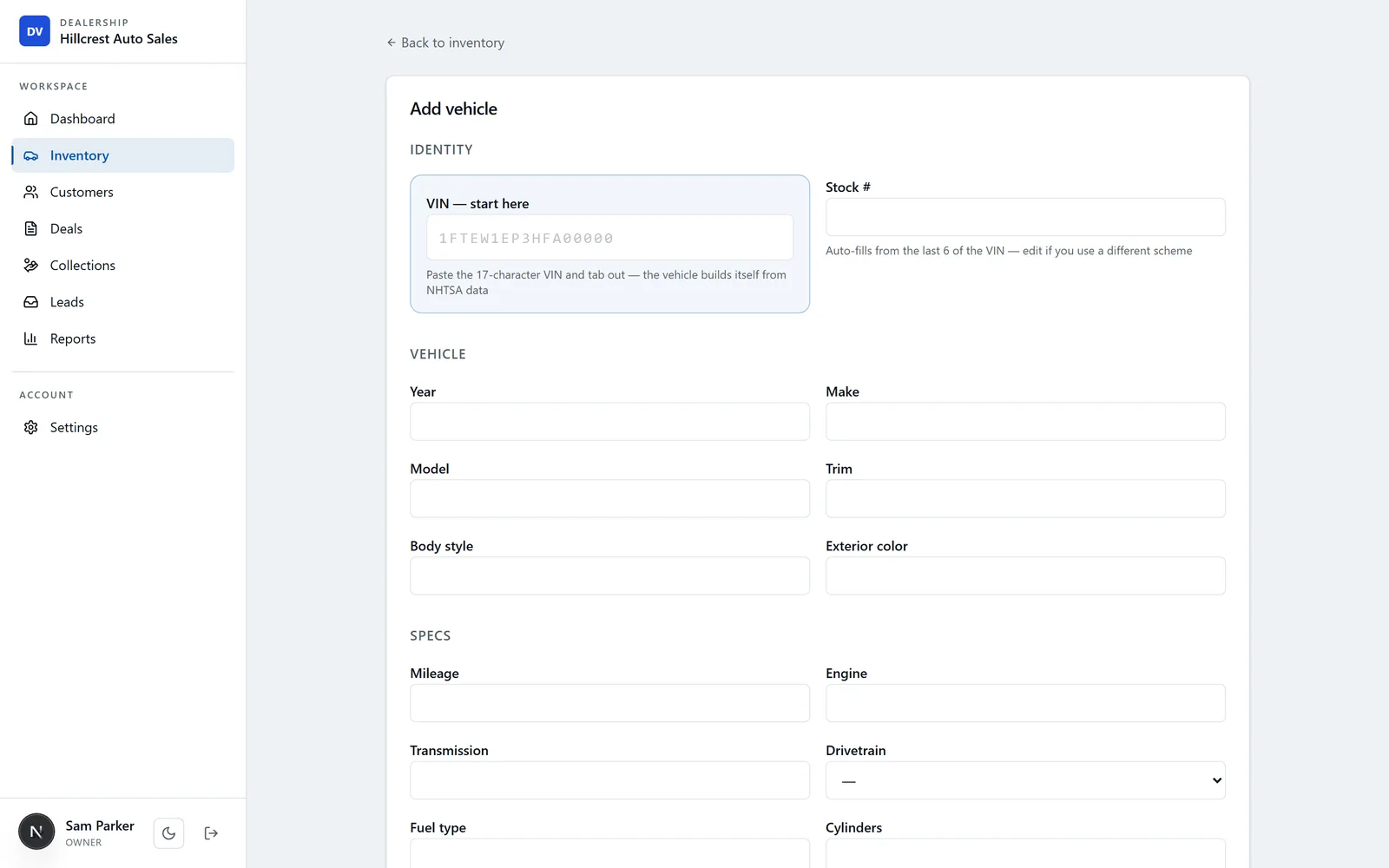
What it doesn't do: DealerVLO doesn't track consignment cars, consignors or owner payouts, and it doesn't produce consignment agreements or owner statements. Its custom forms fill buyer, vehicle, dealer and deal fields only, and its e-signatures are for the buyer, co-buyer and dealer, so the agreement with the owner stays on your own attorney-reviewed form. It's $29 a month flat with unlimited users; see what's included.
Frequently asked questions
What does consignment mean at a used car dealership?
The owner leaves their car on your lot and keeps the title until it sells. You market it, show it and sell it, then pay the owner and keep a fee: a flat amount, a percentage of the sale, or everything above a net price you agreed on. You never buy the car.
How much do dealers charge for consignment?
It's set by agreement, and the structures vary: a flat fee, a percentage of the sale price, or everything above an agreed net. There's no reliable published average, so price it from your own costs to prep, insure, advertise and sell a car, and from what you'd make buying a similar car instead.
What is a good consignment percentage for a car dealer?
Whatever covers your real cost to sell the car plus a profit you'd accept, and still beats the owner's alternative of selling it themselves. Run the math on a real car: compare your take at a few percentages against the gross you'd make buying a similar car outright.
What should a car consignment agreement include?
The owner's net or your fee and how it's calculated, the minimum price and who approves offers, how long the car stays and what happens if it doesn't sell or the owner pulls it early, who pays for recon, detail, insurance and any damage, how a lien is paid off at the sale, and when and how the owner gets paid. Some states set terms these agreements must include, so have an attorney review your form.
What are the disadvantages of consignment for a dealer?
You don't control the price, the owner can take the car back after you've spent time and money on it, the title and any lien stay with the owner until the sale, and with an over-net deal every dollar the car sells under the asking price comes out of your fee. You also carry the work of selling it without the upside of owning it.
Do I need a dealer license to sell cars on consignment?
In many states, selling vehicles for others as a business requires a dealer license, and some states have specific consignment rules such as payout deadlines or trust accounts. The rules vary by state, so check with your state's dealer licensing agency before you take a consigned car.
Does the FTC Buyers Guide apply to consigned cars?
Yes. The FTC's guide to the Used Car Rule says dealers must display a Buyers Guide on used vehicles offered for sale on their lot through consignment, power of attorney or another agreement, the same as on cars they own.
Is it better to consign or buy a car for my lot?
Buy it if you can get it at a price that leaves a good gross after recon and holding costs, because then you control the price and keep all the upside. Consign it when buying would tie up cash or floor plan you'd rather use elsewhere, or when the car is outside the price range you'd normally stock.
Bottom line
Consignment is a tool, not a strategy. It fills your lot without tying up cash, but you trade away control of the price and the car. Price your fee from your own costs, be careful with over-net deals that put all the price risk on you, compare every consignment against what you'd make buying the car, put the whole deal in an attorney-reviewed agreement, and hang a Buyers Guide on it like any other car.
14-day free trial, then $29/mo · Cancel anytime