Private-Party Acquisition for Independent Dealers: How to Buy a Car Off the Street, From First Message to Title in Hand
The execution guide to buying a car directly from a private seller — first contact, title checks, lien payoffs, and paperwork.
Part of the Buying & sourcing inventory guide: How to buy at dealer auctions without getting buried
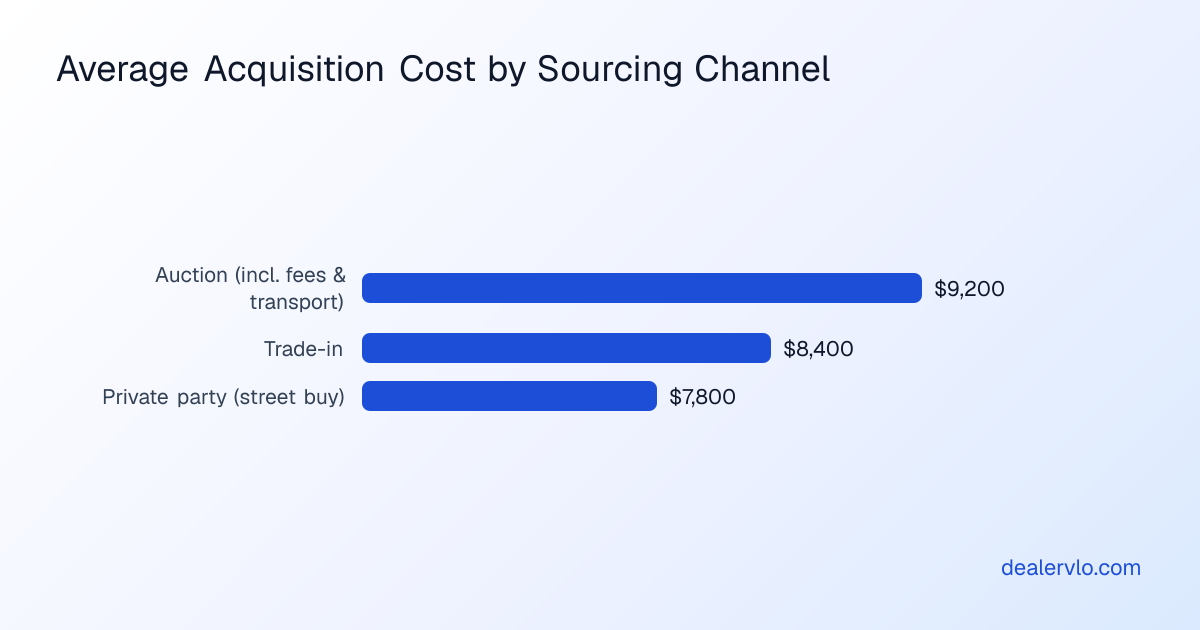
Auction inventory stayed tight through the first quarter of 2026, wholesale conversion rates climbed above historical norms, and used-vehicle inventory at dealers hit the lowest level since 2019. When you can't count on auction supply and trade-in flow follows new-car sales, private party vehicle acquisition stops being a sideline and becomes one of the few sourcing channels that still delivers margin without auction fees or waiting for someone to walk onto your lot.
This is the execution guide to buying a car off the street — the practical steps from first message to title in hand, written for the dealer who is also the one answering Facebook Marketplace at 9 PM, driving out to look at a car, and bringing it back to the lot the same day.
A quick compliance note before we start: this post covers the mechanics of a private-party purchase. It is not legal advice. Title transfer rules, odometer disclosure requirements, and lien-payoff procedures vary by state. Confirm your state's current requirements with your DMV or your attorney before you finalize your process.
First contact: messaging Marketplace and Craigslist sellers
Speed is your sharpest competitive edge. The dealership that responds within 15–20 minutes of a new listing going live converts at three to five times the rate of one that waits four hours. That means you need a saved message template, push notifications turned on, and a process that doesn't require you to be at your desk.
Keep your first message specific, direct, and low-pressure. A good template: "Hi — saw your [Year Make Model] on [Platform]. We buy directly from private sellers at fair market value, no hassle. Would you be open to a quick offer?"
Be upfront that you're buying for your lot. There is no benefit to hiding it, and the seller will figure it out the moment you mention a dealer bill of sale or ask for an odometer statement. Transparency builds trust and saves time — if the seller only wants to deal with another individual, you find that out in message two instead of after you drive out.
What to ask before driving out
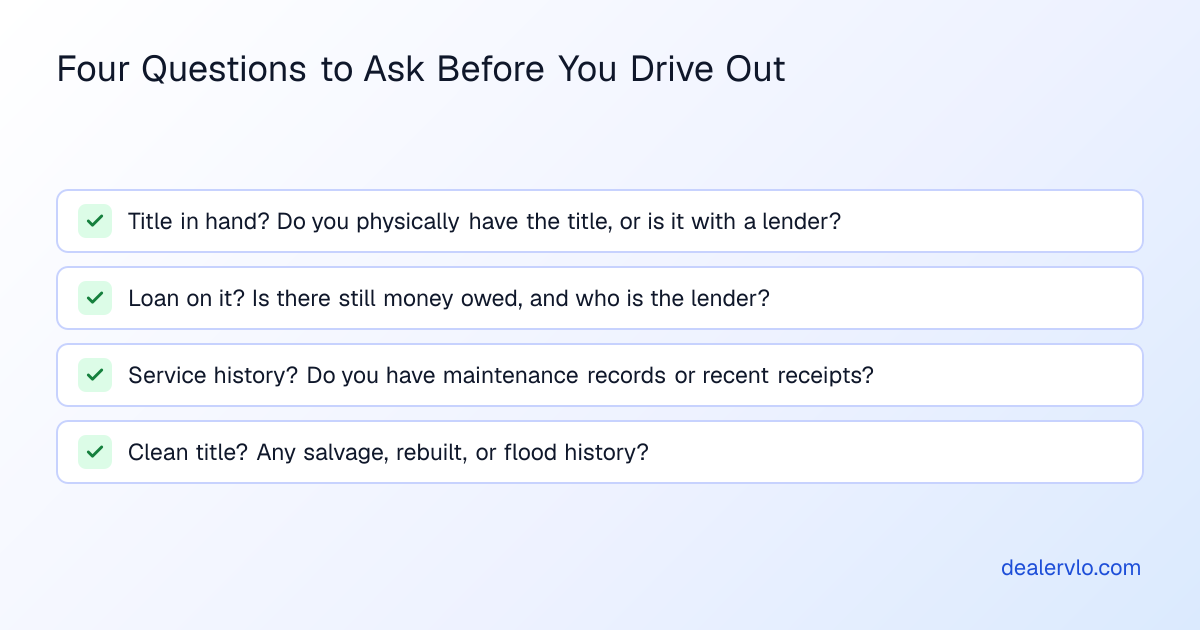
You need four pieces of information before you get in the truck:
- Title in hand? Do they physically have the title, or is it with a lender? If it's with a lender, you have a payoff situation — manageable, but it changes the timeline and the close.
- Loan on it? Is there still money owed? If yes, who is the lender and what is the approximate payoff? You will verify the exact number directly with the lender, but you need to know now whether the seller owes more than the car is worth.
- Service history? Do they have maintenance records, or at least receipts for recent work? It tells you how the car was maintained and gives you something concrete to discuss with a buyer later.
- Clean title? Any salvage, rebuilt, or flood history? If the answer is anything other than "clean," you need a title-history report before you make an offer.
These four questions filter out the cars that will waste your afternoon and surface the ones worth driving to see.
Follow up at least three times
Most deals don't close on first contact. A three-touch sequence over five to seven days captures a significant portion of eventual conversions. Day one is the introduction. Day three is a soft check-in: "Still have the [Make Model]? Happy to take a look this week if you're around." Day six or seven is a final note that leaves the door open: "No pressure — if you decide to move it, we're still interested. Here's my number."
You are not chasing — you are staying visible while the seller talks to two other buyers who flake, realizes how much work a private sale is, and decides a clean dealer transaction sounds pretty good.
DealerVLO tracks every lead's source and date in the lead inbox, so when a Marketplace seller replies four days later, you have the context without digging through your text messages.
Pre-offer checks: title, VIN, and history
You do not make an offer until you have verified three things: the title is in the seller's name and matches their ID, the VIN on the title matches the VIN on the car, and you have run a title-history report.
Title must be in the seller's name and match their ID
The title must be in the seller's legal name and match a current government-issued ID. If the name on the title doesn't match the person standing in front of you, you cannot legally buy from them — they don't own it. No exceptions, no "my brother's car but he's busy," no "my ex-wife's name but we're splitting up." The name on the title is the only person who can sell that car.
VIN matches: title, door jamb, dash
Check three VINs and confirm all three match exactly:
- VIN on the title
- VIN on the driver's door jamb sticker
- VIN visible through the windshield on the dash
Any mismatch is a red flag for title fraud or VIN cloning. Walk away.
NMVTIS title-history report
Before you present a number, run a title-history report through an approved NMVTIS data provider. NMVTIS pulls data from state motor vehicle titling agencies, insurance carriers, salvage auctions, and auto recyclers. The report shows the vehicle's brand history — including any "junk," "salvage," or "flood" determinations — any reports that an insurance company or self-insuring organization determined the vehicle to be a total loss, and any reports that the vehicle was transferred to an auto recycler, junk yard, or salvage yard.
Once a vehicle is branded by a state titling agency, that brand becomes a permanent part of the NMVTIS record. It follows the car across state lines, so a salvage title that was "washed" by transferring it to a state with looser rules will still show the brand in NMVTIS.
Reports typically cost under ten dollars per VIN. Some providers offer volume pricing if you set up a dealer account. Do not skip this step to save nine dollars — a clean NMVTIS report is the only independent confirmation that the seller is telling you the truth about the title.
14-day free trial, then $29/mo · Cancel anytime
Presenting the number
You have seen the car, the title is clean, the VIN matches, and the NMVTIS report came back with no brands. Now you present a number.
The math behind that number — how to price a car so it sells in thirty days and still leaves you gross — is covered in detail in our guides to buying cars that sell fast and the trade-in appraisal process. The short version: you price back from retail comps, subtract reconditioning, subtract your target gross, and arrive at the most you can pay.
Present a firm number based on wholesale and retail comps. Be transparent: "This is what I can pay today, cash, title in hand." Do not negotiate against yourself by saying "I was thinking maybe around…" or "I could probably go up to…" — make one strong offer and let the seller say yes, no, or counter.
If the seller counters and the number still works, great. If it doesn't, thank them, leave your card, and tell them to call you if they change their mind. A surprising number of sellers call back two weeks later after three Marketplace buyers waste their Saturday.
In DealerVLO, the AI price suggestion shows you a range from live comparable listings plus a target price for selling in about thirty days, so you know what retail looks like before you make the offer. Once you close the deal, every line-item reconditioning cost — tires, brakes, detail, whatever it needs — rolls into that car's all-in cost and margin automatically. You know whether the deal actually made money the day you sell it, not three months later when you wonder why the bank account is lower than you thought.
Work out the most you can bid at the lane and still hit your target margin.
Open the Auction Profit CalculatorClosing a car that still has a loan
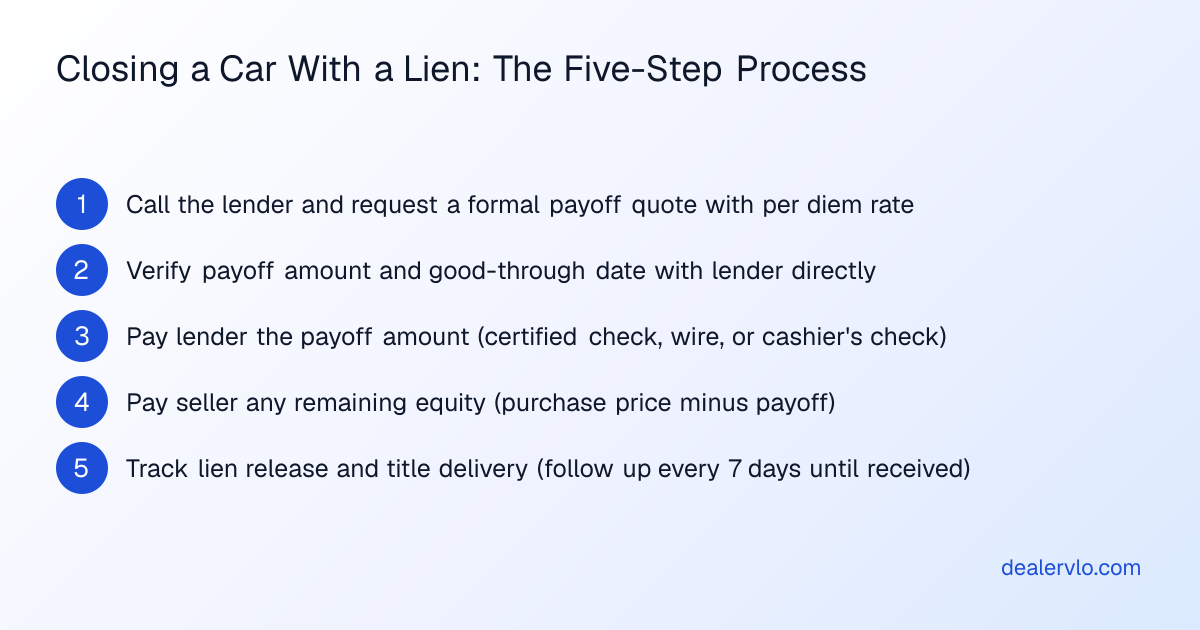
Roughly half the cars you buy off the street will still have a loan. The seller does not have the title in hand because the lender holds it. This is manageable, but it requires three steps: get the payoff quote directly from the lender, pay the lender, and track the lien release.
Get the payoff from the lender directly
Call the lender and request a payoff quote. This is a formal statement showing the exact dollar amount needed to close out the loan by a specific date. Never accept the seller's word on the payoff amount — it changes daily because interest accrues every day.
Most payoff quotes include a per diem rate, which is the amount of interest that adds up each calendar day beyond the quote date. If the quote is valid through the fifteenth and you pay on the seventeenth, you owe the quoted amount plus two days of per diem. Payoff quotes are typically valid for ten to thirty days, depending on the lender.
Pay the lender, pay the seller any equity
This is a three-party transaction. You pay the lender the payoff amount directly — usually by certified check, wire, or cashier's check, depending on what the lender accepts. You pay the seller any remaining equity, which is the purchase price minus the payoff. The seller signs the existing title or a power of attorney, depending on your state's process, and you track the lien release and title delivery.
In some cases you can meet at the lender's branch, pay off the loan in person, and receive the lien-released paper title the same day. In other cases the lender mails the title to you or to the seller, and it can take anywhere from seven business days to six weeks depending on the lender and the state.
The method and timing vary by state and by lender. Confirm the exact process with your state DMV and with the specific lender before you commit to the deal. Some dealers work with a floorplan company that offers lien-payoff services — verifying the payoff, remitting funds, and following up on the title — which can smooth out the process if you are buying cars with loans every week.
If you run your own process, set a calendar reminder to follow up with the lender every seven days until the title shows up. Liens that sit unpaid become a compliance headache fast, and your state likely has a statute governing how quickly you must pay off a trade-in lien. The same principle applies here even though it is a straight purchase, not a trade.
For additional context on wholesale acquisition and managing acquisition costs across channels, see our dealer auction buying guide and the post on buying wholesale cars without killing your margin.
The paperwork
You need three core documents to close a private-party purchase legally: title assignment, odometer disclosure where required, and a bill of sale.
Title assignment
The seller signs over the title to you. The exact location and format of the assignment section varies by state — some states have a reassignment section on the back of the title, some require a separate form, and some require the buyer and seller to appear together at the DMV.
Check your state's title-transfer requirements before you drive out. The last thing you want is to hand the seller a check, get a signature in the wrong spot, and discover the DMV will not accept it.
Odometer disclosure
Federal law requires a written odometer disclosure on many vehicle transfers. The disclosure must be made on a secure title, a reassignment document, or a power of attorney when a vehicle is transferred to a new owner.
Some older vehicles are exempt from the federal odometer disclosure requirement. The specific exemptions — which vehicles, which model years — are set by federal regulation and vary depending on when the vehicle was manufactured. Confirm with your state DMV which vehicles require an odometer disclosure and which are exempt before you finalize your paperwork process. Do not assume you know the rule — it has changed over time, and states may impose their own additional requirements.
For a deeper look at state-specific title forms and compliance, see our post on automated dealer paperwork by state, which covers title and registration forms for all fifty states.
Bill of sale
The bill of sale is your proof of purchase. It should include the date of sale, the seller's name and address, the buyer's name and address (your dealership name and business address), the vehicle identification (VIN, year, make, model), the purchase price, the odometer reading, and signatures of both parties.
Some states require a specific bill-of-sale form. Others accept any document that contains the required elements. Check your state's rule and keep a blank template saved so you can print or fill it on your phone.
DealerVLO auto-fills federal forms and state title and registration forms for all fifty states from the deal jacket, and you can upload your own fillable PDF forms — including your state's bill of sale — and DealerVLO will map the fields and fill them from the deal. On a small lot where you are the one printing the RMV-1 at ten at night, eliminating fifteen minutes of form-filling per deal adds up fast.
14-day free trial, then $29/mo · Cancel anytime
A repeatable weekly routine: tracking metrics and logging inventory the same day
Private party vehicle acquisition works when it stops being ad hoc and becomes a routine you run every week. That means tracking your contact-to-close metrics, logging your all-in cost per car, and getting the car into inventory the same day you bring it back to the lot.
Track contact-to-close metrics
Log these numbers every week:
- Number of sellers contacted
- Response rate (how many replied)
- Appointment-show rate (how many actually showed up or let you come see the car)
- Offers made
- Offers accepted (your conversion rate)
- Average time from first contact to keys in hand
These six metrics tell you whether your process is working or where it is breaking down. If your response rate is high but your show rate is low, you need better qualifying questions up front. If your offer acceptance rate is under twenty percent, your pricing might be too aggressive or you are targeting the wrong cars.
You do not need a complicated spreadsheet — a running tally in a notebook works. The goal is to see the pattern over four to six weeks so you know how many contacts you need to generate one buy.
Log all-in cost per car
Every car you buy off the street needs a complete all-in cost: purchase price, any lien payoff, transport if you paid someone to deliver it, and every dollar of reconditioning. DealerVLO tracks per-car reconditioning costs line by line, and those costs roll into that car's all-in cost and margin automatically. You see exactly what you have into it before you price it, and you see your actual gross the day you sell it.
If you are not tracking all-in cost per car, you are guessing at margin. And if you are guessing at margin, you do not know whether street buying is making you money or costing you money relative to auction buys or trade-ins.
Get the car into inventory the same day
The car goes into your inventory system the same day you bring it back to the lot. Not tomorrow, not when you get the title back from the lender — today. VIN, mileage, purchase price, condition notes, and a quick photo on your phone.
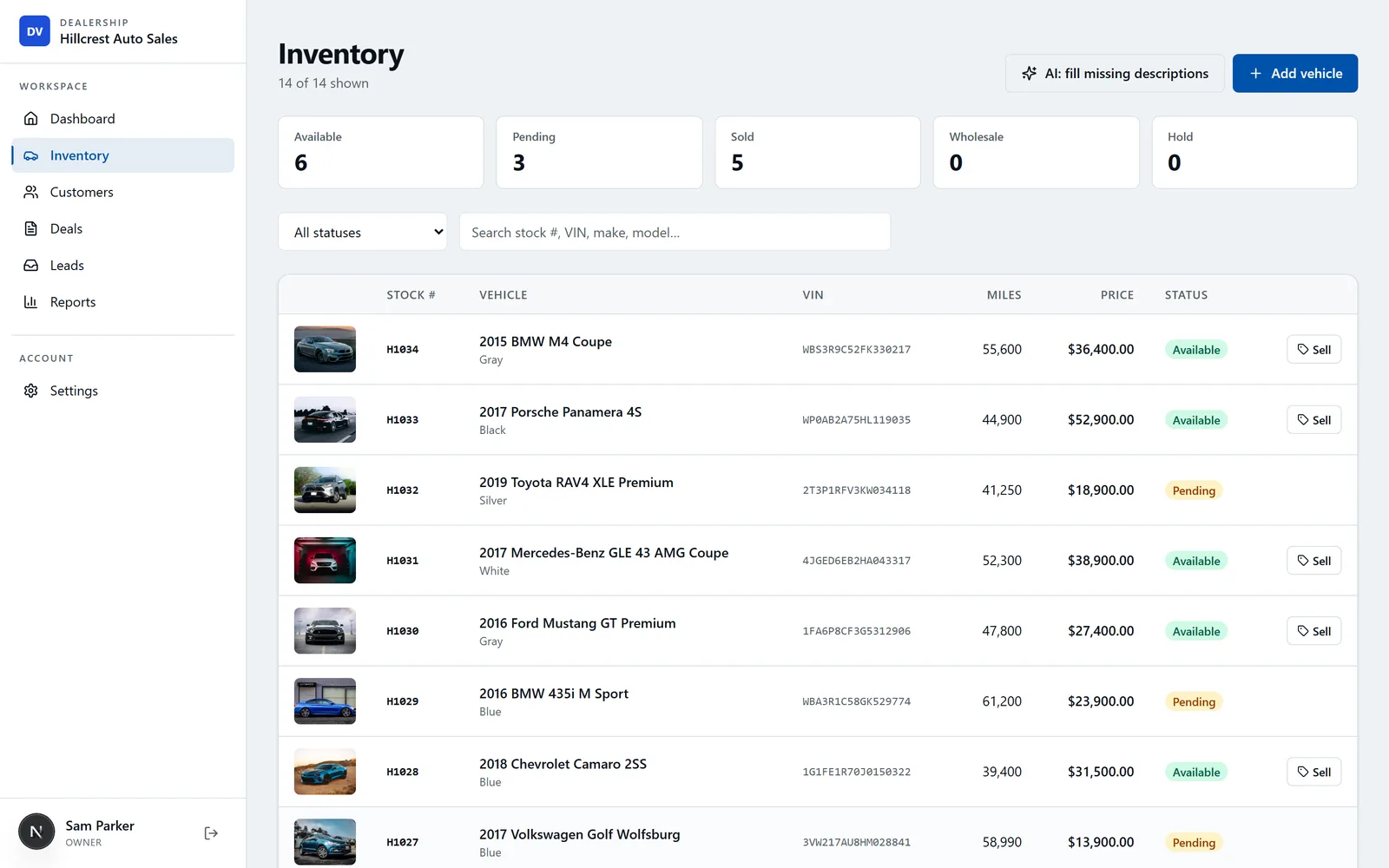
In DealerVLO, adding a vehicle takes about ninety seconds: VIN decode pulls the year, make, model, and trim, you upload photos from your phone, and the car is live in inventory with days-on-lot tracking starting that day. Every car shows its days in inventory, an aging flag at sixty-plus days, and a dashboard count of units aged sixty-plus so nothing sits forgotten in the back row.
Street purchases used car dealers make consistently are the ones who treat it like a weekly discipline instead of an opportunistic side channel. Set aside two hours every Monday to message new listings, follow up on prior contacts, and schedule appointments for the week. The ROI on those two hours — when you are buying at the right number and the alternative is paying auction fees on tight inventory — is hard to beat.
For additional sourcing strategies and how to balance private-party buys against other channels, see our guide to where to find used car inventory besides the auction. And once the car is on your lot, the vehicle intake process guide walks through getting it from the back row to the front line in seventy-two hours.
Frequently asked questions
How do I know if a private seller is actually the owner and not a curbstoner?
The title must be in the seller's legal name and match their current government-issued ID exactly. If the name on the title does not match the person you are talking to, they do not own the car and you cannot legally buy it from them. Beyond the title check, red flags include meeting in a parking lot instead of at their home, vague answers about service history, multiple cars listed under the same phone number, and reluctance to let you see the registration or insurance. For a detailed breakdown of curbstoner warning signs, see our post on where to find used car inventory besides the auction, which covers sourcing channels and the risks in each one.
What is the safest way to buy a car from a private seller who still owes money on it?
Get the payoff quote directly from the lender — never accept the seller's word, because interest accrues daily and the number changes. Pay the lender the payoff amount directly, pay the seller any remaining equity, and track the lien release and title delivery. The method and timeline vary by state and by lender, so confirm the exact process with your state DMV and the specific lender before you commit. Some lenders allow you to close the transaction at a branch and walk out with the lien-released title the same day; others mail it, and it can take weeks.
Do I need an NMVTIS title check on every car I buy off the street?
Yes. An NMVTIS report shows the vehicle's brand history — salvage, junk, flood, or total-loss determinations — plus any reports that the car was sold to a salvage yard or auto recycler. Once a vehicle is branded by a state titling agency, that brand becomes a permanent part of the NMVTIS record and follows the car across state lines. A clean title in the seller's hand does not guarantee a clean history, and a nine-dollar report is the only independent confirmation you have before you hand over a check. Get the report from an approved NMVTIS data provider.
Which vehicles need a federal odometer disclosure when I buy them from a private seller?
Federal law requires a written odometer disclosure on many vehicle transfers, but some older vehicles are exempt. The specific exemptions vary depending on when the vehicle was manufactured and are set by federal regulation. Confirm with your state DMV which vehicles require an odometer disclosure and which are exempt before you finalize your paperwork. Do not assume you know the rule — it has changed over time, and your state may impose additional requirements beyond the federal baseline.
How do I track whether private-party buying is actually making me money compared to auction buys?
Log your contact-to-close metrics every week: sellers contacted, response rate, show rate, offers made, and offers accepted. Then track the all-in cost per car — purchase price, lien payoff if applicable, transport, and every dollar of reconditioning. Compare that all-in cost to what you would have paid at auction for the same year, make, model, and mileage, including buyer fees, transport, and recon. DealerVLO tracks per-car reconditioning costs line by line and rolls them into each car's all-in cost and margin, so you see your actual gross the day you sell it and can compare sourcing channels side by side over a month.
How quickly should I respond to a Facebook Marketplace or Craigslist listing to have a realistic chance of buying the car?
Speed is the sharpest competitive edge in used car acquisition strategies for private-party buying. Dealers who respond within fifteen to twenty minutes of a new listing going live convert at three to five times the rate of those who wait four hours. That means push notifications turned on, a saved message template ready to go, and a process that works from your phone. Most sellers talk to the first two or three people who reply, and if you are not in that group, you are not getting the car.
Bottom line
Private party vehicle acquisition is one of the few sourcing channels left where you can still buy at a number that leaves real margin without auction fees or waiting for trade-in flow. The process — first contact, title and VIN checks, NMVTIS report, presenting the number, closing a lien payoff if needed, and handling the paperwork — is repeatable once you have run it a few times. Track your contact-to-close metrics, log every car's all-in cost, and get it into inventory the same day. When auction supply stays tight and wholesale conversion stays high, the dealers who build a consistent street-buying routine have inventory when their competitors are waiting for the next sale.
DealerVLO is built for the dealer who is also the buyer, the one filling out the title application, and the one answering leads at night. Fourteen-day free trial, twenty-nine dollars a month, no per-deal fees. Start your trial today and see how much faster the paperwork moves when the system fills it for you.
Quote a payoff on an in-house note — current balance plus per-diem interest, good through a date.
Open the BHPH Payoff Calculator