Where to find used-car inventory besides the auction
The off-auction sourcing channels that carry the best gross for a small lot: buying off the street, trades you don't retail, the service lane, referrals, and online — plus how to do each safely.
Ask most independent dealers where they get their cars and the answer is "the auction" — as if it's the only door. It's the busiest door, and on sale day it can feel like the only one, but it's also the most competitive and the most expensive place you'll ever buy a car. You're bidding against forty other dealers, paying a buy fee, and hauling the thing home, all before you've spent a dollar on recon.
The lots with the healthiest gross don't buy only at the auction. They buy where nobody's bidding against them — off the street, out of their own service lane, from the customers they already sold. This is the map of those channels: where they are, what makes each one work, and how to buy off the street without inheriting somebody else's title problem.
Why auction-only sourcing caps your gross
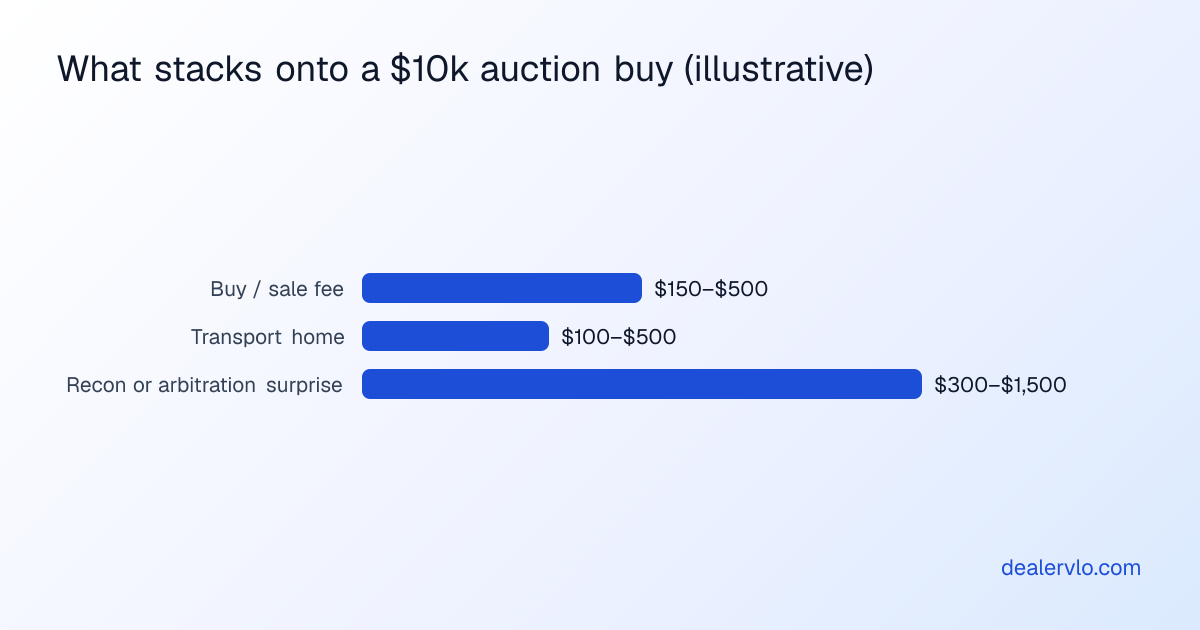
Nothing wrong with the auction — I still buy there, and the auction buying guide is its own manual. But understand what it does to your cost basis. Every car you buy there arrives with a stack on top of the hammer price: a buy fee, transport, and the risk that a unit you inspected for ninety seconds under bad lighting needs more than you thought. On a clean car those are just the cost of doing business. On a miss, they're the difference between a gross and a break-even.
The deeper problem is competition. An auction is a room built to make you pay the most anyone's willing to pay — that's the entire point of a bid. When you source only there, your average buy sits right at the market's ceiling, and your gross is whatever recon and the retail market leave you on top of a full-retail wholesale price. Widen your sourcing and your average cost basis drops, because the off-auction cars come in under that ceiling. You don't have to abandon the auction. You have to stop letting it set your whole cost of goods.
Buying off the street — the highest-margin channel
The best buys I make don't happen at 9 a.m. on sale day. They happen when a regular person decides to sell a clean car and lists it on Marketplace or Craigslist for what they think it's worth — which is often well under what you'd pay wholesale for the same unit. No buy fee, no transport, no other dealers in the room. Just you, a fair offer, and a title.
The catch is that this channel has no arbitration and no quality control — you are the quality control. That's where the discipline lives:
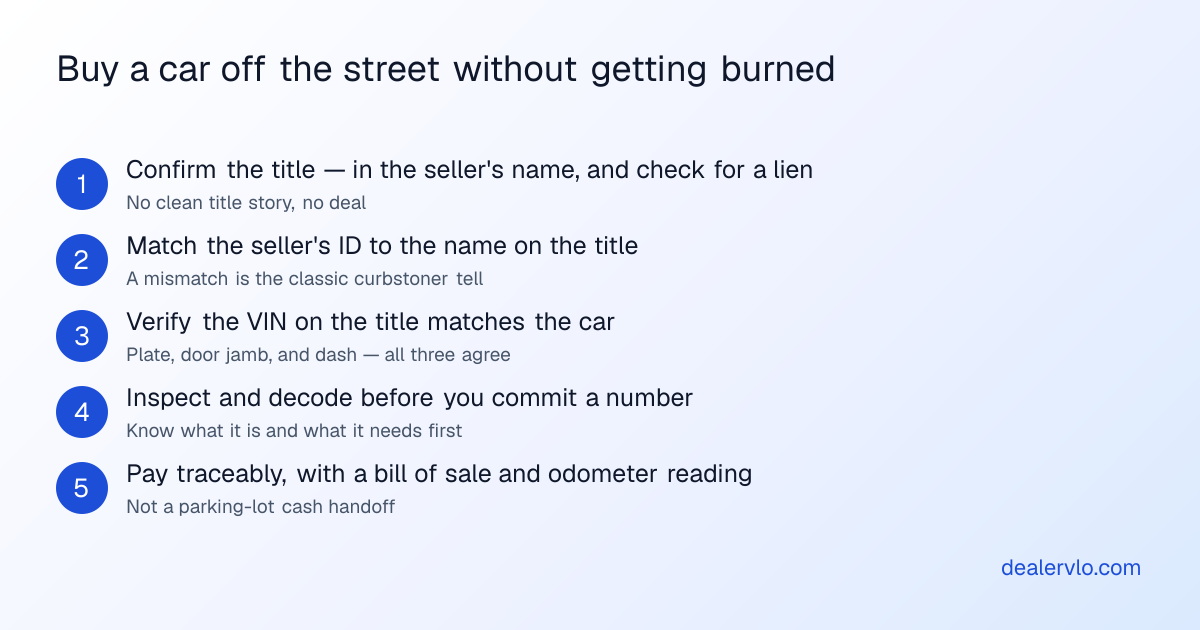
Confirm the title is in the seller's name before you talk price, and check whether there's still a lienholder or payoff on it. Match the seller's ID to the name on the title. Make sure the VIN on the title matches the VIN on the car — plate, door jamb, and dash all agree. Inspect it and decode the VIN so you know exactly what it is and what it needs before you commit a number. Then pay with a method you can trace, and write a bill of sale with the odometer reading.
One flag worth naming: curbstoners — people flipping cars for profit without a license, often on titles they never put in their own name. If a "private seller" has three cars in the driveway, won't title one in their name, or is cagey about how they got it, that's not your bargain, it's your problem. A too-good price with a fuzzy ownership story is a walk, every time.
Decode any VIN free — year, make, model, trim, engine — straight from NHTSA.
Open the VIN DecoderTrade-ins: the inventory that walks onto your lot
Every deal you write is a chance to buy a car, not just sell one. A trade is inventory nobody else bid on — but only if you appraise it as a buy, not as a discount on the sale. When you let a trade allowance become a negotiating lever ("I'll give you two grand for it to make the numbers work"), you've stopped valuing the car and started giving away gross. Appraise it cold, the way the trade-in appraisal guide lays out, and decide one thing up front: retail or wholesale.
Retail the clean, in-demand units that fit your lot and your market. Everything else — the wrong-for-you brands, the high-mileage stuff, the projects — move to wholesale or the auction fast, before it starts aging on your line. The mistake I see (and made) is retailing every trade because it's "already here." A trade you should have wholesaled in week one and instead nursed for ninety days didn't save you a buy — it cost you a floor-plan payment and a parking spot.
Dump it at auction now or retail it? Compare the two nets and find the break-even day.
Open the Wholesale vs. Retail CalculatorService lane, referrals, and your own past customers
If you have any service relationship — your own shop, or a mechanic you're friendly with — that bay is a sourcing channel. Cars come in for an estimate the owner doesn't want to pay, and that owner is now a motivated private seller standing in front of a dealer. A standing "if you ever decide to just sell it, I'll make you a fair offer" turns declined repairs into inventory.
Your own past customers are the most overlooked channel of all. You sold them a car two or three years ago; some of them are ready to trade up right now, and their current car is one you already know the history on. The dealers who mine this well keep the customer's information somewhere they can actually search it — which is the difference between "I think I sold a Civic to a guy named Dave" and pulling up every customer who bought a compact three years ago and sending a two-line text. That's a database job, not a shoebox-of-business-cards job.
Online marketplaces and other dealers' overflow
Beyond the public, the online channels stack up: wholesale platforms, dealer-to-dealer apps, and the simple fact that other lots have cars that don't fit them and would rather move at a wholesale number than sit. A high-line lot doesn't want the clean economy commuter it took in trade; that's exactly your car. Building a couple of dealer relationships where you take each other's misfit inventory is free, repeatable sourcing.
The same "is this still available?" Marketplace thread that finds you a private-party car finds you these too. The work isn't finding cars — it's responding fast and having a process so the good ones don't get away while you're deciding. Which is the real point: none of this matters if it's not repeatable.
Building a repeatable pipeline (so you're not auction-dependent)
A channel you use once isn't a channel — it's an accident. The difference between "I bought a good car off Marketplace that one time" and sourcing off-auction is that the second one is a habit: you check the private-party listings on a schedule, you make the standing offer in the service lane every time, you text past customers when you're short on a segment, and you log every unit you buy the moment you buy it so you actually know your cost basis by channel.
That last part is where a lot of dealers lose the thread. If you buy a car off the street and don't record what you paid, your transport, and your recon against that specific unit, you'll never know whether your street buys actually out-perform your auction buys — you'll just have a feeling. Log it at intake, decode the VIN, and let days-on-lot start counting from day one:
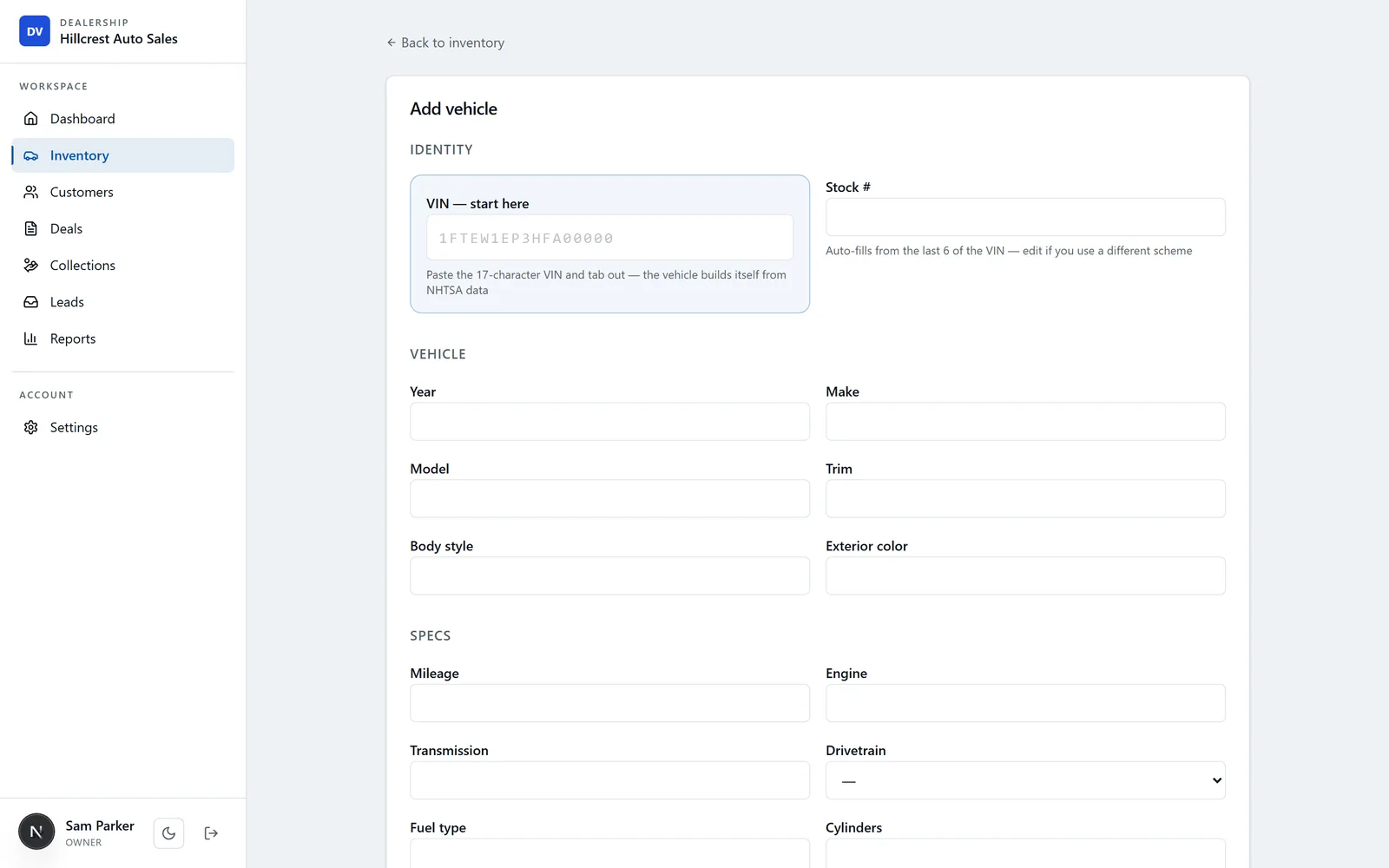
Do that on every unit, from every channel, and after ninety days you can see which doors actually feed your best gross — the same way you'd judge anything else in this business: with your own numbers, not a hunch. Track it against how each unit sells, the way the buy-cars-that-sell-fast framework does, and your sourcing gets sharper every quarter.
Frequently asked questions
Where do used-car dealers buy cars besides the auction?
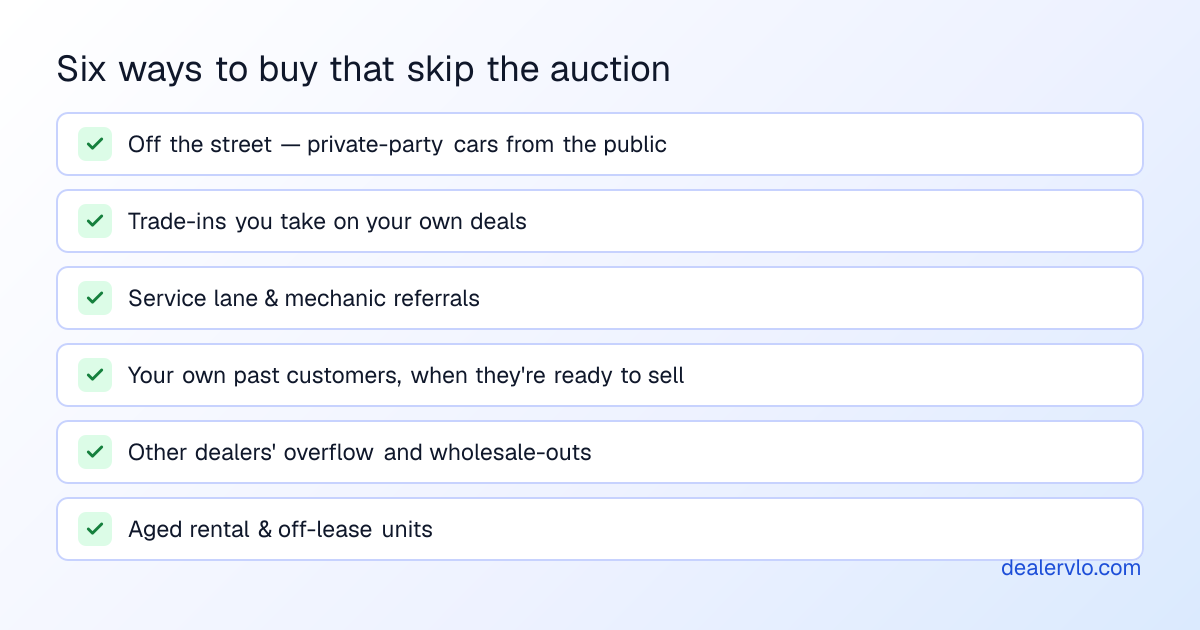
Directly from the public (Marketplace, Craigslist, word of mouth), trade-ins on your own deals, the service lane and mechanic referrals, your own past customers, other dealers' overflow, and aged rental or lease units. You're not bidding against other dealers on any of them, so the buy is usually cheaper — you just have to build the channel instead of showing up on sale day.
Is it cheaper to buy cars off the street than at the auction?
Usually the buy price is lower — no competitive bid, no buy fee, no transport. But cheaper to buy isn't automatically more profitable: a street car can hide recon or a title issue that auction arbitration would have surfaced. Pair the lower price with a real inspection and title check and the savings survive to the sold line.
How do I buy a car safely from a private seller?
Confirm the title's in the seller's name and check for a lien, match their ID to the title, verify the VIN on the title matches the car, inspect and decode it before you commit a number, and pay traceably with a bill of sale and odometer reading. If the ownership story is fuzzy, walk.
What's a curbstoner?
Someone buying and selling cars for profit without a license, often on titles they never put in their name. They compete with you for cheap private-party cars, and a car passed through one can carry a messy paper trail. Several cars, no title in their name, or a vague backstory are the flags.
Can trade-ins really be a source of inventory?
Yes — every deal is a chance to buy a car nobody else bid on. Decide per trade whether you retail it or wholesale it, appraise it as a buy rather than a discount on the sale, and move the ones that don't fit your lot fast instead of letting them age.
Bottom line
The auction is a door, not the building. The dealers with the best cost basis buy where there's no bid against them — off the street, out of trades they appraise honestly, through the service lane and their own customers — and they treat every one of those as a repeatable channel, not a lucky find. The buy is cheaper; the discipline is doing the title check and the inspection so the savings survive.
The part that makes it repeatable is knowing your numbers by channel, and that only works if every unit gets logged the day you buy it. That's the habit DealerVLO is built around: paste the VIN, the specs decode, cost and days-on-lot start counting, and the same record flows to your paperwork and your website. One system of record for every car, however you found it — $29/month flat, 14-day free trial.
Work out the most you can bid at the lane and still hit your target margin.
Open the Auction Profit Calculator