Why Are Cars Sold at Auction? Every Seller, and What Their Reason Tells You Before You Bid
Why are cars sold at auction? Trade-ins, aged units, off-lease, rental, repos, and total losses. What each seller's reason means for your bid.
Part of the Buying & sourcing inventory guide: How to buy at dealer auctions without getting buried
Why are cars sold at auction? Because auction turns a car that doesn't fit the seller's business into cash in a day. Franchise stores wholesale trades they don't want to retail and units that aged out. Leasing companies, rental fleets, and lenders sell off-lease returns, defleets, and repossessions. Insurance companies sell total losses at salvage auctions.
Consumers ask whether auction cars are bad. Dealers should ask a more useful question: who sent this car to the lane, and why? Almost every car at a wholesale auction is there because of the seller's business model, not because of a hidden defect. The reason it's for sale tells you what it probably needs, which tells you what it's worth to you.
I'm the buyer for my own small lot in Tewksbury, Massachusetts, and DealerVLO is the system I built to run it. This post goes through every major seller, why each one uses auction, and how each reason should change your bid.
Why cars end up at auction: the short answer
Every seller at auction has the same problem. They're holding a vehicle that doesn't fit how they make money, and holding it costs them. Auction solves it in a day: thousands of dealer buyers, a known sale date, and payment that clears in days instead of weeks of retail marketing.
- A franchise dealer wholesales a trade that doesn't fit its brand, price range, or certified program, or a unit that has aged past its limit.
- A leasing company sells the car that came back at the end of the lease.
- A rental or fleet company sells vehicles that reached their planned age or mileage.
- A lender sells a repossession to recover what's owed.
- An insurance company sells a total loss, but at a salvage auction, which is a different market.
None of those reasons is "this car is a lemon." Some cars at auction are rough, but the condition report and announcements usually say so. What matters is that each reason predicts a different set of costs, and the dealer who prices that in wins the car at the right number.
Two different auctions: dealer wholesale vs. salvage
Before the seller types, separate the two markets. Most consumer articles blur them, and they shouldn't.
Dealer wholesale auctions (Manheim, ACV, OPENLANE, and independent lanes) mostly sell running, retail-able cars from dealers and commercial consignors. OPENLANE's annual report describes its supply as off-lease, repossessed, rental, and fleet vehicles that have reached a predetermined age or mileage, plus vehicles from dealers turning their inventory.
Salvage auctions (Copart and IAA) mostly sell damaged vehicles and insurance total losses. Copart's 10-K for fiscal 2025 says 81% of the vehicles it processed came from insurance company sellers. Salvage can make money for a dealer with a body shop and a plan for the branded title, but it's a different business with a different buyer. Everything below is about the dealer lanes.
Where do auction cars come from? Every seller, and why they sell
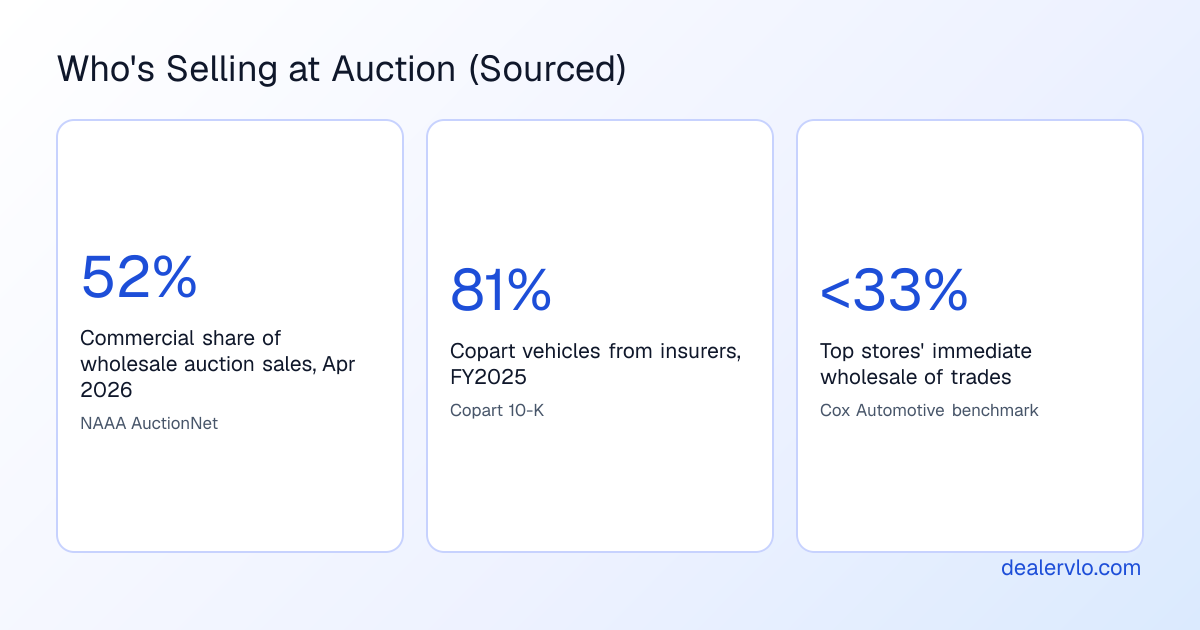
Auction volume splits into dealer consignment and commercial consignment, and the mix moves. In April 2026, the National Auto Auction Association's AuctionNet data put commercial consignors at 52% of wholesale auction sales, up from 47% a year earlier, with dealer consignment falling from 53% to 48% (Auto Remarketing). When commercial supply rises, you see more late-model off-rental and off-lease units in the lanes, so it pays to watch the mix.
Franchise trade-ins the store didn't want
This is the classic auction car. A franchise store takes a trade to make a new-car deal, then decides the trade isn't worth retailing. It's the wrong brand for the lot, too old or too high-mileage for the store's price range, ineligible for the certified program, or it needs more recon than the store wants to spend.
Cox Automotive's used-car benchmarks track this as "immediate wholesale," meaning trades never offered for retail, and say top used-car departments keep it under 33%. Even the best franchise stores send a meaningful share of their trades straight to the lane.
What it tells you: the store decided it couldn't make enough money retailing it. Sometimes that's purely brand fit, like a 10-year-old domestic sedan traded in at a luxury import store, and the car is a fine retail unit for an independent. Sometimes it's because the store's service department looked at it and didn't like what it saw. Read the condition report for the second case.
Aged units: right car, wrong lot
Many franchise stores run aging policies. The auction house ACV says many dealerships wholesale units that reach 60 or 90 days. Their floor plan, their market, or their price was wrong for that car, and the policy says it goes.
What it tells you: usually a demand or pricing problem, not a mechanical one. A convertible that sat through a northern winter or a truck that sat on a lot full of sedans can be a strong buy for a dealer whose market wants it. Ask whether your market would have bought it in 30 days. And watch your own lot for the same thing: DealerVLO flags any car at 60 days with "aging, consider repricing," so you decide on a unit before it turns into one of these.
14-day free trial, then $29/mo · Cancel anytime
Off-lease returns
At the end of a lease the customer hands the car back, and the leasing company sells it. Many go to auction.
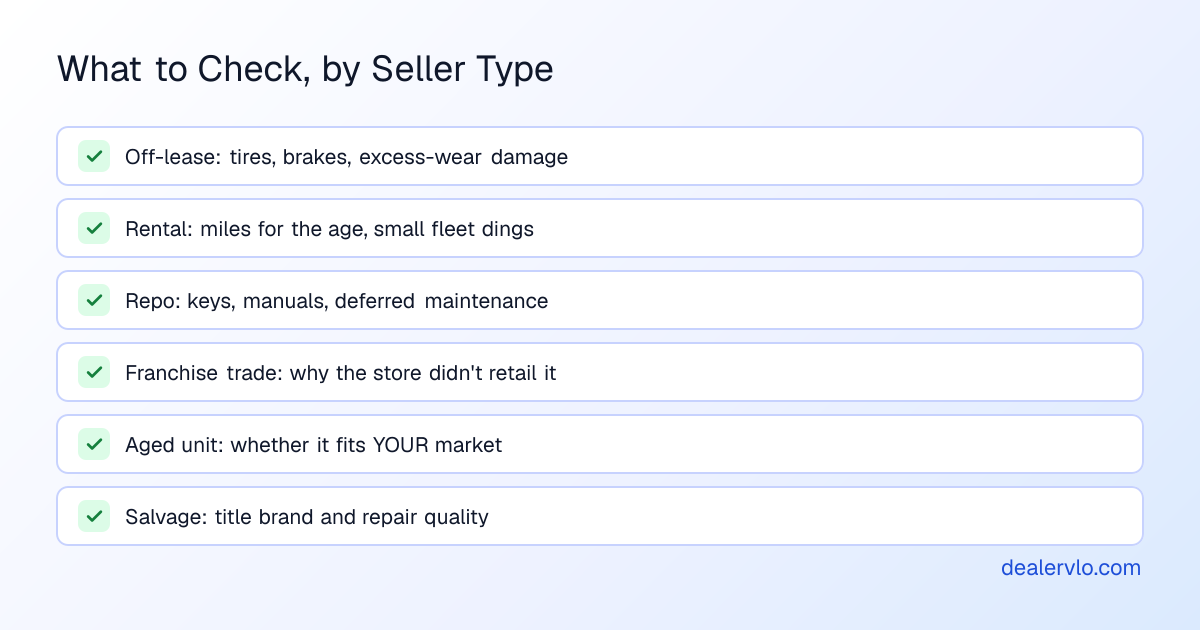
What it tells you: usually low miles for the age and a known ownership history, but leases end with whatever tires and brakes the car has. Lessees have little reason to replace either near turn-in, so expect tires, brakes, and some cosmetic wear-and-tear in your recon budget.
Rental and fleet defleets
Rental companies and corporate fleets sell vehicles once they reach a planned age or mileage. That's a business decision about the fleet, not about the individual car.
What it tells you: young cars with high miles for their age. They were often on a regular maintenance schedule but drove by many different people. Expect small dings, interior wear, and base trims.
Government fleets sell the same way. The GSA sells federal fleet vehicles at auction once they meet replacement criteria. Expect plain specs, high idle hours on some units, and regular service.
Repossessions
When a borrower stops paying, the lender repossesses the car and usually sells it at auction to recover what's owed.
What it tells you: the biggest unknowns in the lane. A borrower who stopped making payments may also have stopped changing the oil. Keys, manuals, and accessories can be missing. Some repos are clean, but price in a second key, a full service, and a cushion for surprises.
Other dealers dumping their own mistakes
Independent dealers and wholesalers run cars through the lanes too: their own aged units, trades they took to make a deal, and buys that didn't work out.
What it tells you: the least predictable category. An independent's aged unit has already been retailed and passed over, sometimes twice. Check how many times it has crossed the block if the auction shows run history.
Before you bid on any of these, run the numbers. Plug in the hammer price, fees, transport, and recon, and the calculator shows what you actually clear at your retail price:
How the seller's reason should change your bid at auction
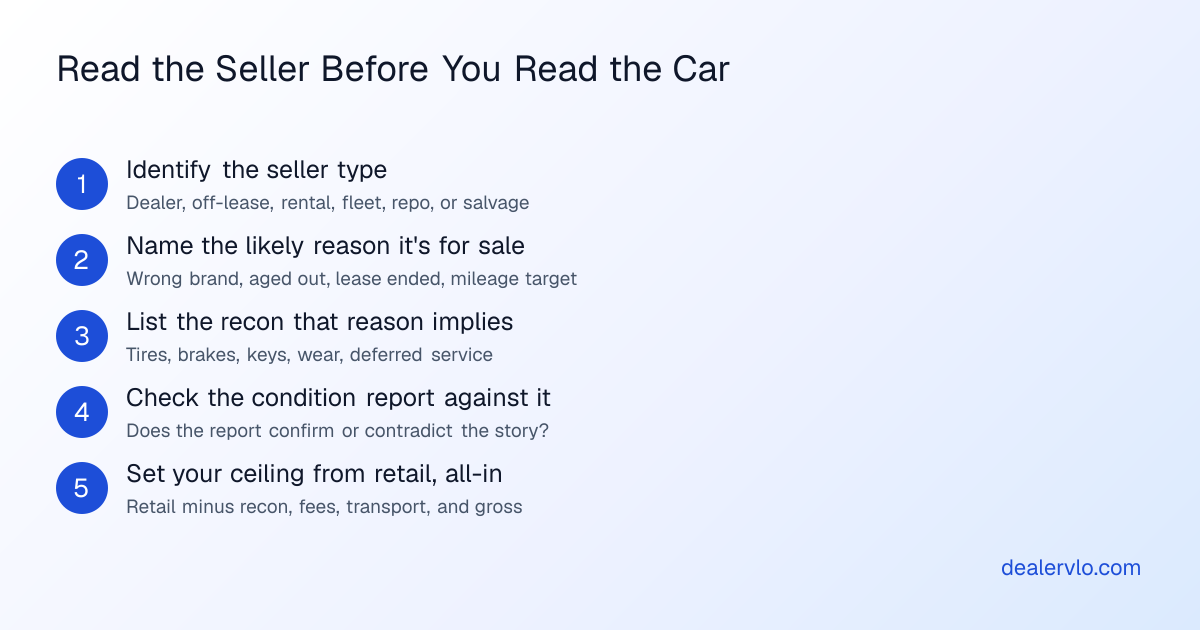
Once you know who sold the car and why, you know what it probably needs. That turns a vague "looks clean" into a bid ceiling:
- Identify the seller type. The listing, the seller name, or the announcements usually tell you.
- Name the likely reason. Wrong brand for the store, aged out, lease ended, mileage target, repo.
- List the recon that reason implies. Off-lease: tires and brakes. Repo: keys and a full service. Rental: interior and small dings.
- Check the condition report against it. If the report confirms the story, good. If a "clean trade" has cleared codes and missing undercarriage photos, the story is wrong. The condition report red-flag guide covers what to look for.
- Set your ceiling from retail, all in. Start from what the car will retail for in your market, then subtract recon, buy fee, transport, holding cost, and the gross you need. The all-in auction math is where most dealers leak money.
Step five depends on knowing retail before you bid. DealerVLO's AI price suggestion shows a price range from live comparable listings and a target price for selling in about 30 days. Run it on the cars you plan to bid on and you know your exit price before the car rolls, not after you've won it.
Track whether your read was right
The only way to get better at this is to check your guesses. If you priced an off-lease unit for tires and brakes and it also needed a windshield and a detail you didn't plan for, you should know that before your next off-lease buy.
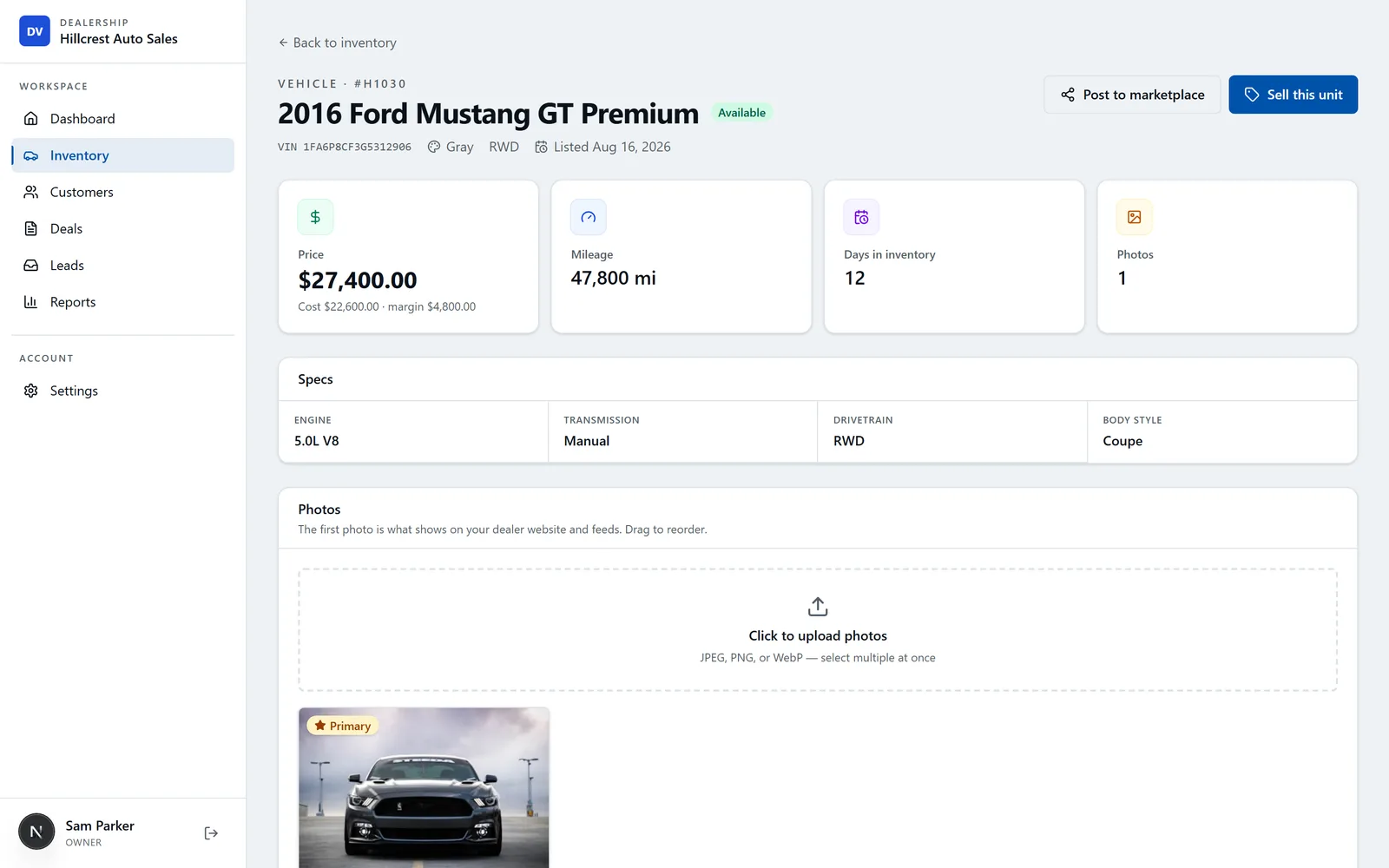
In DealerVLO every car carries its acquisition cost, and reconditioning is tracked line by line: tires, brakes, detail, mechanical. All of it rolls into the car's all-in cost and margin. Every car also shows its days in inventory, gets an "aging, consider repricing" flag at 60 days, and appears in the aging report buckets (0–30, 31–60, 61–90, 90+). Look back over a quarter of buys and you'll see which kinds of cars made money and which ate it in recon or sat. Otherwise you become the store sending aged units back to the lane.
For more on what eats auction gross, see the mistakes that erase the spread and the seven buying mistakes that kill gross. And if you want inventory that doesn't come through the lane at all, here's where to find cars besides the auction.
14-day free trial, then $29/mo · Cancel anytime
Frequently asked questions
Why are cars sold at auction?
Because auction turns a car that doesn't fit the seller's business into cash fast. Franchise dealers wholesale trade-ins that don't fit their brand or price range and units that have aged past their limit. Leasing companies sell off-lease returns, rental and fleet companies sell vehicles that reached their planned age or mileage, lenders sell repossessions, and insurance companies sell total losses at salvage auctions. Almost none of it is sold because the car is a hidden lemon. It's sold because holding it doesn't fit how the seller makes money.
Where do dealer auction cars come from?
Two kinds of sellers: dealers and commercial consignors. Dealers send trade-ins and aged inventory. Commercial consignors are leasing companies, rental companies, fleet operators, lenders with repossessions, and manufacturers. The National Auto Auction Association's AuctionNet data put commercial consignors at 52% of wholesale auction sales in April 2026, up from 47% a year earlier.
Are auction cars bad?
Not as a group. Most cars at dealer auctions are there because of the seller's business, not because they're broken: a trade the store didn't want to retail, a lease that ended, a rental that hit its mileage target. Some are rough, and those are usually disclosed in the condition report or announced. The real risk is buying without knowing the seller's reason and pricing the recon that reason implies.
What's the difference between a dealer auction and a salvage auction?
Dealer wholesale auctions like Manheim, ACV, and OPENLANE mostly sell running retail candidates from dealers and commercial consignors. Salvage auctions like Copart and IAA mostly sell insurance total losses and damaged vehicles. Copart's 10-K says 81% of the vehicles it processed in fiscal 2025 came from insurance companies. Different market, different title risk, and a different buyer.
Why do franchise dealers wholesale trade-ins instead of retailing them?
Fit and time. A franchise store wants used cars that match its brand, price range, and certified program, and it doesn't want to spend recon money on a high-mileage or off-brand trade. Cox Automotive's used-car benchmarks say top used-car departments keep immediate wholesale of trades under 33%. Many stores also have aging policies that send any unit past 60 or 90 days to auction.
How should knowing the seller change what I bid?
Price the story, not just the car. An off-lease unit often needs tires, brakes, and reconditioning for wear. A rental is young but high-mileage for its age. A repo may have unknown maintenance and missing keys. A franchise store's aged unit may simply have been the wrong car for its market and the right car for yours. Build those likely costs into your bid ceiling before the car rolls.
Bottom line
Cars go to auction because they stopped fitting someone else's business, not usually because something is secretly wrong with them. The seller's reason is free information: it predicts the recon, and the recon sets your bid. Know who sold it, price what that implies, and check afterward whether you were right.
If you want each car's retail range, all-in cost, and days on lot in one place, start a free 14-day DealerVLO trial.
Dump it at auction now or retail it? Compare the two nets and find the break-even day.
Open the Wholesale vs. Retail Calculator