7 Auction Buying Mistakes That Quietly Kill Your Gross (And How to Avoid Them)
Dealer auction buying mistakes cost you gross on every unit. Learn the hidden fees, arbitration traps, and TCO blind spots that sink deals before they hit…
Every time you bid at auction, you're making a high-stakes call with incomplete information — and every dealer who buys wholesale has paid tuition on a car that looked great on the block and evaporated gross the moment it touched their lot. The problem isn't bad luck; it's repeatable mistakes in how you price, inspect, and plan around the real cost of an auction car.
This guide walks through the seven most common dealer auction buying mistakes that quietly kill your gross, the dollar impact of each, and the specific changes that keep you profitable when you're bidding against fifty other dealers who didn't do the math.
Note: This article covers auction fees, transport costs, reconditioning economics, and arbitration policy — not legal or tax advice. Fee schedules and arbitration rules change; confirm current rates with your auction rep and consult your accountant or attorney before making operational changes.
Mistake 1: Bidding the hammer price instead of total landed cost
The hammer price is not what you pay. It's not even close.
When you bid eight thousand on a unit, you're committing to eight thousand plus buyer fees, transport, gate fees, potential storage, reconditioning, state inspection, and detail. On a typical auction purchase in 2026, those ancillary costs add anywhere from two thousand to four thousand dollars before the car is lot-ready — and if you don't subtract that from your gross before you bid, you've already lost the deal.
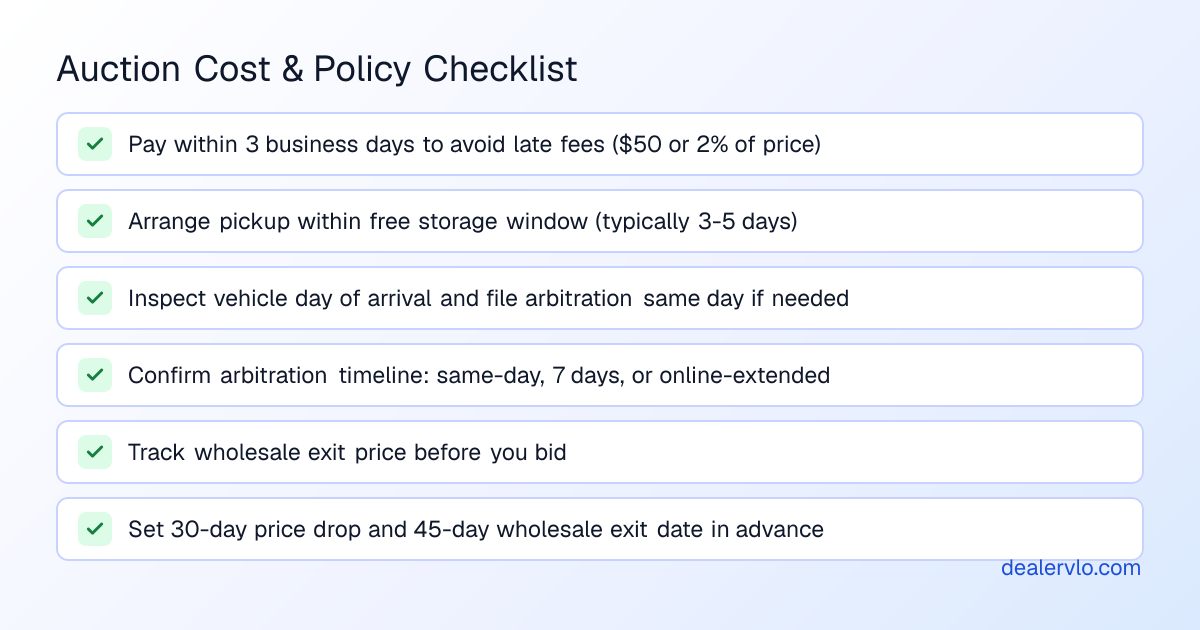
Here's what the real number looks like. Auction buyer fees now average around one thousand to fifteen hundred dollars per unit before you ever arrange transport or touch the car. IAA charges a service fee of one hundred five dollars per unit plus a fifteen-dollar environmental fee; storage is typically free for three to five business days, then runs twenty to fifty dollars per day depending on vehicle size and location. Manheim's fee structure is account-specific and volume-tiered, with no published universal schedule — industry guidance suggests budgeting four hundred to seven hundred dollars per vehicle as a starting estimate and confirming specifics with your account representative.
Transport costs in 2026 range from about sixty cents per mile on long cross-country hauls to two dollars thirty cents per mile for short, urgent, or enclosed moves. The national average in 2026 is roughly one dollar twenty-three cents per mile; most dealers pay between six hundred and fifteen hundred dollars to ship a car, depending on distance and method. If you're buying out of state, that's real money before the car ever sees your lot.
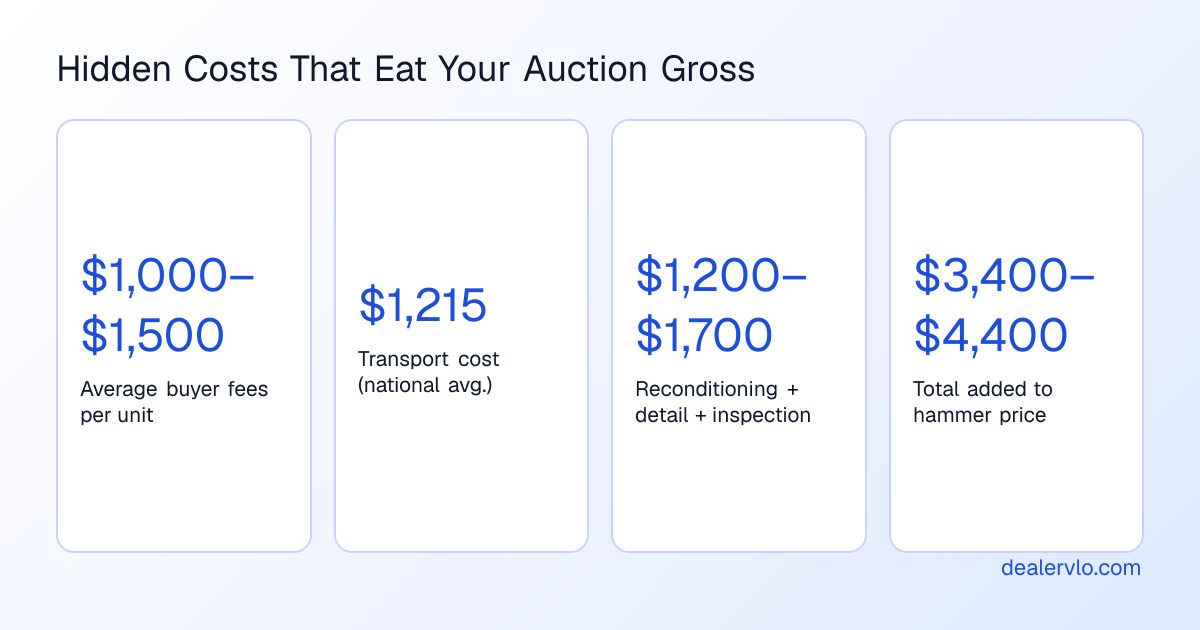
Reconditioning runs another thousand to fifteen hundred dollars on average — industry benchmarks put the figure at roughly eleven hundred dollars per vehicle, though it climbs fast if you hit brakes, tires, or deferred maintenance. Add a full detail at one hundred dollars or more and a state inspection averaging eighty dollars, and you're looking at a minimum of twelve hundred dollars in recon and prep before the car is front-line ready.
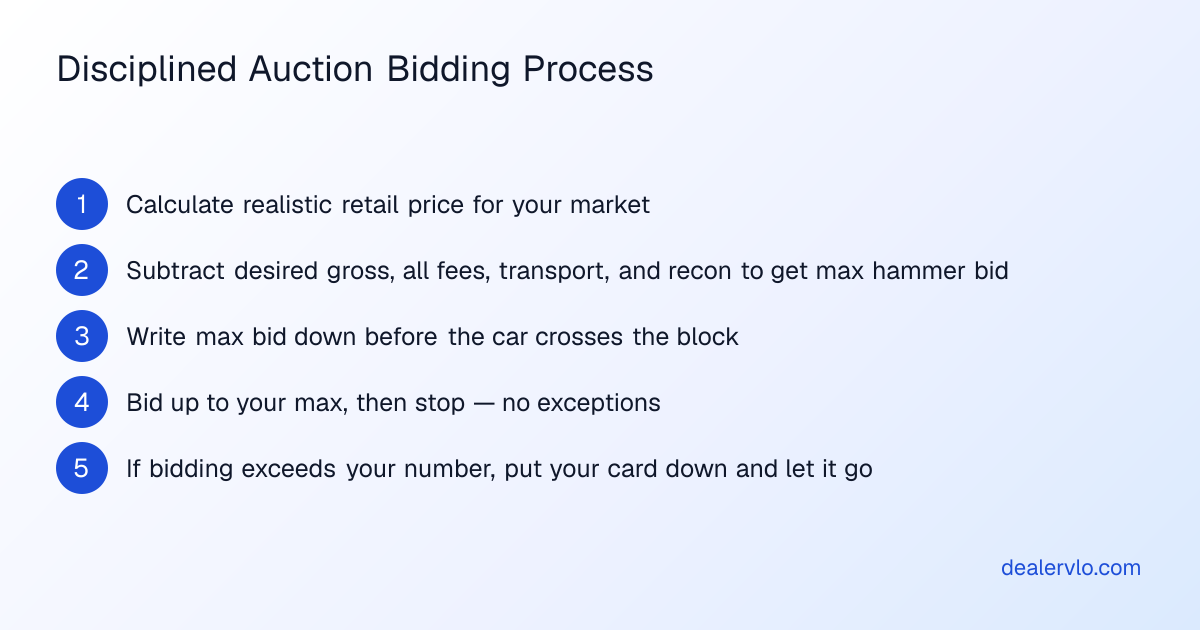
The fix is simple but not negotiable: before you bid, work backward from your retail target. Subtract your desired gross, then subtract every fee, transport mile, and recon line item you can reasonably predict. What's left is your maximum hammer bid. If the bidding goes past that number, let it go — the next guy just bought your problem.
Mistake 2: Buying the story instead of the car
Auction listings come with condition reports, seller disclosures, and sometimes a story — one-owner, trade-in from a franchise store, fleet lease return. None of it matters if you don't put hands on the car.
The most expensive cars I've seen dealers buy are the ones they bid on from the lane without walking the lot. You're trusting a condition report written by someone who has no stake in your gross and bidding against dealers who did the walk and found the frame rust, the repaint, or the check-engine light that clears on its own until it doesn't. Remote bidding and online auctions make this worse — you're buying off photos and a scanner report, and unless the defect is severe enough to trigger arbitration under the current threshold, you own it.
In 2026, the baseline arbitration threshold is eight hundred dollars in repair cost per defect for vehicles under fifty thousand dollars; for higher-value units sold at fifty thousand or more, each individual defect must cost at least two percent of the purchase price to qualify. That means a seven-hundred-dollar surprise is yours to eat, and if you stack three of those on one car, you just vaporized two thousand dollars in gross with no recourse.
The discipline that saves you is the pre-bid inspection. If you're buying in-lane at a physical auction, walk the car before you bid — check the body gaps, pull the dipstick, pop the hood, look for overspray and frame damage, and run the VIN through your history provider. If you're buying online, lean hard on the condition report and photos, and set a bid ceiling that accounts for unknowns. When you can't inspect, lower your max bid by the cost of one or two average recon surprises — treat it as insurance.
One more thing: vehicle history reports are not optional. They catch title brands, odometer rollbacks, and prior total losses that the seller didn't announce, and every one of those is a deal-killer if you find it after you own the car. Run the report before you bid, not after.
Mistake 3: Ignoring arbitration windows and disclosure rules
Arbitration is your safety net when a seller misrepresents a car — but only if you know the timelines and the current policy, and only if you act inside the window.
Under the NAAA arbitration guidelines effective June 1, 2026, the clock starts ticking the moment the hammer falls. For in-lane sales, "Sale Day" is Day 1, and depending on how the vehicle was announced, you have either same-day-only arbitration (if announced "A" in-lane sale day only), seven calendar days (if announced "B" in-lane or "C" online), or potentially longer if the auction offers extended coverage. For online timed sales at Manheim that close after 5:00 PM auction time, "Day 1" for arbitration claims is the following calendar day — meaning if you bought a car late Friday night, your clock doesn't start until Saturday.
If you miss the window, you own the defect. It doesn't matter that the transmission slips or the frame is bent; if you didn't file within the arbitration period, the auction will not arbitrate it.
The second trap is not understanding what qualifies. As of June 1, 2026, generic "No Arb for [defect]" announcements are now prohibited and may themselves be grounds for arbitration. Similarly, announcing only a warning light or diagnostic trouble code no longer relieves a seller of responsibility for the underlying condition — sellers are directed to disclose the specific defect, provide a descriptive disclosure, or sell the car Red Light or As-Is. Advanced driver assistance systems (ADAS) — adaptive cruise, lane departure warning, blind spot monitoring — are now formally added to the list of covered components, so if those systems are inoperative and not disclosed, you have a claim.
But here's the part that costs dealers: you have to act fast. That means the moment the car arrives, you inspect it, you test-drive it, you scan it, and if anything is wrong that wasn't announced, you file immediately. Waiting until you're halfway through recon or until a customer test-drives it and finds the problem is too late — the auction will point to the calendar and deny the claim.
The practical habit that protects you is a day-one arrival inspection checklist. The car hits your lot, you verify the VIN, you check every disclosed item, you test every system the condition report said was good, and if anything is off, you call your auction rep that day. Most arbitration losses aren't because the defect didn't qualify — they're because the dealer filed on day eight when the policy gave them seven.
For a full walkthrough of the arbitration process and how to file a winning claim, see the auction arbitration dispute guide.
Mistake 4: Chasing the bid instead of the margin
Auction lanes are designed to create urgency. The auctioneer is calling, the bid is climbing, and you've already invested the time to inspect the car and decide it fits your lot — so when someone bids five hundred over your number, it's tempting to go one more round.
That's how you turn a profitable deal into a break-even or a loss.
Every time you go over your max bid, you're cutting your gross by exactly that amount. If you planned fifteen hundred in profit and you chase the bid six hundred dollars higher to "win" the car, you're now at nine hundred gross — and that's before any recon surprises, holding cost, or the reality that the retail price you had in mind might not hold in your market.
The emotional component is real. You spent twenty minutes inspecting the car, you walked away from the last three that had frame damage or salvage titles, and this one is clean — so when the bid stalls fifty dollars below your max and then jumps two hundred over it, your brain tells you that losing the car is wasting the time you already spent. That's sunk cost fallacy, and it's expensive.
The defense is writing down your max bid before the car crosses the block and treating that number as non-negotiable. If the auction is online, set your proxy bid and walk away. If you're in the lane, write the number on your sheet and when the bid passes it, put your card down. The next unit is two cars away, and there are four more auctions this month — you'll find another car, and it will be at your number.
One test I use on my own lot: if I wouldn't pay that price for the car from a wholesaler I trust who lets me inspect it on his lot with no time pressure, I don't pay it at auction where the inspection window is ten minutes and the pressure is designed to make me bid higher. Auction fever is real, and the cure is a number you set in advance and a willingness to let the car go when the room disagrees with you.
For more on how to calculate the right bid and what "paper spread" actually leaves you after fees, see auction paper spread vs real gross.
Mistake 5: Buying cars your market won't pay for
Auction inventory is national; your customers are local. What sells at a premium in Florida doesn't move in Montana, and what your market will pay top dollar for might sit unsold two states over — but auctions aggregate inventory from everywhere, and if you're not careful, you'll buy a car that's priced right for someone else's zip code.
This is particularly painful with high-trim, high-mile luxury cars and niche vehicles. A seven-year-old German sedan with a hundred twenty thousand miles and every option might look like a value buy at auction, especially if the hammer price is half of clean retail — but if your customer base is credit-challenged buyers shopping for a fifteen-hundred-dollar down payment and a three-hundred-dollar payment, that car will sit on your lot until you wholesale it at a loss or keep slashing price until the gross is gone.
The fix is knowing exactly what your market buys before you leave for the auction. Look at your last twelve months of sales: what's your average retail price? What's your median days to sale by vehicle type? What percentage of your customers finance, and what loan-to-value ratio does your lender allow? If the car you're considering at auction doesn't fit that profile, it doesn't matter how good the deal looks on paper — it's the wrong car for your lot.
Another version of this mistake is buying cars that match your taste instead of your customers' budget. I've seen dealers who love trucks buy a loaded crew cab that's too expensive for their market, and I've seen import specialists chase a clean domestic sedan because it was a great price, then realize they have no buyers for it. Profitable auction buying is not about finding great cars — it's about finding cars that are great for your specific customer base, at a price that leaves room for gross after all-in costs.
When I'm walking the auction lot, I ask one question for every car I consider: would I retail this to the customer who bought from me last week? If the answer is no — wrong price range, wrong body style, too many miles for my lender, wrong color for my market — I keep walking, even if the car is objectively nice.
Mistake 6: No exit plan for the car that doesn't sell
Every car you buy at auction should have two prices in your head before you bid: the retail price you're aiming for, and the wholesale floor you'll accept if the car doesn't move in thirty days. If you don't know both numbers before you buy, you're counting on retail to work, and the moment it doesn't, you're stuck with a depreciating asset, rising floor plan interest, and no plan.
The wholesale exit plan is simple: before you bid, call a wholesaler you trust or check your state's wholesale network and ask what they'd pay for the car right now, as-is. That number — not what you hope it's worth, but what you can verifiably sell it for today — is your absolute floor. If your retail plan falls apart, if the recon costs spiral, if the market shifts while the car is in recon, you need to know you can get out at that wholesale number and take a small loss instead of a catastrophic one.
Here's the math that matters. Say you're bidding on a car you plan to retail at fourteen thousand. You think you can land it all-in for ninety-five hundred, which gives you forty-five hundred in gross if retail happens. But wholesale bid on that car today is eighty-two hundred. That means if retail doesn't work, your downside is roughly thirteen hundred dollars (ninety-five hundred all-in cost minus eighty-two hundred wholesale out, ignoring holding costs and time). If you're comfortable with that risk — if one good deal this month covers one bad one — then bid. If you're not, or if wholesale bid is seventy-five hundred and your downside is two thousand or more, pass.
The mistake is buying cars where the gap between your all-in cost and wholesale out is wider than your risk tolerance, then holding them too long because you're anchored to the retail number you had in mind. Holding costs — floor plan interest, insurance, lot rent if you pay it, and the opportunity cost of capital tied up in a car that isn't selling — compound every month. A car that sits for ninety days doesn't just lose the gross you planned; it costs you the gross you could have made on the car that would have taken its place.
The discipline is setting a date and a price before the car ever hits your lot. If it doesn't sell retail in thirty days, you drop the price. If it doesn't sell in forty-five, you wholesale it. The date and the floor price are not aspirational — they're operational rules, and the only way you avoid the temptation to hold and hope is by deciding the exit before you're emotionally invested in the outcome.
For a detailed framework on when to retail and when to cut your loss and wholesale, see auction vs retail breakeven decision tree.
Mistake 7: Ignoring small fees because they're small
Auction fees, gate fees, late payment penalties, storage charges — none of them feel like deal-killers when you're looking at one car. A fifty-dollar late fee, a hundred-dollar gate charge, a couple days of storage at thirty dollars per day: every one of those is a rounding error on a ten-thousand-dollar transaction, so it's easy to treat them as noise and focus on the big numbers.
The problem is that small fees compound across volume, and if you're buying ten or twenty cars a month, those "rounding errors" add up to real money that never makes it to your gross.
Here's an example. IAA's late payment fee is fifty dollars or two percent of the vehicle purchase price, whichever is greater, and it applies automatically if full payment isn't completed within three business days from the auction date by 5:00 PM local branch time. If you're buying a twelve-thousand-dollar car, two percent is two hundred forty dollars — and that penalty hits whether you were two hours late or two days late. Pay ten cars late over the course of a year and you've given the auction twenty-four hundred dollars for nothing.
Storage is the same. Most auctions give you three to five business days of free storage after the sale, then start charging. If you're slow to arrange transport or your driver doesn't pick up on time, you're paying twenty to fifty dollars per day per car. Let three cars sit for a week each because your transport vendor was backed up, and you've spent three hundred to six hundred dollars that didn't buy you a single dollar of vehicle value.
The fix is operational discipline: pay on time, pick up on time, and track every fee on every car so you see the pattern when it's costing you. The fees are disclosed in the auction's terms and on your invoice — read them, build them into your cost model, and treat avoiding them as part of the profit strategy, not an administrative footnote.
Manheim has a vehicle availability penalty that works in your favor if you're the buyer: for any vehicle listed and sold on Manheim.com and facilitated through a Manheim auction, the seller must make the vehicle available at the listed pickup location within three business days of the sale date, or the seller may be assessed a fee of up to five hundred dollars to compensate the buyer for each sale not fulfilled, which fee is passed on to the buyer. Knowing that rule means you can hold sellers accountable when they don't deliver, and it's a reminder that fees flow both ways — the auctions enforce them on everyone, so the operators who read the policies and follow the timelines keep more gross than the ones who don't.
How to build a system that doesn't leak gross
Avoiding auction buying mistakes isn't about being a better negotiator or having a better eye for cars — it's about having a system that forces you to do the math, follow the policy, and stick to your plan even when the lane is loud and the car looks good.
Here's the system that works:
Before you go to auction, build a buyer profile for your lot: average retail price, average days to sale, typical recon cost, and the vehicle types your customers actually buy. Write it down. Every car you consider at auction gets measured against that profile before you bid.
For every car you inspect, calculate total landed cost: hammer price plus buyer fees, transport, recon estimate, and detail. Subtract that from your realistic retail price (not the top of the market, not what the car might bring in a perfect week — what you'll actually sell it for in your market). What's left is your gross. If it's not enough to justify the time and risk, walk.
Before you bid, write down your maximum hammer price and your wholesale exit number. The max bid is non-negotiable; the wholesale floor is your parachute if retail doesn't happen. If you can't get comfortable with the downside, don't bid.
The day the car arrives, inspect it against the condition report and the seller's disclosures. If anything is wrong that wasn't announced and it crosses the arbitration threshold, file that day — not tomorrow, not when you get around to it. The arbitration window is a hard deadline, and the auction will not make exceptions.
At thirty days, if the car hasn't sold, drop the price. At forty-five, if it still hasn't moved, wholesale it. Holding cost and opportunity cost are real, and the longer you hold a car that isn't selling, the more gross you lose on the deals you didn't buy because your capital was tied up.
If you run your auction buying through that system on every car, you'll walk away from more cars than you buy — and that's the point. The cars you do buy will be the right cars at the right price for your market, with enough margin to survive a recon surprise and still make you money. For additional strategies on managing wholesale inventory and avoiding common traps, see the dealer auction buying guide.
A solid dealer management system helps you track landed cost, recon expenses, days in inventory, and real gross per unit so you can see patterns and adjust before small mistakes become expensive habits. I built DealerVLO for my own lot specifically to surface those numbers without manual spreadsheets, and it now tracks total cost and real margin per car for dealers across all fifty states.
Frequently asked questions
What fees should I include when calculating total landed cost at auction?
Include the hammer price, buyer fees (typically one thousand to fifteen hundred dollars per unit), transport (sixty cents to two dollars thirty per mile depending on distance and urgency), gate fees if applicable, reconditioning (average eleven hundred dollars), detail (one hundred dollars or more), and state inspection (around eighty dollars). Also budget for potential storage fees if you can't pick up within the free window, usually three to five days. Add all of those before you bid — that sum is your true cost, and your gross is what's left after you subtract it from realistic retail.
How long do I have to file an arbitration claim after buying a car at auction?
It depends on how the vehicle was announced and whether the sale was in-lane or online. Under NAAA guidelines effective June 1, 2026, "Sale Day" is Day 1. In-lane sales announced "A" are same-day arbitration only; "B" in-lane and "C" online give you seven calendar days. At Manheim, if a timed sale closes after 5:00 PM auction time, Day 1 starts the following calendar day. The key is to inspect the car the day it arrives and file immediately if you find an undisclosed defect — waiting even one extra day can put you outside the window.
What defects qualify for arbitration under current NAAA rules?
For vehicles under fifty thousand dollars, any defect with a repair or replacement cost of eight hundred dollars or more that was not disclosed qualifies. For vehicles sold at fifty thousand or more, the threshold is two percent of the purchase price per defect. As of June 2026, generic "No Arb" announcements are prohibited, and sellers must disclose the specific defect or sell the car Red Light or As-Is. Advanced driver assistance systems like adaptive cruise and lane departure warning are now covered, so if those are inoperative and undisclosed, you can arbitrate.
How do I avoid emotional bidding and stick to my maximum price?
Write your maximum bid on paper before the car crosses the block, and treat it as non-negotiable. Calculate it by working backward from your retail target: subtract your desired gross, all fees, transport, and recon, and what's left is your ceiling. If you're bidding online, set a proxy bid and close the window. If you're in the lane, put your card down the moment bidding passes your number. Chasing a bid even two or three hundred dollars over your max cuts your gross by exactly that amount, and auction fever is expensive — the cure is a number you decided in advance and the discipline to let the car go when the room disagrees.
When should I wholesale a car instead of holding it for retail?
Set a wholesale exit date and price before the car hits your lot. If the car doesn't sell retail in thirty days, drop the price. If it still hasn't moved by forty-five days, wholesale it at your pre-set floor price. Holding costs — floor plan interest, opportunity cost, and depreciation — compound every month, and the longer you hold a car that isn't selling, the more gross you lose. Know your wholesale floor before you buy (call a wholesaler or check your network to get a real bid), and treat that number as your parachute if retail doesn't work.
What's the biggest mistake dealers make when buying at auction?
Bidding on hammer price instead of total landed cost. The hammer is just the starting point — once you add buyer fees, transport, recon, and detail, your all-in cost is typically two to four thousand dollars higher. If you don't subtract all of that from your retail target before you bid, you've already killed your gross. The second-biggest mistake is not inspecting the car before you bid and then discovering defects that don't meet the arbitration threshold, leaving you to eat the repair cost with no recourse.
Bottom line
Auction buying mistakes are expensive because they're repeatable — if you're overbidding by three hundred dollars per car or missing arbitration windows or ignoring transport costs, you're doing it on every car, and that pattern costs you more over a year than one big disaster ever would.
The good news is that every mistake in this list has a simple operational fix: do the math before you bid, inspect before you buy, know the arbitration policy and the deadlines, set a max bid and stick to it, buy cars your market will actually pay for, plan your exit before you need it, and track the small fees so they don't compound into big losses.
If you build those fixes into a system and run every auction purchase through it, you'll walk away from more cars — and the cars you do buy will leave you with real gross instead of regret. That's the difference between auction buying that builds your lot and auction buying that quietly bleeds you dry, one car at a time.
Work out the most you can bid at the lane and still hit your target margin.
Open the Auction Profit Calculator