VIN Auto-Decoding for Used-Car Inventory: How It Works and Why It Kills Data-Entry Errors
How VIN auto-decoding works for used-car inventory: what NHTSA returns from 17 characters, the check digit that catches typos, and why decoding once pays off.
Part of the Inventory, pricing & aging guide: Inventory Turn Rate for Used Car Dealers: Benchmarks, Formula & How to Improve
Switching from another DMS? Compare DealerVLO to DealerCenter, Frazer, or Lot Wizard.
Adding a car to inventory is one of those jobs that looks trivial and quietly isn't. Someone reads the VIN off the windshield sticker, types it in, then fills in the year, make, model, trim, and engine — often from memory or a guess — and every one of those keystrokes is a chance to introduce an error that follows the car all the way to the title office. VIN auto-decoding replaces that whole ritual with a single paste. This is a technical look at how it works, what it pulls, and why decoding once and reusing it everywhere is the difference between a clean title and a bounced one.
14-day free trial, then $29/mo · Cancel anytime
What's actually in those 17 characters
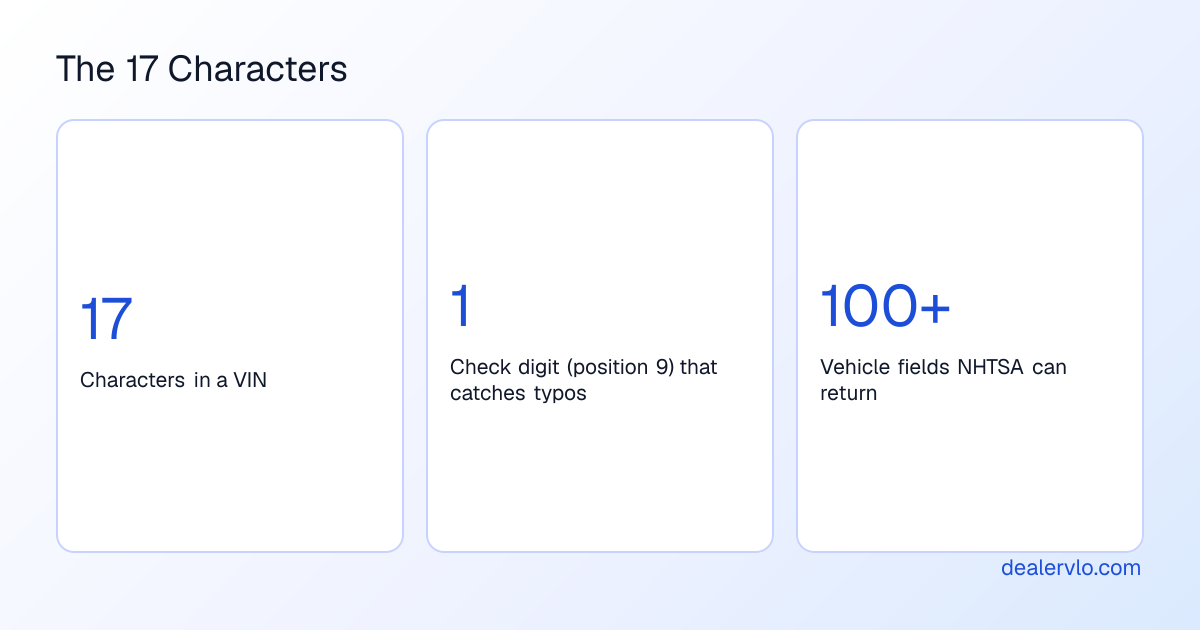
A vehicle identification number isn't random — it's 17 structured characters that encode the manufacturer, the vehicle attributes, a check digit, the model year, the plant, and a serial number. The National Highway Traffic Safety Administration runs a free public database, vPIC, that maps those characters to the vehicle's build, and it returns well over a hundred fields: the identity (year, make, model, trim, body class), the powertrain (engine, cylinders, displacement, transmission, drivetrain), weight and dimensions (GVWR, doors, wheelbase), safety equipment (ABS, stability control, airbag locations, backup camera, driver-assist), and the manufacturing plant. Decoding is a lookup against that authoritative source — not a guess.
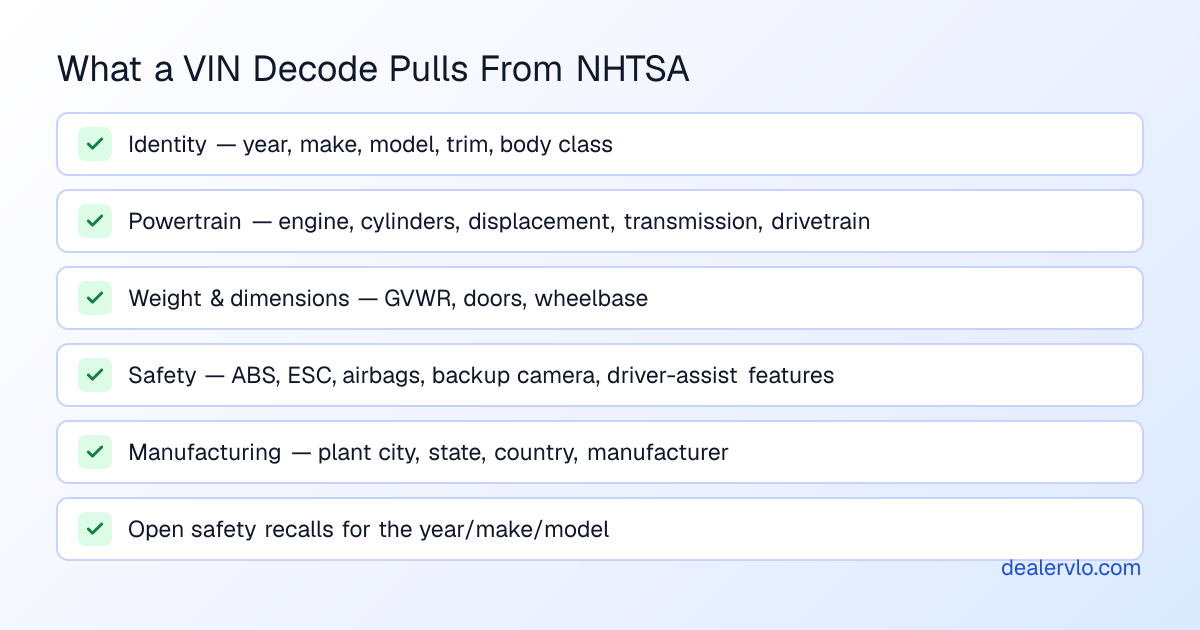
You can see exactly what comes back by running any VIN through our free VIN decoder — it's the same NHTSA decode that fills the inventory form inside the product, and it now surfaces open safety recalls for the vehicle's year, make, and model alongside the specs.
The check digit: a built-in typo detector
Here's the detail most people don't know: the ninth character of a VIN is a check digit, calculated from the other sixteen with a fixed formula. Its entire job is to catch transcription errors. Mistype a character and the check digit usually stops matching, so a decoder can flag the VIN as invalid before a bad number ever reaches your paperwork. A real decoder validates the format first and only decodes VINs that pass — which means the typo gets caught at the windshield, not discovered weeks later when a title comes back rejected.
14-day free trial, then $29/mo · Cancel anytime
Why decoding once matters more than decoding at all
The error that costs you isn't the decode — it's the re-entry. When a person types the VIN and specs into the inventory record, then a listing, then the title application, they're transcribing the same data three or four times, and every copy is a fresh chance for a transposed digit or a wrong trim. A mismatch between what's on the title application and the actual vehicle is precisely the kind of thing that bounces a title at the registry and drags a customer back to the counter.
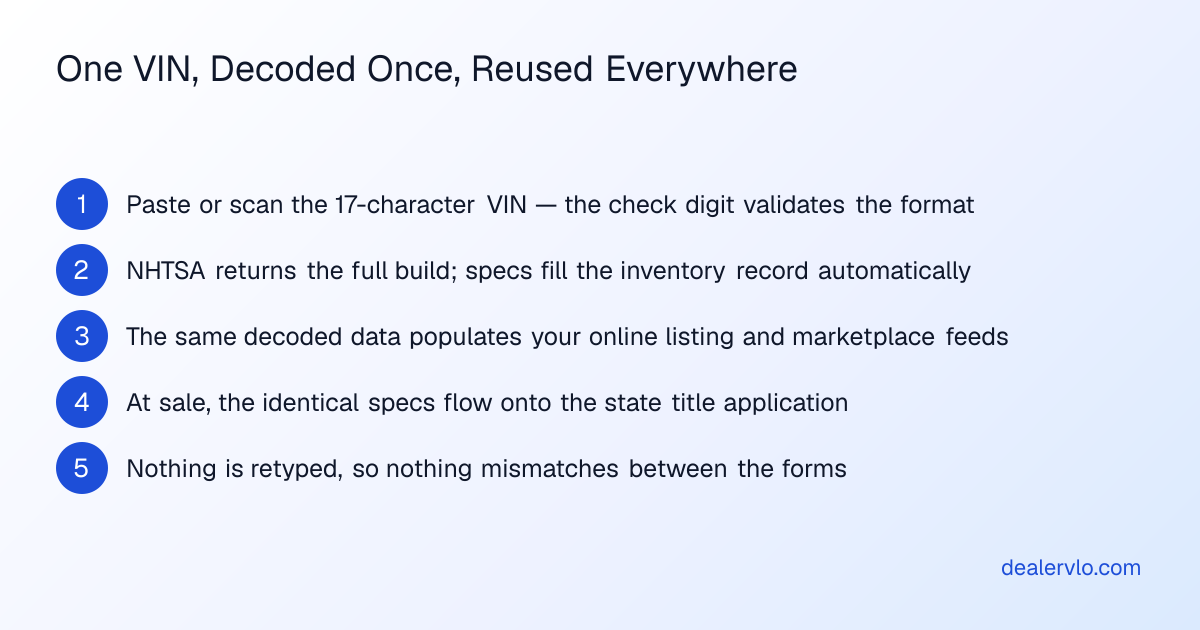
Auto-decoding fixes this by making one decoded record the single source of truth. Paste the VIN when you add the vehicle, and the specs fill the inventory record; that same data populates your online listing and marketplace feeds; and at sale it flows onto the state title application. Nothing is retyped, so nothing mismatches — the bill of sale, the listing, and the title form all carry identical, correct data. It's the same reason buying cars that sell fast depends on getting the unit online accurately and quickly: the faster and cleaner the intake, the sooner it's working for you.
The mobile advantage
Because the decode is a cloud lookup, it works from any device — you can decode a VIN standing next to the car at the auction or on your lot, from a phone, and see the full build before you commit a dollar. That's the practical edge of cloud-based inventory over desktop-era software: the same decode and the same record whether you're in the lane or at the office desk. No syncing a laptop back at the shop, no re-entering what you scanned in the field.
You don't even have to type the 17 characters on a phone. In DealerVLO, the Add vehicle screen has a Scan VIN button: point the phone's camera at the barcode on the door-jamb sticker and the decode runs on what it reads, no app to install. If the camera won't cooperate, "Use a photo instead" reads the barcode from a picture. I wrote up the whole setup, including the driver's-license side, in scanning VINs and licenses from your phone.
Frequently asked questions
How does VIN auto-decoding work? It sends the 17-character VIN to NHTSA's free vPIC database and reads back 100+ build fields — year, make, model, trim, engine, safety features, plant — writing them straight into the inventory record instead of a person typing them.
Does it reduce data-entry errors? Yes — it removes the re-typing that creates them. Decode once, reuse the same record across inventory, listing, feeds, and the title form, and there's no chance for a mismatch between documents.
What's the check digit? The ninth VIN character, calculated from the others to catch typos. A mistyped VIN usually fails the check digit, so a decoder can flag it before the bad number reaches your paperwork.
Can I decode from a phone on the lot? Yes — it's a cloud lookup, so it works from any browser, right next to the car at the auction.
Is it free? The NHTSA decode is free, our public VIN decoder is free with no signup, and inside DealerVLO it's built into the inventory workflow at no extra cost.
The bottom line
VIN auto-decoding isn't a convenience feature — it's error prevention. Seventeen characters, validated by a check digit, decoded once against the authoritative source, and reused across every document a sale touches, so the specs on the title application match the car in the lane. Try the free decoder on your next VIN, or run a real unit through DealerVLO and watch the inventory form fill itself.
14-day free trial, then $29/mo · Cancel anytime