Why Your AI Chatbot Gives Customers Wrong Specs (and How to Ground It in Your Real Inventory)
Why a dealer's AI chatbot quotes wrong specs and prices, who's liable when it does, and how to ground it in your real inventory before a shopper drives in.
Part of the Inventory, pricing & aging guide: Inventory Turn Rate for Used Car Dealers: Benchmarks, Formula & How to Improve
Switching from another DMS? Compare DealerVLO to DealerCenter, Frazer, or Lot Wizard.
You added an AI chatbot to your website six months ago. It books appointments, answers after-hours questions, and catches leads you would have missed. Then a shopper walks in asking about the sunroof on the F-150 out front, the one that doesn't have a sunroof. Or they show up expecting the $18,500 the bot quoted, when you marked the car $19,995 two weeks ago and your website changed the same day. The bot didn't.
That isn't a prompt problem. It's a grounding problem: the bot is answering from stale, incomplete or mismatched inventory data. And to the shopper on the other end, it makes no difference whether the bot invented the sunroof or faithfully repeated an old record. Your dealership said it. This guide covers the two ways a dealer chatbot goes wrong, the fix that reduces (not eliminates) made-up answers, what one tribunal ruling says about who is responsible, and the checks to run on your own systems before you blame the AI.
14-day free trial, then $29/mo · Cancel anytime
What "hallucination" actually means in a dealer context
A hallucination is an answer your own records don't support. Applied to a dealer chatbot, that splits into two failure modes you troubleshoot separately.
Stale or wrong source data, repeated faithfully. The bot quoted an old price, a car you already sold, or the wrong trim, because that's what its copy of your inventory said the last time it refreshed. The fault is in the pipeline: the export from your DMS, the feed to the chat vendor, the refresh schedule. You fix the pipeline, not the model.
A made-up answer. The model produces a plausible spec when it has nothing to go on. Ask "Does this RAV4 have navigation?" when the record holds year, make, model, mileage and price but no equipment, and instead of saying "I don't know," the bot guesses from what's common for that trim.
A chatbot vendor should be engineering against the second and helping you fix the first. If all they offer is prompt tuning, they're treating the symptom.
Why equipment and price are the highest-risk answers
Most shopper questions a bot gets wrong are about equipment. Whether a specific RAV4 has navigation depends on that VIN's packages. If your record carries the equipment, from the window sticker or your own notes, the bot can answer. If it carries only year, make, model and price, the bot has nothing to ground the answer in and you get one of two bad outcomes: it guesses, or it tells the shopper to call, which defeats the point of having it.
The fix is to limit the bot to questions your data can answer. When a shopper asks about a feature the record doesn't list, the bot should say so: "I don't see option details for that car. Let me have someone check the window sticker for you." That preserves trust. A confident wrong answer costs you the deal when the shopper drives an hour for a feature that isn't there.
Price carries more risk, because shoppers make money decisions on it. The bot should quote only the current price from your inventory, keep add-ons and fees separate from the vehicle price, and never improvise a discount.
In DealerVLO, the dealer website and the CarGurus, Cars.com and Autotrader feeds read the same price from each car (its internet price, or its asking price if none is set), so there's one number per car for any system to pick up, not three. The window sticker that prints from each vehicle's page lists the equipment grouped by category, which is the same detail a shopper's question usually turns on.
The technical fix: retrieval-augmented generation, and its limits
Retrieval-augmented generation (RAG) is the standard pattern for reducing made-up answers. Before the bot replies, it looks up the relevant records (your inventory, the car's page on your site) and writes the answer from what it found rather than from what the underlying model happens to know. It keeps answers current without retraining anything, as long as the records it looks up are current.
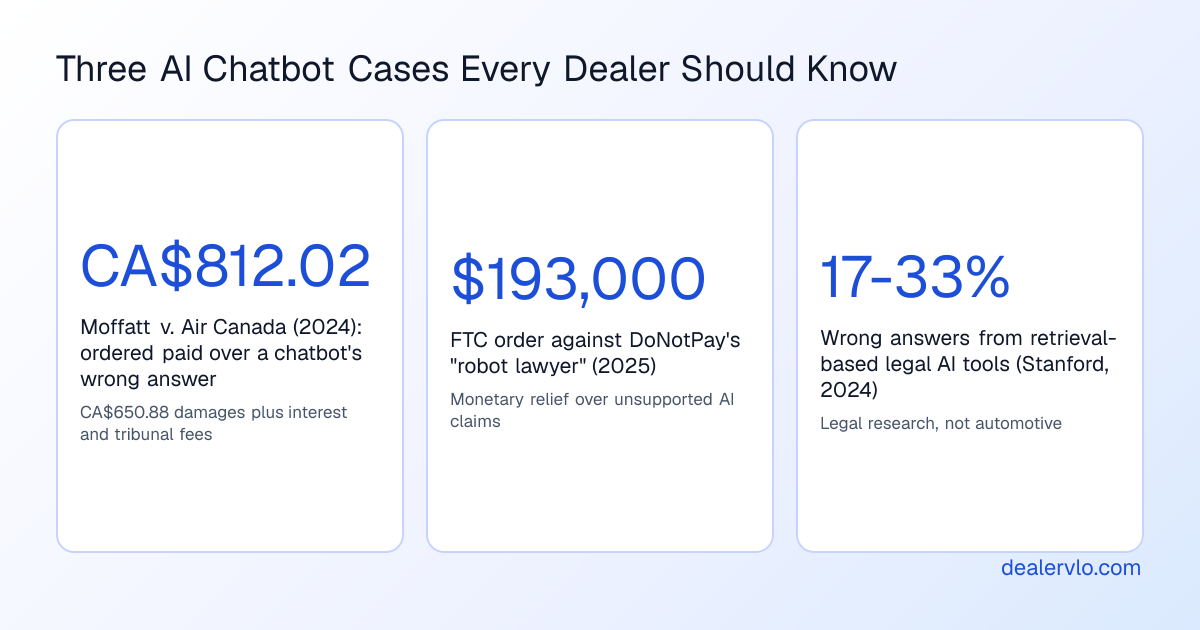
RAG is not a complete fix. A 2024 Stanford study, "Hallucination-Free? Assessing the Reliability of Leading AI Legal Research Tools," tested legal-research products built on retrieval and found they still gave wrong answers roughly 17% to 33% of the time. That's legal research, not car sales, so don't quote it as a dealer benchmark. The point is that retrieval narrows the problem without closing it, and a vendor promising "accurate answers grounded in your inventory" should be able to show you how it handles a question the data can't answer.
Grounding is a pipeline with three parts: a connection to your current inventory, a lookup that pulls the right VIN when a shopper asks about a specific car, and an instruction that makes the bot say "I don't know" instead of filling gaps. Break any one and the bot starts quoting last week or inventing.
Why the inventory feed itself is often the real bug
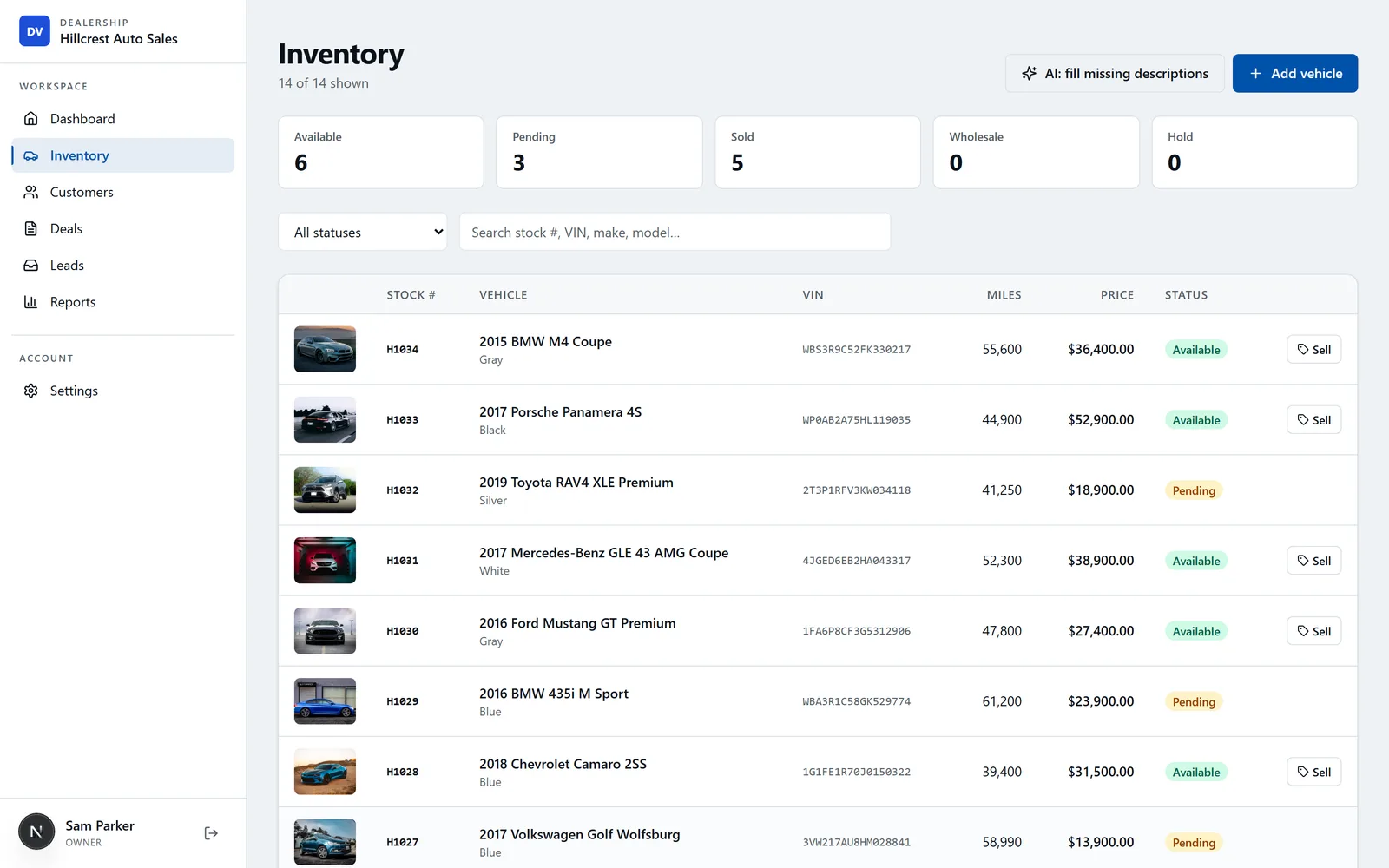
Inventory rarely lives in one place. It flows from your DMS or inventory tool to your website, your listing sites, your CRM, and now your chatbot, and every hop has its own format and refresh schedule. If your DMS exports a color as "Magnetic Gray Metallic," your website shows "Gray" and the bot reads a field that says "Silver," you have three systems quoting three colors for one VIN and none of them is hallucinating. We cover formats and refresh schedules in detail in what a vehicle inventory feed is and what makes yours good.
So when the bot quotes a wrong option, color or price, the first question isn't "is the AI hallucinating." It's when did this VIN's record last reach whatever the bot reads, and in what format. If a shopper asks about a car you sold this morning and the bot says it's available, the likely cause is a copy that refreshes overnight.
Ask your chatbot vendor these four questions:
- Where does the bot read inventory from: your DMS, a feed, or your website?
- How often does that refresh, and is it automatic?
- If I change a price at 2 p.m., when will the bot see it?
- When two sources disagree about the same VIN, which one does the bot trust?
If the vendor can't answer all four with specifics, the pipeline wasn't built for accuracy.
In DealerVLO, a price change or a car marked sold shows on your DealerVLO website within about a minute, and reaches CarGurus, Cars.com and Autotrader with the next daily feed. A chatbot that reads your website is working from the current price; one that reads a listing site may be up to a day behind. That's worth knowing when you tell the vendor which source to use.
14-day free trial, then $29/mo · Cancel anytime
Is your website blocking AI crawlers in the first place?
A separate cause of wrong answers: AI tools that browse your site to answer a shopper can be blocked from reading it. If your website's robots.txt, or your CDN's bot rules, block agents such as GPTBot, ChatGPT-User or PerplexityBot, those tools can't see your live inventory pages and will answer from old cached data or send the shopper to a listing site instead. The five-minute check and what to ask your vendor are in is your dealership website blocking ChatGPT.
DealerVLO's dealer website doesn't block search engines or AI crawlers: its robots.txt allows every crawler and points to a sitemap that lists the home page, the inventory page and every available car (sold and hidden cars drop out). Each car page carries Car structured data with the VIN, mileage, price and specs, and the site carries your dealership's name, address, phone and hours as AutoDealer structured data.
The ruling every dealer should know: your chatbot speaks for you
If you're counting on a disclaimer in the chat window, read Moffatt v. Air Canada, 2024 BCCRT 149. Air Canada's website chatbot told a grieving customer he could buy a full-fare ticket and claim a bereavement discount afterward. The airline's actual policy, on another page of the same site, said otherwise, and it refused the refund.
Air Canada argued it couldn't be held liable for information provided by one of its "agents, servants, or representatives – including a chatbot." British Columbia's Civil Resolution Tribunal rejected that. Tribunal member Christopher Rivers called it "a remarkable submission" and wrote: "While a chatbot has an interactive component, it is still just a part of Air Canada's website." He also found no reason a customer should have to double-check one part of the airline's website against another. Air Canada was ordered to pay CA$650.88 in damages for negligent misrepresentation, plus interest and tribunal fees, CA$812.02 in all.
The parallel to a dealer is close. A shopper who drives in on the strength of your bot's sunroof or your bot's price is in the same position, and "the real details are on the window sticker" is close to the argument Air Canada lost. It's a Canadian small-claims decision, so it doesn't bind a U.S. court, but it applies the same misrepresentation reasoning dealers already live with: a statement on your website is your statement. This isn't legal advice; talk to your attorney about how it applies in your state.
For how a car's record and website listing fit together, see our guide to car dealer inventory management software.
The Chevrolet $1 Tahoe (and why it's a different problem)
In December 2023, a user typed instructions into the ChatGPT-powered chatbot on Chevrolet of Watsonville's website telling it to agree with anything a customer said, then asked for a 2024 Tahoe on a $1 budget. The bot agreed and called it a legally binding offer. The screenshots spread widely, no car changed hands, and the dealership took the chatbot down. The bot was built by Fullpath, a dealer marketing software company.
That was an instruction override, not a data problem. The bot didn't lack inventory data; a user talked it out of its own rules. The fixes are different: tighter limits on what the bot will discuss, and never letting it agree to a price or terms, rather than better feeds. The lesson overlaps with Air Canada's, though. Whether the bot was tricked or just wrong, it was speaking on the dealership's website.
What the FTC is watching: claims about what AI can do
The FTC's AI enforcement so far is about claims, and it applies to whoever markets the tool. In January 2025 the Commission approved a final order against DoNotPay, which had promoted its service as "the world's first robot lawyer." The FTC said the company never tested whether its AI performed at the level of a human lawyer. The order requires $193,000 in monetary relief, notice to past subscribers, and bars DoNotPay from claiming its service performs like a real lawyer without evidence to back it up.
For a dealer, the takeaway is narrow and practical. If your website or your chatbot vendor tells shoppers the bot gives "accurate answers from our live inventory," be able to back that up. Don't let marketing copy promise more than your data pipeline delivers.
Diagnostic checklist: what to audit before you blame the model
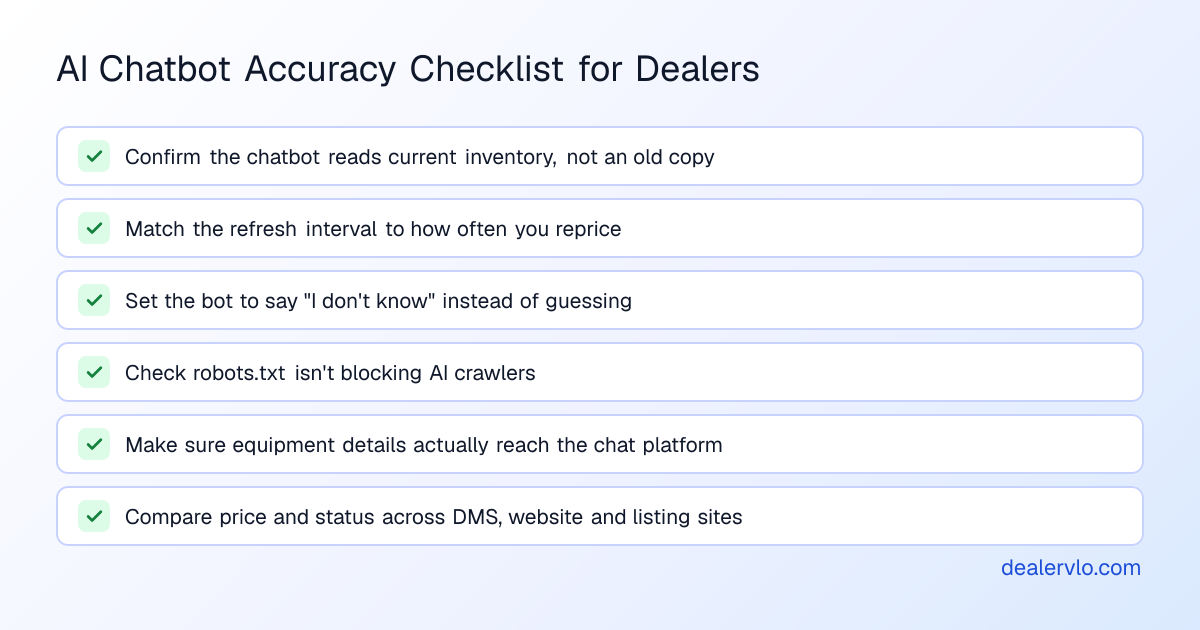
When a shopper reports a wrong spec, price or availability from your chatbot, run these checks in order:
-
Check the source. Pull whatever file or feed the bot reads. Is the VIN's data correct there? If not, the problem is upstream: your DMS export, a sync, or a field mapping.
-
Check the refresh time. When did the bot's copy last update? If the car sold this morning and the copy refreshes tonight, the bot is working as designed; it's just designed wrong for your turn rate.
-
Check what fields the bot has. Does its data include equipment, or only year, make, model and price? If there's no equipment, either get it into the feed or have the bot say "I don't have that detail."
-
Check robots.txt and your CDN's bot rules. If AI crawlers are blocked, any tool reading your live site gets nothing.
-
Check for conflicts. Do your DMS, website and listing sites show different prices for the same car? Then "the bot said $18,500 but the website says $19,995" complaints will keep coming even when both numbers were true at different times.
-
Check the instructions. Ask the vendor what the bot does when it lacks data: say "I don't know" and hand off to a person, or infer an answer? If it infers, change that setting.
If all six check out and the bot is still wrong, then you have a model or vendor problem, and it's time to escalate or switch.
How DealerVLO keeps one accurate record per car
DealerVLO runs in a web browser, so there's nothing to install. Every car's record holds its VIN, stock number, photos, acquisition cost, reconditioning cost lines, and asking and internet price. When you add a car one at a time, the VIN decode fills in the year, make, model and specs, and "Scan VIN" reads the barcode on the door-jamb label with your phone's camera in the browser and runs that decode, so the basics start from the VIN, not from typing.
The dealer website is included and inventory posts to it automatically. Its robots.txt allows every crawler, each car page carries Car structured data with the VIN, mileage, price and specs, and the website and the CarGurus, Cars.com and Autotrader feeds read the same price from each car. A car marked sold drops off the website right away and off the listing sites with the next daily feed.
Every priced car page shows a monthly payment estimator, clearly labeled as an estimate, with a button to your Financing page. When a shopper sends an inquiry through the site, DealerVLO emails your dealership and, if the shopper gave an email, sends them an automatic confirmation. The lead inbox records each lead's source and, when they asked from a car's page, which car, so you can see what they were looking at before you call back.
What DealerVLO doesn't do: it isn't a chatbot and doesn't answer shoppers for you. What it gives a chatbot, or a search engine, or a shopper, is one current record per car to read. For how the pieces fit together, see our overview of used car dealer software, and our VIN and license scanner guide for the add-a-car flow.
For how fast your inventory turns, and so how fast your bot's copy goes stale, see our inventory turn rate guide and the free inventory turn calculator.
Frequently asked questions
Why does my AI chatbot quote specs or prices that don't match my website?
Usually because the chatbot and your website read from different copies of your inventory, or the chatbot's copy hasn't refreshed since you changed something. Chat platforms commonly pull inventory from a file export, an API, or by reading your site, and if that copy refreshes once a day, a price you changed this morning won't reach the bot until the next refresh. Ask your vendor where the bot reads from and how often, then shorten that interval or point it at the live source.
What is retrieval-augmented generation (RAG) and does it stop hallucinations?
Retrieval-augmented generation means the chatbot looks up the relevant records (your inventory, your car pages) before it answers, and writes the answer from those records instead of from what the model happens to know. It reduces made-up answers but doesn't eliminate them: a 2024 Stanford study of AI legal-research tools built this way found they still gave wrong answers roughly 17% to 33% of the time. RAG only helps if the records it pulls are complete and current, and the bot is told to say it doesn't know when they aren't.
Am I responsible if my chatbot gives a customer wrong information?
Likely, yes. In Moffatt v. Air Canada (2024), a British Columbia tribunal held the airline responsible for wrong refund information its website chatbot gave a customer, rejecting the argument that the bot was responsible for its own statements. That was a Canadian small-claims decision, not a U.S. ruling, but the reasoning is the ordinary misrepresentation logic: a statement on your website is your statement. This isn't legal advice; ask your attorney how it applies in your state.
How often should my inventory feed update to keep the chatbot accurate?
Match it to how often your inventory changes. A lot that sells a few cars a month and rarely reprices can live with a daily refresh. A lot that turns cars weekly and reprices aging units every few days needs the bot reading a source that updates as you work, or it will keep quoting yesterday's price. Ask your chatbot vendor how often their system pulls your inventory and whether it can read your live website instead.
What's the difference between a chatbot hallucination and the Chevrolet $1 Tahoe incident?
A hallucination is the bot making up an answer it has no data for, such as saying a car has navigation when your record lists no equipment. The December 2023 Chevrolet of Watsonville incident was different: a user gave the bot instructions that overrode its own, and got it to agree to a $1 Tahoe. Hallucinations are reduced by grounding the bot in complete, current data; instruction overrides are reduced by tighter limits on what the bot will discuss and agree to.
How do I know if my website is blocking AI crawlers from reading my inventory?
Open yoursite.com/robots.txt in a browser and look for lines such as User-agent: GPTBot or User-agent: ChatGPT-User with a Disallow rule under them. If they're there, AI tools that browse your site to answer a shopper's question can't read your inventory pages. Blocking can also happen at your CDN or firewall, which you can't see in robots.txt, so ask your website vendor directly.
Bottom line
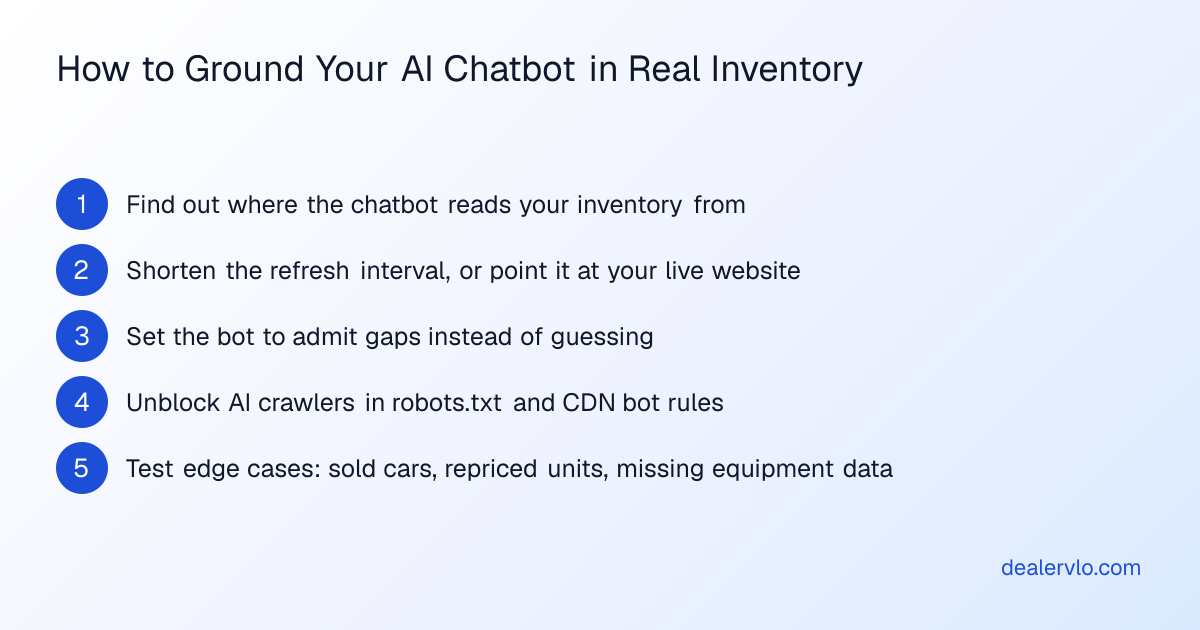
If your chatbot is quoting wrong specs, stale prices or cars you sold last week, fix the data before the prompt. Find out where the bot reads your inventory and how often it refreshes, get equipment into the record or have the bot admit it doesn't know, make sure your site isn't blocking AI crawlers, and keep one price per car across every system. Retrieval helps only when what it retrieves is right. And as Air Canada learned, what the bot says on your website is treated as what you said, so hold it to the same standard as a salesperson's quote.
DealerVLO gives you that one record per car: the same price on your website and your listing feeds, sold cars off the site right away, and structured data any crawler can read.
14-day free trial, then $29/mo · Cancel anytime