The Stocking Report — September 2026: the used cars to buy for your lot this month
A dealer's September 2026 used-car buy list: what wholesale is doing (Manheim), where demand is (iSeeCars), the segments to stock, and what to leave in the lane.
Part of the Inventory, pricing & aging guide: Inventory Turn Rate for Used Car Dealers: Benchmarks, Formula & How to Improve
Switching from another DMS? Compare DealerVLO to DealerCenter, Frazer, or Lot Wizard.

This is the first edition of a monthly series: what the wholesale market is actually doing, where used-car demand actually is, and what that means for the cars you should raise your hand on this month. Not "hot models" content-farm filler — the current data, read the way a buyer reads it, with sources you can check.
One ground rule up front, same as the evergreen stocking guide: the best car to stock is a fit for your market, not a national list. What a monthly report can honestly add is the market layer — which segments the data says to lean into or away from right now, and why.
14-day free trial, then $29/mo · Cancel anytime
The September used-car market: a softening lane and expensive gas
Two facts define this month's buying environment.
Wholesale is cooling off. Cox Automotive's Manheim Used Vehicle Value Index came in at 207.4 in mid-August — down 1.2% from July adjusted, and now flat against a year ago after running hot through the spring. Cox's own read is that this is "a normal part of late-summer slowdown after a strong spring bounce," not a break in the market. Wholesale supply sat at 27.7 days as of mid-August, up 2.6 days on last year — still tight by any historical standard, but looser than it's been.
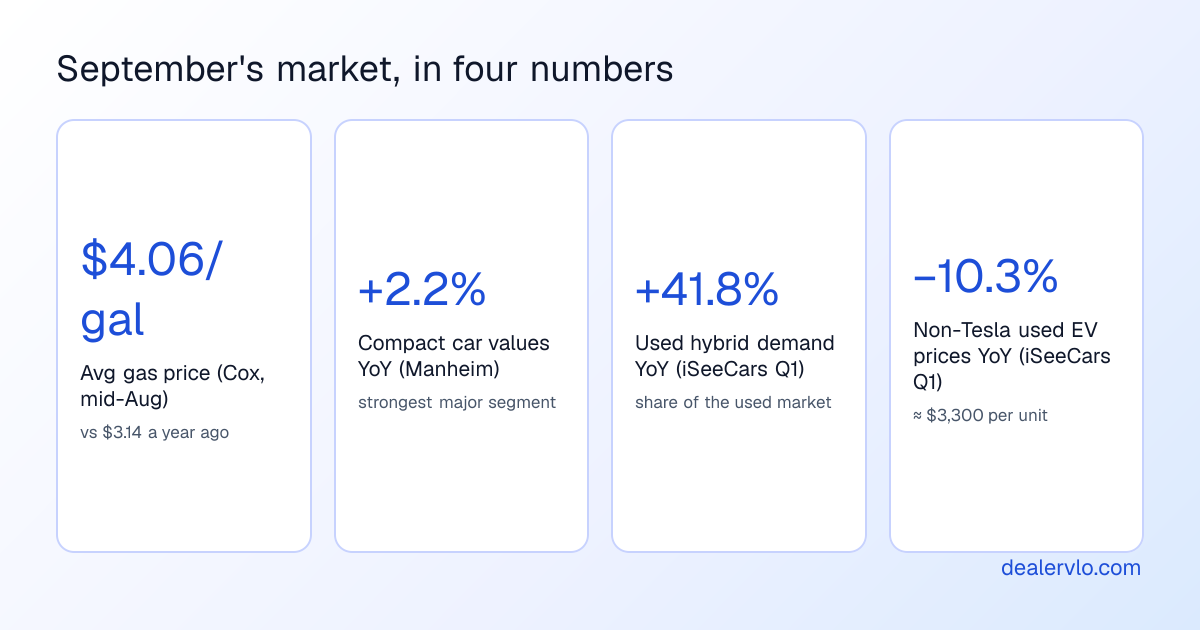
Gas is $4.06 a gallon on average per that same Cox report — against $3.14 a year ago. Every month that holds, the customer walking onto a small lot cares more about a payment and a fuel bill they can live with.
For a buyer, that combination reads one way: the lane is getting friendlier just as demand tilts toward efficient, affordable transportation. That's the whole September thesis.
Buy #1: cheap gas commuters — the segment that won't quit
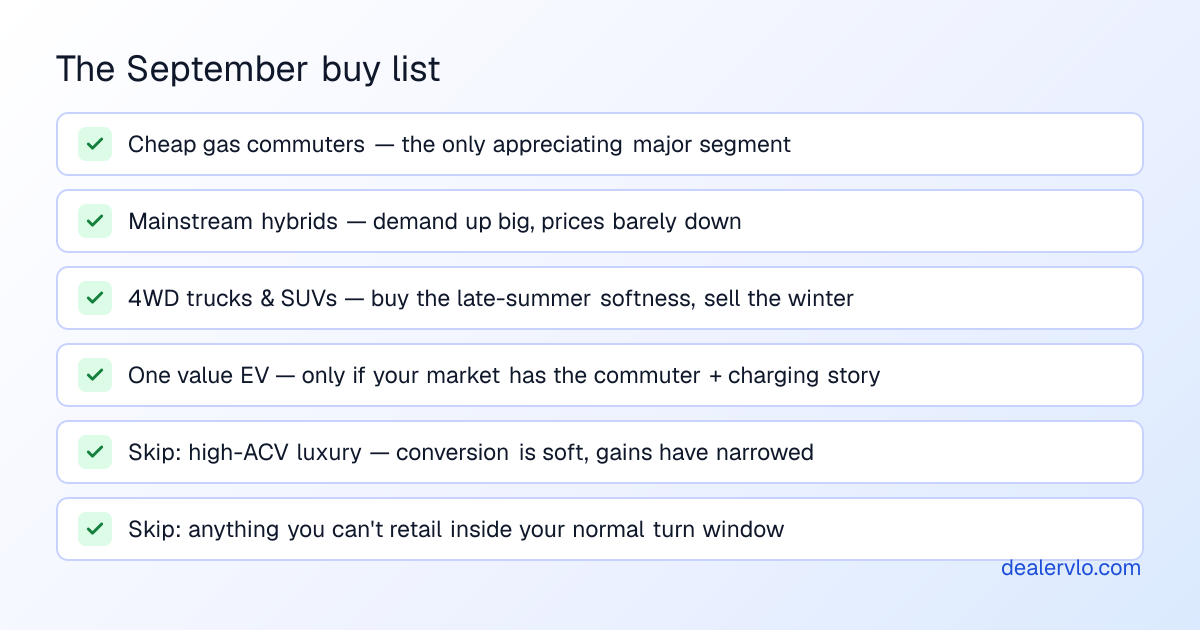
In Manheim's mid-August segment data, compact cars were the strongest major segment, up 2.2% year over year — while midsize cars, SUVs, and pickups all posted declines. Wholesale doesn't appreciate against the tide without retail demand underneath it, and at $4-a-gallon gas the demand is not a mystery: the sub-$15k Corolla/Civic/Elantra/Sentra tier is what a payment buyer with a commute actually needs.
The catch is the same thing that makes them good: everyone at the lane can read the board too, so clean compacts don't go cheap. This is where discipline beats enthusiasm — know your retail-back number before the unit rolls through, and remember that in an appreciating segment your protection is buying condition (one-owner, clean history, honest miles), because the cheap rough ones are cheap for a reason. These are also the units where fast-selling fundamentals matter most: right colors, right equipment, no story to tell.
Buy #2: mainstream hybrids — demand grew 41.8%, prices barely moved
The most striking demand number in the market right now comes from iSeeCars' Q1 2026 study of 6.7 million used sales: used hybrid market share grew 41.8% year over year, while used hybrid prices slipped only 1.4% — the smallest decline of any non-Tesla powertrain category. Demand up that hard with prices that sticky means the appetite is real and supply hasn't caught it.
For an independent lot the play is the boring, liquid metal: RAV4 Hybrid, Camry Hybrid, Prius, Accord Hybrid, Escape/Maverick hybrids — the commuter-adjacent stuff a payment buyer cross-shops against the gas version and picks when fuel is $4. The caution is the mirror of the opportunity: the lane knows this too, so the risk isn't demand, it's overpaying into it. The same bid-ceiling discipline applies — a great segment bought $1,500 over the money is a bad deal in any market.
Buy #3: 4WD trucks and SUVs — buy the softness, sell the winter
Here's the seasonal trade every northern dealer knows, and the data happens to line up with it this year. Manheim shows pickups and SUVs softening in the late-summer data — which means September is the cheap end of the cycle for exactly the inventory that gets bid up when the first snow is in the forecast. I buy for a Massachusetts lot; I don't need to explain to anyone in New England what happens to 4WD demand — and 4WD asking prices — between October and December. The pattern isn't a law of physics, but it recurs often enough that buying winter inventory in a soft September lane is about as close to a structural edge as this business offers. (For the full-year version of this pattern, see used-car sales seasonality and when to stock up.)
If trucks are your lane, the truck-sourcing guide covers where the clean ones actually come from. Two hedges: buy the honest miles and the rust-free underbody (recon on a rough 4x4 eats the winter premium fast), and don't hold so much winter stock that a mild December turns your edge into aged inventory.
14-day free trial, then $29/mo · Cancel anytime
The contrarian slot: one value EV — for the right lot only
The iSeeCars data shows non-Tesla used EV prices down 10.3% year over year — roughly $3,300 a unit — while EV demand keeps growing from a small base. That's a genuine value-buy setup: the depreciation has already happened to somebody else, and $4 gas is free advertising for anything that plugs in.
But the same study says non-Tesla EVs averaged around 60 days on market — meaningfully slower than the overall market. So this is a fit question, not a market question: if your buyers commute, your area has charging, and your economics survive a slower turn, one well-bought Bolt/ID.4/Ioniq-class unit is a sensible experiment. If your lot lives on 30-day turns and floor-plan interest, the math that matters is the gross-versus-holding-cost math, and it probably says pass.
The run list: specific units to hunt in September
Segments set the direction; the lane runs on nameplates. Here's the specific run list — makes, models, years, and the trim tier to target in each play. Two honest framing notes first: where a number appears next to a model, it's from iSeeCars' February 2026 fastest-selling study (1–5-year-old used vehicles, against a 53-day market average); everything else is structural reasoning — generations, equipment, and liquidity — not invented statistics. And the usual rule outranks every name below: a unit that doesn't fit your buyers isn't on your list, whatever a report says.
The commuter play — sub-$15k gas, mid trims, boring colors:
- Toyota Corolla, 2017–2019, LE. The 2017 refresh made Toyota's active-safety suite standard, which matters to exactly this buyer. LE is the liquid middle — base L strippers and loaded XSEs both sit longer at this price point.
- Honda Civic, 2016–2021 (tenth gen), LX or EX. The widest-demand compact there is; EX gets you the sunroof-and-alloys package payment buyers say yes to. Verify service history on the turbo cars like you would any small-displacement turbo.
- Hyundai Elantra, 2017–2020, SEL. The value angle: Corolla/Civic demand at a friendlier bid. Remaining factory powertrain-warranty transfer questions are worth knowing cold, because they're a real closing tool on Hyundais.
- Toyota Camry / Honda Accord, 2015–2019, LE/SE and LX/Sport. When the commuter buyer has a family — same logic, one size up.
The hybrid play — the +41.8% demand, in metal:
- Honda Civic Hybrid. The one mainstream nameplate with a sourced number this month: 34.8 days on market in the February study — eighteen days faster than the average used car. Newer inventory, so it's a payment-buyer unit, but it's the demand surge wearing a Honda badge.
- Toyota RAV4 Hybrid, 2019+ (current gen), XLE or XLE Premium. The segment king, and every hybrid RAV4 is AWD from the factory — which makes it a twofer with the winter play below.
- Toyota Camry Hybrid (2018+), Accord Hybrid (2018+), Prius (2016–2022). The proven hybrid liquidity tier. Prius especially: unkillable demand at commuter money, and the 2016+ generation is the one to hunt.
- Ford Maverick hybrid, 2022+. The wildcard — a hybrid truck at compact-car money, and they don't sit. One catch for northern lots: the hybrid was front-drive-only in its early years, so it's a hybrid-play unit, not a winter-play unit.
The winter play — 4WD bought in the September softness:
- Ford F-150, 2015–2020, XLT SuperCrew 4x4. The liquid dead-center of the truck market. XLT crew short-bed is the config that sells to the most buyers; regular-cab 2WD work trucks are a different (and slower) market.
- Chevy Silverado / GMC Sierra 1500, 2014–2019, LT/SLE crew 4x4 with the 5.3L. Same logic, GM flavor — and the brand-loyal buyer means both belong on the list, not one.
- Toyota Tacoma (2016+) and 4Runner. You will not steal either at auction — Toyota truck money is real money — but they're the closest thing to guaranteed turn the winter market has. Buy on condition, not on price fantasy.
- AWD crossovers one tier down: RAV4, CR-V, Subaru Outback/Forester, 2015–2019. The winter play for commuter budgets. Mid trims again (XLE, EX, Premium), and budget real tires into recon — an AWD unit on worn all-seasons undercuts its own pitch.
The value-EV slot — one unit, right market only:
- Hyundai Kona Electric — 31.4 days in the February study, faster than the market average and cheap to buy after the segment's price drop.
- Chevy Bolt, 2020–2022. The depreciation-capture special. Many had battery packs replaced under GM's recall — a documented pack replacement is a selling point, so pull the service history before you bid, not after.
- VW ID.4. The iSeeCars data showed it with the segment's steepest price drop (down 13.2% year over year) — maximum depreciation capture, for the lot that can hold a slower turner and tell the charging story.
Take it to the lane and let the bid ceiling do the deciding — literally:
The full run list on one page — every unit, why it's on the list, and a blank max-bid column to fill in before the lane. Enter your email and it opens ready to print; you'll also get next month's Stocking Report (unsubscribe anytime).
What to leave in the lane this month
High-ACV luxury. Manheim's luxury segment gains have narrowed to +0.7%, and overall sales conversion at 56.9% is down four points from a year ago — softer sell-through at exactly the price point where a mistake costs the most. A $45,000 German SUV that misses is a quarter of a small lot's capital doing nothing. Unless luxury is your store, September is not the month to learn it.
Anything outside your turn window. The market layer never overrides the lot layer. A unit that's right for the season but wrong for your customer base isn't a September opportunity — it's December's markdown.
On margins — the honest version
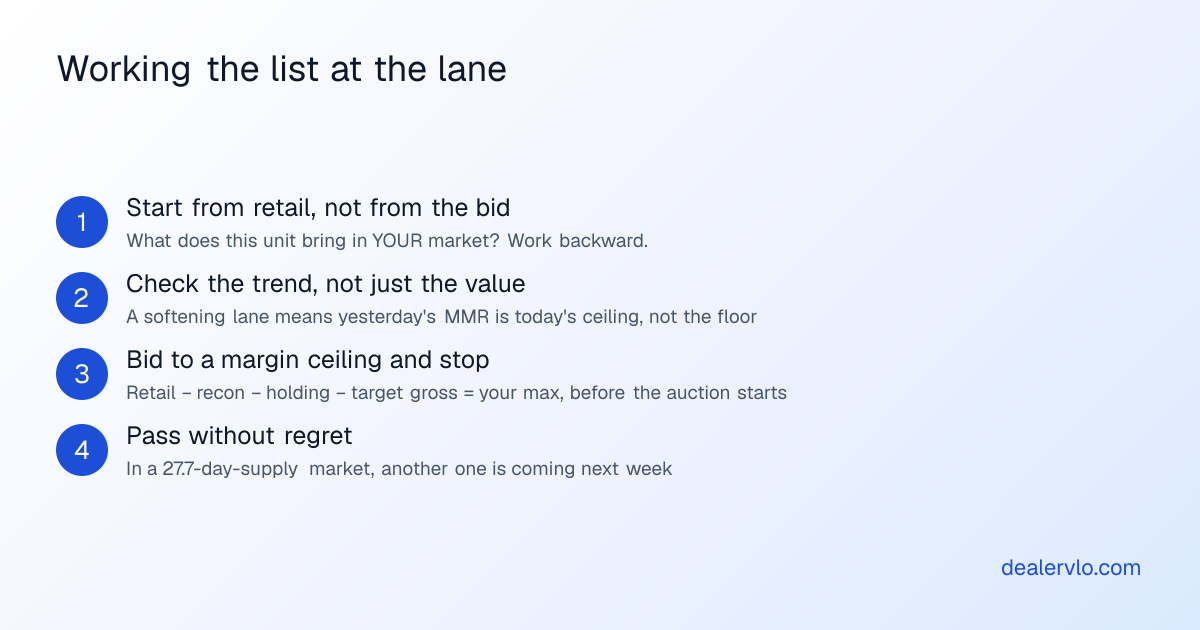
You'll notice this report doesn't print a "expected profit: $2,400" next to each segment. That's deliberate. Front-end gross on the same Corolla is different money in Worcester than in Wichita, different again between a one-owner unit and a rough one, and any blog that quotes you per-model margins is making them up. Margin isn't a property of the model — it's a property of the buy.
What I can give you is the mechanism: start from what the unit retails for on your lot, subtract recon, holding, and the gross you're in business to make, and that's your bid ceiling — before the auction starts, not during it.
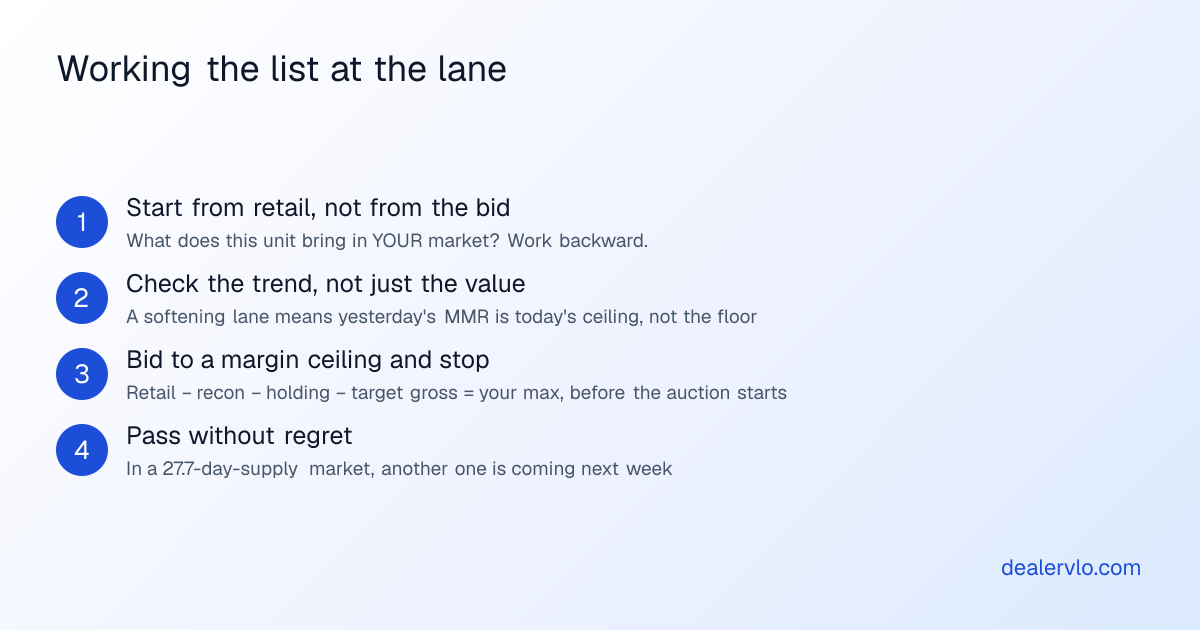
Better yet, don't take my word for the mechanism — run a unit from the list through it right here. Your market's retail number, your recon estimate, your target gross, and the ceiling falls out:
Frequently asked questions
What are the best used cars for dealers to buy in September 2026?
The run list above, in short: 2017–2019 Corolla LE, 2016–2021 Civic LX/EX, and 2017–2020 Elantra SEL for commuters; RAV4 Hybrid XLE (2019+), Camry/Accord Hybrid (2018+), Prius (2016–2022), and the Civic Hybrid (34.8 days on market per iSeeCars) for the hybrid surge; XLT/LT crew-cab 4x4 half-tons (2015–2020) bought in the current softness for winter.
Are wholesale prices going up or down right now?
Softening — the Manheim index was 207.4 in mid-August, down 1.2% from July and flat year-over- year, which Cox calls a normal late-summer slowdown. For buyers, that's the friendly end of the cycle.
Should independents stock used EVs in 2026?
Only with a local story. Non-Tesla EV prices are down about 10% year-over-year — real value — but they averaged ~60 days on market in Q1. Fit question, not market question.
How much margin should I expect on these units?
Margin is made at the buy. Work backward from your market's retail through recon, holding, and target gross to a bid ceiling — no honest report can quote per-model profit.
How often does this report come out?
Monthly — current wholesale data plus the latest demand studies, turned into a buy list. The evergreen fit framework is in the best cars to stock guide.
Bottom line
September 2026 is a buyer's month: a cooling lane, tight-but-loosening supply, and demand concentrated exactly where cheap-to-run inventory lives. Lean into commuters and hybrids, use the softness to load winter 4WD stock, keep the luxury money in your pocket, and let the bid ceiling — not the lane — decide what comes home.
Tracking whether it worked is the other half: DealerVLO's deal jacket ties every unit's buy price, recon, days on lot, and final gross into one record, so next month you're stocking from your own numbers, not just mine. It's $29/month flat, with a free 14-day trial — no charge until day 14.
14-day free trial, then $29/mo · Cancel anytime