How to Price a Used Car From Live Market Comps
The right asking price is whatever your local market is actually asking — minus the franchise premium. Here's how to price from real comps, and let the research do itself.
You buy a clean trade at the sale, get it through recon, shoot the photos — and then you're sitting on the price field with the cursor blinking. Price it too high and it sits, aging, quietly eating your gross in floor-plan interest and a softening market until you finally cut it anyway. Price it too low and you hand a buyer money you didn't have to give away. The right number isn't your gut and it isn't what you paid — it's whatever your local market is actually asking for the same car, minus the premium a franchise store gets that you don't.
That last part is where most of us drift. This is the way I price a car for turn: anchor on real, current comps, read the middle of the pack, and set an asking price that pulls serious calls inside about a month. I'll also show you how DealerVLO now does the legwork — it looks up the live comps for you the moment you add the car.
Overpricing is a turn problem, not a patience problem
The car that sits isn't waiting for the right buyer. It's telling you the price is wrong. Every extra week on the lot is floor-plan interest ticking, a used-car market that keeps softening under you, and the ad and lot carry — and it usually ends the same way: with a markdown you could have just priced in on day one. Aging is the market's feedback, and it's almost always about the number, not the buyers. (This is the whole argument behind an aging-and-markdown discipline and why inventory turn is the metric that actually pays your bills.)
Underpricing is the quieter leak. A clean car listed at the bottom of the pack sells fast and feels like a win — but a fast sale at a soft number is still money left on the table. The goal isn't the lowest price or the highest; it's the price that turns the car near the top of what the market will actually pay.
Where dealers anchor to the wrong number
Three anchors sink more asking prices than anything else:
- What you paid. The market does not care what you gave at the auction. Your cost sets your floor for a deal, not the retail ask. (Buying right is a separate muscle — buy cars that sell fast so pricing them is easy.)
- The guidebook alone. KBB, MMR, and Black Book are a sanity check, not the street. They lag, they blend national numbers that may not match your ZIP, and no buyer shops a guide — they shop live listings. Use the guides to confirm you're in the neighborhood, then price to the live market.
- The franchise / CPO number. Carvana, CarMax, and franchise certified listings carry a warranty, a brand, and a marketing budget you don't — so their price on the same car runs high. Match them and you've priced yourself out. Your edge as an independent is being the sharper number on the identical car, which is exactly how small lots compete with the giants.
Punch in cost, recon, holding days, and sale price to see your true net gross and margin.
Open the Profit Margin CalculatorPrice from real comps, in four steps
The fix is boring and it works: price to what the same car is actually listed for near you, right now.
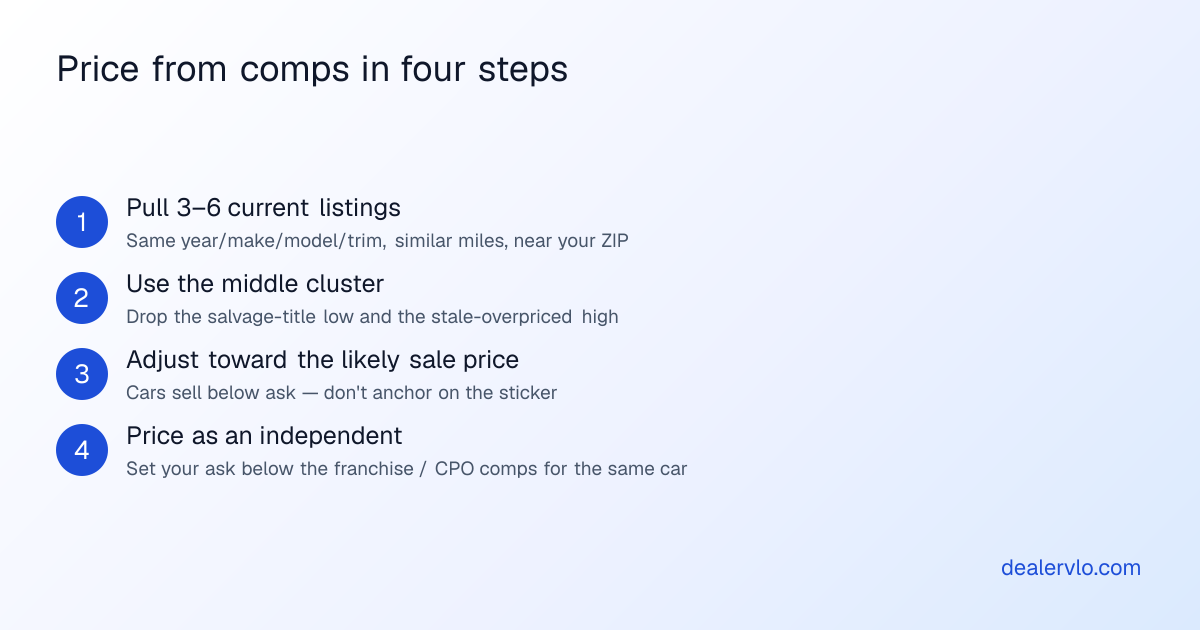
Pull three to six current listings of the same year, make, model, and trim — similar mileage, close to your market. You're building a picture of what a buyer sees when they search this car today.
Use the middle cluster and throw out the outliers. There's almost always a rock-bottom listing (salvage title, a rough one, or a typo) and a stale one that's been sitting overpriced for two months. Ignore both. The middle of the clean comps is your market.
Adjust toward the likely sale price. Published asking prices skew high — cars sell for less than the sticker, and the overpriced strays drag the average up. Aim a touch above where the clean ones would actually change hands, not at the top of the asks.
Set your ask as an independent. Price at or just under the middle of the clean, non-franchise comps, and stay below the Carvana/CPO numbers. Let your photos, your reconditioning, and an honest description justify sitting a notch above the cheapest car — not the highest. A right-priced clean car gets the calls; the calls are what let you hold gross.
Let the research do itself
The catch with all of that is time. Pulling comps by hand — opening five tabs, filtering by year and mileage and ZIP, eyeballing the middle — is a few minutes per car, so it's the step that quietly gets skipped, and cars get priced from gut instead.
That's the part we built into DealerVLO. When you add a vehicle, the price suggestion looks up current listings for that year, make, and model near your ZIP, shows you the real listings it found — each one a click away so you can verify it yourself — and hands you a rounded asking range with a target to aim for.
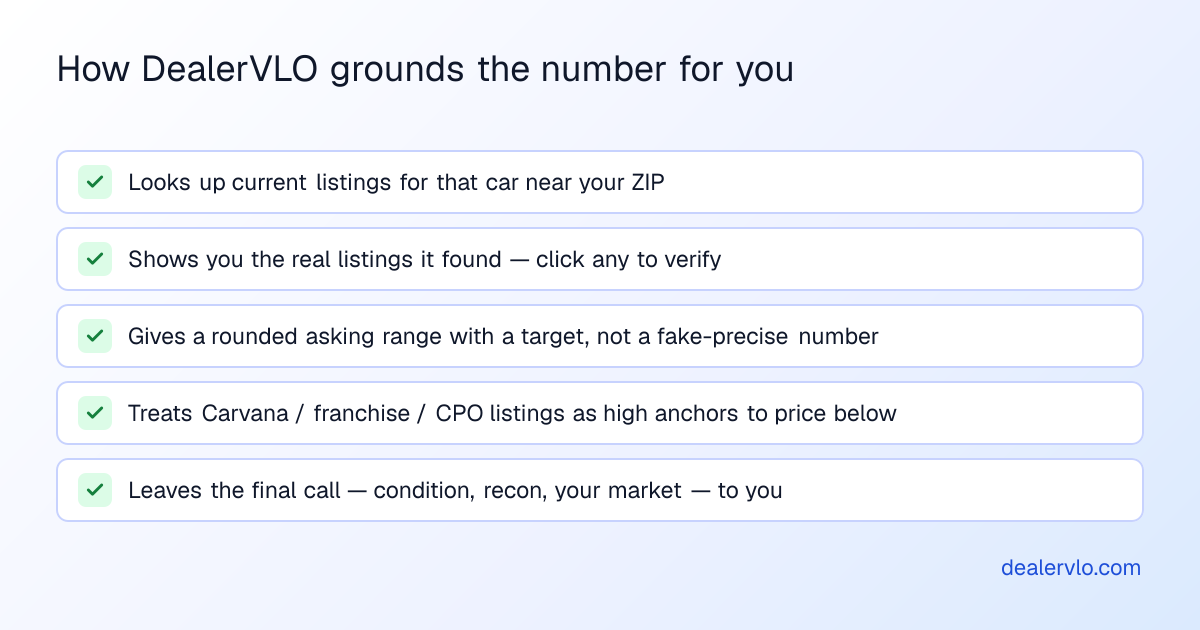
Two things about it matter. It's grounded in what's actually listed today, not a number guessed from thin air — and it's built to think like an independent, treating the Carvana and franchise/CPO listings as high anchors to price below rather than match. And it gives you a range, not a false-precise figure, because nobody can tell you your exact car is worth $16,347 — the honest answer is a band, and where you land in it is your call on condition, recon, and your own market. It's a starting point you can verify in one click, not an appraisal. (It's one of a handful of places we put AI where it actually helps instead of bolting it on for the brochure.)
Frequently asked questions
How should a used-car dealer set the asking price on a car?
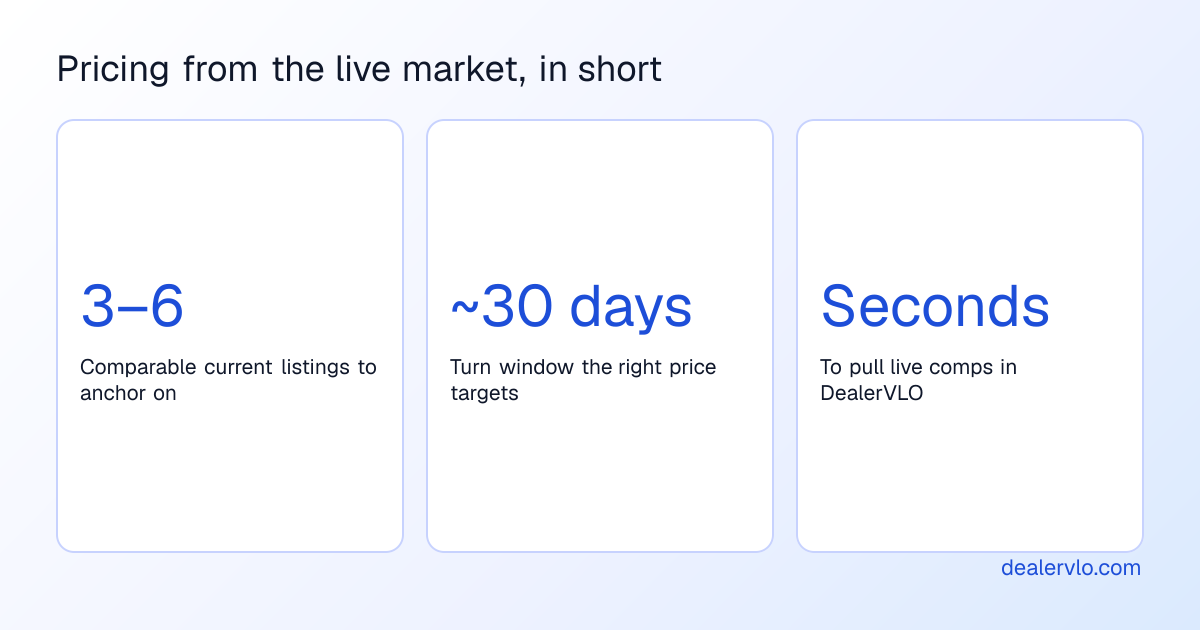
Start from what the same year, make, model, and trim is actually listed for right now near you — not what you paid, not the guidebook, not gut. Pull three to six current comps, use the middle of the pack, and set your ask slightly above the likely sale price. As an independent, price below the franchise and CPO listings for the same car. The goal is a number that draws serious calls inside about 30 days.
Why not just use a pricing guide like KBB or MMR?
Guides are a sanity check, not a market. They lag the street, blend national data that may not match your ZIP, and buyers shop live listings, not a guide. Anchor on what's actually for sale near you, then use the guide to confirm you're not way off.
Should I just match the lowest price I see?
No. The lowest listing is often a salvage title, a rough example, or a mistake, and racing to the bottom kills your gross. Price near the middle of the clean comps and let condition, photos, and recon justify sitting a notch above the cheapest one.
How does DealerVLO's price suggestion work?
When you add a car, it looks up current listings for that year, make, and model near your ZIP, shows you the real ones it found, and gives you a rounded asking-price range with a target. It treats Carvana and franchise/CPO listings as high anchors to price below, and it's grounded in what's listed today. It's a starting point you verify in one click, not an appraisal.
How often should I re-check a car's price?
Re-look at anything that's sat a couple of weeks without a serious call. Comparable cars sell or get relisted, and the price that was right on day one may be high now. Aging is the signal — when a unit crosses your turn window, the price is wrong, not the buyers.
Bottom line
Pricing a used car isn't a guess and it isn't a guidebook lookup — it's reading what your local market is actually asking for the same car and landing near the top of what it will really pay, below the franchise premium. Do that consistently and your cars turn before they age; skip it and you pay for the guess in markdowns.
The reason we built the live-comp price suggestion into DealerVLO is that the research is the part that gets skipped, and skipping it is expensive. Enter the car once and the comps come to you — grounded in real listings, shown so you can verify them, framed as a range you finish with your own judgment. It's $29/month flat, unlimited users, with a free 14-day trial a card starts, no charge until day 14. Price the next one from the market instead of your gut.