How a small used-car lot competes with CarMax and Carvana
You don't beat the superstores on price or ad budget. You beat them on the things a 300-car chain structurally can't do — oddball inventory, saying yes on financing, speed, and knowing the customer's name.
Every independent dealer I know has had the same gut-punch moment: a customer stands on your lot, likes a car, then says "well, CarMax has one for…" and you feel the walls close in. You can't out-advertise them, you can't match a no-haggle price backed by billion-dollar buying power, and you can't build a fifty-thousand-car search index. It's easy to conclude the game is rigged.
It isn't — you're just trying to win the wrong game. The superstores are built for scale, and scale comes with structural weaknesses a small lot can exploit every single day. This is the honest version of how a lot like mine competes with the giants: not by being a smaller CarMax, but by being the thing a 300-car chain can never be.
Why you can't (and shouldn't) fight them on their turf
Their turf is the fat middle of the market: the clean, three-year-old, high-demand sedan and SUV that everyone wants and everyone stocks. A national chain optimizes ruthlessly for that lane — huge selection, transparent pricing, a slick online flow. If your plan is to offer the same cars, priced the same way, marketed the same way, you have signed up for a fight you'll lose on every axis that scale wins: ad spend, selection depth, and cost of capital.
So don't. The mistake isn't competing with CarMax — it's competing with CarMax by imitating CarMax. Every dollar you spend trying to look like a smaller superstore is a dollar spent on your weakest ground. The dealers who thrive next to the giants do the opposite: they lean into everything the giants had to give up to get big.
The four advantages a small lot actually has
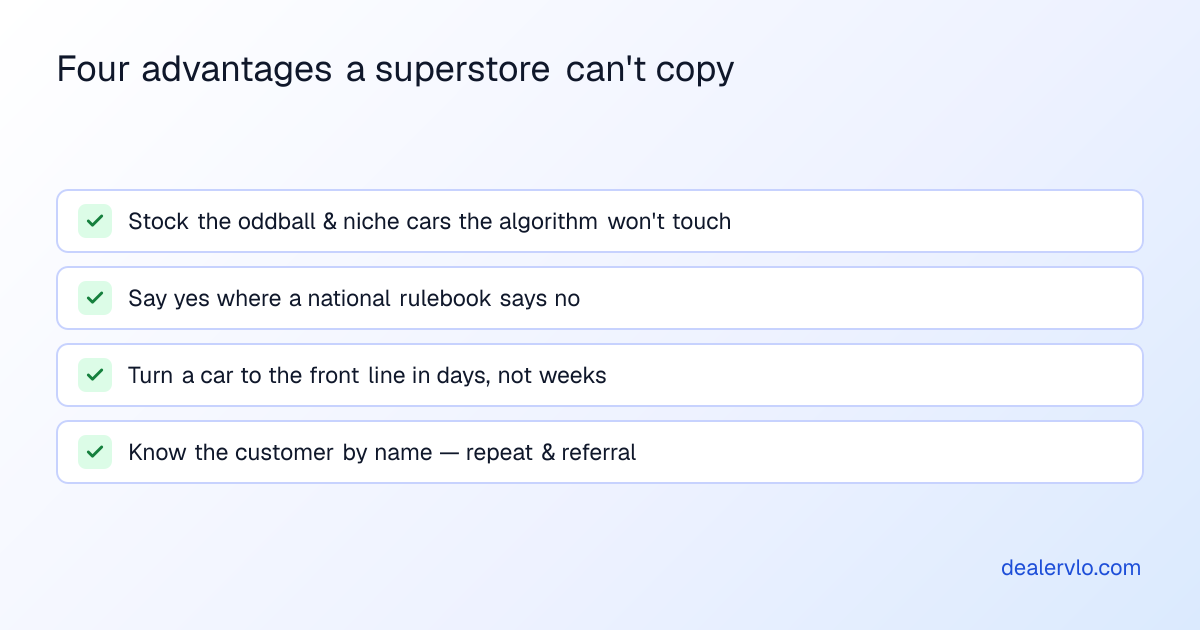
A superstore trades flexibility for scale — that trade is the opening. Four structural edges fall out of it, and none of them require a bigger checkbook:
- Inventory the algorithm won't touch. A national buyer skips thin, weird, and niche. You don't have to.
- Saying yes. A big-box deal desk runs to a rulebook; you can look at a marginal-credit buyer or a messy trade and work it.
- Speed. You can get a car front-line-ready in days; a logistics chain moves it through hubs.
- The relationship. You can know the customer's name, their last car, and their kid's name. A kiosk can't.
The rest of this post is how to actually press each one.
Inventory: stock what the superstores won't touch
The superstores make their money in the center of the bell curve. That leaves both tails wide open: the enthusiast car, the clean work truck, the older-but-honest commuter below their price floor, the specific trim a national algorithm treats as too thin to stock. Those are cars you can buy under the market ceiling — often off-auction, where nobody's bidding against you — and sell to a buyer who genuinely can't find them anywhere else.
This is where a good eye beats a big algorithm. You know your local market — what the tradespeople drive, what the enthusiasts hunt, what moves fast on your corner. Stock to that, the way the what-to-stock framework lays out, and you're not on the same shelf as CarMax at all. A buyer who wants exactly your car isn't price-shopping it against a superstore's generic one — because the superstore doesn't have it.
Financing & trades: say yes where the algorithm says no
Here's the moment the giant loses: a buyer with thin credit, a trade that still has a payoff, or a down payment that doesn't fit a clean template walks into a no-haggle, no-exceptions process and gets a polite decline. That same buyer walks onto your lot and needs one thing — someone willing to work it. Flex the trade, structure the financing, find the lender who'll take the deal. That's not a weakness in your model; it's the entire reason someone picks a person over a machine.
No-haggle pricing sounds great in an ad and falls apart the second a real deal has moving parts. Your ability to sit down and solve a buyer's actual problem — structuring around a monthly payment, working a trade honestly, getting creative on approval — is a product the superstores literally cannot offer at scale. Price your cars right for the market so you're in the conversation, then win it on flexibility.
Speed & service: the relationship moat
A car sitting in your back lot waiting on recon is selling to nobody, and every day it sits is floor-plan interest and lost turn. Speed to the front line is one of the cleanest edges a small operator has — and most give it away. A national chain moves a car through regional reconditioning and transport hubs; you can get one cleaned, inspected, shot, and listed in days if you run a tight process:
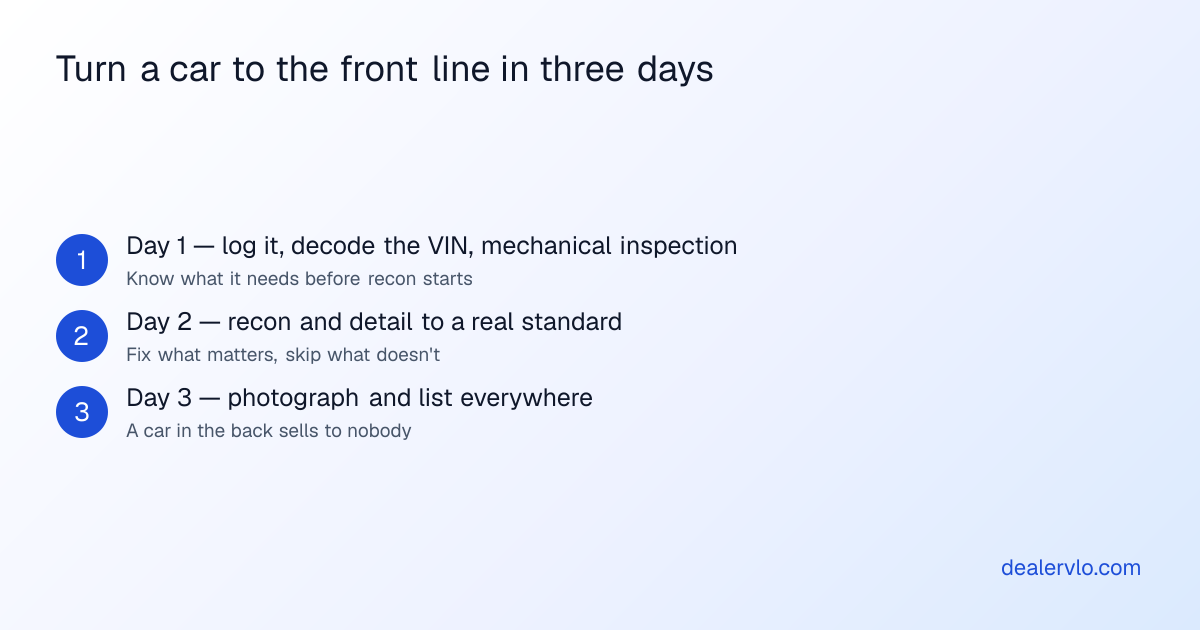
The three-day recon workflow is its own post, but the point here is competitive: fresh metal in front of buyers faster, at a lower carrying cost, is a structural win over any logistics-heavy chain.
Get your annual turn rate and days' supply — and see what the same inventory could make at a faster turn.
Open the Inventory Turn CalculatorThen there's the part no superstore can buy: you can know your customers. The person you sold to two years ago is ready to trade up now, and you know their history — if you kept it somewhere you can actually search. That's the difference between "I think I sold a truck to a guy named Mike" and pulling up every customer who bought a pickup three years ago and sending a two-line text. Repeat and referral business is the moat the giants can't cross, and it runs on remembering people.

What to stop doing (copying the big guys)
Half of competing with the superstores is refusing to fight them where they're strong:
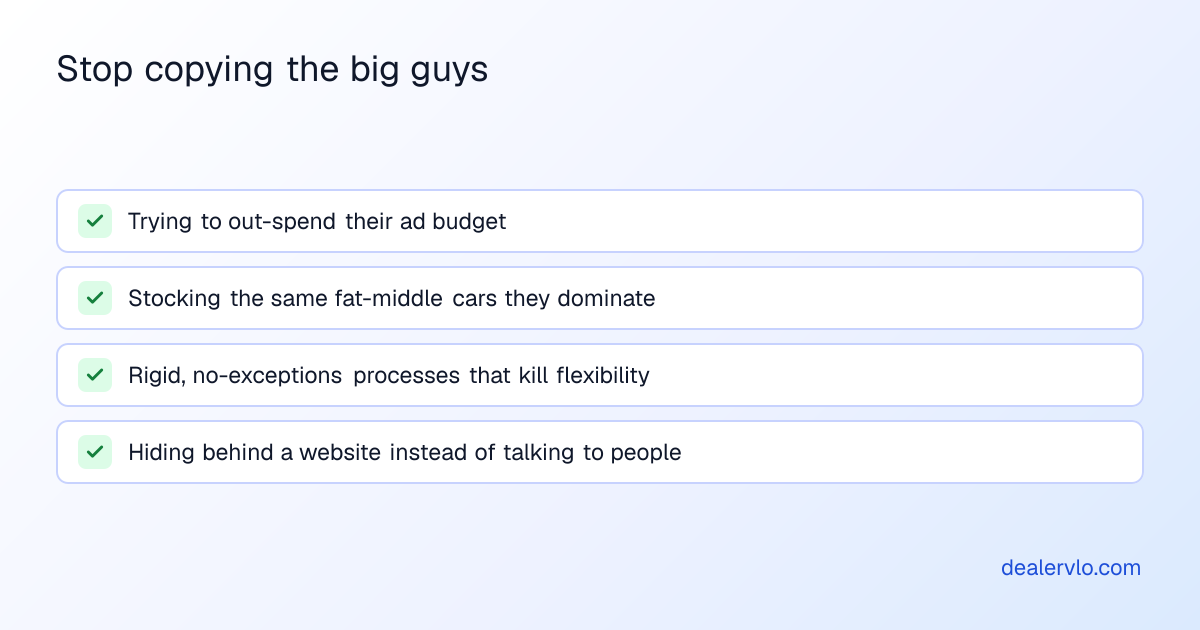
Stop trying to out-spend their ad budget — you can't, and your own channels plus word of mouth are cheaper and stickier. Stop stocking the exact fat-middle cars they dominate. Stop bolting on rigid processes that kill the flexibility that's your whole edge. And stop hiding behind a website — your ability to talk to a human being and solve their problem is the product. Every one of those is you trying to be a small CarMax instead of a great independent.
Frequently asked questions
How can a small used-car dealer compete with CarMax or Carvana?
Not on their terms. Compete on what a national chain structurally can't do: stock the niche and oddball cars their algorithm avoids, say yes on tough credit and messy trades, turn cars to the front line in days, and know your customers by name. Play your size as the advantage.
Why do people buy from small dealers instead of CarMax?
Usually because the small lot has the exact car they want, could get them financed when the big-box process declined them, or because they'd rather deal with a person who'll work the deal than a fixed-price kiosk.
Should a small dealer match CarMax's no-haggle pricing?
Be fair and transparent, but don't throw away your flexibility. No-haggle works for a chain because it cuts labor across thousands of sales; on a small lot, working the deal is your advantage, not a weakness.
What inventory should a small lot stock to avoid the superstores?
The tails of the market they under-stock: enthusiast and niche models, work trucks, clean older units below their price floor, and specific trims a national algorithm treats as too thin — cars you can buy under the ceiling and sell to a buyer who can't find them elsewhere.
Can a small dealer really turn cars faster than Carvana?
On the recon-to-front-line clock, yes. A tight small-lot process gets a bought car sellable in days, while a national logistics chain moves it through hubs. That speed is less floor-plan cost and faster turn — a real structural edge.
Bottom line
You will never beat CarMax or Carvana at being CarMax or Carvana, and you shouldn't try. You beat them by being what they gave up to get big: the lot with the car nobody else has, the dealer who says yes when the rulebook says no, the operation that turns a car in three days, and the person who remembers your name. Those aren't consolation prizes — they're structural advantages the giants can't buy back.
Pressing all four at once takes staying organized: knowing your inventory and its cost, structuring deals fast without losing margin, and keeping every past customer a search away. That's what DealerVLO is built to do for a small lot — one system for inventory, deals, and customers, so you can move fast and say yes with your numbers in front of you. $29/month flat, 14-day free trial.
Turn your ad spend into a cost per car sold and a real ROI — and see how many units the spend has to produce just to break even.
Open the Marketing ROI Calculator