How to Work a Used-Car Deal Backward From the Monthly Payment
Payment-first desking: start from the buyer's monthly payment target, work backward to the maximum amount financed, and find the highest price that fits.
Part of the BHPH, financing & F&I guide: How to Run a Buy Here Pay Here Dealership: The Whole Loop, From Approval to Payoff
Switching from another DMS? Compare DealerVLO to DealerCenter, Frazer, or Lot Wizard.
Why payment-first desking matters in 2026
When a buyer walks onto your lot today, they're not thinking about the $15,000 price tag on that Civic—they're asking themselves whether they can swing $350 a month. The market has shifted hard in this direction: shoppers are choosing an acceptable monthly payment rather than simply a car, and if you're still desking deals by cutting the sticker price until it hurts, you're leaving money on the table and showing inventory that won't pencil.
The payment-first desking method flips the process: you start with the buyer's target monthly payment, lock in their interest rate and term, calculate the maximum amount they can finance, add their down payment and trade equity to arrive at their total purchasing power, then work backward through sales tax and fees to find the highest vehicle selling price that still delivers their payment. This keeps you from discounting a car that would have fit their budget at 72 months instead of 60, and it stops you from wasting time on units they can't structure no matter how much you discount.
Important compliance note: The federal Truth in Lending Act requires you to provide written disclosures—APR, finance charge, total of payments, payment amount, number of payments—before the buyer signs the contract. The Consumer Financial Protection Bureau enforces these rules, and you must give the customer a fully completed form, not a blank one. This article covers desking methodology; it is not legal or tax advice. Confirm your state's current sales tax rules, documentation fee caps, and title fee schedules with your DMV or state motor vehicle authority before quoting out-the-door numbers.
14-day free trial, then $29/mo · Cancel anytime
The five-step reverse calculation
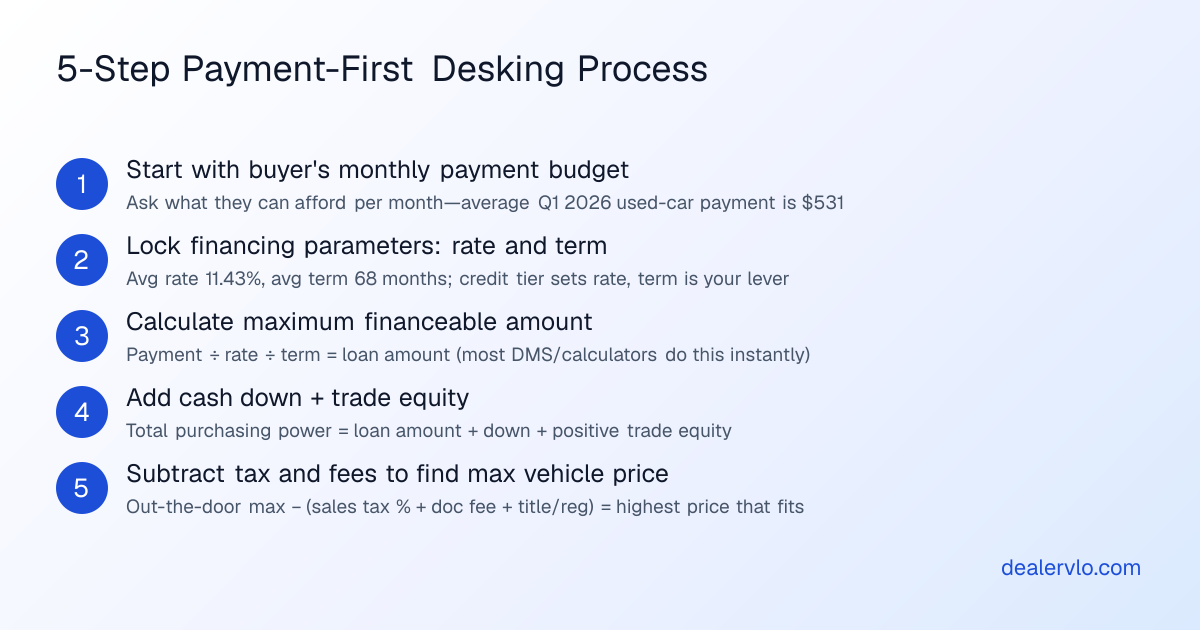
Step 1: Start with the buyer's monthly payment budget
Ask what they can comfortably afford per month, not what they want to spend on a car. As of Q1 2026, the average used-car monthly payment sits at $531, but your buyer's number will depend on their income, existing obligations, and comfort level. Get a realistic figure—if they say $400, you're working with $400, not the $600 they might stretch to after you show them a truck they can't afford.
Step 2: Lock in the financing parameters
You need two inputs: the interest rate the buyer qualifies for, and the term length you're structuring.
Interest rate depends on credit tier. In Q1 2026 the average used-car rate was 11.43 percent, but that's a blend—excellent credit might see around 6.30 percent, while poor credit can run over 21 percent. Pull credit early or use the rate your lender quotes for their tier.
Term length is where you have flexibility. The average used-vehicle loan term in Q1 2026 was 67.73 months—call it 68 months or a standard 72-month contract. But lenders commonly offer anything from 24 to 84 months, and stretching from 60 to 72 months can add meaningful purchasing power without touching the rate or the payment. This is the variable most operators under-use.
Step 3: Calculate the maximum financeable amount
Using the payment, rate, and term, calculate how much the buyer can borrow. This is basic amortization math—most DMS platforms and deal structure calculators do it instantly, but the formula is:
Loan amount = Payment × [(1 − (1 + monthly rate)^−number of payments) ÷ monthly rate]
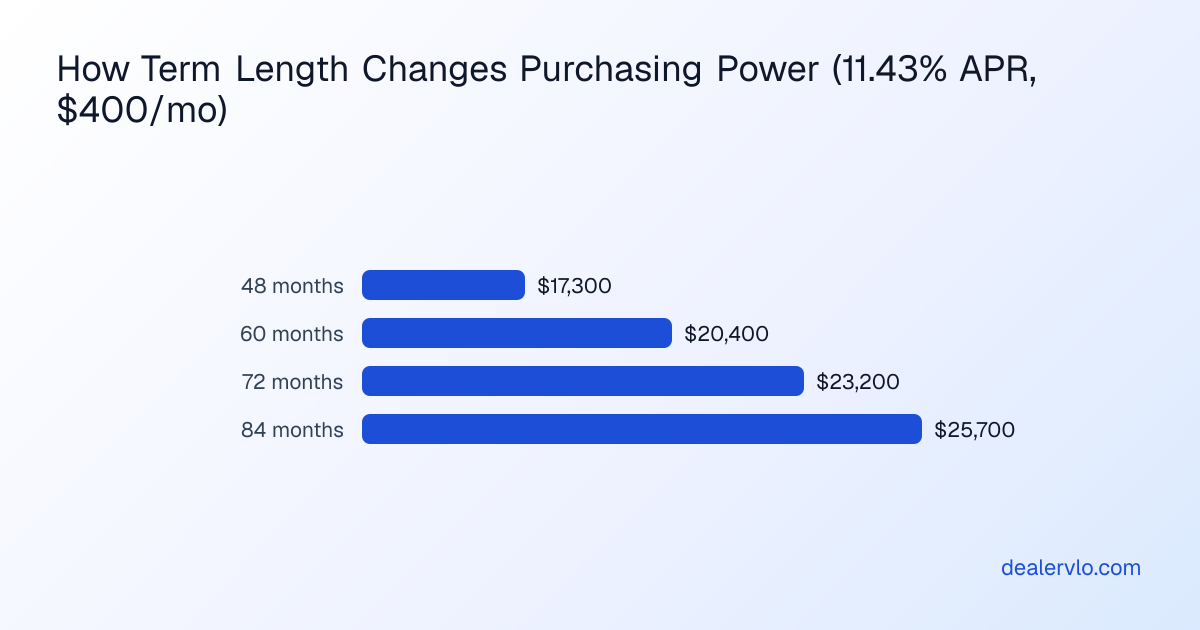
For a concrete example: a buyer with a $400 monthly budget, an 11.43 percent APR, and a 72-month term can finance roughly $23,200. If you drop that same buyer to 60 months, the financeable amount falls to around $20,400. That $2,800 difference is a higher-margin truck versus a cheaper sedan, or it's gross profit you don't have to give away.
Step 4: Add cash down and trade equity
The buyer's total purchasing power is the loan amount plus any cash they're putting down and any positive equity in their trade-in. If the buyer in step 3 has $2,000 down and a trade worth $3,000 with a $2,500 payoff (so $500 net equity), their out-the-door maximum is $23,200 + $2,000 + $500 = $25,700.
If the trade is upside-down, subtract the negative equity from the loan amount before you proceed (our guide to negative-equity trade-ins covers the payoff and the three ways to cover the shortfall). And remember: many states let you apply the trade-in value as a credit against the taxable sale price, which reduces the tax burden. For instance, Texas assesses its 6.25 percent sales tax on the net sale price after trade credit—on a $20,000 car with a $5,000 trade allowance, you're taxed on $15,000, saving the buyer $312.50. That credit effectively increases purchasing power, but the exact rule varies by state. Five states—Alaska, Delaware, Montana, New Hampshire, and Oregon—have no vehicle sales tax at all, which simplifies the math but isn't the reality for most of us.
Work backward from a customer's monthly payment to the highest vehicle price you can structure. Enter the trade allowance and the payoff separately and negative equity comes off the budget.
Open the Deal Structuring CalculatorStep 5: Work backward through fees and taxes to vehicle price
Now subtract all the mandatory add-ons to find the maximum vehicle selling price that fits the payment. The components you need to account for:
-
Sales tax: Varies by state and often by county or city. Some states apply a flat state rate; others stack county and municipal taxes on top, adding one to five percentage points. Look up your buyer's registration address, not your lot's location, because the rate follows where they title the vehicle.
-
Documentary fee: Your processing or doc fee. Roughly 15 states impose statutory caps—California famously caps it at $85 for most dealers, and Ohio's 2026 cap sits at $398. States without caps, like Georgia, Michigan, and Pennsylvania, leave it to the market; the national average in 2026 runs $350 to $500, and dealers in uncapped states routinely charge $700 or more. Whatever you charge, it must comply with your state's limit if one exists, and it has to be disclosed clearly. If a customer asks whether the doc fee is legally required, the honest answer is no—the work is required, but the fee amount is set by you within any state cap.
-
Title and registration fees: State-mandated, non-negotiable, and usually a few hundred dollars depending on the state and vehicle weight or value.
-
Optional products: Extended warranties, GAP insurance, paint protection, and dealer-installed accessories are not mandatory, and they don't factor into the payment-first calculation unless the buyer agrees to roll them into the loan. Keep them separate during the initial structure so you see the base deal clearly.
The formula is:
Maximum vehicle price = Out-the-door max − (sales tax + doc fee + title/reg fees)
Because sales tax is a percentage of the vehicle price in most states, this becomes a circular calculation—you need the price to compute the tax, but you need the tax to find the price. Solve it algebraically or use a deal structure tool that iterates to the answer. For rough mental math, if your combined tax rate is 7 percent and fees total $600, divide the buyer's remaining purchasing power by 1.07, then subtract the flat fees.
Why this method stops you from over-discounting
The biggest leak in traditional price-first desking: a buyer says they can't afford the payment on the truck you showed them, so you start cutting the price. You drop it $1,000, $1,500, maybe $2,000 before they agree. But if you'd started from their payment and worked backward, you'd have discovered that moving them from a 60-month term to a 72-month term at the same rate would have covered the entire gap without touching your gross.
At an 11.43 percent APR over 60 months, a $400 monthly payment supports a loan of roughly $20,400. Stretch that same $400 payment to 72 months and the supportable loan jumps to around $23,200—a $2,800 increase. That difference is often larger than the discount you'd otherwise give, and the buyer gets the vehicle they wanted at the payment they said they could afford. Yes, they pay more interest over the life of the loan, but that's their choice to make after you show them the term trade-offs and provide the Truth in Lending disclosures. Your job is to structure a deal that works; their job is to decide whether the term length fits their financial plan.
When payment-first desking reveals a mismatch early
Sometimes the reverse calculation tells you the deal won't work no matter how you structure it. A buyer wants a $28,000 truck, they have $1,000 down, no trade, a 15 percent interest rate because of credit issues, and they insist on a $350 monthly payment. Run the numbers: at 15 percent over 72 months, $350 a month finances roughly $18,800. Add the $1,000 down and you're at $19,800 total purchasing power. After a 7 percent sales tax and $500 in fees, the maximum vehicle price that fits is around $17,800. You're $10,000 apart before you even walk the lot.
That's not a negotiation problem—it's a reality problem. Payment-first desking surfaces it in the first five minutes, before you've spent an hour showing them inventory, running credit, and grinding on price. At that point you have options: show them vehicles in the $16,000–$18,000 range that do fit, help them find a cosigner or a larger down payment to increase purchasing power, or let them walk and work a deal that will actually close. What you don't do is show them the $28,000 truck, let them fall in love with it, then discover two hours later that no amount of discounting will make the payment work.
What you control and what you don't
In payment-first desking, you have three levers:
-
Term length: You can often move a buyer from 60 to 72 or 72 to 84 months if the lender approves it and the vehicle's age and mileage support the term. Longer terms lower the payment or increase the financeable amount.
-
Down payment and trade equity: If the numbers don't work, ask if the buyer can increase their down payment or if they have another trade asset. Even $500 more down can bridge a gap without cutting your gross.
-
Vehicle selection: If the truck they want doesn't fit, show them what does. Payment-first desking gives you a maximum vehicle price before you walk the lot, so you're not guessing.
What you don't control:
-
Interest rate: That's set by the lender based on the buyer's credit tier, and while you may have rate markup discretion within regulatory limits, you can't fix bad credit during the deal.
-
Sales tax and state fees: These are set by state and local governments. You collect and remit them; you don't waive them. Trade-in tax credits are state policy, not dealer concessions.
-
Doc fee caps: If your state caps the doc fee, you're bound by that cap. California's $85 limit, Illinois's $324.24, and Maryland's $500 cap are statutory. Charging above the cap isn't negotiation—it's a violation.
How this changes your inventory strategy
Once you start desking payment-first routinely, you notice patterns in what your buyers can actually finance. If your market is mostly subprime and near-prime buyers averaging 14 percent interest, and they come in with $300–$400 monthly budgets, your sweet spot might be $12,000–$16,000 vehicles, not the $22,000 trucks you've been stocking because the margin looks better. Payment-first desking makes your pricing strategy and your acquisition decisions converge—you stop buying cars that look profitable on paper but don't fit what your customers can structure.
It also changes how you present inventory. Instead of leading with "here's a great truck for $19,995," you can lead with "here's a truck that fits your $425 payment at 72 months with $2,000 down." The price is still disclosed—federal and state law require it, and hiding the price until after you've sold the payment is a recipe for distrust and complaints—but you're framing the deal around the number the buyer already told you matters most.
14-day free trial, then $29/mo · Cancel anytime
Truth in Lending compliance and payment-first desking
The federal Truth in Lending Act requires you to disclose the APR, finance charge, total of payments, monthly payment amount, and number of payments before the customer signs the retail installment contract. The Consumer Financial Protection Bureau enforces these rules and requires you to hand the buyer a fully completed disclosure, not a blank form to fill out later.
Payment-first desking actually makes TILA compliance easier, because you're calculating and discussing the exact payment, rate, and term from the start. By the time you sit down to finalize the paperwork, the buyer has already seen the numbers and agreed to them in principle. What you can't do is quote a payment during desking, then change the rate, term, or add undisclosed fees when you print the contract. The payment you desk is the payment that has to appear on the disclosure, or you redo the structure and get agreement again before they sign.
You must retain copies of the Truth in Lending disclosures for at least two years. If you're using a DMS or dealer paperwork software that auto-populates the federal disclosure from your deal structure, make sure it's pulling the correct APR (including any dealer markup within legal limits) and that the finance charge calculation includes all mandatory fees. Errors in the disclosure aren't just sloppy—they're federal compliance violations.
Common mistakes and how to avoid them
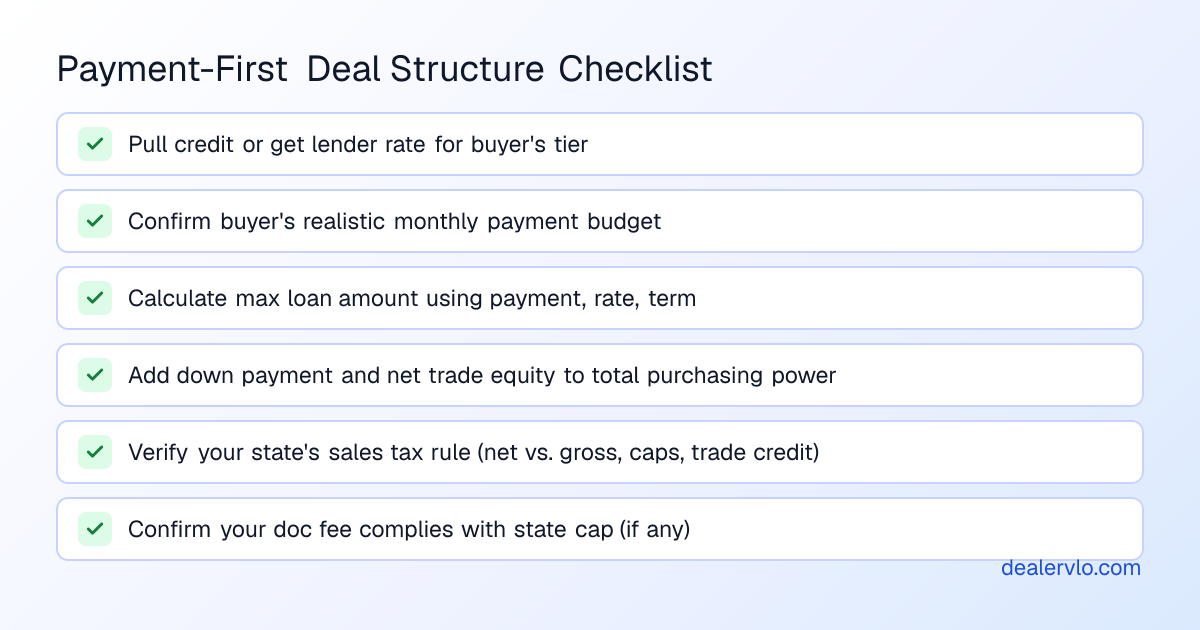
Forgetting that tax is calculated on net price after trade credit in many states. If your state allows a trade-in tax credit and you calculate tax on the full vehicle price, you'll overstate the payment or understate the maximum affordable vehicle price. Check your state's rule and apply it correctly.
Quoting a payment without confirming the buyer qualifies for the rate. If you desk a deal at 8 percent and the buyer's credit comes back at 16 percent, the payment you quoted is wrong and you're starting over. Pull credit before you finalize the structure, or desk it at a conservative rate and let a lower approved rate become a pleasant surprise.
Ignoring doc fee caps. If you're in a capped state and you charge above the limit, a customer complaint to your state motor vehicle regulator or attorney general can result in penalties and forced refunds. Know your state's cap and stay under it.
Showing vehicles outside the calculated range. Payment-first desking gives you a maximum vehicle price. If the buyer's max is $14,500 after tax and fees and you show them a $17,000 car because "maybe we can make it work," you're back to price-first thinking and you've wasted everyone's time.
Failing to explain term trade-offs. A 72-month loan costs the buyer more in total interest than a 60-month loan at the same rate, even if the monthly payment fits their budget. Show them both options, explain the total cost difference on the Truth in Lending disclosure, and let them choose. Don't just default to the longest term because it makes the deal easier to structure.
Tools and systems that make this faster
On my lot, I built DealerVLO because I got tired of spending 45 minutes per deal printing forms, running calculations in a spreadsheet, and copying numbers between screens. The software calculates the payment and works backward to vehicle price in real time as you adjust term, rate, down payment, and trade figures, and it auto-fills the state-specific title paperwork and federal disclosures so the numbers stay consistent. Other dealers now use it for the same reason—it's faster than paper, and it eliminates the manual errors that blow up deals or trigger compliance problems.
If you're still running deals on paper or in a spreadsheet, you can make payment-first desking work, but you'll need a financial calculator or an amortization table and you'll be doing the tax and fee math manually. A deal structure calculator speeds it up and reduces mistakes. Whatever system you use, the method is the same: payment and rate and term determine the loan amount, cash and trade equity add to purchasing power, and tax and fees subtract to reveal the maximum vehicle price.
How payment-first desking fits your deal jacket and compliance workflow
Every deal you close needs a complete deal jacket with the buyer's credit application, the Truth in Lending disclosure, the retail installment contract, the title application, the odometer disclosure, the buyer's guide (if required in your state), and any other state-mandated forms. Payment-first desking doesn't change what goes in the jacket—it changes how you arrive at the numbers that go on those forms.
When you desk the deal from the payment backward, you're calculating the same figures that will appear on the contract and the TILA statement before you print them, which makes the paperwork stage faster and less error-prone. The payment, APR, term, amount financed, and total of payments should match what you agreed on during the structure phase. If they don't, either you made a calculation error or you changed a variable without telling the buyer, and both are problems.
State-specific paperwork varies—if you're in Massachusetts like I am, you're filling out the RMV-1 title application and the damage disclosure; if you're in California, you've got different forms and the $85 doc fee cap to stay under. DealerVLO generates the correct forms for all 50 states, but whatever system you use, make sure your desking numbers feed cleanly into your state title forms so you're not re-keying data and introducing errors. For state-specific form checklists, see the guide for your state—our Massachusetts checklist covers the RMV-1 and damage disclosure, and we have similar guides for California, Florida, Texas, and others.
When to walk away from a deal that won't structure
Payment-first desking will show you deals that don't work before you invest time in them. If the buyer's credit, down payment, and monthly budget combine to a maximum vehicle price of $8,000 and your cheapest unit on the lot is $11,000, you're $3,000 apart and no amount of creative financing will close it. You have three choices: send them to a buy-here-pay-here lot that can carry the paper in-house at higher risk and higher rates, ask if they can bring more cash down or find a cosigner, or let them walk.
What you don't do is force the deal by hiding fees, misrepresenting the term or rate, or rolling so much negative equity and back-end product into the loan that the buyer is upside-down the day they drive off. Those deals blow up in complaints, chargebacks, and regulatory scrutiny, and they're not worth your license or your reputation. Payment-first desking gives you the math to know when to walk away; having the discipline to actually do it is what separates operators who stay in business from those who don't.
Frequently asked questions
How do I calculate the maximum loan amount from a monthly payment?
Use the amortization formula: take the monthly payment and divide it by the monthly interest rate, multiply by [1 − (1 + monthly rate) raised to the negative number of payments]. For example, a $400 payment at 11.43 percent APR over 72 months finances roughly $23,200. Most DMS platforms and deal structure calculators do this instantly, but the formula is standard loan math. Lock in the payment, rate, and term, and the maximum financeable amount falls out.
What happens if the buyer's target payment is too low for any car on my lot?
You have three options: show them that the payment they want only supports a lower-priced vehicle and walk them to your cheaper inventory, ask if they can increase their down payment or bring a cosigner to improve the loan amount, or let them walk and work a deal that will close. Payment-first desking reveals the mismatch in the first few minutes, so you're not wasting time on a deal that won't pencil. Sometimes the honest answer is "the truck you want is $18,000 and your payment supports $13,000—here's what fits your budget, or here's how much more down you'd need."
Can I legally charge any doc fee I want, or are there limits?
Roughly 15 states cap dealer documentation fees by statute. California caps it at $85, Ohio at $398 as of 2026, and several other states impose limits ranging from $150 to nearly $800. States without caps—like Georgia, Michigan, and Pennsylvania—leave it to the market, and the national average runs $350 to $500, with some dealers in uncapped states charging $700 or more. Check your state's current limit before you set your fee, because charging above a statutory cap isn't a negotiation issue—it's a violation that can trigger penalties and refunds.
Do all states let me subtract trade-in value before calculating sales tax?
No. Many states allow a trade-in tax credit, meaning you calculate sales tax on the net purchase price after subtracting the trade allowance—this is the rule in Texas and a number of other states. But not every state offers this credit, and five states—Alaska, Delaware, Montana, New Hampshire, and Oregon—have no vehicle sales tax at all. The rules vary by state, so confirm your state's trade-in tax treatment with your DMV or state motor vehicle authority before you quote an out-the-door price. Assuming a trade credit exists when your state doesn't allow one will make your tax calculation wrong and blow up the deal.
How does extending the loan term from 60 to 72 months change what the buyer can afford?
Extending the term lowers the monthly payment for the same loan amount, or increases the loan amount for the same monthly payment. At an 11.43 percent APR, a $400 monthly payment finances roughly $20,400 over 60 months but around $23,200 over 72 months—a $2,800 increase in purchasing power without changing the rate or the payment. The buyer pays more total interest over the life of the loan, and you must disclose that in the Truth in Lending statement, but stretching the term is often a better fit than discounting the vehicle. The average used-vehicle loan term in Q1 2026 was just under 68 months, and many lenders approve terms up to 84 months depending on the vehicle and the buyer's credit.
What disclosures do I have to give the buyer before they sign the contract?
The federal Truth in Lending Act requires you to provide written disclosure of the APR, the finance charge (total interest and certain fees over the life of the loan), the total of payments, the monthly payment amount, the number of payments, any late fees, and whether prepayment penalties apply. The Consumer Financial Protection Bureau enforces these rules, and the disclosure must be a fully completed form handed to the buyer before they sign the retail installment contract—you can't give them a blank form or wait until after signing. You must keep copies of these disclosures for at least two years. Payment-first desking makes compliance easier because you're calculating the exact payment, rate, and term up front, so the numbers you desk match the numbers on the disclosure.
Bottom line
Payment-first desking isn't a sales trick—it's a structural method that aligns what you show, what you price, and what the buyer can actually afford. Start with their monthly payment target, lock the rate and term, calculate the maximum they can finance, add down payment and trade equity, subtract tax and fees, and you're left with the highest vehicle price that delivers their payment. This keeps you from discounting cars that would pencil at a longer term, stops you from wasting time on mismatched inventory, and surfaces deal problems in minutes instead of hours.
The math is basic loan amortization. The disclosure requirements are federal law. The tax rules and doc fee caps are state-specific, and you need to know yours. But the logic is universal: if you know what a buyer can pay per month and what rate they qualify for, you can calculate what they can buy before you walk the lot. That's faster for you, clearer for them, and it results in deals that close instead of grind.
14-day free trial, then $29/mo · Cancel anytime