Negative-Equity Trade-Ins on a Small Lot: How to Structure the Deal Without Eating It
When a customer's payoff is bigger than your trade allowance: the equity math, getting the payoff right, three ways to cover the shortfall, and when to walk.
Part of the Selling & your sales team guide: The In-Person Used-Car Sale: From Test Drive to Close on an Independent Lot
Switching from another DMS? Compare DealerVLO to DealerCenter, Frazer, or Lot Wizard.
When a customer owes more on their trade than you'll allow for it, the difference is negative equity, and it has to go somewhere. The customer pays it in cash, it's added to the amount financed if the lender allows it, or the customer picks a cheaper car or walks. What you don't do is raise the trade number to make it disappear. That just moves the loss into your gross.
This is the dealer's side of the deal: the equity math, getting the payoff right (the part most articles skip), three honest ways to cover the shortfall, how to show the customer, and when to walk. It isn't legal advice, and your lender sets its own limits. (If you're a buyer trying to get out from under a car loan, the FTC's guide to negative equity is the place to start.)
14-day free trial, then $29/mo · Cancel anytime
The math: allowance minus the verified payoff
Trade equity is one subtraction: what you allow for the trade minus what's owed on it. When the answer is below zero, that's negative equity.
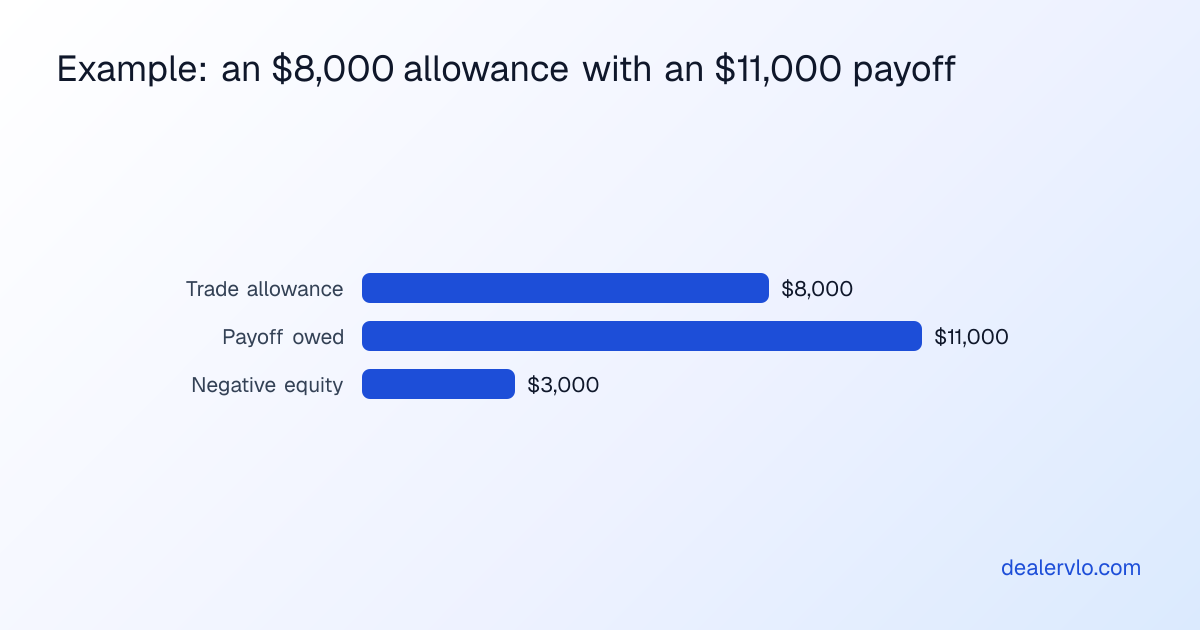
Here's an example. You appraise the customer's trade and allow $8,000. Their lender's written payoff quote says $11,000. Trade equity is $8,000 − $11,000 = −$3,000. That $3,000 doesn't vanish when they hand you the keys. You're paying off an $11,000 loan to take in an $8,000 car, and somebody has to fund the difference.
Two numbers in that subtraction have to be solid. The allowance comes from your appraisal, which our trade-in appraisal guide walks through. The payoff comes from the lender, in writing, which is the next section.
Get the payoff right first
Most of the negative-equity content out there is written for buyers, so it skips the part that actually lands on you: getting the payoff right and the check out the door on time.
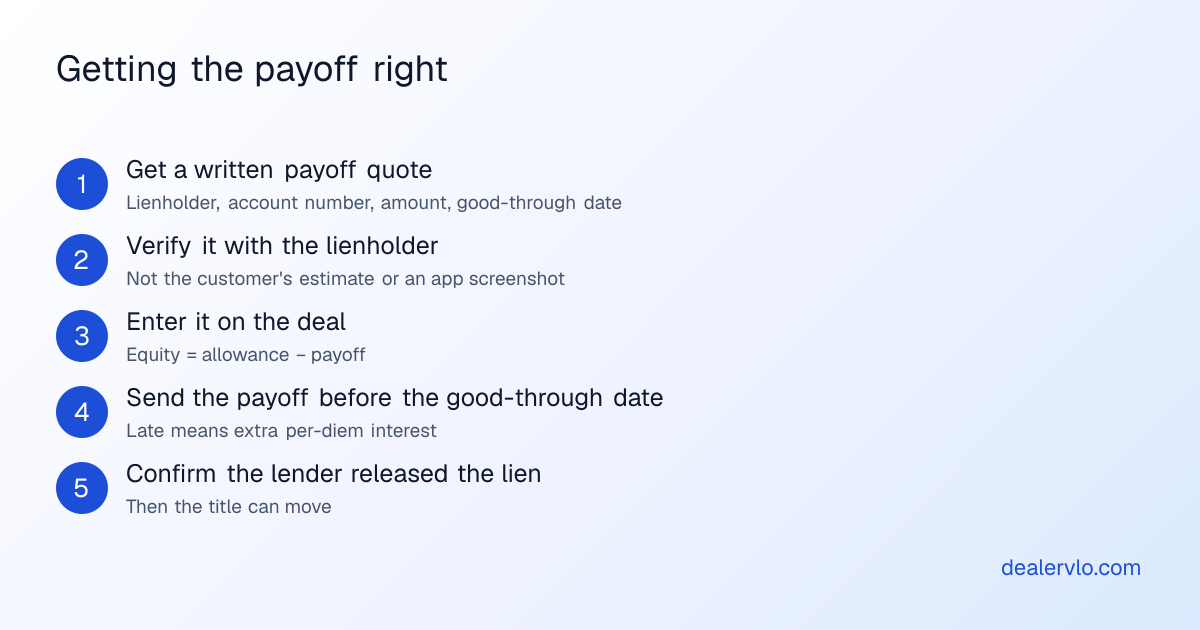
- Get a written payoff quote from the lienholder. Not the customer's guess, and not a screenshot of their banking app. A real quote has the lienholder's name, the account number, the payoff amount, the date it's good through, and the per-diem interest after that date.
- Watch the good-through date. A quote is only good for a set window. If your check lands after it, the lender will want the extra days of interest before it calls the loan paid. That money usually comes out of your pocket.
- Send it promptly and confirm it arrived. Then confirm the lender released the lien so the title can move. Until that happens, you own a car you can't retail cleanly.
In DealerVLO, the trade-in on a deal records the allowance and the payoff, plus the details you need to actually send the check: the lienholder, the loan account number (stored encrypted), the date the quote is good through, and the per-diem interest after that date. The per diem is stored for reference; DealerVLO doesn't recalculate the payoff from it, and it doesn't request, send or track payoffs or lien releases for you. That part is still you and the lender.
Don't bury the shortfall in the trade allowance
The tempting move is to "find" the $3,000 in the trade: allow $11,000 on an $8,000 car, and the payoff goes away on paper. Here's what actually happens. You now own a car worth $8,000 that you paid $11,000 for. When you retail or wholesale it, the $3,000 shows up as a loss on that car, which is to say it comes out of your gross.
Over-allowing also wrecks your own numbers. Your appraisals stop meaning anything, your inventory costs drift above market, and you start pricing cars to cover mistakes instead of to sell. Appraise the trade for what it's worth, take the real payoff, and let the shortfall be visible. Then you can decide how to cover it.
Three ways to cover the shortfall
Back to the example: $3,000 of negative equity on an $8,000 allowance. There are three honest options.
- The customer covers it in cash. They bring $3,000 more on top of their down payment. It's the cleanest version: the new loan only finances the car they're buying.
- It's added to the amount financed, if the lender allows it. The $3,000 rides on the new loan, so the loan balance, the payment and the loan-to-value all go up. Each lender sets its own limits, so ask yours before you quote a payment. On a financed deal the down payment can't go below zero to absorb the shortfall; the federal Truth in Lending rules have it show up as part of the amount financed instead (Regulation Z commentary).
- A cheaper car, or no deal. Sometimes the honest answer is a car where the payment still works with the shortfall rolled in, or no car today.
Option 2 is the most common, and it's worth knowing what it does to the customer. When the Consumer Financial Protection Bureau studied loans from nine lenders (three banks, three finance companies and three captive lenders) made from 2018 to 2022, it found the average negative equity financed on used-vehicle loans was $3,284. Loans carrying negative equity averaged a 73-month term, and those borrowers were more than twice as likely to have the account sent to repossession within two years as borrowers whose trade had positive equity.
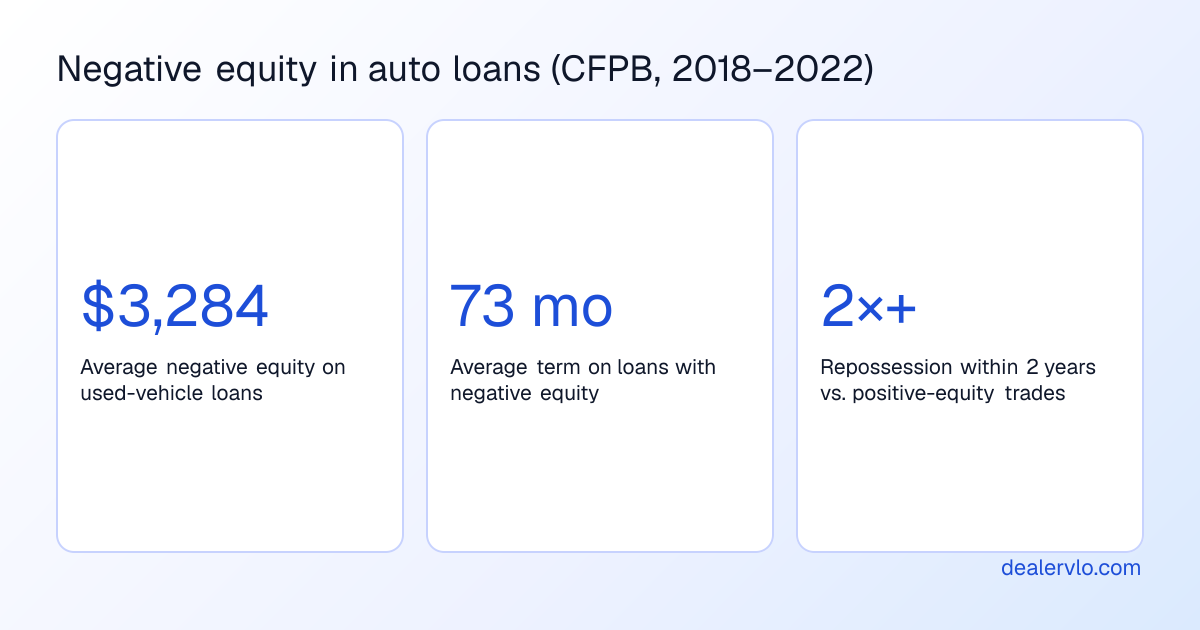
That data comes from big lenders, not small lots, but the direction is the point: rolled-in negative equity makes a loan harder to keep current. If you're the one carrying the paper, that's your risk.
To see what the shortfall does to the price a customer can afford, run their payment through the free calculator below with the trade allowance and the payoff entered separately.
Work backward from a customer's monthly payment to the highest vehicle price you can structure. Enter the trade allowance and the payoff separately and negative equity comes off the budget.
Open the Deal Structuring CalculatorShow the customer the math
Customers who are upside down usually know it, or half know it. What they don't want is a surprise at signing. Put the numbers in front of them early and plainly:
"Your car's worth $8,000 to us. Your lender says you owe $11,000. That leaves $3,000 we have to cover. We can do it a few ways: you put it down, we see if the bank will add it to the loan (that raises the payment to about this), or we look at a car where the payment still works."
Say it the same way every time, with the real numbers. The FTC's buyer guide specifically warns shoppers about dealers who promise to pay off the trade and then roll the balance into the new loan anyway, and calls that illegal. Never imply the shortfall is gone when it's been financed. Our post on qualifying questions covers getting the payoff conversation started before you're deep into a car.
When to walk the deal
Walk, or at least slow down, when:
- The shortfall is more than the lender will finance and the customer can't cover the rest in cash.
- The payment it creates is one they can't realistically make. A deal that comes back as a repossession isn't a sale.
- The payoff can't be verified. No written quote, no deal.
- You're the lender. On a buy-here-pay-here deal, rolling in negative equity means lending money that didn't buy any car. Decide your own limit, write it into your underwriting, and hold to it.
14-day free trial, then $29/mo · Cancel anytime
Where DealerVLO fits, and what it doesn't do
DealerVLO's deal jacket computes the deal math live as you type: totals, trade equity, payment, and front-end and F&I gross. When the payoff is more than the allowance, the deal shows the negative equity and adds it to the amount due, and the bill of sale and the retail installment contract each print it as its own line, so the shortfall is visible on the paperwork instead of hidden in the trade number.
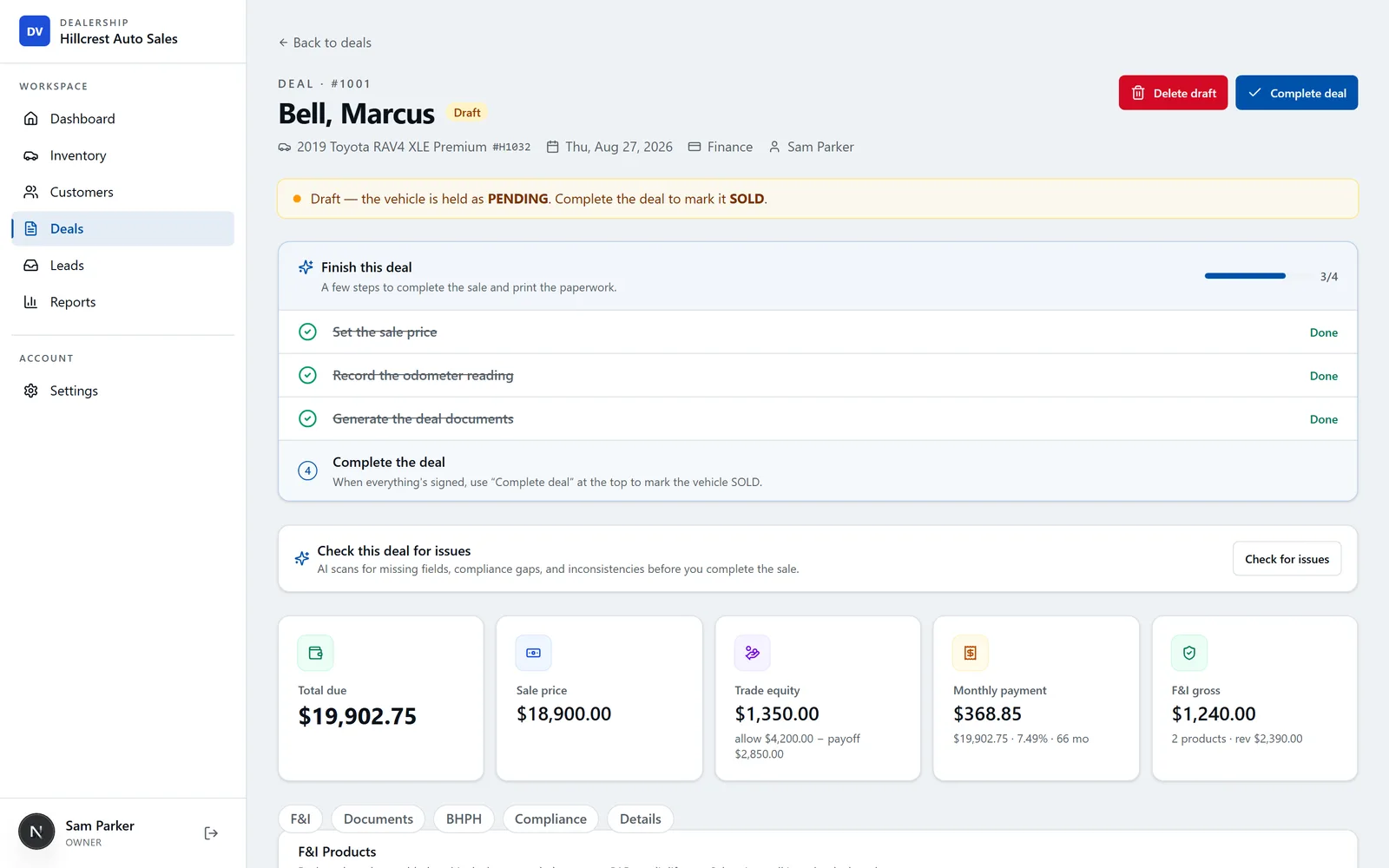
What it doesn't do: DealerVLO isn't a lender. It doesn't pull credit, make credit decisions, or send applications to lenders, and it doesn't know any lender's limits on negative equity. It doesn't request, send or track payoffs or lien releases, and it doesn't recalculate a payoff from the per diem. For the rest of the deal-structuring picture, see structuring a deal from the monthly payment and our list of lenders for independent dealers. It's $29 a month flat with unlimited users; see what's included.
Frequently asked questions
How do you calculate trade equity on a deal?
Trade equity is your trade allowance minus the verified payoff on the trade. If you allow $8,000 and the lender's written payoff quote says $11,000, the trade equity is minus $3,000. Use the payoff from a written quote with a good-through date, not the customer's estimate.
What do you do when the payoff is more than the trade is worth?
The shortfall has to be covered one of three ways: the customer pays it in cash, it's added to the amount financed if the lender allows it, or the customer picks a cheaper car or walks. What you shouldn't do is raise the trade allowance to hide it; that just moves the loss into your own gross.
Can you roll negative equity into a used-car loan?
Often, yes, if the lender approves it. The negative equity becomes part of the amount financed, so the loan, the payment and the loan-to-value all go up. Each lender sets its own limits, so check with yours before you promise anything. The down payment can't go below zero to absorb it; on the contract it shows up in the amount financed.
Should I raise the trade allowance to cover a customer's negative equity?
No. If the trade is worth $8,000 and you allow $11,000 to make the payoff disappear, you now own an $8,000 car you paid $11,000 for, and the $3,000 comes out of your gross. Appraise the trade honestly and show the shortfall as what it is.
What should a trade-in payoff quote include?
The lienholder's name, the loan account number, the payoff amount, the date the quote is good through, the per-diem interest after that date, and where to send the payment. Get it in writing from the lienholder, not from the customer's memory or an app screenshot.
What happens if the payoff quote expires before the payoff reaches the lender?
The lender will want the extra days of interest, and the balance won't be fully paid until it gets them. Someone has to cover that, and it's usually the dealer. Send the payoff well before the good-through date and confirm the lender received it.
When should I walk away from an upside-down trade?
When the shortfall is bigger than the lender will finance and the customer can't cover it in cash, or when the payment it creates is one the customer can't realistically make. A deal that only works by hiding the shortfall isn't a deal.
How do buy-here-pay-here dealers handle negative equity?
On a buy-here-pay-here deal you're the lender, so rolling negative equity in means you're lending money that didn't buy any car. Decide your own limit on how much, if any, you'll carry, write it into your underwriting, and apply it the same way on every deal.
Bottom line
Negative equity isn't a problem to make disappear. It's a number to put on the table. Appraise the trade honestly, get the payoff in writing, send it before the good-through date, and cover the shortfall in the open: cash, financed if the lender allows, or a different car. The deals that go wrong are the ones where the shortfall got hidden in the trade or glossed over at signing.
DealerVLO shows the trade equity live on every deal, keeps the payoff details on the trade, and prints the negative equity on the bill of sale and contract, for $29 a month flat.
14-day free trial, then $29/mo · Cancel anytime