Test-Drive Theft and Payment Fraud: How a Small Lot Protects Its Cars
A small lot loses a whole car two ways: a test drive that never comes back, or a payment that bounces. The on-lot controls that stop both.
Part of the Selling & your sales team guide: The In-Person Used-Car Sale: From Test Drive to Close on an Independent Lot
Switching from another DMS? Compare DealerVLO to DealerCenter, Frazer, or Lot Wizard.
There are two ways a small lot loses an entire car in one afternoon. The first is a test drive that never comes back: a pleasant buyer, a quick look at a license, keys handed over, and the car is three towns away before anyone thinks to call. The second is a buyer who pays with something that bounces: a cashier's check that looked perfect, a car and a title that left the same day, and a call from your bank two weeks later.
Neither one is about luck. Both happen when a lot has no written routine and someone skips a step because the buyer seemed fine. This post is the routine I'd want on any small lot: a test-drive policy, key control, when a GPS tracker earns its keep, how to check a cashier's check, and the red flags that should stop a deal cold. It's about the in-person side. For buyers you never meet, see remote car sales without getting burned.
Why a small lot is an easy target
A big store has a receptionist, a key machine and three people on the floor. A small lot often has one person who is also answering the phone, pulling a car around and writing up a deal. That's exactly the situation a thief looks for: busy staff, keys within reach, nobody watching the clock.
The loss is also bigger for you than for a big store. One missing unit can be a month's gross on a small lot, and if your floor plan lender still wants its payoff, you're paying for a car you no longer have. That's why the controls below are cheap and boring on purpose. They only work if they happen on every drive, including the ones with a buyer you like.
The test-drive policy: what happens before the keys move
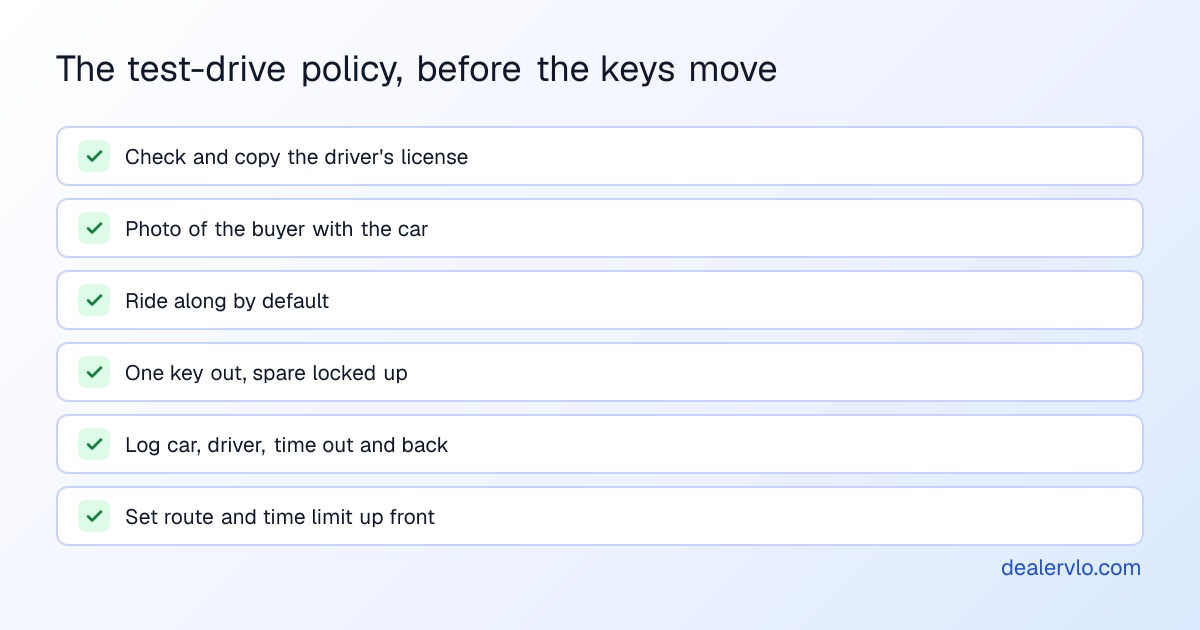
Write it down, keep it to one page, and make it the rule for everyone who hands out keys, including you. Here's what goes on it.
Check the license and copy it. Look at the photo and the person in front of you, check that it isn't expired, and keep a copy. How you're allowed to copy and store a driver's license varies by state, so ask your attorney or dealer association what applies to you, and keep the copies somewhere locked, not in an open folder on the desk. A buyer who won't let you copy their ID doesn't drive the car. That one rule filters out a lot of trouble.
Take a photo of the buyer with the car. It takes ten seconds on your phone and gives you a face, a plate and a timestamp if you ever need to file a report.
Ride along by default. Going with the buyer is also better selling, which the test drive to close walkthrough covers. A solo drive should be an exception you choose for a buyer you've vetted, on a short route, not something a buyer talks you into.
One key out at a time. The spare stays locked up, so a car can't go out on one key while someone pockets the other.
Log it. Car, driver, time out, expected time back. A clipboard is fine. The point is that someone notices when a car is twenty minutes late, while it's still nearby.
Set a route and a time limit. Tell the buyer up front: about fifteen minutes, this loop, back here. A buyer who wants an hour on the highway alone is telling you something.
If you use DealerVLO, the "Scan driver's license" button on the Add customer screen reads the barcode on the back of a US license with your phone's camera and fills in the buyer's name, date of birth, address and license number, with a warning if the license is expired. The license image is read on the phone and never uploaded. It's a fast way to have a customer record before the keys move. It is not a test-drive log, so keep the clipboard.
14-day free trial, then $29/mo · Cancel anytime
Key control on the lot
Most test-drive thefts start with a key that was too easy to grab. A few habits close that gap:
- Keys live in a locked box or cabinet, not on a pegboard by the door or in the cup holders.
- Only staff hand out keys. A buyer never gets sent out to the lot to "go grab the keys from the Accord."
- Count keys at close. Every car, every key, every night. A missing spare you find on Tuesday is a problem you can fix. A missing spare you find after the car is gone isn't.
- Swap keys if the buyer drove in. Some dealers hold the buyer's own car keys during a solo drive. It isn't foolproof, since a thief may have arrived in a car they don't care about, but it raises the cost of not coming back.
When a GPS tracker is worth it
A GPS tracker on inventory won't stop a theft, but it can shorten one, and that matters when the car is your capital. Whether it's worth it comes down to what a lost car costs you compared with what the tracker costs.
Pricing varies a lot by product: some are a one-time hardware purchase, others add a monthly or yearly service plan. Price a few, then compare the cost per car against your average unit. On a lot of $8,000 commuters with tight key control, a tracker on every car is probably overkill. On a $40,000 truck, or a model that thieves in your area like, one tracker that you move from car to car can be cheap insurance. If you put trackers on inventory, ask your attorney how to disclose them to buyers and make sure they're off before the car is sold.
Payment fraud: the cashier's check that isn't
The second way to lose a car is to hand it over for money that isn't real. The usual tool is a fake cashier's check, because buyers and sellers both treat a cashier's check like cash. It isn't. The FTC's page on fake check scams warns that fake checks can look real even to bank employees and can take weeks to be discovered. When one comes back, the bank takes the money back out of your account, and the car is long gone.
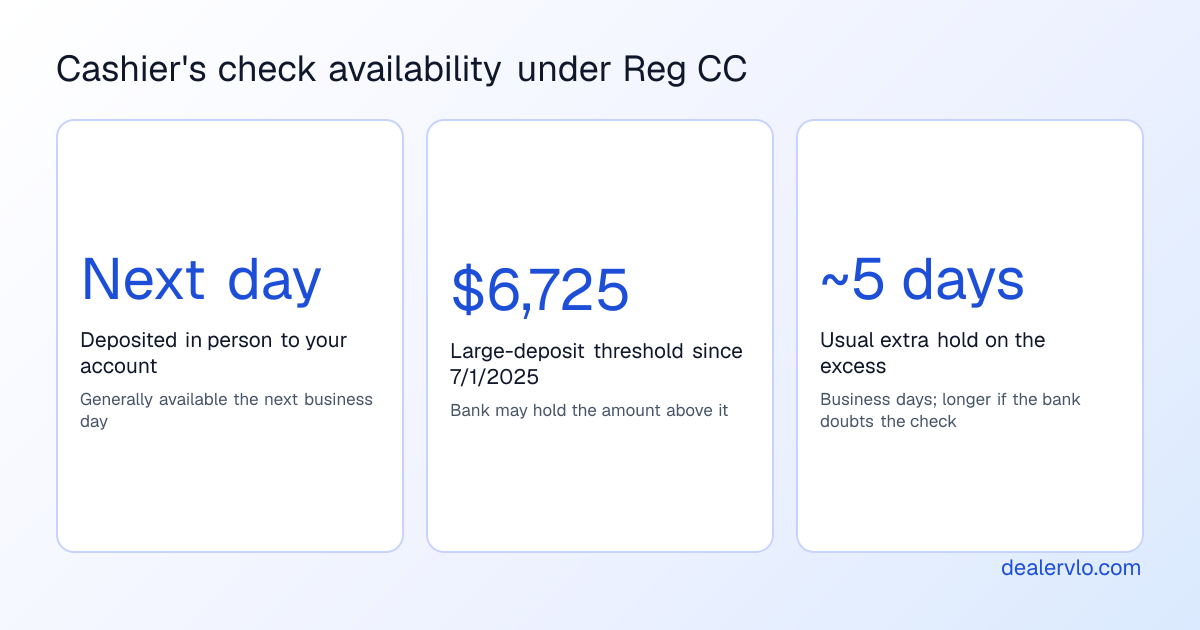
This is where most dealers get the rule wrong, so here is what federal law actually says. Under the Federal Reserve's Regulation CC, a cashier's check deposited in person into an account held by the person it's made out to is generally available the next business day (12 CFR 229.10). But there are exceptions (12 CFR 229.13):
- Large deposits. If your check deposits on one banking day total more than $6,725, the bank can hold the amount above $6,725 longer than the normal schedule, usually about five more business days. That threshold went up from $5,525 on July 1, 2025, so older articles still quote the old number. On a car deal, the check is almost always over it.
- Reasonable cause to doubt the check. If the bank has a real reason to believe a check won't be paid, it can hold it longer.
Your bank's funds-availability disclosure is the final word on your account, and this isn't legal advice. The part that matters on the lot is simpler: "available" doesn't mean "paid." Availability rules say when your bank has to let you use the money. They don't say the check is good. A counterfeit can sit in your account as available funds and still come back unpaid after the car has left.
How to verify a cashier's check before the car leaves
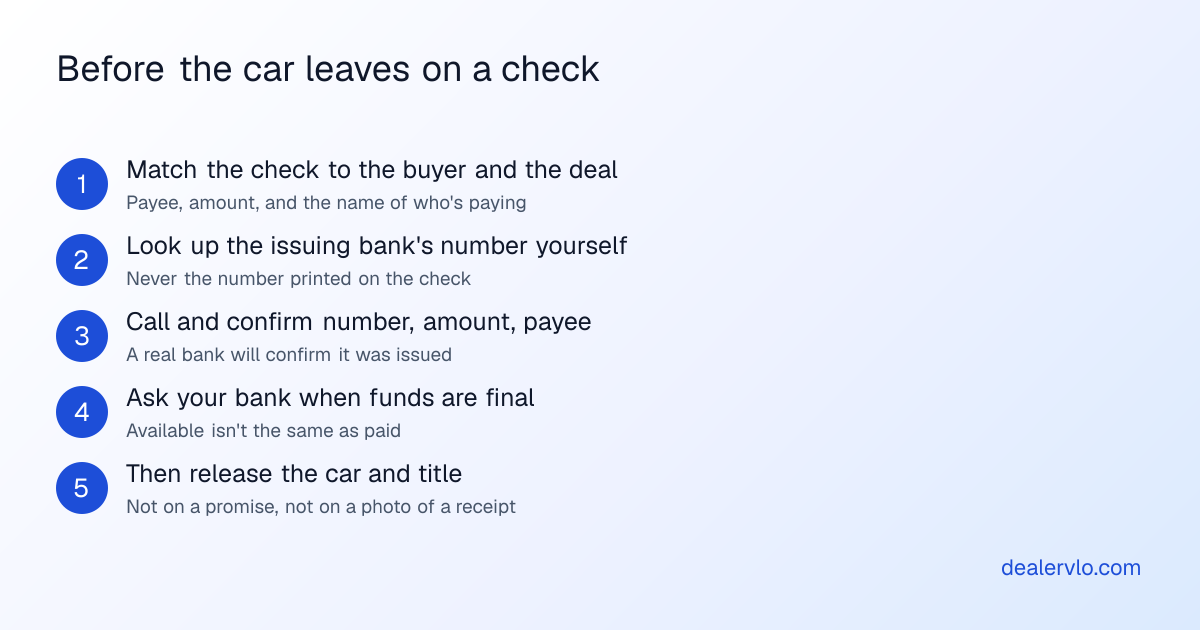
- Match it to the deal. The payee is your dealership, the amount is the total due on the buyer's order, and the person paying is the buyer on the deal. A check for more than the deal is a red flag on its own (more below).
- Look up the issuing bank's phone number yourself, from the bank's website or a branch listing. Never call the number printed on the check, because a fake check comes with a phone number that answers for the scammer.
- Call and confirm that the bank issued that check number, for that amount, to your dealership.
- Deposit it and ask your bank when the funds will be final, not just available.
- Release the car and the title only after that. If the buyer won't wait, take a deposit and schedule delivery for when the money is final. A real buyer with a real check can wait a few days. Wires deserve the same patience: confirm with your bank that a wire has landed. A screenshot of a sent wire isn't money.
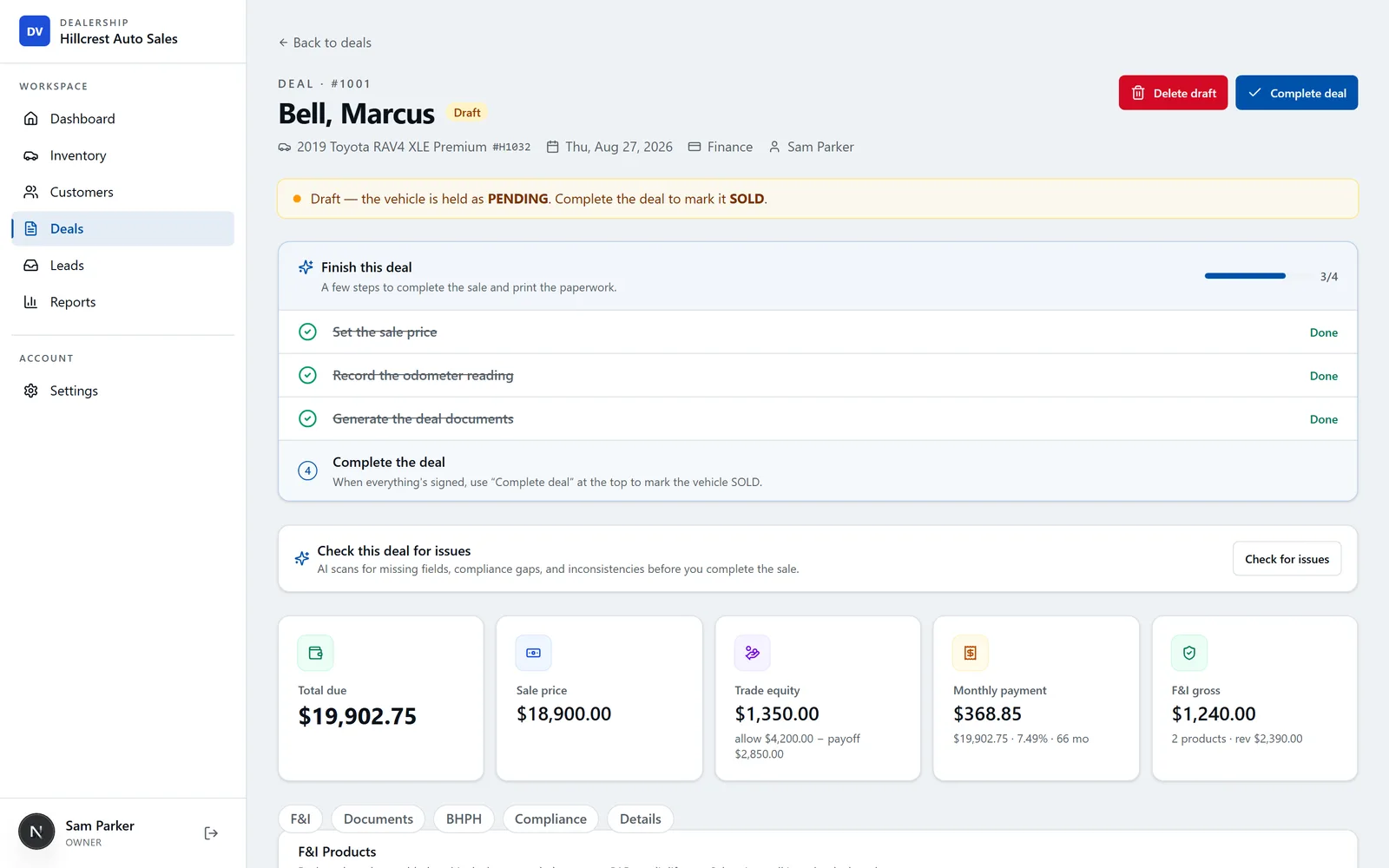
Step one is easier when the total due is already computed and printed. In DealerVLO the deal jacket works out the total from the price, trade, fees and taxes as you type, so you can hold the check up against the buyer's order and see in one glance whether the numbers match.
For how to take smaller deposits and down payments without eating card fees or chargebacks, see how dealers take deposits and down payments.
Red flags that should stop a deal
None of these proves fraud by itself. Each one is a reason to slow down and verify before anything leaves the lot:
- Overpayment. The buyer pays more than the deal and asks you to refund the difference, or to pay their "shipper" out of it. This is the classic fake-check play. Never refund anything until the original payment is final.
- Rush pickup. The buyer needs the car today, after the bank closes, or before the check could possibly clear.
- A third party paying. The check or wire comes from someone who isn't on the deal and who you never talk to.
- A shipper collecting the car. Someone you've never met shows up with a truck before the money is final.
- Names that don't match across the license, the check and the deal paperwork.
- Changed payment instructions by email. Confirm any change with a phone call to a number you already have.
Writing down that you checked helps too. DealerVLO's deal compliance checklist lets you record that the Red Flags (identity theft) review and the OFAC screen were done on each deal. It's a checklist you complete, not an automated screening service, but it means a busy Saturday doesn't skip the step. Deal documents can be e-signed in person or by emailed link, and if you turn on DealerVLO's online credit application, it deliberately doesn't collect Social Security or driver's license numbers. You collect the SSN in person or by phone before you pull credit.
14-day free trial, then $29/mo · Cancel anytime
Insurance: check before you need it
Don't assume your policy covers a car stolen on a fake test drive. Many dealer physical-damage policies exclude losses where someone takes a car by trick or fraud unless you buy false pretense coverage back. The used car dealer insurance guide explains how dealers open lot and false pretense coverage fit together. Ask your agent, in writing, how your policy handles a car that leaves on a test drive and doesn't come back, and how it handles a car released on a payment that bounces.
Frequently asked questions
How do car dealers prevent test drive theft?
With a written test-drive policy everyone follows: check and copy the driver's license and take a photo of the buyer with the car before any keys move, ride along by default, hand out one key at a time and keep the spare locked up, log who took which car and when, and set a route and a time limit. Most test-drive thefts depend on a salesperson skipping one of those steps because the buyer seemed fine.
Does the bank have to make a cashier's check available the next day?
Generally, yes. Under the Federal Reserve's Regulation CC, a cashier's check deposited in person into an account held by the person it's made out to is normally available the next business day. But if your check deposits that day total more than $6,725 (the threshold since July 1, 2025), the bank can hold the amount above $6,725 for longer, usually about five more business days, and it can hold any check longer if it has reasonable cause to doubt it will be paid. Your bank's own funds-availability disclosure is the final word on your account.
If a cashier's check shows as available, is it safe to release the car?
No. Available means the bank is letting you use the money, not that the check has been paid by the bank it's drawn on. The FTC warns that fake checks can look real even to bank employees and can take weeks to be discovered, and when one comes back you owe the bank the money. Call the issuing bank at a number you look up yourself to confirm the check, and on a large or unusual payment, wait until your bank confirms the funds are final before the car or the title leaves.
Should a car dealer let customers test drive alone?
Ride along by default. A solo drive is a judgment call for a buyer you've vetted, on a short set route, after you've copied their license, photographed them with the car and confirmed with your insurance agent how your policy treats unaccompanied drives. Never hand over keys solo to someone who won't let you copy their ID.
Does dealer insurance cover a car stolen on a test drive?
Don't assume it does. Many dealer physical-damage policies exclude a loss where someone takes a car by trick, such as a fake test drive, unless you've bought false pretense coverage back. Ask your agent exactly how your policy handles it before you need it.
Bottom line
You won't stop every thief, but most of them are counting on a busy lot skipping a step. Put the test-drive policy on paper, lock up the keys, and treat every cashier's check as unpaid until you've called the bank yourself and your own bank says the money is final. "Available" is a banking rule, not a guarantee. A real buyer will wait a day. A thief won't.
DealerVLO is the DMS I run my own lot on: license scanning into customer records, a deal jacket that computes the total due, a Red Flags and OFAC checklist on every deal, and e-signatures, for $29 a month flat. Start your free 14-day trial at dealervlo.com/signup.