Car Sales Qualifying Questions: What to Ask a Walk-In Buyer (and What Not to Ask)
A working question bank for qualifying walk-ins: budget, timeline, financing method, trade-in, decision-makers, and usage — plus what not to ask.
Part of the Selling & your sales team guide: The In-Person Used-Car Sale: From Test Drive to Close on an Independent Lot
Why qualifying questions matter when you're doing everything yourself
When you're the one greeting the walk-in, showing the car, working the numbers, and printing the paperwork, you can't afford to spend an hour on someone who's three months away from buying or shopping a price range you don't stock. Asking the right qualifying questions up front tells you whether you have a real buyer today, what you need to show them, and how much time to invest before you move to the next lead.
This is a question bank, not a walkthrough of the sale. For the full in-person sale flow — test drive, presentation, close — read the in-person used-car sale guide. That pillar covers qualifying without interrogating in context; this article goes deeper on the specific questions to ask, why each one matters, what different answers tell you, and the clumsier version of each question to avoid.
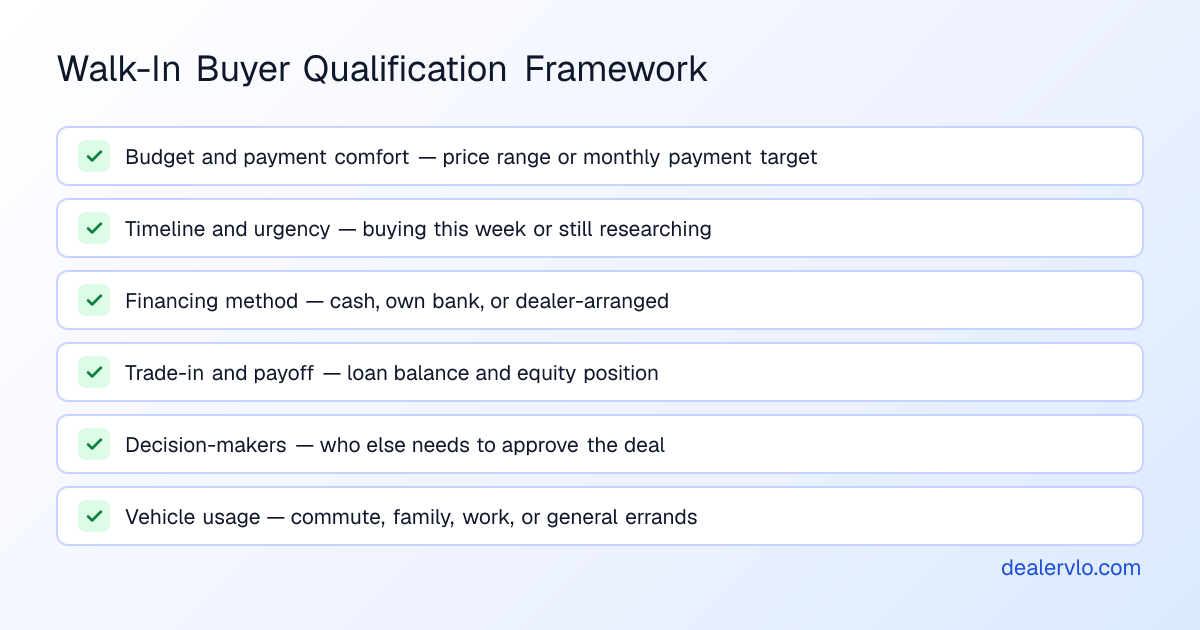
The best qualifying happens in a relaxed, conversational order — not a rapid-fire list. Ask one question, listen all the way through, then use what they said to guide the next one. The goal is to learn six things fast: their budget and payment comfort, their timeline, how they plan to pay, whether there's a trade, who else is part of the decision, and how they'll use the vehicle.
Budget and payment comfort
The question:
"Do you have a specific price range you want to stay in, or a monthly payment that works for your budget?"
Why it matters:
This tells you which cars on your lot to show and whether you're even in the same ballpark. A buyer comfortable at $300 a month is looking at a very different inventory than one who can do $500, and you need to know that before you walk them to a car they can't afford.
What different answers tell you:
- "I want to keep it under $15,000" or "around $250 a month" — Clear target; you can show cars in that range and structure a deal to hit it.
- "I'm not sure yet" or "depends on the car" — They haven't done the math or don't want to say. You'll need to feel them out by showing a mid-range car and watching their reaction.
- "I'm paying cash, so price is what matters" — Skip payment talk; focus on the sale price and any prep or warranty you include.
The clumsier version to avoid:
"You probably can't afford the high-end model, right?"
Assumptive questions about what someone can or can't afford put people on defense immediately. Ask about the range they're targeting, not the limit they're stuck with.
DealerVLO shows each car's all-in cost — purchase price plus every line-item recon expense — so you know your true margin before you quote a price or structure a payment.
14-day free trial, then $29/mo · Cancel anytime
Timeline and urgency
The question:
"What's your timeline? Are you looking to drive something home this week, or are you still in the research phase?"
Why it matters:
A buyer who needs a car today because theirs just died is a very different conversation than someone casually browsing. The first one is ready to make a decision if the numbers work; the second one might come back in a month, or never. Knowing the timeline helps you decide how much time to invest right now and whether to push for a close or set a follow-up.
What different answers tell you:
- "My car won't pass inspection" or "I need something by the end of the week" — High urgency. They're motivated, and if you have the right car at the right price, you can close today.
- "I'm just starting to look" or "maybe in the next month or two" — Low urgency. Get their contact info, show them what you have, and follow up later. Don't spend an hour on the demo if you have other leads.
- "I'm trading my car in and want to know what it's worth" — They're serious enough to consider a trade, which usually means they're closer to buying. Keep going.
The clumsier version to avoid:
"So you're just tire-kicking today?"
This sounds dismissive, and even if they are just looking, you've lost them. Ask about the timeline neutrally and let them tell you.
Every lead that comes into DealerVLO — phone, web form, or email — records its source and timestamp, so you can see who walked in cold, who filled out an online form, and how long ago. That helps you prioritize who to call back first and who to keep warm for later.
How they plan to pay
The question:
"How were you thinking of paying — cash, financing through your own bank or credit union, or would you like us to help arrange financing?"
Why it matters:
This tells you whether you're going to earn any F&I gross, whether they already have a rate in mind, and how long the paperwork will take. A cash buyer or someone with their own approval is simpler and faster; someone who needs dealer-arranged financing opens the door to working with your lenders and potentially earning points or placing a warranty.
What different answers tell you:
- "I'm paying cash" — Straightforward. Price and prep are the main levers; F&I products are optional but less likely.
- "I already got approved at my credit union" — They have a rate and an amount. You can still shop it with your lenders if you have better terms, but they're not walking in blind.
- "I'll need financing, and I'm not sure where" — This is your F&I opportunity. You'll work with your lenders, and you have room to structure the deal with reserve or products.
- "I have bad credit" — Manage expectations early: rates will be higher, down payment matters, and you may need to show cars in a narrower price range.
The clumsier version to avoid:
"What's your credit score?" or "Do you have bad credit?"
Opening with credit questions feels intrusive and adversarial. Ask about their plan for paying first; you'll get to credit details later if dealer financing is in play.
DealerVLO's deal jacket computes the payment live as you adjust the sale price, down payment, term, and rate — so when a buyer says they want to stay at $300 a month, you can show them what that looks like with their trade equity and the rate you expect, before you print anything. If you offer dealer-arranged financing, you can let buyers submit a credit application online through your DealerVLO site; it deliberately does not collect a Social Security number online (you get that in person or by phone before you pull credit), and every application is encrypted and logged.
Trade-in and payoff
The question:
"Are you trading anything in? And if so, is there a loan on it, and roughly what's still owed?"
Why it matters:
A trade changes the structure of the deal. If they have equity, it becomes their down payment; if they're upside down, the negative equity rolls into the new loan and raises the amount you need to finance. Knowing the rough payoff up front tells you whether the deal is even possible at the price they want, and whether you need to adjust the car you show them or the terms you offer.
What different answers tell you:
- "No trade" — One less thing to appraise and one less payoff to confirm. Move on.
- "Yes, and it's paid off" or "I own it outright" — All the trade value is equity. Appraise it, agree on a number, and use it as the down payment.
- "Yes, and I owe about $8,000 on it" — You'll need to confirm the actual payoff with their lender (a ten-day payoff quote is standard), then compare that to what you'll give them for the car. If your appraisal is $10,000 and they owe $8,000, they have $2,000 equity. If your appraisal is $6,000 and they owe $8,000, they're $2,000 upside down, and that $2,000 either gets added to the new loan or paid in cash.
- "I think I still owe something, but I'm not sure how much" — Tell them to call their lender and get the payoff, or do it yourself once you have their account details and permission. You can't structure the deal until you know the real number.
The clumsier version to avoid:
"You're probably upside down, right?"
Don't assume negative equity out loud, even if the car and the year make it likely. Ask the neutral question, get the payoff, and do the math.
The actual payoff is confirmed with the lender — not the customer's last statement — because the balance includes per-diem interest through the payoff date. For the mechanics of how payoffs, lien releases, and equity work, read the private-party acquisition guide; the same process applies to trade-ins.
DealerVLO's deal jacket has dedicated fields for the trade vehicle, your appraisal, and the payoff amount, and it computes the net trade equity (positive or negative) automatically. That number flows into the deal math so you see the real cash down, amount financed, and payment all in one view.
14-day free trial, then $29/mo · Cancel anytime
Decision-makers
The question:
"Is it just you making the decision, or is there anyone else you want to involve before we move forward?"
Why it matters:
If a spouse, parent, or friend has to approve the deal, you need to know now — before you spend an hour negotiating, only to hear "I need to talk to my wife first" at the end. Ideally, everyone who has a say is there during the walk-around and test drive, so you don't have to start over.
What different answers tell you:
- "Just me" — You have one decision-maker. If they say yes, you can close.
- "My husband is at work, but he trusts me to pick" — Confirm whether he's okay with the price and payment before you do paperwork. If there's any doubt, get him on the phone or reschedule for when he can come in.
- "I need to bring my dad back to see it" — The dad is the real buyer, or at least has veto power. Invite them both to come back, and focus your time on him when he does.
- "My co-signer has to approve it" — The co-signer is part of the financing conversation. Get their information early so your lender can pre-qualify both of them.
The clumsier version to avoid:
"Does your wife let you buy cars without her?"
This sounds condescending no matter who you're asking. Phrase it as a neutral logistics question: who needs to be part of the conversation?
If you're working online leads, ask about decision-makers when you're setting the appointment, so everyone who matters shows up the first time.
Quote a payoff on an in-house note — current balance plus per-diem interest, good through a date.
Open the BHPH Payoff CalculatorHow the vehicle will be used
The question:
"What are you mainly going to use this for? Daily commute, family hauling, work, or something else?"
Why it matters:
Usage tells you which features to highlight and which cars to steer them toward. Someone with a 60-mile highway commute cares about fuel economy and comfort; someone hauling kids and gear needs space and safety features; someone using it for work needs reliability and low maintenance. When you know the use case, you can tie the car's specifics — mileage, options, history — to what actually matters to them.
What different answers tell you:
- "Daily commute, about 30 miles each way" — Fuel economy, highway manners, and a solid service history matter. Show them something with reasonable miles, a recent timing belt or major service if applicable, and good MPG.
- "I need to fit three car seats" — Space is non-negotiable. Show them a minivan, three-row SUV, or a sedan with a wide back seat, and let them test the seat install before they commit.
- "I run a handyman business, so I need a truck" — Bed length, towing capacity, and condition of the suspension matter more than heated seats. Show them a work-ready truck, not a luxury model.
- "Just running errands and getting groceries" — Low miles per year, so reliability and ease of use matter more than fuel economy. A well-maintained older car with low annual mileage is a good fit.
The clumsier version to avoid:
"You don't need all those fancy features, right?"
Don't tell them what they need. Ask how they'll use it, then recommend the car that fits.
DealerVLO's inventory view shows every car's mileage, days on the lot, recon notes, and photos in one scrollable list, so when a buyer describes their use case, you can scan your stock and pick the two or three best fits without flipping between a spreadsheet and a key board.
What not to ask: keep it to the car and the deal
Your qualifying questions should cover the vehicle, the budget, the timeline, the trade, who's deciding, and how they plan to pay. Stick to that. Personal questions unrelated to the sale — where they work, what they do for a living, their family situation, their credit history before you've agreed to help with financing — feel intrusive and shift the tone from helpful to interrogative. If the conversation wanders into territory that doesn't help you show them the right car or close the deal, steer it back.
How DealerVLO organizes the answers so you don't lose them
Once you've qualified a walk-in, you need a place to record what you learned — otherwise you're re-asking the same questions when they come back, or your salesperson is guessing at the payment structure when you're ready to write it up.
DealerVLO's deal jacket captures all of it: the customer's contact information, the car they're buying, the trade vehicle and payoff, the payment terms, and the F&I products. The deal math updates live as you adjust the numbers, so you can show them the payment with different down payments or terms without printing three versions. Every deal stays in the system with its full history, so if they leave and come back two days later, you pull up the same jacket and pick up exactly where you left off.
If you're working online leads, DealerVLO's lead inbox records the source, timestamp, and every reply, so you can see who's responding and who's gone cold. That helps you prioritize your callbacks and follow-ups without a separate spreadsheet.
14-day free trial, then $29/mo · Cancel anytime
Keep the questions in order and the tone conversational
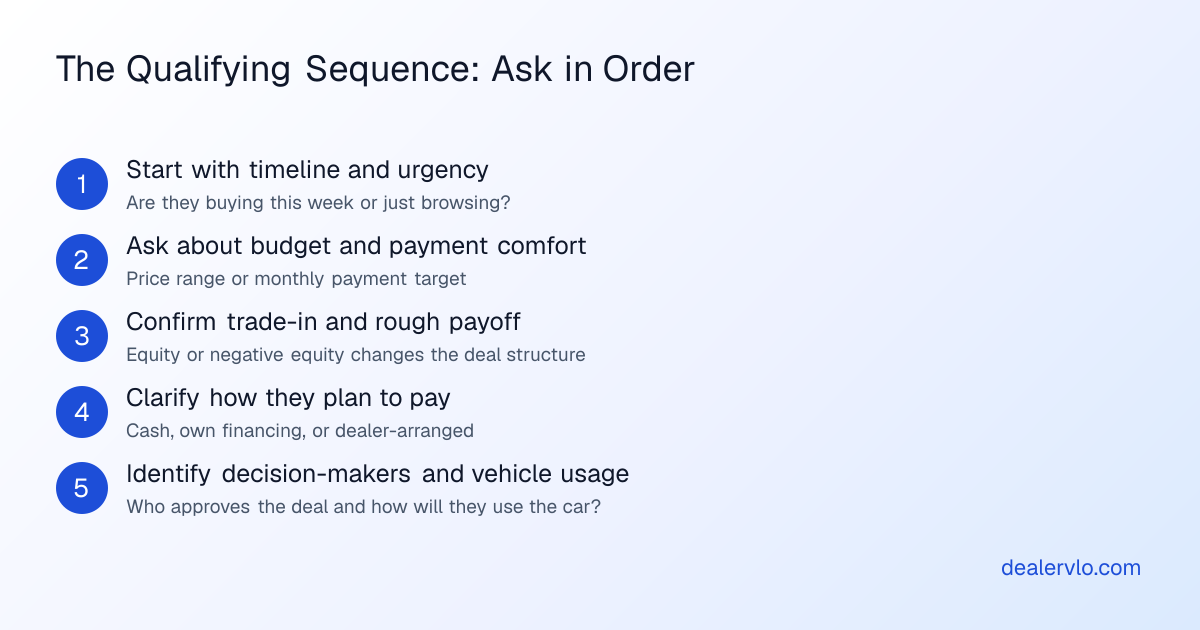
Effective car sales discovery questions follow a sequence: rapport first, then motive and timeline, then budget and payment, then vehicle fit. That flow keeps the buyer from feeling interrogated and keeps you in control of the conversation.
Ask one question at a time. Listen all the way through. Use what they said to guide the next question. If they say "I need something this week because my car died," you know urgency is high and you can move quickly. If they say "I'm just starting to look," you know to get their contact info and not spend an hour on a demo if you have other leads waiting.
The clumsier version of every qualifying question assumes something negative — low budget, bad credit, no decision authority — and puts the buyer on defense. The better version asks neutrally and lets them tell you. That difference in tone is what separates a qualifying conversation from an interrogation, and it's why the best salespeople listen more than they talk.
Tie your pay plan to the behaviors you want
If you're hiring salespeople, the way you pay them shapes how they qualify buyers — or whether they skip it. A commission structure that rewards volume over gross encourages cutting price to close fast; a structure that rewards gross profit encourages working the qualifying questions so the salesperson knows the buyer's real budget and shows them the right car the first time.
For a breakdown of commission structures that don't leak gross, read the used-car sales pay plan guide. If you're hiring your first salesperson, the hiring guide covers when to do it, what to look for, and how to structure the first comp plan so you don't pay too much or too little. And if you need to measure whether your salesperson is actually qualifying buyers or just throwing keys, the performance measurement guide walks through the metrics that matter on a small lot.
DealerVLO's sales report shows front-end and back-end gross per deal, plus a salesperson leaderboard if you have a team, so you can see who's closing at full gross and who's giving the lot away. Every deal ties to a salesperson, and you can filter the report by date range, salesperson, or both.
Frequently asked questions
What are the most important qualifying questions to ask a car buyer?
The six most important questions cover budget and payment comfort, timeline, how they plan to pay (cash, their own financing, or dealer-arranged), whether there's a trade-in and what's owed on it, who else is part of the decision, and how the vehicle will be used. These tell you which cars to show, how urgent the sale is, and whether you can close today or need to follow up later.
How do you qualify a car buyer without sounding like you're interrogating them?
Ask one question at a time in a conversational tone, listen all the way through, and use their answer to guide the next question. Avoid assumptive questions like "You probably can't afford that, right?" and stick to neutral phrasing: "Do you have a specific price range you want to stay in?" The sequence matters as much as the words — rapport first, then motive and timeline, then budget and vehicle fit.
What should I ask about a trade-in during the qualifying conversation?
Ask one plain question: "Are you trading anything in? And if so, is there a loan on it, and roughly what's still owed?" The rough payoff tells you whether they have equity or are upside down, which changes the structure of the deal. The actual payoff is confirmed with the lender later — a ten-day payoff quote is standard — so you don't need exact numbers during the initial walk-around.
What are the clumsier versions of qualifying questions I should avoid?
Avoid opening with credit questions like "What's your credit score?" or "Do you have bad credit?" Ask about their plan for paying first. Avoid assumptive budget questions like "You probably can't afford the high-end model, right?" Ask about the range they're targeting instead. And avoid dismissive timeline questions like "So you're just tire-kicking today?" Ask neutrally when they're looking to buy and let them tell you.
How do I know if a walk-in buyer is ready to buy today or just looking?
Ask about their timeline directly: "Are you looking to drive something home this week, or are you still in the research phase?" High-urgency signals include needing a car because theirs died, failed inspection, or is costing too much to fix. Low-urgency signals include "just starting to look" or "maybe in a month or two." If they brought a trade or already got approved for financing, they're usually serious.
What questions should I avoid asking a buyer during qualification?
Skip personal questions unrelated to the sale — where they work, what they do for a living, family details, or anything that doesn't help you show them the right car or structure the deal. Keep your questions focused on the vehicle, the budget, the timeline, the trade, who's making the decision, and how they plan to pay. If the conversation wanders into territory that doesn't help you close, steer it back.
Bottom line
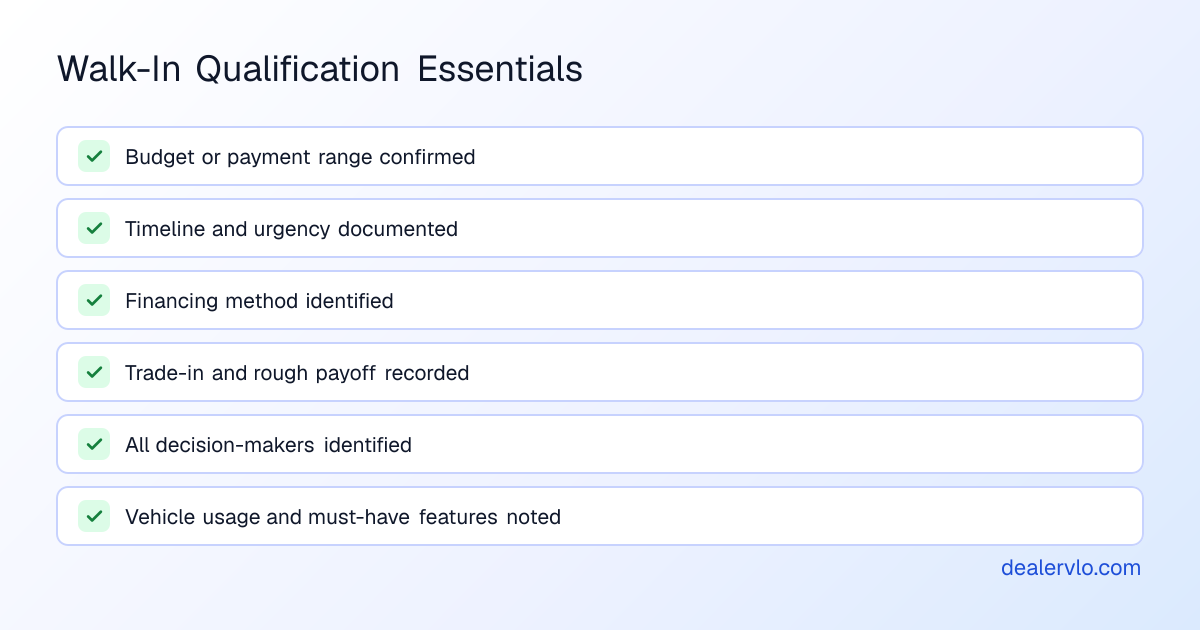
Qualifying a walk-in efficiently means asking six things in order: budget, timeline, how they plan to pay, trade-in and payoff, decision-makers, and how they'll use the vehicle. Ask each question once, listen all the way through, and skip the assumptive or intrusive versions that put buyers on defense. The answers tell you which cars to show, whether you can close today, and how to structure the deal so it works for both of you.
DealerVLO handles the deal math, the trade equity calculation, the payment structure, and the forms — so once you've qualified the buyer, you can move straight to writing it up without switching between a calculator, a spreadsheet, and a filing cabinet. Start your free trial at signup and see how the deal jacket keeps everything in one place.