How to Measure Salesperson Performance at a Used-Car Dealership
Units sold is the wrong scoreboard. Measure gross, average per unit, cash-vs-finance mix, and close rate — and you'll see which salesperson is actually making you money.

Here's a question that will change how you run your sales floor: is the salesperson at the top of your units board actually your most valuable one? On a lot of lots, the answer is no — and you'd never know it, because you're keeping score with the wrong number.
Why is units sold the wrong way to rank salespeople?
Ranking salespeople on units sold rewards exactly the behavior that thins your gross: discount hard, skip the back-end, move metal. The person who sells eight cars at a healthy margin can make you more money than the person who sells ten by giving away price — but on a units board, the discounter wins and your best closer looks average.
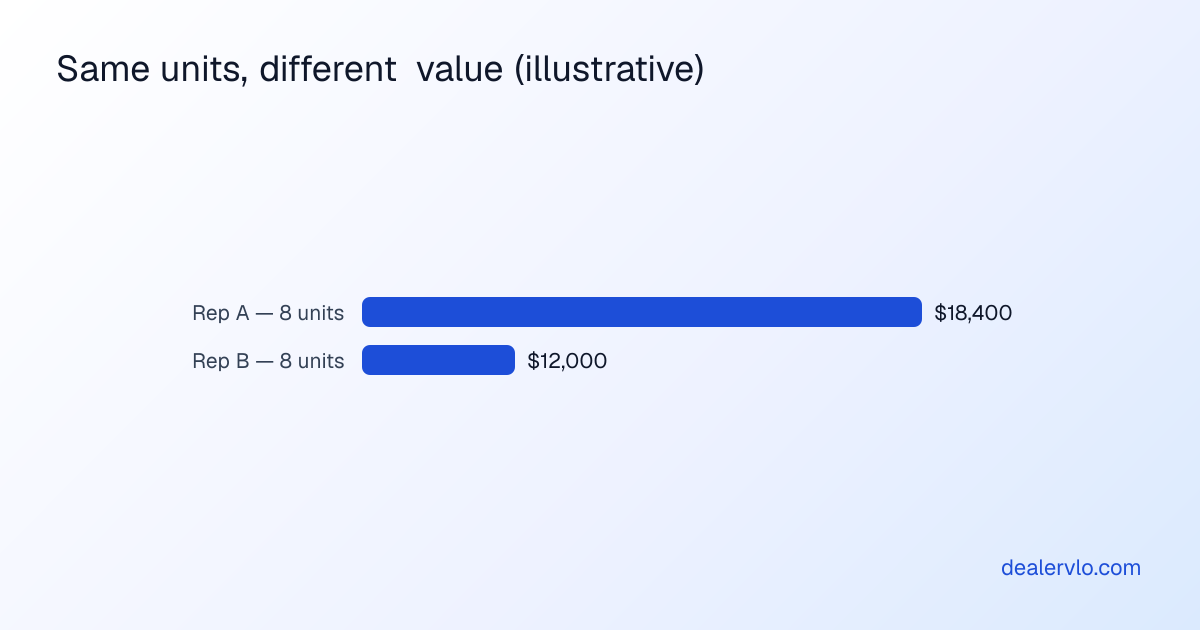
(Illustrative — same eight units, very different total gross. The gap is almost always front-end discounting plus whether they worked the back-end.)
Units is a fine measure of workload and a fine tiebreaker. It's a terrible ranking. What you actually want to rank on is gross — and especially average gross per unit, the quality signal units completely hide.
What metrics measure salesperson performance?
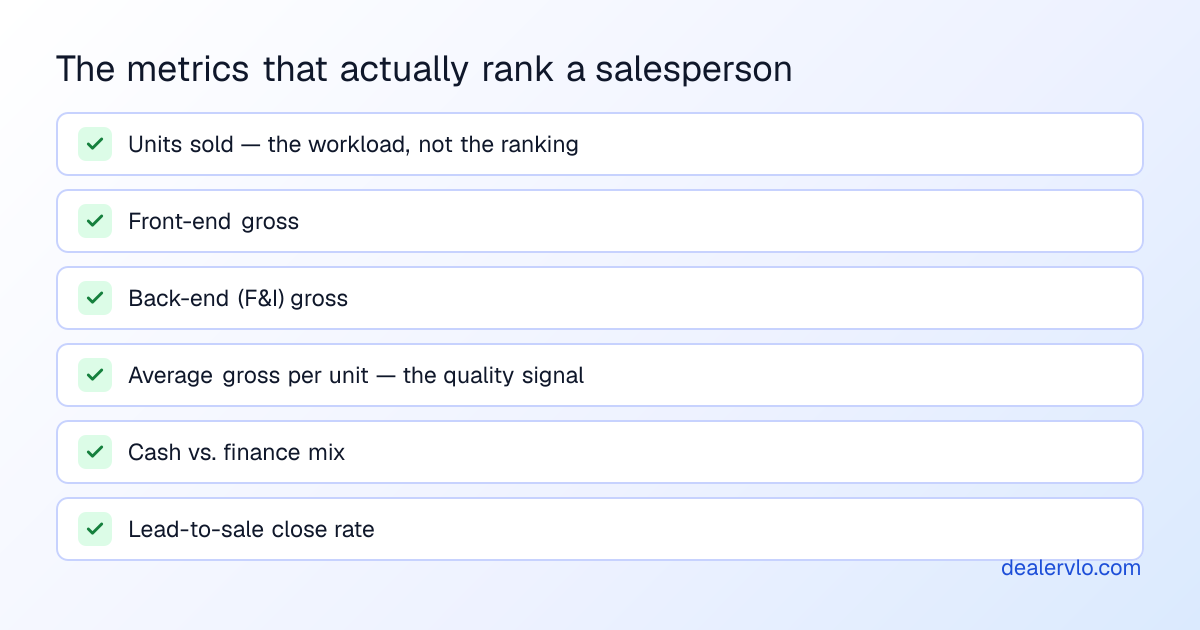
- Front-end and back-end gross separate the closer who holds price and writes F&I from the one who gives both away.
- Average gross per unit is the single best quality signal — it's how you spot the person selling fewer, richer deals.
- Cash vs. finance mix matters because finance deals carry the back-end; a salesperson stuck at all-cash is leaving F&I gross uncollected.
- Close rate tells you who converts the opportunity they're given versus who just gets handed more of it.
You can only measure what you assign
The reason most lots rank on units is simple: units is the only thing they reliably capture. Gross per salesperson requires two things to be true — every deal tied to the person who closed it, and every deal carrying its real cost so the gross is honest. Get those right and the leaderboard builds itself:
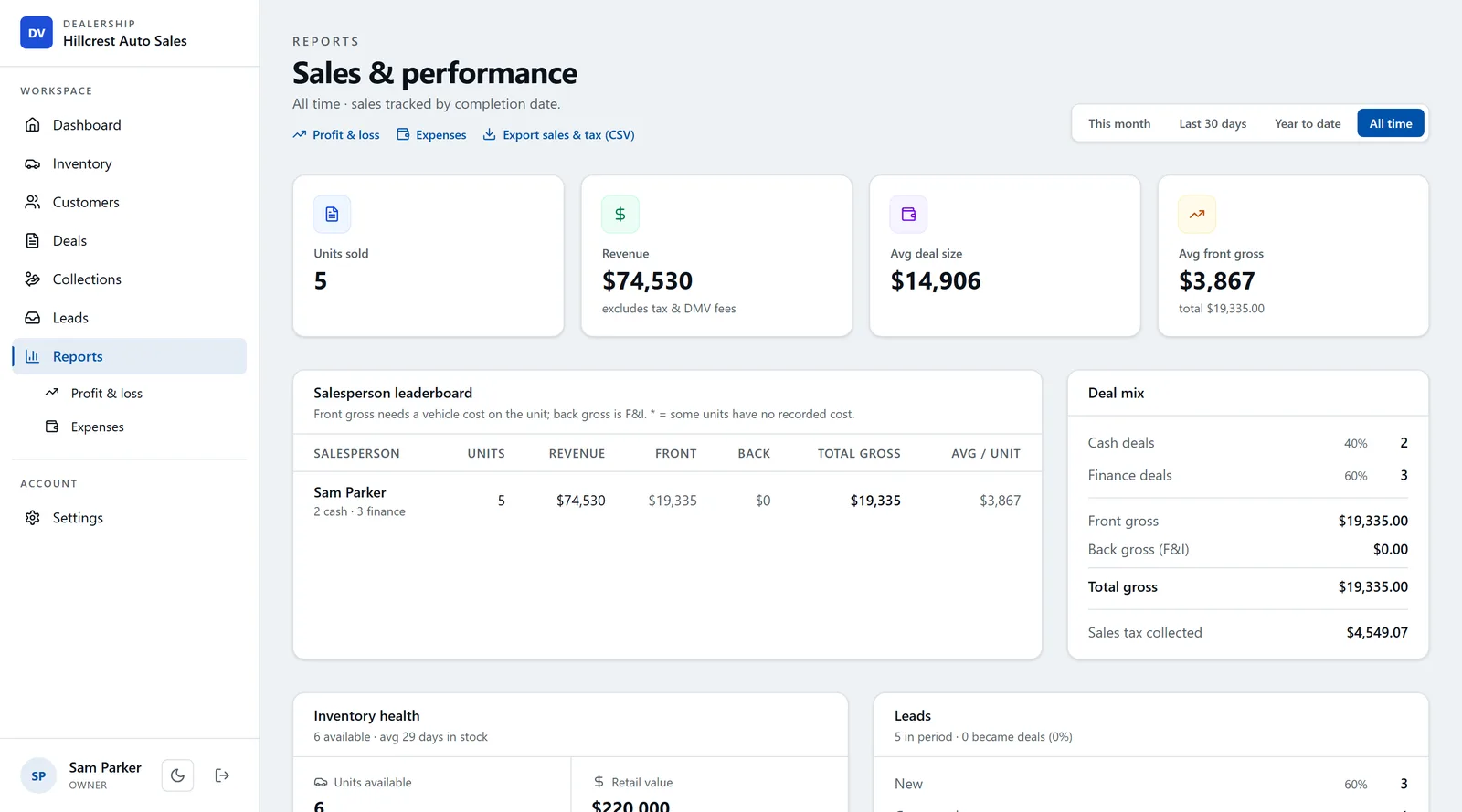
That's the difference between a spreadsheet you update once and abandon and a leaderboard that's always current: when deals are assigned and costs are recorded as part of closing the deal, the performance numbers are a by-product, not a monthly project.
Make it a conversation
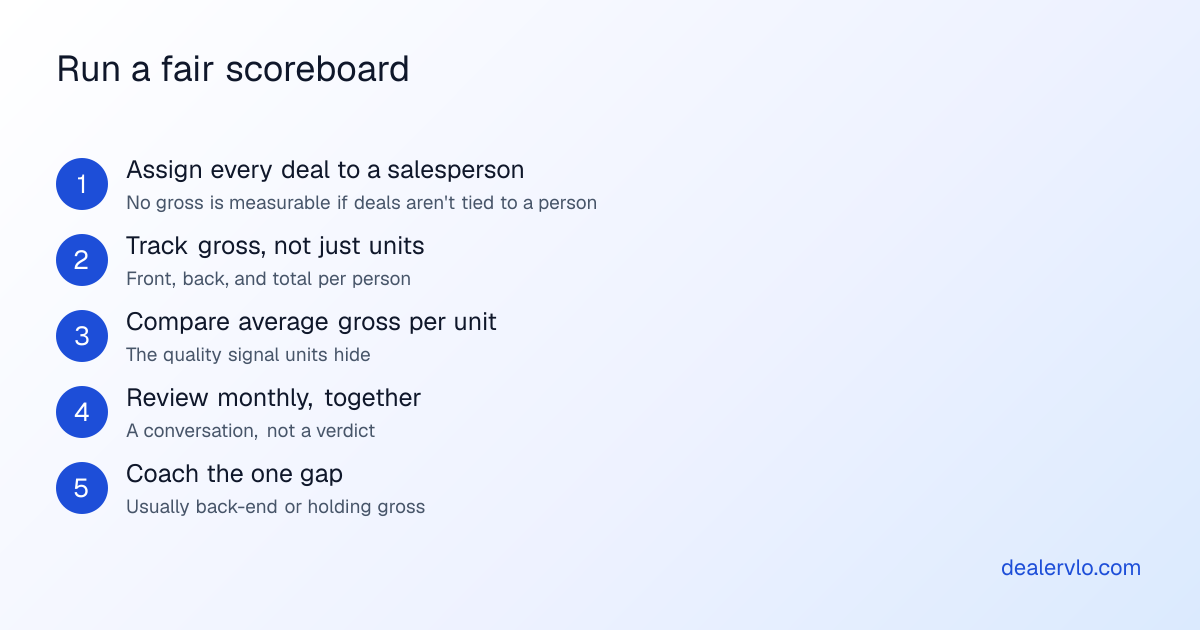
The scoreboard isn't for punishing people — it's for coaching them. Review monthly, look at gross and average-per-unit together, find the one thing to work on (usually back-end presentation or slowing down to hold gross), and check it next month. Low-drama, consistent reviews build a team that starts watching its own numbers.
If you're just bringing on your first salesperson, set this up from day one — and when it's time to pay them, the sales-commission calculator makes a gross-based plan easy to model.
Frequently asked questions
What metrics measure a car salesperson's performance? Units, but never alone — add front-end gross, back-end (F&I) gross, and total per person; average gross per unit (the quality signal); cash-vs-finance mix; and lead-to-sale close rate. Together they separate who moves metal from who makes money.
Why is units sold a bad way to rank salespeople? Units say nothing about profit. Someone can lead on units by discounting and skipping the back-end while producing less total gross than a lower-volume, higher-margin seller. Ranking on units rewards the behavior that thins your gross.
How do I track gross profit per salesperson? Tie every deal to the salesperson who closed it and record every deal's real cost, so gross is accurate. Then gross per person is a roll-up — front, back, total, average per unit. The hard part is usually consistent assignment and cost capture, which is why a DMS beats a spreadsheet.
What is a good closing rate for a salesperson? It depends on lead quality and source, so published benchmarks mislead. Compare internally and over time — a salesperson against their own trend and against others working the same sources. Track it to coach, not to hit an outside number.
How often should I review performance? Monthly with each salesperson, weekly at a glance yourself. Monthly matches commissions and goals and smooths out a single slow week. Make it a conversation focused on one thing to improve.
Bottom line
Measure salespeople on the money they make, not the metal they move. Track gross, average per unit, mix, and close rate — and your real top performer stops hiding behind the units board. DealerVLO ties every deal to its salesperson and rolls up front and back gross automatically, so the leaderboard is always live. Start a free trial.
Work out a salesperson's commission on a deal — rate, pack, and mini — and what's left for the house.
Open the Sales Commission Calculator