Can AI Negotiate a Used-Car Deal? What a Small Lot Should Actually Hand Off
AI can't sit across the desk and close a deal. It can set your floor, prep your counters, and rehearse objections. What to hand off, what to keep.
Part of the Selling & your sales team guide: The In-Person Used-Car Sale: From Test Drive to Close on an Independent Lot
The pitch says AI will negotiate for you. Here's the honest version.
On dealer forums right now you'll find threads about "digital salespeople" that negotiate deals on their own. It's a fair thing to be curious about. Every operator has wished for a version of themselves that could answer the 9 PM "what's your best price?" text without losing a sale or giving away the gross.
I sell cars on my own lot and I use AI every day. My take: AI is very good at getting you ready to negotiate and not very good, or safe, at negotiating. This post is about that line: what a small lot should hand off, what to keep, and what to do when the buyer across the desk has been coached by a chatbot too.
I've already covered the broader use of AI on the lot and whether you need an AI BDC for lead follow-up. This one is about the price conversation itself.
What negotiating actually is (and why it resists automation)
A negotiation is not a math problem with a right answer. It's a person deciding, in real time, how much a deal is worth to them. You read whether the buyer is a payment shopper or a price shopper. You notice they've been to two other lots. You decide whether this is a deal you'd rather have than a car you'd rather keep. None of that is on a screen.
The parts that are on a screen (your cost, your days on the lot, the market range) are exactly the parts AI is good with. That's the whole split, and it tells you where to use it.
Step one: know your floor before anyone walks in
The single biggest negotiating mistake I see on small lots isn't a weak counter. It's not knowing the lowest number you can take until the buyer is already pushing on it. Work up from cost:
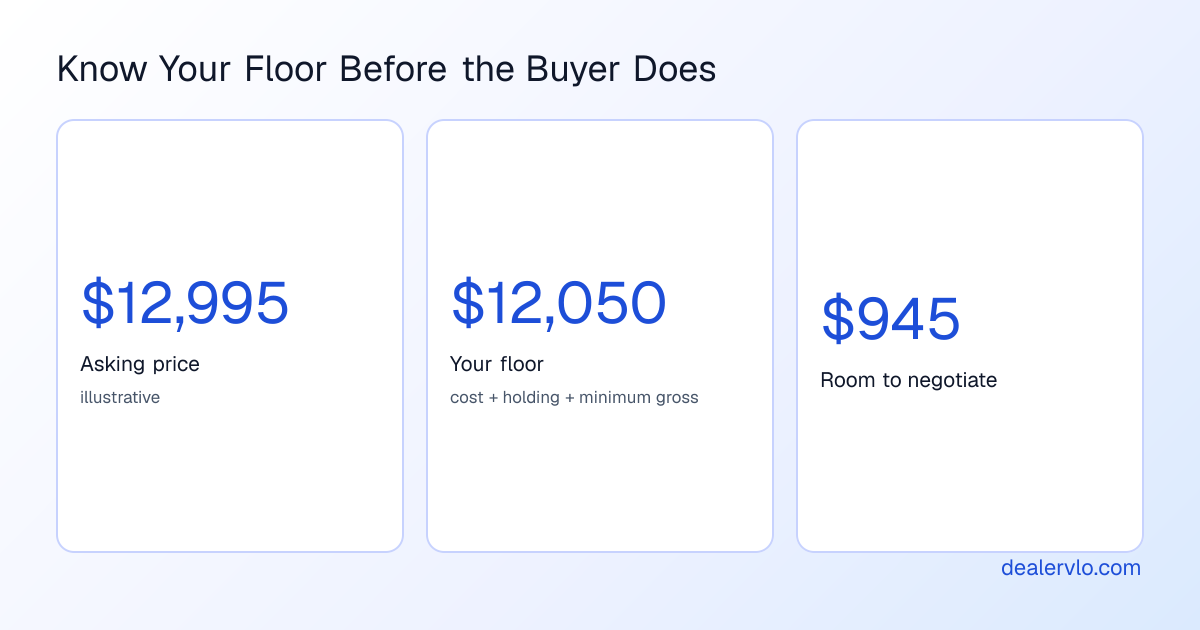
Floor = all-in cost + expected holding cost + the minimum gross you'll accept.
Here's the derived math on an illustrative $12,995 car. Say the all-in cost (purchase, recon, fees) is $9,800. Call holding cost $35 a day and expect about 30 days to sell: $35 × 30 = $1,050. Say you won't take less than $1,200 gross. Floor: $9,800 + $1,050 + $1,200 = $12,050. Against the $12,995 ask, that's $945 of room. Your own numbers will differ; the point is that the number exists before the conversation does.
An AI assistant can do this arithmetic instantly if you paste in your figures, and it's a good sanity check when you're tired at 6 PM. Don't ask it to guess your cost or your holding rate; give it real numbers or it'll invent plausible ones. If you don't know your all-in cost per car, that's the first fix, and a holding cost calculator makes it concrete.
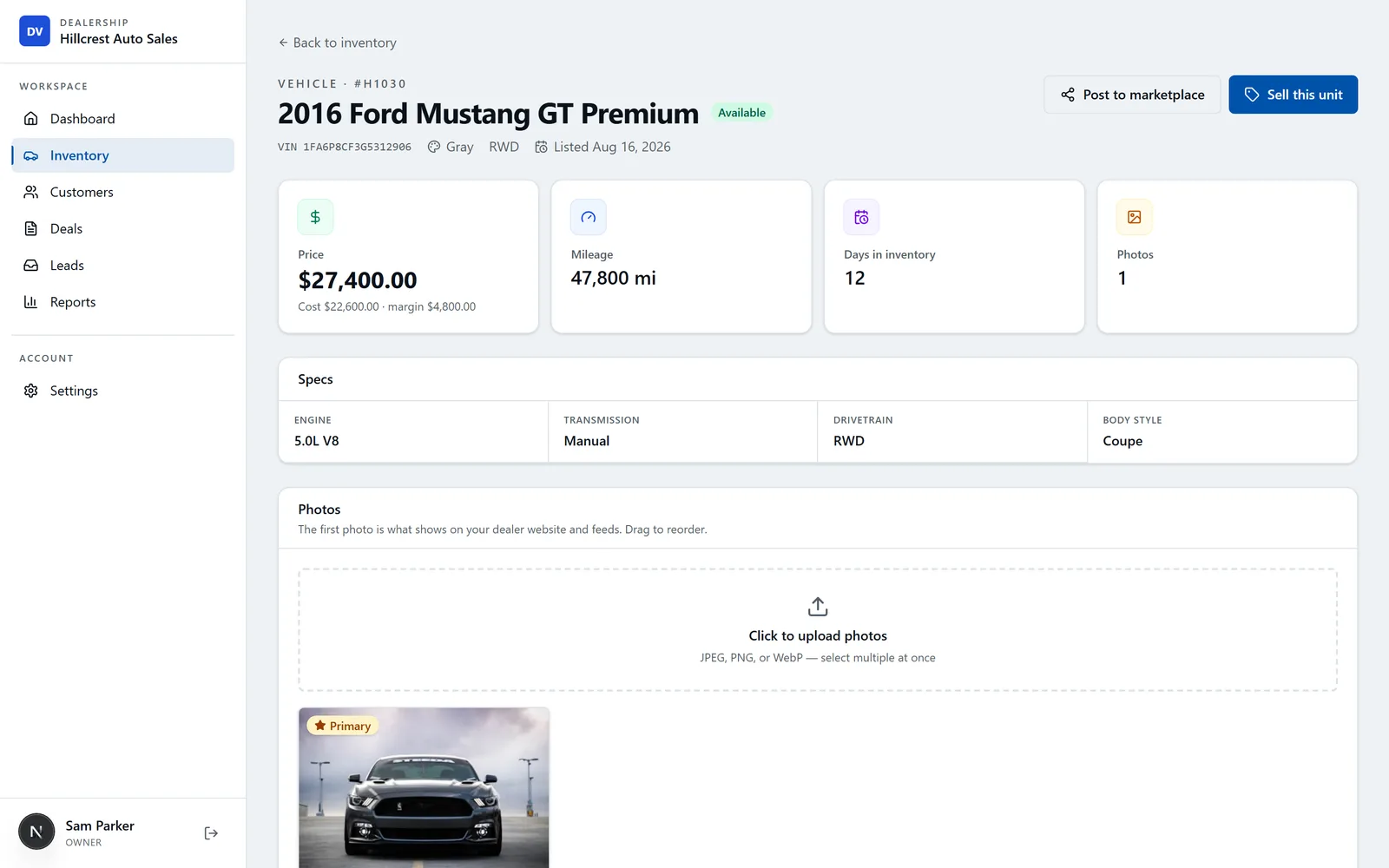
In DealerVLO, the all-in cost is already on the car: purchase price plus every reconditioning line you logged roll up into the cost and margin on the vehicle page, next to its days on the lot. That's the number you'd otherwise dig out of a notebook.
Step two: let AI do the prep work
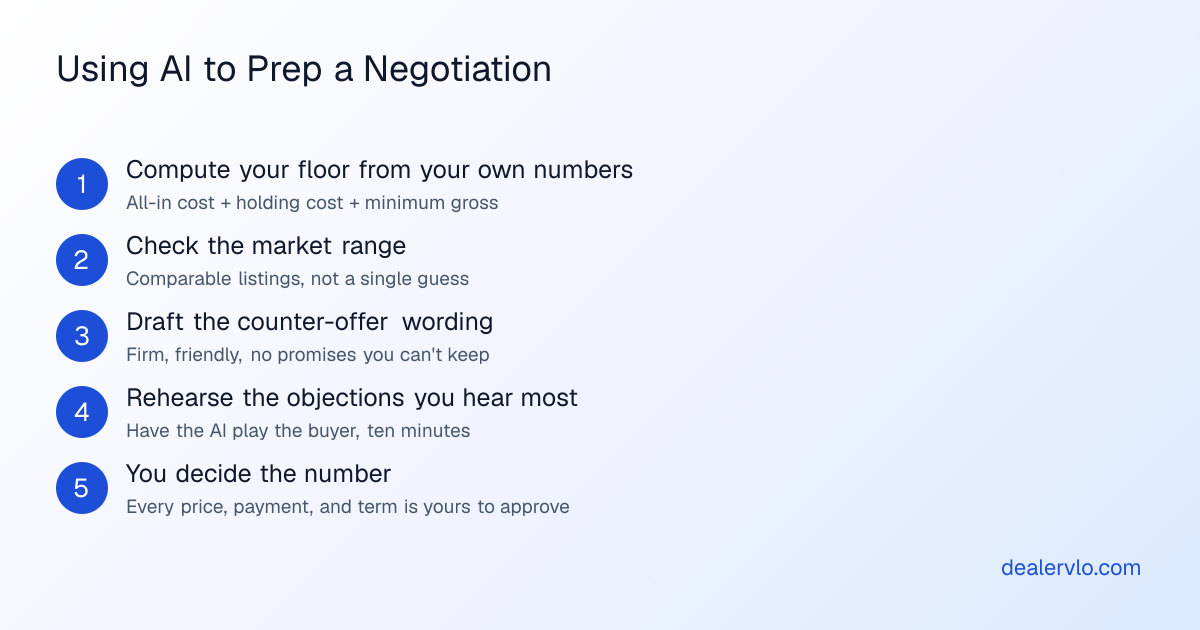
Once the floor is set, AI earns its keep in three places, all of them before or after the conversation:
Market range. A buyer will quote a comparable at you. Know the range first. That means comparable listings, not one screenshot and not a single "value." (I walk through pricing from market comps separately, and the AI appraisal tools post covers where the tools are weak.) DealerVLO's price suggestion shows a range from live comparable listings plus a target price for selling in about 30 days, which is a good starting point for the ask. It's a research aid, not a verdict.
Counter-offer wording. A low-ball text deserves a reply that's firm and friendly, and most of us write those badly at the end of a long day. Paste the message, tell the AI your floor is off-limits and that you want to keep the buyer talking, and ask for two versions. Pick one, edit it into your own voice, and send it yourself.
Objection rehearsal. This is the underrated one. Tell the AI to play a skeptical buyer, give it the ten things you hear most ("the other lot has one cheaper," "I'll pay cash today," "what's your best price?"), and practice your answers for ten minutes. It costs nothing and the conversation on the lot gets noticeably calmer. If you want the human side of this, handling the price objection is where I start.
14-day free trial, then $29/mo · Cancel anytime
Where handing it off goes wrong
An AI that talks to customers under your store's name is a different animal from an AI that helps you write. The risks are concrete:
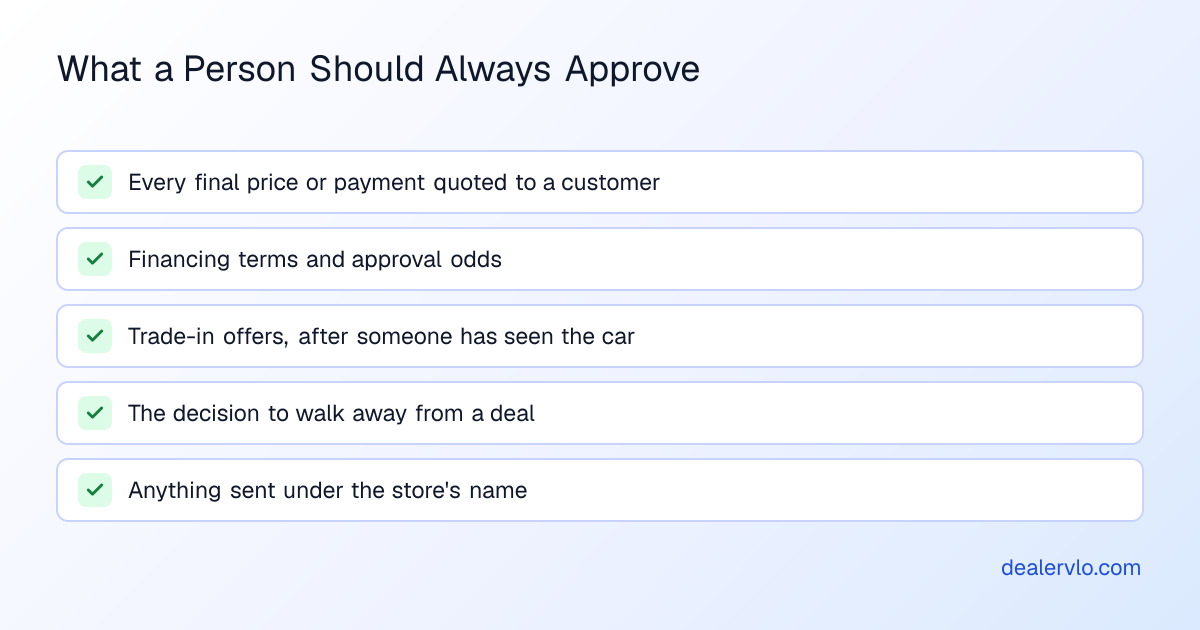
It speaks for you. If a chatbot tells a customer "we can do $11,500," you've made an offer, at least in the customer's mind. Nobody wants to be the dealer who argues later that the software wasn't authorized.
It doesn't know what you'd rather keep. A car that's been sitting 75 days is a different negotiation than one you bought yesterday. Aged inventory is a decision about carrying cost, and it's yours. In DealerVLO, every car shows its days in inventory and gets an aging flag at 60 days, which is a prompt for you to decide on a price move. It does not reprice anything on its own, and I wouldn't want it to.
Financing gets messy fast. Payment, rate, and approval questions are the ones where an unreviewed answer costs you the most. Keep them with a person. (For structuring the deal itself, the deal from monthly payment post is the walkthrough.)
A trade-in is a physical inspection. An offer on a trade made without anyone seeing the car is a guess with your name on it.
Put a real dollar-a-day number on every unit sitting on your lot.
Open the Holding Cost CalculatorThe other side of the desk: buyers are using AI too
Some of your customers now arrive having asked a chatbot for your car's market value and a script for the conversation. I can't tell you how many, and I'd be lying if I put a number on it. The practical effect is that the "I did my research" buyer is easier to picture than it was two years ago.
Don't treat it as an attack. A buyer with a comps range and a script is a buyer who's serious about buying. What beats it is what has always beaten the buyer who arrives with a printout: a price you can explain. If your ask is built from real comps and your floor is built from real costs, you can say "here's why it's priced there" and mean it. The dealers who struggle are the ones whose number came from a hunch.
A small lot doesn't compete with the big retailers by matching their price files. It competes by being the person who can actually make a decision, on the spot, from numbers they trust.
Step three: you decide the number
Here's the rule I run by. AI can compute, draft, research, and rehearse. Every price, payment, and term that reaches a customer passes through a person who's read it. Once you've got that rule, the tools get much less scary. The floor calculation, the market range, the counter drafts, the practice sessions all make you faster and more consistent, and the actual negotiation stays with the only person who knows what the deal is worth to your lot.
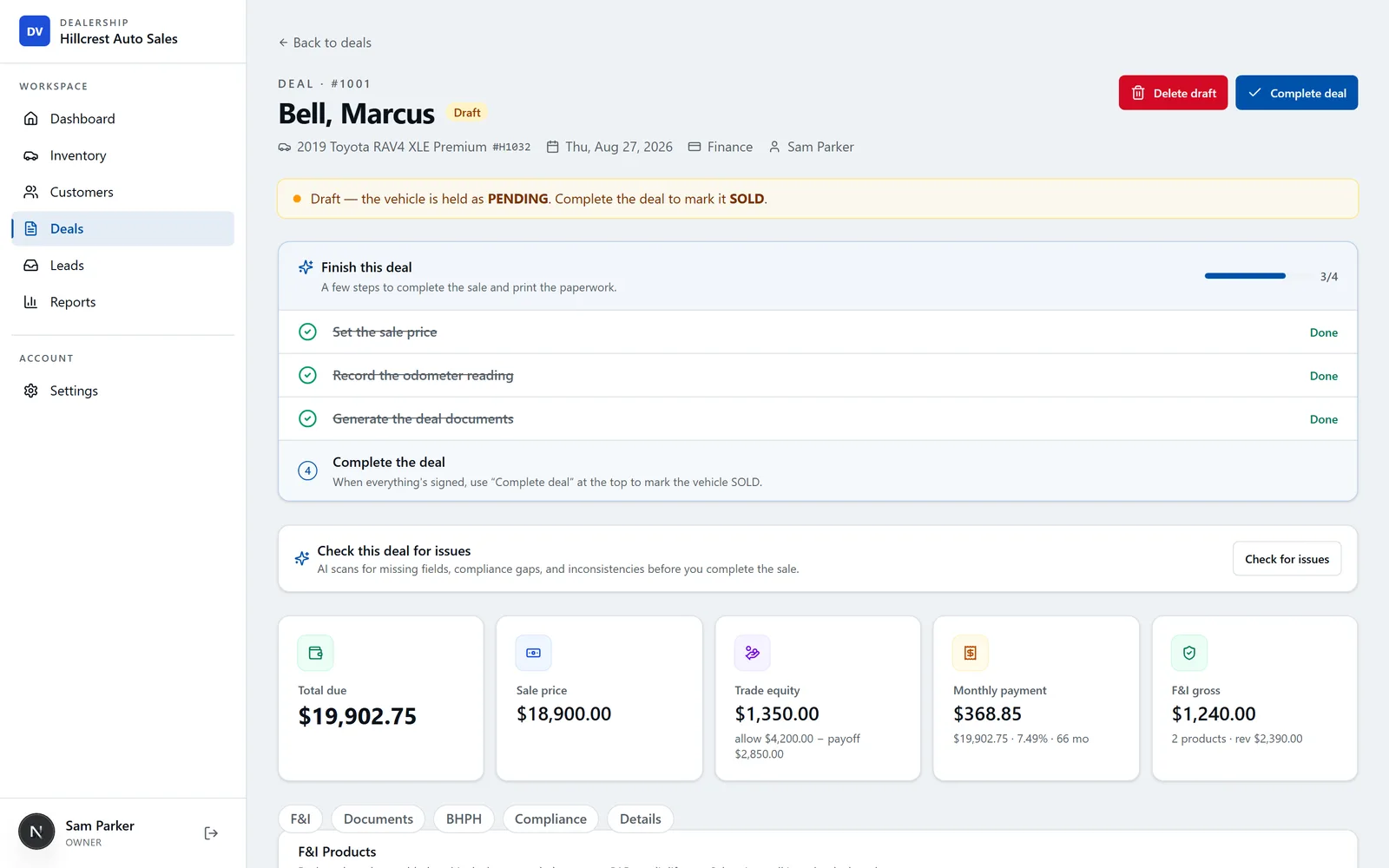
In DealerVLO, the deal jacket computes the live math while you structure the deal: totals, trade equity, payment, and front-end and F&I gross, so you can see what a concession costs before you say yes to it.
14-day free trial, then $29/mo · Cancel anytime
Frequently asked questions
Can AI negotiate a car deal for a dealer?
Not in the way the pitch decks suggest. Software can prepare you to negotiate: it can compute your floor price, draft counter-offer wording, and rehearse objections with you. The negotiation itself, reading the buyer, deciding when to hold and when to move, and agreeing to a number, is still a person's job. Anything that speaks for the store on price or financing without you reviewing it is a risk you should look at closely before turning it on.
Are car buyers using AI to negotiate with dealers?
Some are. A buyer can paste your listing into a chatbot and ask for comparable prices, a counter-offer script, or questions to ask. You can't measure how many, and you shouldn't assume it's rare. The practical response is not to fight it. Price your cars from real comps, know your floor before the buyer arrives, and be ready to explain the number in plain language.
How should a small dealer set the lowest price they'll take?
Work up from cost, not down from the ask. Take the car's all-in cost (purchase, recon, fees), add what it will realistically cost you to hold the car while it sells, then add the minimum gross you'll accept. That total is your floor. Everything between the floor and your asking price is negotiating room, and you should know that number before anyone walks the lot.
Should I let an AI chatbot quote prices to customers?
Be careful. A chatbot that states a price, a payment, or a financing term in writing is speaking for your dealership. If it gets a number wrong, you may be the one holding the bill. A safer setup is AI that answers questions about the car and hands anything involving price, payment, or credit to a person.
What can AI do well in a used-car negotiation?
Three things: preparation, wording, and practice. It can help you compute the floor from your own numbers, draft a firm but friendly reply to a low-ball offer, and role-play the ten objections you hear most so your answers are ready. All of that happens before or after the conversation, with you deciding what actually gets said.
Bottom line
Use AI to get ready for the negotiation, not to have it. Know your floor from real costs, know your market range from real comps, rehearse your answers, and keep every number a customer sees under your own review. That's how a small lot gets the benefit of the technology without handing the deal to something that can't be held accountable for it.
If you want your cost, margin, and days on lot in one place so the floor is a glance instead of a project, start the free trial at /signup.
Punch in cost, recon, holding days, and sale price to see your true net gross and margin.
Open the Profit Margin Calculator