Handling Price Objections on the Lot: A Step-by-Step Framework for Used-Car Dealers
Step-by-step framework for handling price objections when a walk-in says your price is too high—anchoring to comps, value stack, and when to hold firm.
Part of the Selling & your sales team guide: The In-Person Used-Car Sale: From Test Drive to Close on an Independent Lot
Switching from another DMS? Compare DealerVLO to DealerCenter, Frazer, or Lot Wizard.
What you're up against when someone says "that's too high"
A walk-in has test-driven a car on your lot, they're qualified, they like the vehicle—and then they say your price is too high. That objection arrives in some form on almost every deal. Most of the time, it isn't a real roadblock; it's a test to make sure they're getting a fair deal. Sometimes it's legitimate: they've seen a lower comp, they have a hard budget ceiling, or they're anchored to an unrealistic book value. Your job is to find out which one you're dealing with, and then handle it without giving away gross you don't have to lose.
This post walks through the four-step framework for handling the in-person price objection—acknowledge, clarify, respond, and advance—and when to hold your number versus when to move. It assumes you're running a compliant lot: your advertised price already includes your doc fee and any other required charges, so when a customer says "too high," they're looking at your real all-in number. If you're still quoting vehicle-only pricing on window stickers and adding fees at the desk, you're out of compliance with current FTC guidance, and the objection-handling process below won't save you.
14-day free trial, then $29/mo · Cancel anytime
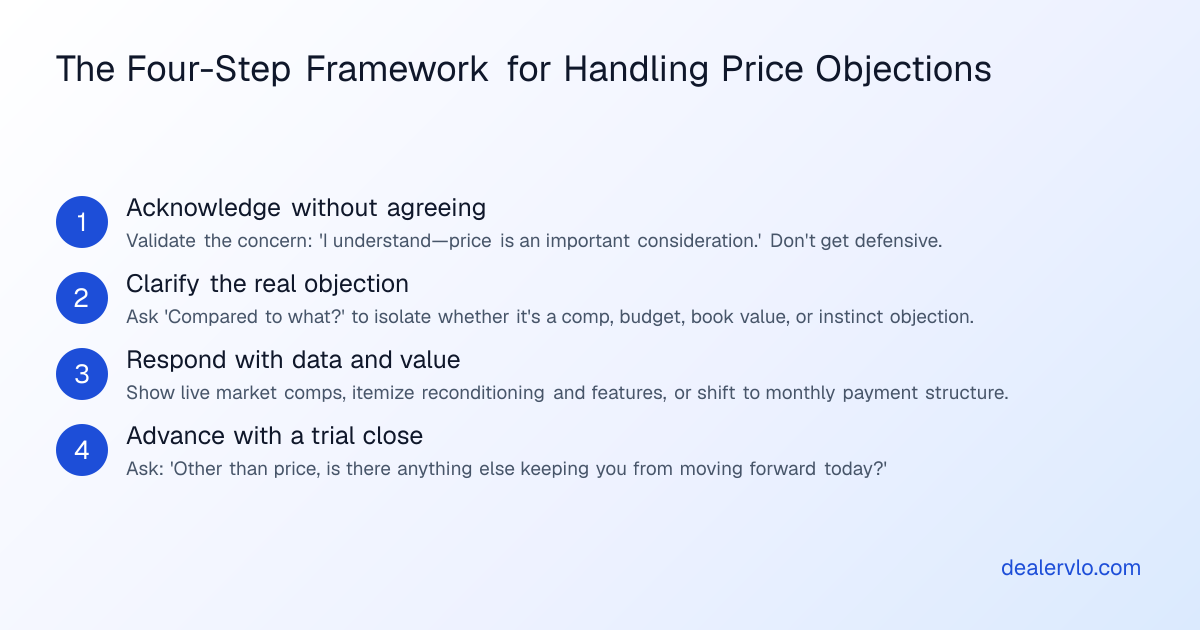
The four-step objection-handling framework
Step 1: Acknowledge without agreeing
The worst response to "your price is too high" is to get defensive or to immediately justify the number. Getting defensive causes customers to lock up or dig in harder on their objection, and most objections aren't serious—they're just a test. Instead, validate the concern without agreeing with it: "I understand. Price is an important consideration," or "I appreciate you being upfront about your budget." That defuses the need to fight and keeps the conversation open.
You're not conceding anything. You're buying yourself the space to ask the next question.
Step 2: Clarify—isolate the real objection
This is the most important step in the process. The surface objection is rarely the real one. The customer who says "that's too high" might mean:
- I saw a lower price on another lot or listing site
- I'm anchored to a book value I looked up
- I can't afford this monthly payment
- I'm testing you to see if you'll drop the price
- I don't see enough value to justify this number
Your job is to find out which one it is before you respond. The most effective way to do that is to ask a clarifying question that makes the customer define their frame of reference. The simplest one: "Compared to what?"
That forces them to be specific. If they name a competing listing, you now have something concrete to work with. If they cite Kelley Blue Book or Edmunds, you can walk through what those tools include and exclude. If they hesitate or say "it just feels high," they're objecting on instinct—and that's a value conversation, not a price negotiation.
Never defend the number directly without clarifying first. You'll waste time answering the wrong objection, and you'll look like you're scrambling.
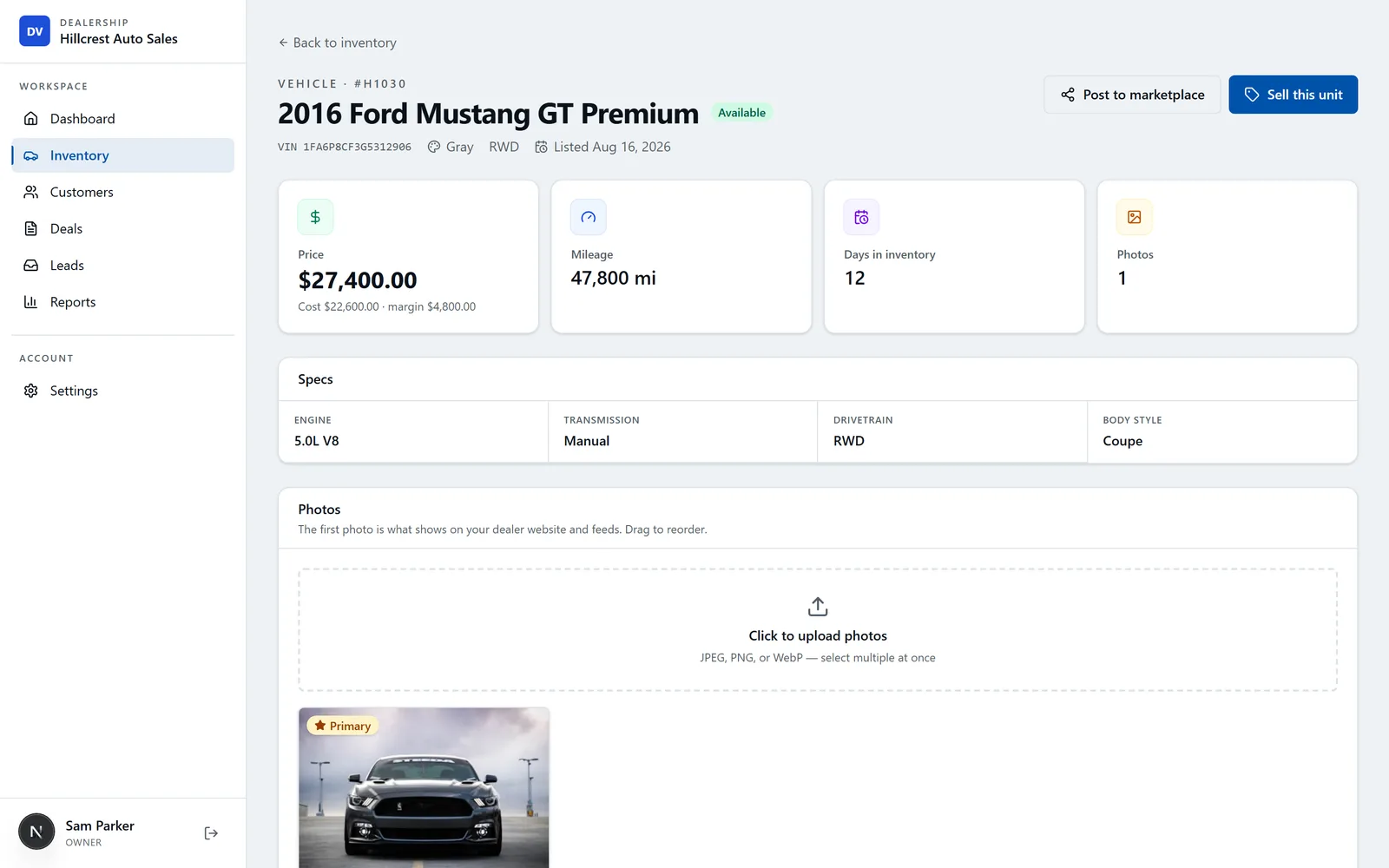
When you're structuring deals in DealerVLO, every vehicle's acquisition cost and its reconditioning lines roll into the all-in cost, so you can see your true gross on the deal before you respond to the objection—you know exactly how much room you have to move, if any.
Step 3: Respond—address the specific concern with facts
Once you've isolated the real objection, you can address it. The response depends on what step two revealed.
If they cite a specific competing listing
Don't bash the competitor. Instead: "That's possible—the market's competitive right now. But I want to make sure you're comparing apples to apples. Let me show you exactly what's included in our deal so you have the full picture." Then walk through the differences: miles, condition, reconditioning already performed, accident history, equipment, any included warranty, and what your dealership backs. Most of the time, a lower-priced comp is lower for a reason.
If the comp is genuinely comparable and meaningfully cheaper, you're in a real negotiation—see the section below on when to move.
If they're anchored to a book value
Book values are averages across a region, and they lag the market. Walk them through what you know about this specific unit: "I understand where that number comes from, but here's what book values don't capture—this car has new tires, brakes just done, a clean history report, and it's priced against live comps in our market that are running higher than book right now. Let me show you what similar units are actually listed at today." Pull up your comps—whether that's your own research, a pricing tool, or a quick search on Cars.com—and show them the current market.
In DealerVLO, the AI price suggestion for each car shows you a range from live comparable listings and a target price for selling in about 30 days, so you can anchor your response to what the market actually looks like today, not what a book value averaged three weeks ago.
If they're objecting on instinct or value
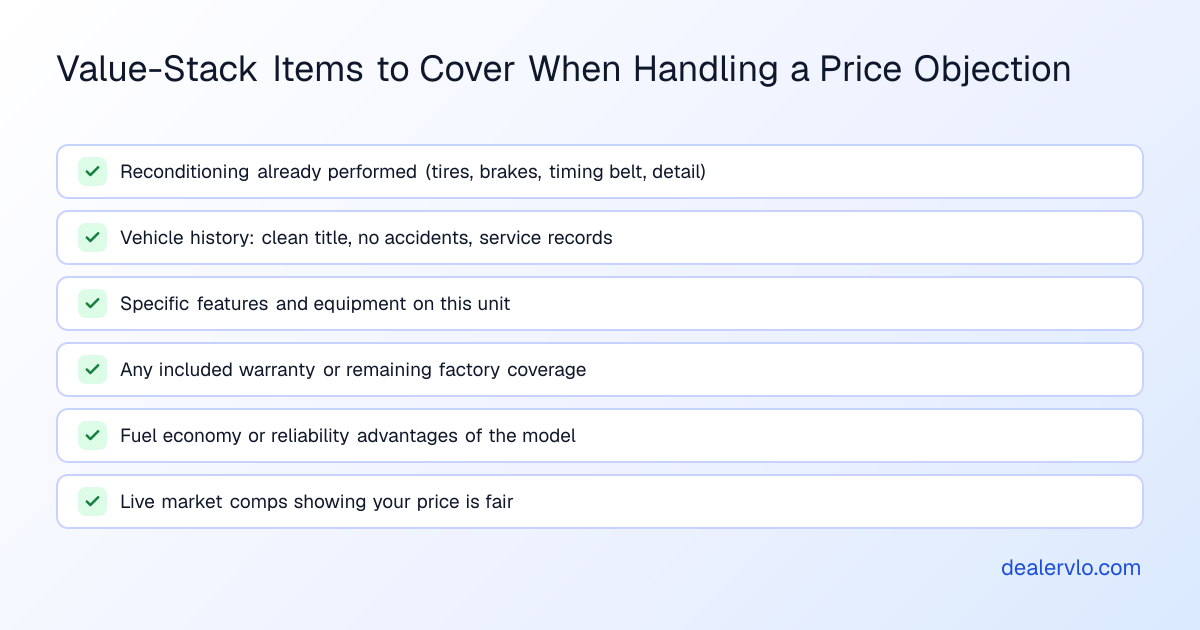
This is the most common scenario. They haven't done detailed comp research; they just feel like the number should be lower. That's a value conversation. Build the value stack—itemize everything they're getting:
- Reconditioning you've already done: new tires, brakes, timing belt, a detail, whatever it was
- Vehicle history: clean title, no accidents, one owner, full service records
- Specific features and equipment on this unit
- Any remaining factory warranty or a dealer-backed warranty you're including
- Fuel economy, reliability, or resale advantages of this model
Shift the conversation from the sticker price to the total value they're walking away with. A car priced $1,200 higher than a comp but with $1,500 in fresh tires and brakes is a better deal, and most buyers will see that once you lay it out.
One effective technique: offer to show them a less expensive vehicle with fewer features. When you know what the buyer actually needs—four-wheel drive, third-row seating, low miles—and you offer a cheaper unit that doesn't have those, it reminds them why the price on the original car is where it is. If they truly want those features, the price objection often evaporates.
Step 4: Advance—move toward close with a trial question
After you've addressed the objection, don't let the conversation stall. Use a forward trial close: "So if we can get clarity on that, is there any reason we couldn't move forward today?" or "Other than the price, is there anything else that would keep you from taking this car home?"
If they say "No, that's the only thing," you've isolated the problem and you can solve for it. If they bring up something new—"Well, I also need to talk to my spouse," or "I'm not sure about the color"—you weren't dealing with a real price objection in the first place. You were chasing a smoke screen, and now you know the real objection.
Never move to discounting or restructuring the deal without isolating first. You might drop the price only to hear "I also need to think about it," and you've given away gross for nothing.
14-day free trial, then $29/mo · Cancel anytime
When to shift to monthly payment instead of price
Many buyers make their decision based on monthly budget, not total vehicle price. If the payment works, the deal works—regardless of what the sticker says. The customer who says "I can't afford $25,000" is often a payment buyer, not a price buyer, and your negotiation happens in the payment structure, not the vehicle price.
Signs you have a payment buyer:
- "What's the payment on this?"
- "What do I need to put down to get the payment where I need it?"
- They name a monthly budget number before you've discussed financing
- They glaze over when you talk about total price but perk up at payment
If the objection reveals a budget constraint rather than a market-comp concern, transition to payment after you clarify. "I want to make sure this works for your budget. What were you looking to stay at monthly?" Then structure term, down payment, and rate to hit a workable number while protecting margin.
You can often protect gross by adjusting term and down payment while keeping the vehicle price intact. For the payment buyer, the monthly number is the decision point—that's where you need to deliver.
The calculator close: shrinking the gap
This is one of the most powerful techniques in objection handling. It takes a monthly payment difference that feels big—say, $30 a month—and reframes it as something small. "$30 a month is a dollar a day. For a dollar a day, you're getting four-wheel drive and 30,000 fewer miles. Does that make sense?" It usually does, because a dollar a day doesn't feel like a sacrifice.
Use it when the payment gap is narrow and the value difference is real. Don't use it to justify a $100/month gap on a unit that doesn't deliver the value—it'll sound like a trick.
A warning on term and negative equity
Monthly payment selling can obscure total cost. A customer who stretches to 84 months to hit $499/month is often upside down within 24 months, and you're setting them up to walk away from the car or default on the note. According to Edmunds, a record 25.5% of financed new-car purchases in Q3 2026 carried terms of 84 months or more, and 21.2% of buyers committed to monthly payments of $1,000 or more. It's your job to make sure the structure makes sense for them long-term, not just to fit a number they named.
If a trade-in brings negative equity onto the deal and the customer is already stretching on term, walk through what the payoff timeline looks like. DealerVLO's deal jacket shows trade allowance and payoff separately, and when the payoff exceeds the allowance, the negative equity prints as its own line on the bill of sale and the retail installment contract, so the buyer sees exactly what they're financing. That transparency protects both of you.
For more on structuring deals with upside-down trades, see our guide to handling negative-equity trade-ins on a small lot.
In DealerVLO, you enter the trade allowance and the lienholder payoff details on the deal—account number, the date the quoted payoff is good through, and the per-diem interest after that date—and the deal math computes the equity or the negative equity automatically, rolling it into the amount due.
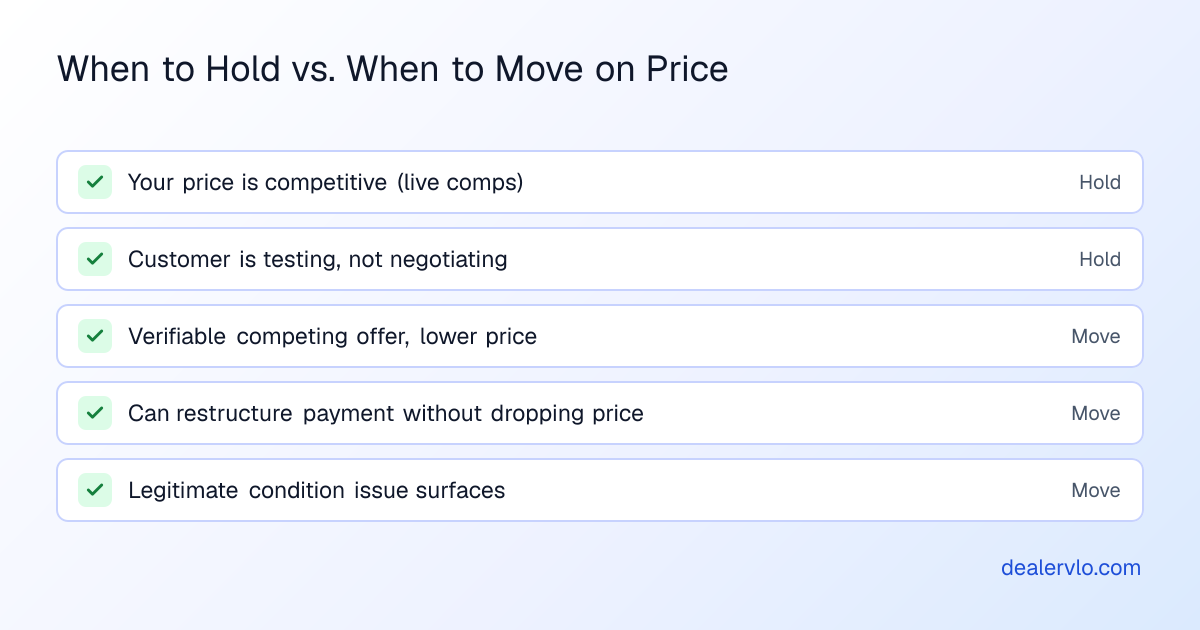
When to hold your number and when to negotiate
Hold firm when your price is already competitive
If you've anchored successfully to market comps and your price is demonstrably in line with or below comparable units, you hold. Use empathy, logic, and a redirect: "I'm glad you asked. We price our cars competitively from day one based on live market comps, so you're already seeing our best number. What I can do is take care of the whole financial package and make sure the payment works for your budget." When run cleanly, this handles the price objection over 90% of the time without discounting a dollar.
You're not being rigid. You're protecting margin on a car that's already priced right, and most customers respect that when you explain it with data instead of defensiveness.
DealerVLO shows days in inventory on every car and flags units aged 60+ days, so you know which cars have been sitting and might need a price adjustment, and which ones are fresh and competitively priced. If a car has been on the lot eight days and you're holding firm, that's a market-driven decision. If it's been there 90 days and you won't budge, the market has already told you the price is wrong.
Hold firm when they're testing you, not negotiating
Most objections aren't serious—they're just a test. Customers are hesitant to work with dealerships and will toss out an objection to make sure they're getting a good deal. If you fold immediately, you've confirmed their suspicion that your price had room in it, and they'll keep pushing. If you hold with confidence and show them the value, they usually move forward.
The key is tone. Holding firm doesn't mean being confrontational. It means staying calm, showing the comps, walking through the value, and offering to solve for payment or structure instead of price.
Move when they produce a verifiable competing offer
If the customer shows you a screenshot or a printout of a comparable unit at a meaningfully lower price—same year, make, model, similar miles, similar condition—you're in a real negotiation. Salespeople are often willing to match or beat competitors' prices to close the sale, and it's reasonable to ask: "If I can get close to that number, are we doing this deal today?"
Verify the comp first. Is it still available? What's the actual condition and history? Does it include the same equipment? If it checks out and the gap is real, you have three options: match it and close the deal, explain why your unit is worth the premium and hold, or let them walk and buy the cheaper car.
Which one you choose depends on your margin, your inventory turn, and how long the car has been sitting. A fresh unit with strong gross, hold. A 75-day-old car with thin margin, match it and move it.
Move when you can protect gross by restructuring instead of discounting
For the payment buyer, you can often deliver the monthly number they need without dropping the vehicle price. Adjust the term, increase the down payment, or find a better rate. The customer gets the payment they wanted, you keep your gross, and the deal closes.
This is where the out-the-door price calculator becomes useful during the sales process—you can show the customer the full deal structure, including tax, title, doc fee, trade equity, and down payment, and work backward from the monthly payment they need to the vehicle price and term that make it possible.
Move when the unit has a condition issue they surfaced
If the customer points out something you missed—a check-engine light, a door ding, a mismatched tire, a concerning line in the vehicle history report—and it's legitimate, that's a reason to adjust. Either fix it before delivery and hold the price, or drop the price to account for the issue and sell it as-is. Don't pretend the issue doesn't exist. That kills trust and the deal.
Punch in cost, recon, holding days, and sale price to see your true net gross and margin.
Open the Profit Margin CalculatorWhat you can't negotiate under current FTC guidance
If a dealer requires a consumer to pay a fee to purchase the car, that fee must be included in the advertised price. Government-required charges like taxes and registration may be excluded, but dealer-required fees that governments authorize but do not mandate—including the full doc fee—must be included.
That means your window sticker, your website, and your verbal quote should already reflect the vehicle price plus your doc fee. When a customer objects to the price, they're objecting to that all-in number. You can negotiate the vehicle price itself, but you cannot present the doc fee as negotiable or optional when it's a required charge.
If you're still adding fees at the desk that weren't in the advertised price, you're risking enforcement action, and the price objection becomes a compliance problem, not a sales problem.
For a full breakdown of what changed and what you need to fix, see our guide to the FTC's new price transparency FAQs for independent used-car dealers.
Anchoring to live market comps: the tools and the process
The "compared to what?" question only works if you can back it up with data. You need to know what comparable units are actually listed at in your market, and you need to be able to show the customer.
Market data tools available in 2026
Platforms like vAuto, DealerSocket, VinSolutions, CDK Global, and similar inventory management systems help price vehicles competitively by combining live market comps, competitor monitoring, and repricing recommendations. The strongest tools share real-time pricing suggestions, competitor monitoring, days-on-lot tracking, and integration with your DMS or CRM. Manheim Market Report (MMR) provides real-time market pricing in your local market for $64 a month.
In DealerVLO, the AI price suggestion on each vehicle shows a price range from live comparable listings and a target price for selling in about 30 days. It's not a final decision—you still price the car based on your cost, your market knowledge, and how fast you need to turn it—but it gives you a data point to anchor to when a customer says your number is too high.
What buyers have already looked up
More than 95% of used-car searches start online, and more than 70% of shoppers compare prices on third-party sites before they visit a lot. They've likely consulted Kelley Blue Book, Edmunds, or similar valuation tools, and they've scrolled through Cars.com, Autotrader, or CarGurus to see what else is available. That means they walk in with a rough sense of market pricing—sometimes accurate, sometimes not.
Your job is to show them what the real market looks like for this specific unit, not the average. Pull up current listings on your phone or your computer and walk them through it: "Here are three comps within 50 miles—same year, make, model, similar miles. This one's listed at $18,900 but it has 30,000 more miles. This one's $17,500 but it has an accident on the history report. Ours is $18,200, clean history, lower miles, fresh tires—you're looking at the best value in the market right now."
That's not a sales pitch. It's data, and most buyers respond to it.
For a deeper look at pricing strategy and how to use market comps to set your numbers in the first place, see our guide on how to price a used car to sell faster using live market comps.
Building the value stack without overselling
Shifting the conversation from price to value is not the same as overselling. Overselling makes claims you can't back up—"this is the cleanest Accord in the state," "you'll never find a better deal," "this car will last 200,000 miles." That damages credibility, and the moment the customer senses you're exaggerating, they stop trusting anything you say.
Building a value stack means itemizing the objective, verifiable attributes of the unit in front of them:
- Reconditioning already performed: new tires, brakes, timing belt, a detail, fresh oil and filters—whatever you've done. Walk them through the invoices if they ask.
- Vehicle history: clean title, no accidents, single owner, full service records. Show them the report.
- Equipment and features specific to this unit: four-wheel drive, leather, a sunroof, the technology package. Compare it to lower-priced units that don't have those.
- Any included warranty: remaining factory coverage or a dealer-backed warranty you're including in the price.
- Fuel economy or reliability advantages: if the model is known for strong resale or low operating cost, mention it—but only if it's true and relevant to their use case.
Each item in the stack is a reason the price is what it is. You're not defending the number; you're explaining it.
In DealerVLO, every car's reconditioning costs are tracked line by line—vendor, description, cost—and they roll into the all-in cost and the gross on the deal. When you're building the value stack on the lot, you know exactly what you've put into the car, and you can walk the customer through it with specifics, not generalities.
Process discipline: role-play, debrief, and tracking what works
Objection handling is a skill, and like any skill it improves with repetition and feedback. The dealers who handle price objections cleanly are the ones who practice the framework until it's automatic, debrief deals that didn't close, and track which techniques actually work in their market.
Role-play the framework until it's muscle memory
Run through the four steps—acknowledge, clarify, respond, advance—with another person playing the customer. Practice different scenarios: the buyer who cites a competing listing, the buyer anchored to book value, the buyer who just says "I need you to do better," the payment buyer. Practice staying calm, asking clarifying questions, and advancing without sounding scripted.
The goal isn't to memorize a script. It's to internalize the structure so you can adapt it to the actual conversation in front of you.
Debrief deals that didn't close
When someone walks without buying, ask yourself: Was the price objection real, or was I chasing a smoke screen? Did I isolate the real objection, or did I respond to the first thing they said? Did I anchor to comps, or did I get defensive? Did I move too fast to discounting, or did I hold when I should have moved?
Most dealers never debrief a lost deal. They assume the customer "wasn't serious" or "just wasn't ready." Sometimes that's true. More often, there was a step in the process that got skipped, and the deal was winnable.
Track gross per deal and closing rate
Your sales report should show you gross per deal and your closing rate on walk-ins. If your average gross is strong but your closing rate is low, you're holding too firm or you're not handling objections well. If your closing rate is high but your gross is weak, you're folding too fast. The goal is to find the balance: close the deals that are closeable at a gross that makes the business work.
DealerVLO's sales report shows front-end and back-end gross per deal, and the dashboard shows you how many leads came in, how many turned into active deals, and how many cars sold this month. You can see the conversion path and spot where deals are falling apart.
For more on structuring compensation so your salespeople are motivated to protect gross while closing deals, see our guide to building a used-car sales pay plan that doesn't leak gross.
14-day free trial, then $29/mo · Cancel anytime
Frequently asked questions
What do you say when a customer says your price is too high?
Start by acknowledging the concern without agreeing: "I understand—price is an important consideration." Then clarify the real objection by asking "Compared to what?" That forces the customer to define their frame of reference. If they cite a specific competing listing, walk through the differences in condition, miles, equipment, and history. If they're objecting on instinct, shift to the value stack—itemize reconditioning, features, history, and any warranty included. After addressing the objection, advance with a trial close: "Other than price, is there anything else that would keep you from taking this home today?"
When should you negotiate price versus hold firm on a used car?
Hold firm when your price is already competitive based on live market comps, when the customer is testing you rather than negotiating in good faith, or when you've isolated the objection and it's not actually about price. Move when the customer produces a verifiable competing offer on a comparable unit, when you can protect gross by restructuring payment and term instead of dropping price, or when a legitimate condition issue surfaces that you missed. The key is to clarify the objection first—never negotiate until you know what you're really solving for.
How do you handle a price objection from a payment buyer?
If the customer reveals a budget constraint rather than a market-comp concern, transition to monthly payment after you clarify. Ask: "What were you looking to stay at monthly?" Then structure term, down payment, and financing rate to hit a workable number while protecting your margin. You can often deliver the payment they need without dropping the vehicle price. Use the calculator close to shrink perceived gaps: "$30 a month is a dollar a day—does that work for the features you're getting?" Just make sure the term and structure make sense long-term; don't stretch them into an 84-month note that leaves them upside down in two years.
What's the best way to anchor your price to market comps on the lot?
When a customer says "your price is too high," ask "Compared to what?" and then show them live listings of comparable units—same year, make, model, similar miles and condition. Pull them up on your phone or computer and walk through the differences: miles, accident history, equipment, reconditioning, included warranty. Most buyers respond to data, not claims. Tools like vAuto, Manheim Market Report, or DealerVLO's AI price suggestion give you the comps to back up your number. The goal isn't to prove you're the cheapest—it's to prove you're priced fairly for what they're getting.
How do you build a value stack without overselling?
Itemize the objective, verifiable attributes of the vehicle: reconditioning already performed (tires, brakes, timing belt), vehicle history (clean title, no accidents, service records), specific equipment on this unit, any included warranty, and fuel economy or reliability advantages of the model. Each item is a reason the price is where it is. Don't make claims you can't back up—show the customer the history report, walk them through the invoices, compare this unit's equipment to lower-priced comps that don't have it. You're not defending the price; you're explaining it with facts they can verify.
What do you do if a customer shows you a lower price from another dealership?
Don't bash the competitor. Verify the comp first: Is it still available? What's the actual condition, history, and equipment? If it's genuinely comparable and meaningfully cheaper, you're in a real negotiation—ask "If I can get close to that number, are we doing this deal today?" If the comp is lower for a reason—higher miles, accident history, missing features, no warranty—walk through the differences: "That's possible, but let me show you what's included in our deal so you're comparing apples to apples." Most of the time, a lower-priced comp is lower because it delivers less value, and the customer will see that once you lay it out.
Bottom line
Handling price objections cleanly is about process, not charisma. Acknowledge the concern, clarify the real objection, respond with data and value, and advance toward close. Most objections aren't roadblocks—they're tests, or they're fixable with payment structure or a clear explanation of market comps. The dealers who hold gross and close deals are the ones who stay disciplined: they don't get defensive, they don't fold without isolating, and they don't chase smoke screens. Practice the framework, track what works, and debrief the deals that didn't close. Over time, the responses become automatic, and the objection stops feeling like a fight and starts feeling like a normal part of the process. DealerVLO gives you the tools to back it up—comps, reconditioning costs, deal structure, and gross per deal in one system, so you know exactly where you stand before you respond.
14-day free trial, then $29/mo · Cancel anytime