The FTC's New Price Transparency FAQs: What Independent Used-Car Dealers Have to Change
The FTC's price transparency FAQs say your advertised price must include your doc fee. Here's what a small used-car lot has to change, step by step.
Part of the Compliance, taxes & deal paperwork guide: What goes in a used-car deal jacket: the complete checklist
On September 15, 2026, FTC staff published the Automobile Industry Pricing Transparency FAQs, 14 questions on how the FTC reads car-dealer price advertising. The short version of the FTC price transparency FAQs: your advertised price has to be "the actual price any consumer can walk in and pay." If every buyer pays your doc fee, the doc fee is part of that price. Only charges the government makes the buyer pay, like taxes, ride on top.
This is the operator version: what a small lot listing on its own website, CarGurus, Cars.com, Autotrader and Facebook Marketplace has to change. This is not legal advice. It's a plain reading of the FTC's own page. For your situation, talk to your attorney or your state dealer association.
14-day free trial, then $29/mo · Cancel anytime
What the FTC price transparency FAQs are, and aren't
The page says it represents the views of FTC staff and is not binding on the public or the Commission. It's not a new rule; it explains how staff applies the FTC Act, which already prohibits deceptive advertising, to car pricing.
Don't read "not binding" as "optional." Question 13 asks how long dealers have to comply, and the answer is that price transparency is not a new requirement: the FTC Act's requirements have been in effect for decades. It offers no grace period. The FTC's press release also notes that earlier this year the Commission sent letters to 97 auto dealership groups warning that advertised prices must include all mandatory fees. For the broader enforcement picture, see FTC dealer compliance in 2026. This post sticks to pricing.
The core rule: what FTC auto dealer pricing has to include
Question 2 is the key one. If you require a buyer to pay a fee to buy the car, that fee goes in the advertised price. The only things you can leave out are amounts a federal, state, or local government agency requires the consumer to pay directly. The FAQ names two categories dealers tend to argue about, and both go in:
- Fees the government allows but doesn't require. A doc fee your state permits is still your fee.
- Fees the government charges you that you pass on. If it lands on you and you hand it to the buyer, it's in the price.
A quick test for any line on the buyer's order: does a government agency make the buyer pay this? If yes, it can sit outside the advertised price. If you charge it, it's in the number. A fee you add for handling the title paperwork is yours, even though the title fee itself is the state's.
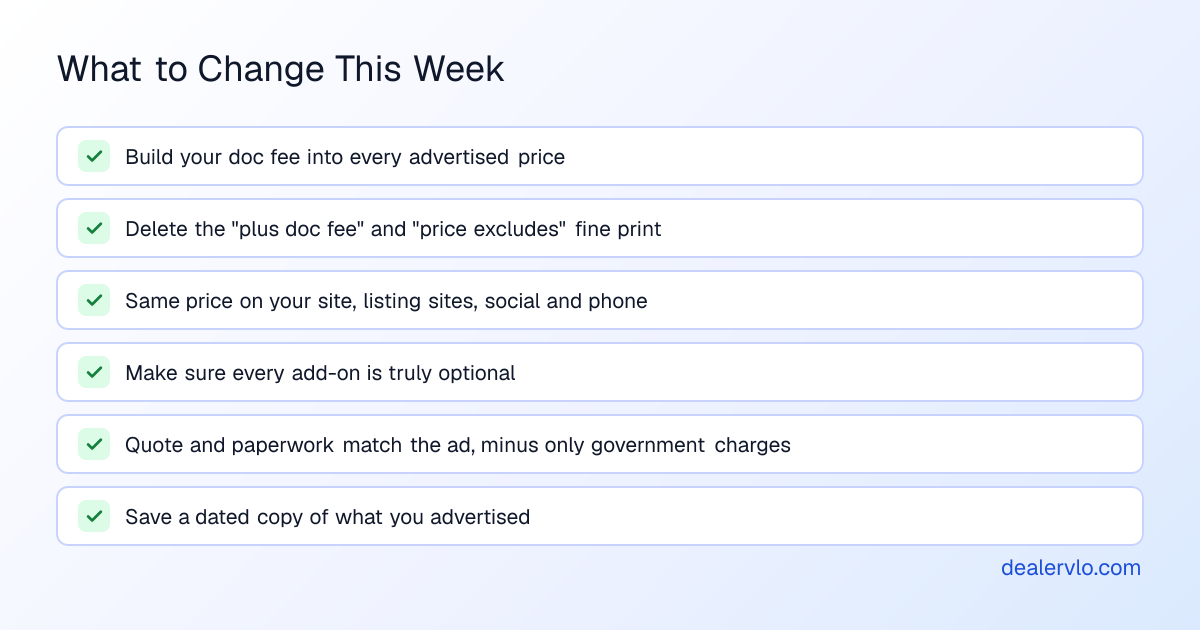
Change 1: put your doc fee in the advertised price
Question 6 says the advertised price must include the full document fee if the dealer requires any consumer to pay it. The FTC's example: a $40,000 car with an $85 doc fee must be advertised at $40,085, with no additional charges besides what the government requires the consumer to pay.
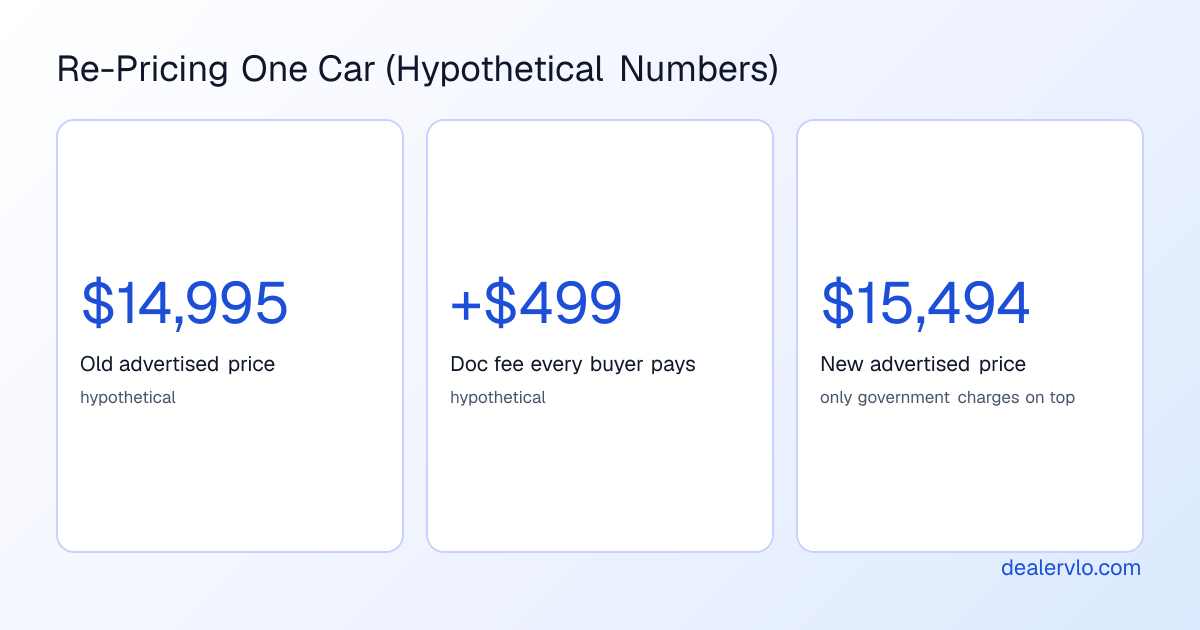
Same math, hypothetical numbers: you've advertised a car at $14,995 and every buyer pays a $499 doc fee. The advertised price becomes $15,494.
If your doc fee varies, advertise with the higher one. The FAQ says that if some buyers would be quoted a higher mandatory fee, that higher fee must be built into the advertised price. State rules don't change the federal answer. Question 7 notes that some states cap doc fees, some require a separate disclosure, and some require specific wording. The actual price stays the most prominent amount in the ad, and then you add whatever disclosure your state requires. Check your state's dealer board or attorney general; our doc fee by state page is a starting point, not the final word.
In DealerVLO, you set your default doc fee once in Settings and it pre-fills every new deal, so you have one known number to build into your prices. To be clear: DealerVLO does not add the doc fee to your advertised price for you. You enter the all-in price on the car.
Change 2: delete the "plus fees" fine print
Plenty of ads read "$14,995 plus doc fee" or "price excludes dealer fees." The FAQs don't use those phrases, but the doc fee answer leaves no room for them: no extra charges except government ones. A footnote doesn't make the smaller number the actual price.
Prominence matters too. Question 5 says the actual price must be the most prominently displayed amount, and prominence is not limited to font size. A big $14,995 over a small "$15,494 with doc fee" fails that test.
The same question covers conditional discounts. The FAQ's example is a $2,000 discount for using dealer financing: fine to mention, but the price a buyer would pay with any financing has to be the headline. If your ads lead with a "with in-house financing" price, fix that line.
And watch the two-price habit. Question 9 says you can't advertise a price only some buyers get. Its example, $24,999 advertised and $26,499 quoted at the lot, is what happens when the website shows an internet price but walk-ins get the sticker. Negotiating down from the ad is fine. Quoting above it isn't.
Change 3: the same price on every listing site, post, and phone call
Question 3 covers dealership and third-party websites, social media, print ads, roadside signs, and phone calls and text messages with your staff. Question 4 adds that inventory-search pages and vehicle pages must show the actual price as the most prominent amount.
Question 12 is the one for anyone who syndicates. Everyone who controls the advertising is responsible. Dealers should give third parties the actual price, take every step within their control to make sure it shows as the most prominent amount, and make sure nobody at the dealership gives contradictory instructions. After you re-price, check how each car displays on every listing site, search page and vehicle page, plus Marketplace posts, social posts and windshield stickers. And tell whoever answers the phone that the advertised price is the price. Our post on car listing sites for dealers covers keeping several sites in step from one feed. CarGurus, for its part, now rates deals on the all-in price including the fees you disclose to it; see is CarGurus worth it for dealers.
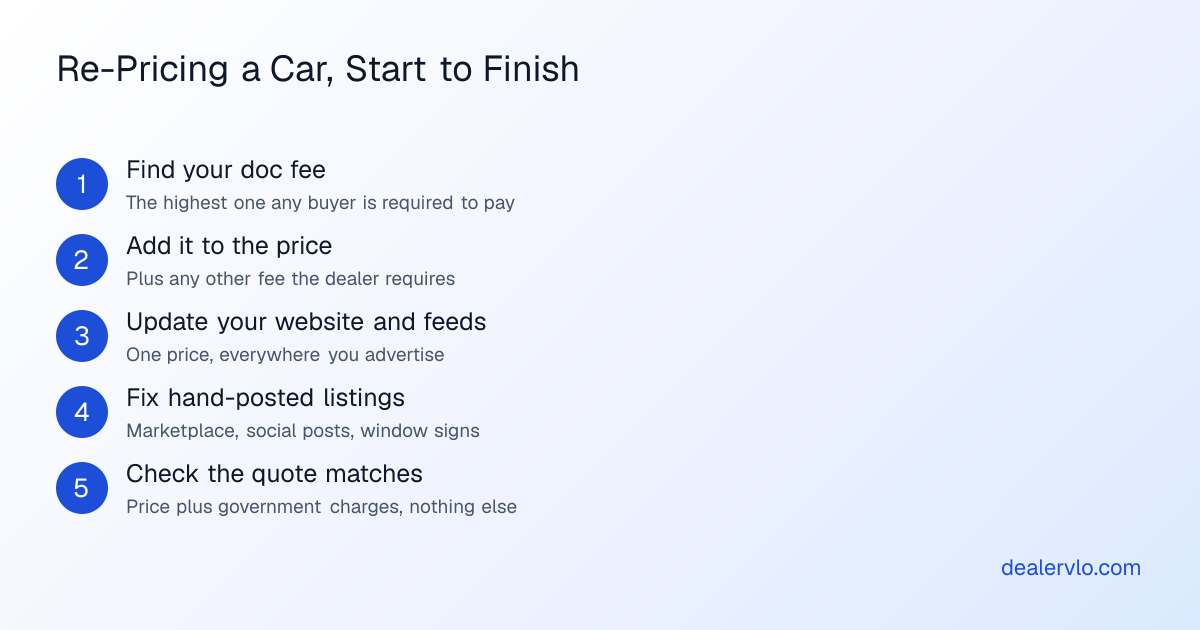
In DealerVLO, your dealer website and your CarGurus, Cars.com and Autotrader feeds read the same price from the car: its internet price, or its asking price if no internet price is set. Change it once and the website shows it right away; the feeds carry it on their next update, and each site posts it on its own schedule. Facebook Marketplace listings are posted by hand, so you update those by hand.
14-day free trial, then $29/mo · Cancel anytime
Change 4: add-ons that aren't really optional
Question 9 also covers optional items like protection packages and accessories. You can offer them, but you can't suggest an add-on is required when it's optional, imply an installed "option" can't be removed and must be paid for, misstate its cost, or charge for options the buyer didn't agree to. The FAQ says the FTC has sued over this and will keep doing so.
That leaves two clean paths. A truly optional product stays out of the advertised price and is a real yes-or-no. A product every buyer pays for is, by question 2's logic, a dealer-required charge that goes in the advertised price. What doesn't work is the middle: a "pre-installed" package nobody can decline that the ad never mentioned.
In DealerVLO, the deal jacket computes the deal math live, totals and F&I gross included, so you can walk the buyer through what's in the number before anyone signs. Whether a product is optional is your sales process, not something software decides.
Change 5: make the quote and the paperwork match the ad
When a buyer comes in on the $15,494 car, the buyer's order should read $15,494 plus government charges, and nothing else they didn't choose. If your desk still adds the doc fee on top of the old sticker, the paperwork contradicts the ad. Build the quote from the advertised number: price, plus government charges, minus trade and down. Our free calculator checks that math.
Build the whole deal — price, tax on the right base, doc, title, minus trade and down — into the out-the-door number and the monthly payment.
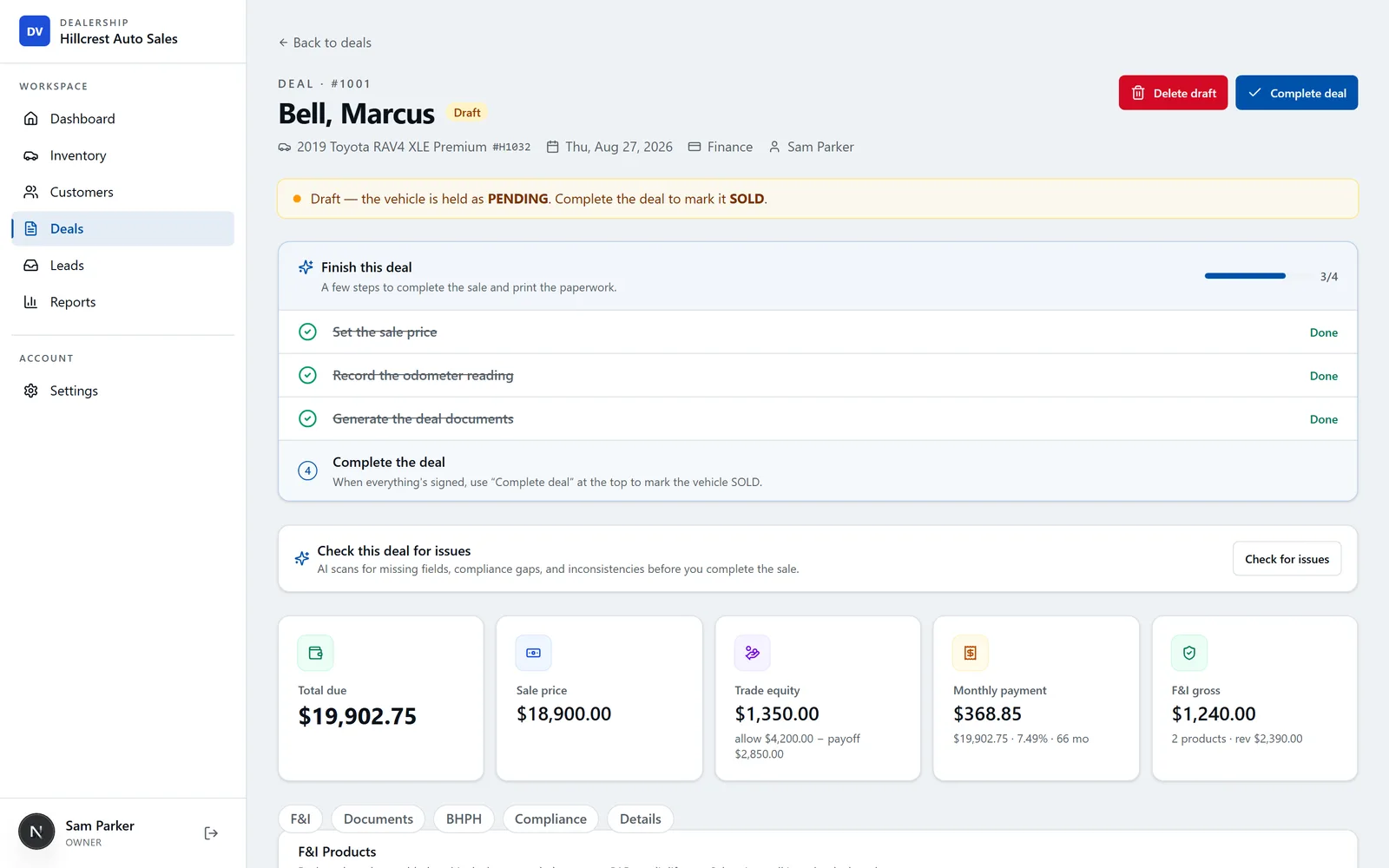
Open the Out-the-Door Price CalculatorIn DealerVLO, the deal jacket computes the total as you type: price, doc fee, tax, trade equity and payment, on one screen. If your advertised price includes the doc fee, enter the sale price and doc fee so they add up to it ($14,995 plus $499 in the example), and the total is the ad price plus government charges.
The same deal fills the FTC Buyers Guide, so the paperwork the buyer signs comes from the deal that holds the price.
Change 6: keep a record of what you advertised
Question 14 asks the public to report violations at ReportFraud.ftc.gov, with copies of ads and contracts. Buyers and competitors can screenshot your ads, so keep your own: dated screenshots of a few vehicle pages on each site whenever you re-price, plus the paperwork for every sale.
Also worth a look: question 10 says a car in transit or stored off the lot can be advertised only if the ad plainly says so, and advertising already-sold cars to pull buyers in is deceptive. Question 11 says buyers can reasonably expect a used car's photo to show the exact car. In DealerVLO, a car marked sold drops off your website and listing feeds, and the deal compliance checklist gives you a place to record the steps you completed on each deal. You fill it in; it isn't an automated review.
Where DealerVLO fits
DealerVLO keeps one price and one fee consistent from the ad to the paperwork:
- One doc fee: set it once in Settings; it pre-fills every new deal.
- One price per car: the website and the CarGurus, Cars.com and Autotrader feeds read the same price (you enroll with each site and still pay its fees).
- A matching deal: the deal jacket computes price, doc fee, tax, trade and payment.
- The paperwork: the FTC Buyers Guide and state forms fill from the deal, with e-signatures and a compliance checklist you complete.
What it doesn't do: add your doc fee to advertised prices, check how a listing site displays your price, post to Facebook Marketplace for you, or give legal advice. You set the all-in price, you check the sites, and your attorney reviews your ads. It's $29 a month, flat, for unlimited users.
While you're re-pricing, check the price itself: a $499 jump in the advertised number changes where a car lands in shoppers' price filters. How to price used cars covers comps and margin.
Frequently asked questions
What are the FTC guidelines for dealership pricing?
In the pricing transparency FAQs FTC staff published on September 15, 2026, the advertised price must be the actual price any consumer can walk in and pay. Only charges a government agency requires the consumer to pay directly, such as taxes, can be left out. Every dealer-required fee, including the doc fee, goes in, and that price must be the most prominent amount in the ad. This is staff guidance, not a new rule, and not legal advice.
What do the FTC FAQs say about dealer doc fees?
The FTC doesn't set a doc fee amount. The FAQs say the advertised price must include the full doc fee if the dealer requires any consumer to pay it: a $40,000 car with an $85 doc fee is advertised at $40,085. If the fee varies between buyers, advertise with the higher mandatory fee. Caps and disclosure wording are state law, so check your state too.
Can car dealers add fees to the advertised price?
Not dealer fees. Under the FTC staff FAQs, only charges a government agency requires the buyer to pay directly, like taxes, can sit on top of the advertised price. Fees the government allows but doesn't require, and government fees charged to you that you pass on, belong inside it.
Does a dealership have to honor an advertised price?
The FAQs don't use the word "honor," but they say the advertised price must be one any consumer can actually pay, negotiated or not. Their example: a car advertised at $24,999 where a walk-in is quoted $26,499 because only a few earlier shoppers got the lower price. They call that misleading. State law may say more, so ask your attorney or state dealer association.
Do the FTC price rules apply to CarGurus, Cars.com and Facebook listings?
Yes. The FAQs name dealership and third-party websites, social media, print ads, roadside signs, phone calls and text messages. Everyone who controls the advertising is responsible, and a dealer should give third parties the actual price and take every step within its control to make it the most prominent amount.
Are the FTC price transparency FAQs a new rule?
No. The page says it represents the views of FTC staff and is not binding on the public or the Commission. It explains how staff reads the FTC Act, and it says price transparency is not a new requirement, with no grace period. The practical reading: fix your ads now.
Bottom line
The FTC price transparency FAQs come down to one sentence: the number in your ad is the number a buyer can pay, plus only what the government charges them. For most lots that means building the doc fee into every advertised price, dropping the "plus fees" fine print, and using that same number everywhere, paperwork included.
If you want the doc fee set once, one price flowing to your website and listing feeds, and the out-the-door total on the deal before anyone signs, try DealerVLO free for 14 days.
14-day free trial, then $29/mo · Cancel anytime
Punch in cost, recon, holding days, and sale price to see your true net gross and margin.
Open the Profit Margin Calculator