FTC Dealer Compliance in 2026: What Enforcement Actually Looks Like
The rules didn't all change — the enforcement did. What the FTC actually cares about at a used-car lot in 2026, and a short self-audit to get ahead of it. Not legal advice.
The rules didn't all change this year. The enforcement did. The FTC has been sending warning letters to auto dealers over deceptive advertising and pricing, and the posture has clearly shifted from writing rules to enforcing the ones — and the longstanding authority — already on the books. For an independent lot, that means the risk usually isn't some obscure new statute you missed. It's the everyday stuff — the advertised price, the add-ons, the customer data you collect — held to a stricter light.
This is a plain-English orientation for operators: what the FTC actually cares about at a used-car lot in 2026, and a short self-audit to get ahead of it. One thing up front — this is not legal advice. For your specific situation, talk to a compliance attorney. What follows is how I think about staying out of trouble on my own lot.
The shift: enforcement, not new rules
It's easy to get lost chasing acronyms. The FTC's CARS Rule — its motor-vehicle pricing-transparency rule — got the headlines, but as of this writing a federal appeals court struck it down, so it isn't in force (confirm the current status before you rely on it either way). Here's why that doesn't let you off the hook: the conduct it targeted — deceptive pricing, surprise junk fees, add-ons dressed up as required — is exactly what the FTC still pursues under its longstanding deceptive-practices authority. You prepare for the principles, not the acronym.
Alongside that sits the durable stuff that hasn't gone anywhere: the Used Car Rule (the FTC Buyers Guide on every unit), the Safeguards Rule for customer data, and — if you're in a state tightening its own screws — parallel state rules like the California CARS-style requirements. The federal and state pressure rhyme: advertise honestly, price transparently, disclose add-ons, protect data.
What the FTC is actually looking at
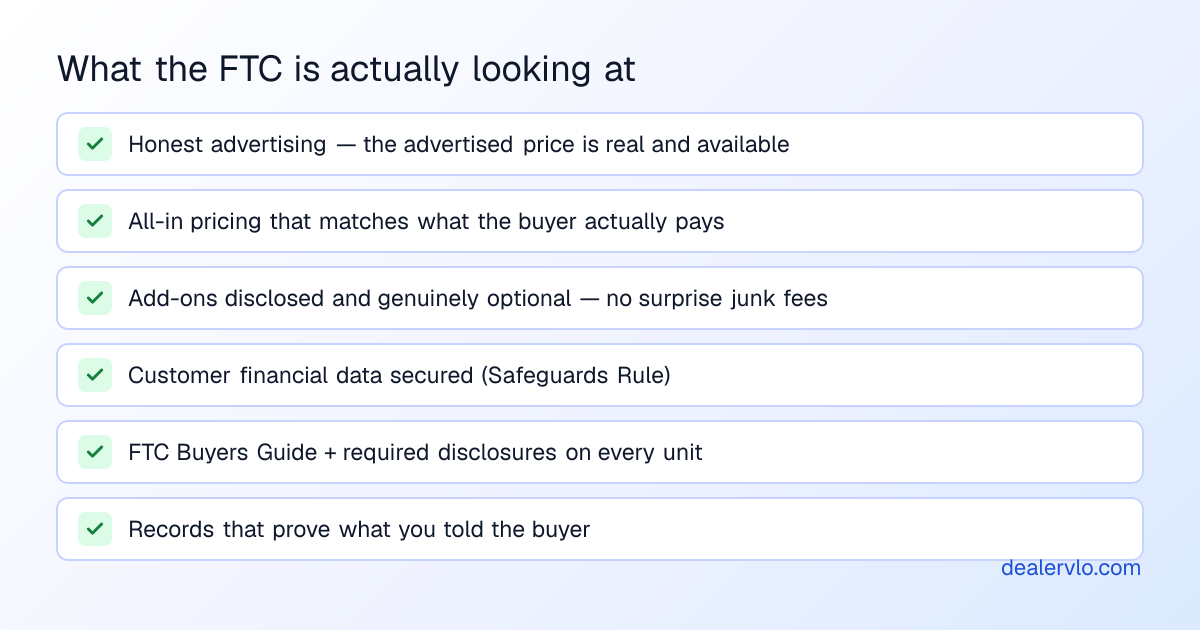
None of this is exotic. The recurring themes are whether your advertising matches your actual pricing, whether add-ons are disclosed and genuinely optional (not slipped into the deal as if they're required), whether the required disclosures are present, and whether you're protecting customer data. The bait-and-switch ad — a price nobody can actually get — and the surprise fee stack at signing are the two that draw letters. Advertise the number a real buyer can drive off for, and make every add-on a yes/no the customer chooses. (This is also just better business — a clear, honest listing out-converts a vague one anyway.)
A short self-audit before the FTC does it for you
You don't need a consultant for the first pass. You need twenty focused minutes.
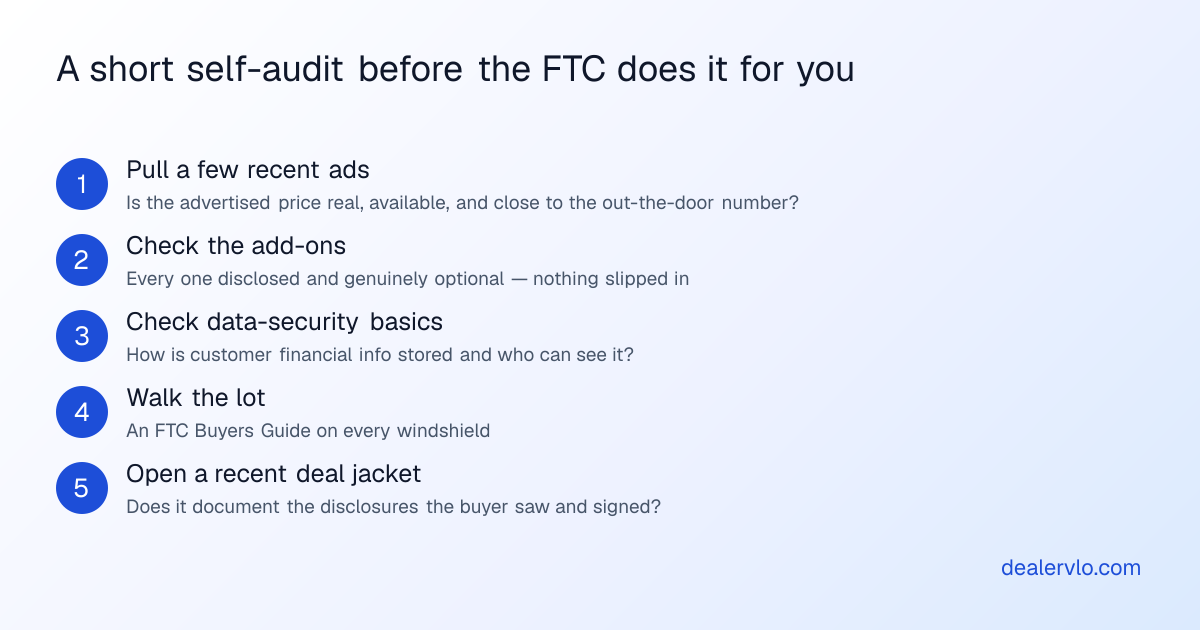
Pull a handful of your recent ads and ask whether the advertised price is real, available, and in the neighborhood of the out-the-door number a buyer actually pays. Walk your open deals and confirm every add-on was disclosed and truly optional. Look at how customer financial information is stored and who can see it. Walk the lot for a Buyers Guide on every windshield. Then open a recent deal jacket and ask the question that matters most: does it document what the buyer saw and signed? If the answer is "it's in my head" or "somewhere in a folder," that's the gap to close first.
Data security isn't a nice-to-have
If you collect Social Security numbers, driver's licenses, and credit applications — every financing lot does — assume the Safeguards Rule is your problem. It expects a written information-security program with reasonable protections around that data. The full breakdown is in our Safeguards Rule write-up; the short version is that "we keep the folders in a drawer and email photos of licenses" is not a defensible answer anymore.
Your documentation is your defense
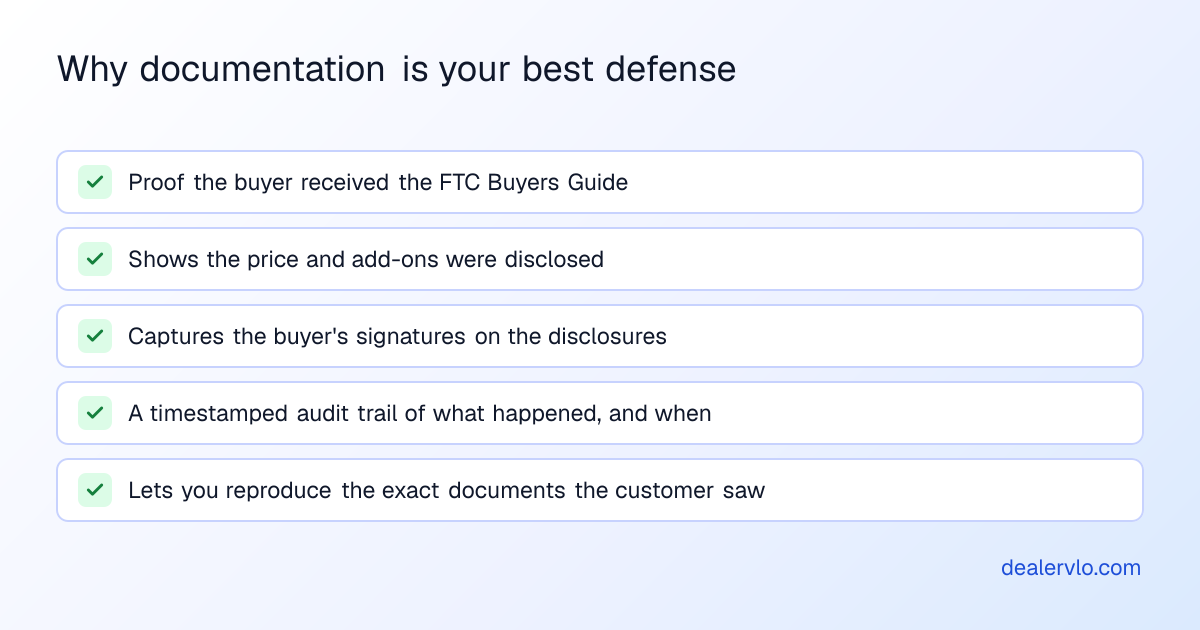
Here's the part that actually protects you: being able to show what you told the buyer and when. A dealer who can reproduce the exact Buyers Guide, price disclosure, and signed forms a customer saw is in a completely different position from one relying on memory and a paper folder. Enforcement rewards the boring virtue of a clean record. That's the whole reason a deal jacket — versioned documents, the disclosures attached, timestamps on what was generated and signed — is worth more than any compliance slogan.
Frequently asked questions
What is the FTC actually enforcing at dealerships in 2026?
Honest advertising, transparent all-in pricing, disclosed-and-optional add-ons, and customer data security — held to a stricter standard. The FTC pursues deceptive pricing under its longstanding authority regardless of any one rule's status. Not legal advice.
Is the CARS Rule in effect?
As of this writing it was struck down by a federal appeals court and isn't in force — confirm the current status. But the conduct it targeted is still pursued under the FTC's existing authority, so prepare for the principles either way.
What is the Safeguards Rule?
It requires businesses handling customer financial information — including dealers who arrange financing — to maintain a written information-security program. If you take credit apps, assume it applies.
What does a compliance check look at?
Your ads versus your pricing, add-on disclosure, required disclosures like the Buyers Guide, and data security — with documentation tying it together. Can you show what the buyer saw and signed?
Does DealerVLO make me compliant?
No software does that on its own, and this isn't legal advice. It does make documentation easy: versioned documents, the Buyers Guide and disclosures in the deal jacket, and a timestamped audit trail.
Bottom line
2026 is the enforcement year, not the rule-change year. You don't get ahead of it by memorizing acronyms — you get ahead of it by advertising the real price, making add-ons optional, protecting customer data, and keeping a record clean enough to prove all three. The dealers who get letters are usually the ones who can't show their work.
That last part is where software earns its keep. DealerVLO builds the paper trail into the deal itself — the FTC Buyers Guide and required disclosures in every jacket, versioned and downloadable, with a timestamped record of what was generated and signed. It won't make you compliant by itself (nothing will, and this isn't legal advice), but it means the day someone asks you to show your work, you can. It's $29/month flat, unlimited users, with a free 14-day trial a card starts.