California CARS Act Dealer Compliance: What Changed on October 1, 2026
California's CARS Act (SB 766) is in effect. For independent dealers: the 3-day right to cancel, total-price advertising, banned add-ons, records and paperwork.
Part of the Compliance, taxes & deal paperwork guide: What goes in a used-car deal jacket: the complete checklist
Switching from another DMS? Compare DealerVLO to DealerCenter, Frazer, or Lot Wizard.
California's CARS Act, short for Combating Auto Retail Scams, took effect October 1, 2026. If you sell used cars in California, it changed four things: how you advertise prices, which add-ons you can sell and how you present them, what records you keep, and, biggest of all, it gives buyers three days to return most used cars for any reason.
I've updated this guide now that the law is live, working from the statute itself (SB 766, which added Civil Code 1784.20 through 1784.44) and DMV's dealer notice, OLIN 2026-10. Where the two disagree, I say so. I'm a dealer, not your lawyer, so treat this as a map of what to ask yours.
14-day free trial, then $29/mo · Cancel anytime
Who the law covers
The act applies to licensed California dealers selling or leasing vehicles to consumers. It carves out:
- Wholesale sales and auction sales
- Fleet sales: more than one vehicle in a single transaction, bought primarily for business or commercial use
- Commercial buyers who purchase five or more vehicles from you a year
- Vehicles with a gross weight rating of 10,000 pounds or more, and motorcycles
- A lessee buying out the vehicle they already lease
Everything else, your typical retail customer buying one car, falls under the new rules.
The three-day right to cancel
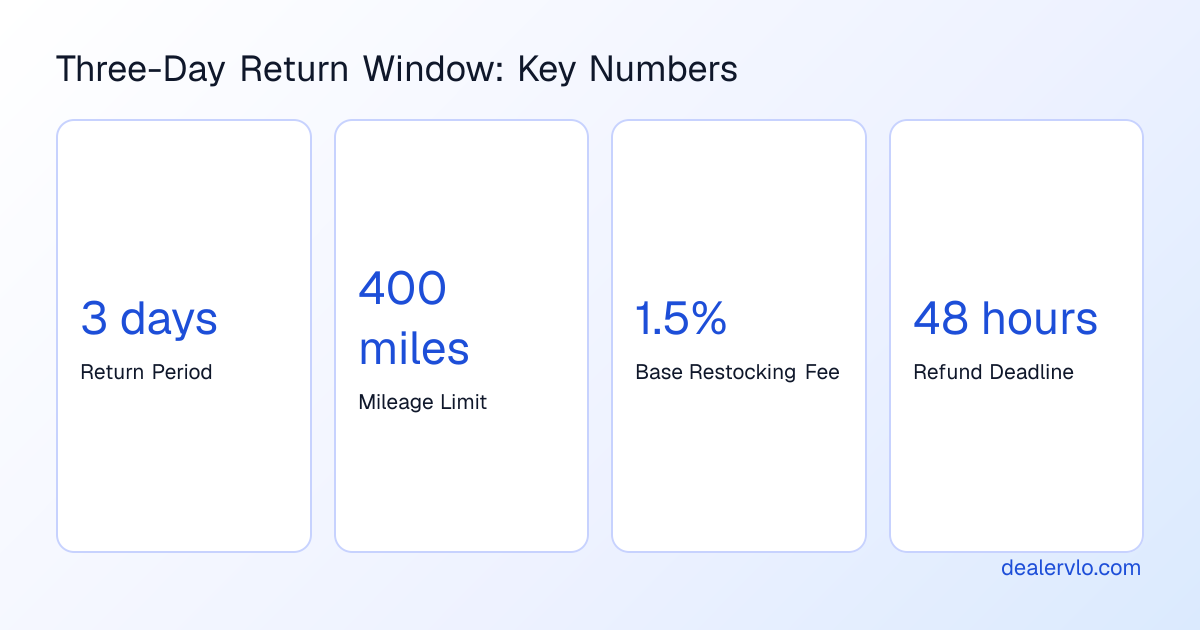
Every used vehicle you sell or lease at retail for $50,000 or less now comes with a three-day right to cancel, for any reason. It replaced the old paid 2-day Contract Cancellation Option under Vehicle Code 11713.21, which covered cars under $40,000 and was repealed as of October 1. You can't charge for the new right, and the buyer doesn't have to ask for it.
The short version:
- The window is three calendar days starting the day after the contract is signed, ending at close of business on the third day (Civil Code 1784.31(i)). If you're closed that day, it runs to your next open day. DMV's dealer notice says "business days", which conflicts with the statute. Settle your store's policy on that with your attorney.
- The mileage cutoff: no right to cancel once the car's been driven more than 400 miles since signing.
- The restocking fee: 1.5% of the sale price, between $200 and $600, plus $1 a mile over 250 miles, capped at $150. It can come out of the refund.
- The refund: within 48 hours after the buyer cancels. Return the trade-in with its keys, or if you've sold it, pay the greatest of the agreed value, what you sold it for, or fair market value.
The full dealer-side walkthrough, with the day counting, the fee math and the refund process, is in California's 3-day right to cancel, for dealers.
The paperwork. Three pieces, all set by statute:
- A first-page notice on every purchase or lease contract (Civil Code 1784.43(e)). It's fixed text that starts "CALIFORNIA DOES NOT HAVE A COOLING-OFF PERIOD FOR NEW VEHICLES" and explains the 3-day right on used cars at $50,000 or less. Contract stock printed before the CARS Act won't have it.
- A separate disclosure titled "3-Day Right to Cancel Used Car Purchase or Lease" (1784.43(b)), with the deadline, both parts of the restocking fee, the 400-mile rule, what the buyer has to return and the trade-in rule. If the deal was negotiated mainly in Spanish, Chinese, Tagalog, Vietnamese or Korean, it also has to be given in that language.
- A wall notice in at least 36-point type in every sales office, sales cubicle and contract-signing room (Vehicle Code 11709.2). The wording is written into that statute.
DealerVLO generates the first two from the deal. The details are in the DealerVLO section below.
Total price advertising
The CARS Act ends the practice of advertising a teaser price and layering charges on later. Every ad for a specific vehicle has to show the total price, and so does your first written reply to a customer asking about a specific car (Civil Code 1784.41(a)). Keep that first written reply for two years and give the customer a copy if they ask in writing.
Under 1784.31(j), total price includes the vehicle's price, any dealer price adjustment and anything installed on the car when the ad runs. You can't subtract rebates to make the number smaller. It excludes the charges listed in Vehicle Code 11713.1(e), which include taxes, registration, the tire fee, the smog certificate, finance charges, the dealer document processing charge, electronic registration fees and emissions testing.
That doc-fee treatment is California's. FTC staff's price transparency FAQs take a different line on doc fees in advertised prices at the federal level, so read both before you settle on how your ads and windshield sheets show price.
Sold cars matter here too: a car you advertise that isn't actually available at that price is one of the misrepresentations the act lists below, so your website and listing sites have to keep up with the lot. A car marked sold in DealerVLO comes off your dealer website right away and off the listing sites with the next daily feed.
Turn your ad spend into a cost per car sold and a real ROI — and see how many units the spend has to produce just to break even.
Open the Marketing ROI CalculatorAdd-on products: what's banned and what you have to disclose
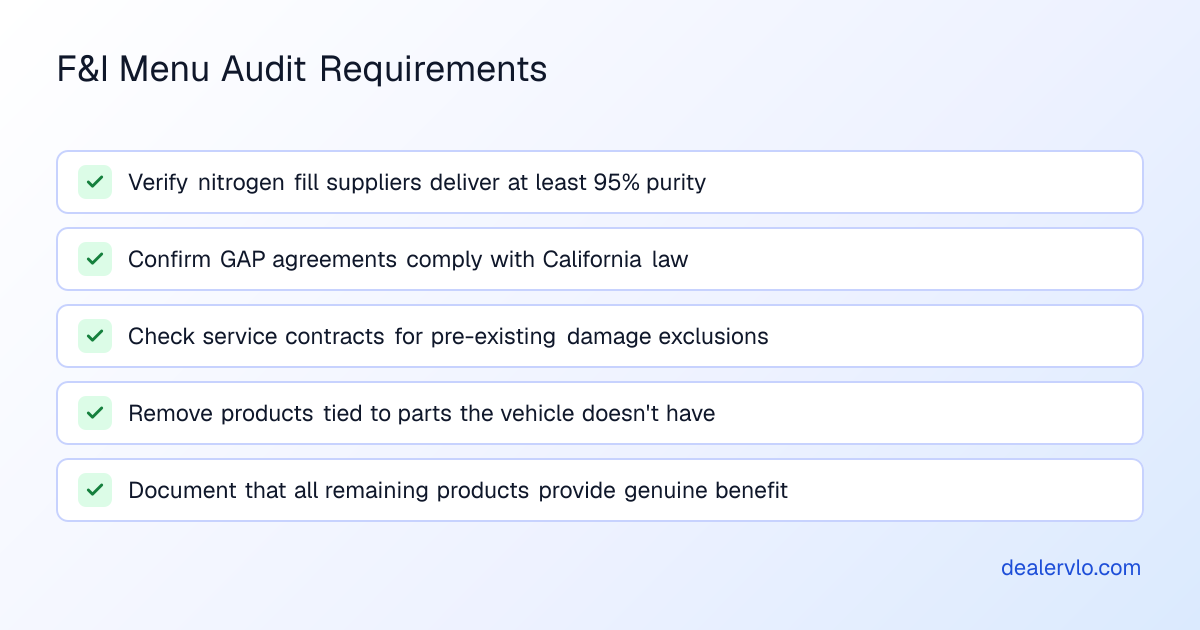
Civil Code 1784.42 makes it illegal to charge for an add-on that doesn't benefit the customer. Its examples are specific:
- Nitrogen tire fills with less than 95% purity
- Products or services that don't provide any coverage
- GAP agreements that don't comply with California law
- Service contracts that would be void because of a pre-existing condition, like prior crash or flood damage
- Oil changes on an electric vehicle
- Catalytic converter markings on a vehicle that doesn't have a catalytic converter
- Surface protection products that void the manufacturer's paint warranty
A product still counts as a benefit if the buyer never uses it or never has a claim. The ban is on products that couldn't help this buyer on this car, not on coverage that went unused.
The act also adds disclosures when you sell add-ons (1784.41(b) through (d)): a written notice that the add-on is not required to buy the car, the total cost of the vehicle at any monthly payment you quote, and a warning that a lower monthly payment often means paying more in total. And when you sell an add-on from a third-party provider, you have to pay that provider within 10 days.
Audit your F&I menu against that list. If you sell nitrogen, document your supplier's purity. If you sell service contracts, don't write them on cars with pre-existing damage that voids them. If a product is tied to a part the car doesn't have, pull it.
14-day free trial, then $29/mo · Cancel anytime
Prohibited misrepresentations
SB 766 bans a long list of misrepresentations. Most should already be off-limits under existing law, but they're now written down specifically. You can't misrepresent:
- Costs or terms of purchasing, financing, or leasing
- Costs, limits, or benefits of add-on products
- Whether the contract is a lease or a purchase
- Whether vehicles are actually available at the advertised price
- Pre-approvals or guarantees for financing or products
- Information on credit applications
- Whether you'll keep a deposit or trade-in if the customer doesn't complete the deal
- Your dealership's affiliation with or approval by any government entity
- Circumstances of repossession
- The customer's ability to move the vehicle out of state or out of the country
Don't lie, don't bait-and-switch, and don't mislead customers about what they're signing. With the CARS Act on the books, sloppy sales language is a compliance problem, not just a customer-service one.
Records retention
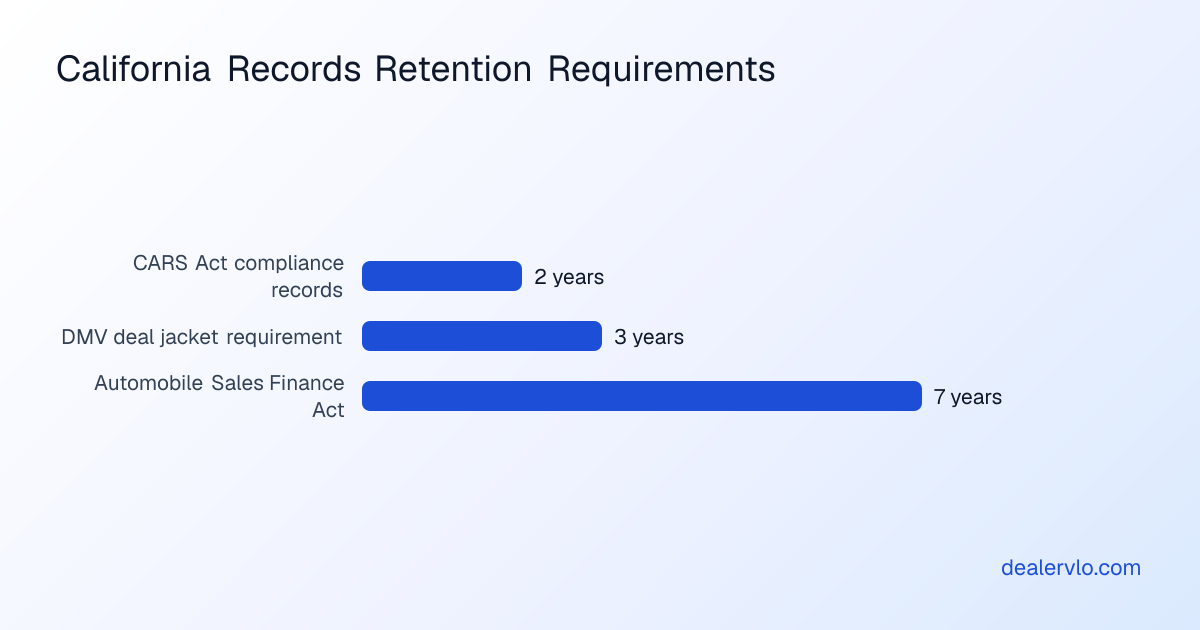
Civil Code 1784.44 requires keeping the records that show you complied for two years from the date each record is created. In practice that means:
- Advertisements and the first written communications showing total price
- Signed purchase, financing and lease documents
- Written correspondence with the buyer, including written questions about add-ons and vehicles
- Records showing each add-on you sold benefits the buyer, proof you paid add-on providers on time, and the loan-to-value figures on GAP deals
- Cancellation requests, refund proof, and proof that trade-ins were returned
- Written complaints from buyers or lessees
That sits alongside California's other retention rules. The DMV's dealer records regulation (13 CCR 272.00) uses three years, and for financed deals Civil Code 2984.5 requires keeping conditional sale contracts for seven years or the length of the contract, whichever is longer. Keep the CARS Act items easy to pull if DMV or a plaintiff's attorney asks.
Enforcement and penalties
The act itself doesn't have a penalties section. DMV's notice says it can investigate and act against dealer licenses, and that violations can also be pursued under California's Unfair Competition Law, False Advertising Law and Consumers Legal Remedies Act. Expect plaintiff's attorneys to cite CARS Act violations in those cases. A pattern of failing to give the cancellation right, running ads without total price, or selling add-ons with no benefit is the obvious risk.
Where DealerVLO fits
DealerVLO is the system I built for my own lot in Massachusetts, and California dealers run on it too. When the CARS Act took effect, we built its paperwork into California deals:
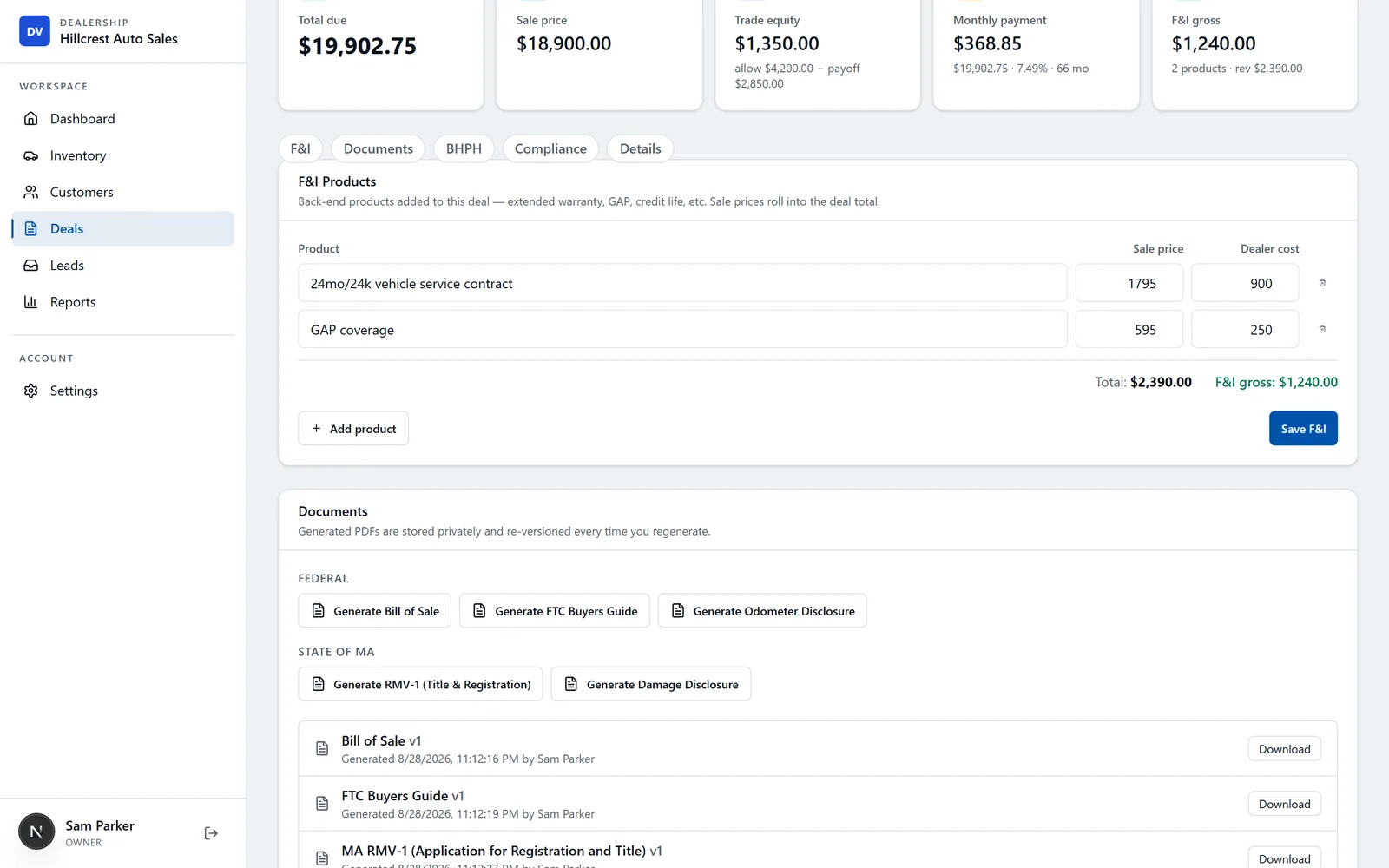
- The 3-Day Right to Cancel disclosure generates as its own document on any California used-car deal at $50,000 or less. It's filled from the deal: buyer, vehicle and VIN, the signing date, the last day to cancel, the odometer at signing and where the 400-mile limit lands, and the restocking fee for that sale price. It sits on the deal's document checklist, so a jacket without it shows as incomplete.
- The first-page notice prints on DealerVLO's bill of sale and retail installment contract for California dealers, in the statute's words.
- Language of negotiation. Each California deal records the language it was mainly negotiated in. Pick one of the five Civil Code 1632 languages and the disclosure gets a translated copy, plus a Language of Negotiation Acknowledgment. Have someone fluent read the translated copy before you rely on it.
- REG 262 prints from the deal onto a blank DMV form loaded in your printer. Signatures stay in ink.
What it doesn't do: track an open cancellation or time your refund, make your wall sign, audit your F&I menu, review your ads, translate your sales contract, or produce a California finance contract. Those stay with you, your forms vendor and your attorney.
Compliance checklist
What should be in place now that the law is live:
Forms and disclosures:
- The "3-Day Right to Cancel Used Car Purchase or Lease" disclosure on every used deal at $50,000 or less
- A translated copy when the deal was negotiated mainly in Spanish, Chinese, Tagalog, Vietnamese or Korean
- The CARS Act notice on page one of every purchase and lease contract, and contract stock that has it
Signage:
- The Vehicle Code 11709.2 notice in at least 36-point type in every sales office, cubicle and contract-signing room
Advertising:
- Ads and first written replies that show total price, with only the Vehicle Code 11713.1(e) items excluded
- Sold cars coming off your website and listing sites promptly
F&I menu:
- Every add-on checked against the 1784.42 list, and the banned ones removed
- The "not required" notice, the total-cost-at-this-payment figure and the lower-payment warning on every add-on sale
- Add-on providers paid within 10 days
Sales process:
- A written procedure for 3-day cancellations: day counting, odometer check, restocking fee, the 48-hour refund and the trade-in return
- Your lender's process for unwinding a cancelled contract, agreed before you need it
- Staff trained on the prohibited misrepresentations
Records:
- CARS Act records kept two years and easy to retrieve
Bottom line
The CARS Act isn't a cosmetic change. It forces price transparency, limits the add-ons you can sell, and gives buyers a return window on most used cars. It's in effect now, so the job is running it on every deal, not preparing for it.
Get the paperwork right first, because it's the part a DMV inspector or a buyer's attorney can see at a glance. DealerVLO fills the 3-day disclosure from the deal and prints the first-page notice on the contract, alongside the rest of your California deal jacket, for $29 a month. Start the 14-day free trial and run your next California deal through it.
14-day free trial, then $29/mo · Cancel anytime