Dealer Doc Fee by State 2026: What You Can Legally Charge
State-by-state doc fee caps for 2026. CA $85, MD $800, 28 states no cap. Statute citations, compliance rules, and what dealers can legally charge.
Part of the Compliance, taxes & deal paperwork guide: What goes in a used-car deal jacket: the complete checklist
Switching from another DMS? Compare DealerVLO to DealerCenter, Frazer, or Lot Wizard.
Before you set your fee: the caps below were verified for 2026, but several states index their cap to inflation (CPI) and adjust it every year, and legislatures change these numbers regularly. Treat this as a starting point, not legal advice — confirm your state's current cap with your state motor vehicle division or dealer licensing board before you print a buyer's order.
14-day free trial, then $29/mo · Cancel anytime
What You Need to Know Right Now
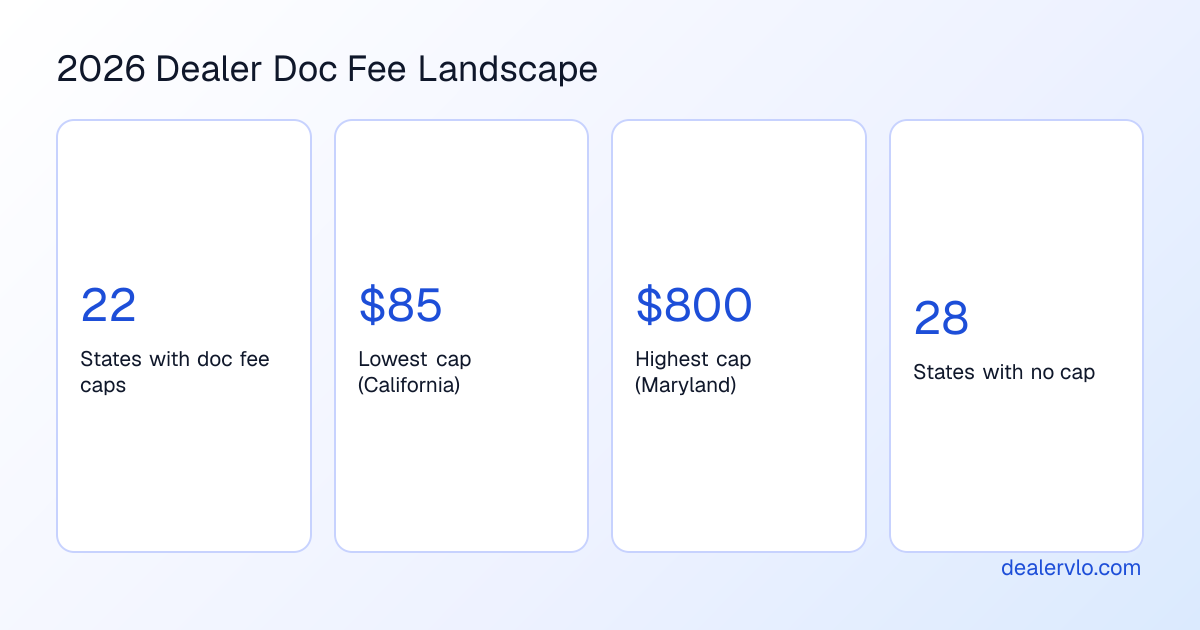
Twenty-two states cap dealer documentation fees by law in 2026. California sits at the bottom at $85, Maryland at the top at $800. The other twenty-eight states? No cap at all—which is why Florida and Virginia dealers routinely charge $800 to $999.
If you're running an independent lot, the doc fee is one of your few reliable per-unit profit centers. It's also one of the easiest ways to land in regulatory trouble if you charge above your state's cap or fail to disclose properly. This guide gives you the specific numbers, the statute citations, and the compliance steps you need.
The Basics: What a Doc Fee Actually Is
A documentation fee is what you charge the customer to prepare and process the sale paperwork—title application, registration, lien filing, bill of sale. It shows up on the buyer's order next to sales tax and registration, but it's not a government fee. It's your fee.
The actual cost to process a deal runs $50 to $150 in labor and materials. In uncapped states, dealers charge $300 to $1,200, so the difference is profit. That's legal—but only if you follow your state's rules.
Where Federal Regulation Stands
The FTC's CARS Rule, which would have imposed nationwide disclosure standards on dealer fees, was vacated by the Fifth Circuit in January 2025 and formally withdrawn by the FTC in February 2026. That doesn't mean the coast is clear.
You're still subject to FTC Act Section 5 (the general prohibition on unfair or deceptive practices) and every state UDAP statute. (The FTC's separate Unfair or Deceptive Fees Rule, in effect since May 2025, covers only live-event tickets and short-term lodging — not vehicle sales.) Class actions over excessive or undisclosed doc fees are rising fast. State caps remain strictly enforceable, and violations can cost you your dealer license.
Punch in cost, recon, holding days, and sale price to see your true net gross and margin.
Open the Profit Margin CalculatorState-by-State Doc Fee Caps
States With the Lowest Caps
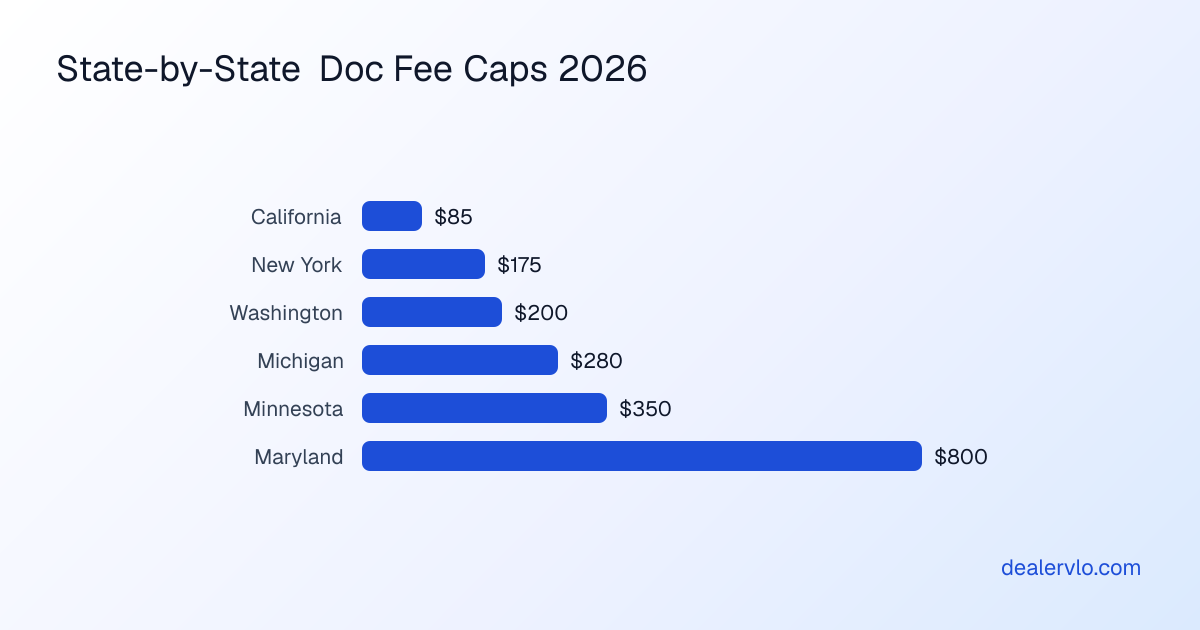
California: $85 or $70
California has the lowest doc fee cap in the country. If you're a DMV private industry partner dealer, you can charge up to $85. If you're not, the cap is $70. Governor Newsom vetoed a bill (SB 791) in October 2025 that would have raised the cap to $260, so the current limits remain in force through at least 2026.
Arkansas: $129
Arkansas caps the fee at $129 and calls it a "service and handling" charge. You cannot charge a separate documentary fee on top of it—this is the single allowable amount.
New York: $175
New York's cap is $175, set by regulation in August 2021. You can only charge this fee if you actually perform the service of filing the registration or title application. If the customer handles their own paperwork, you can't charge it.
Iowa: $180
Iowa's cap is $180 for all vehicles, new or used. It's straightforward—no sliding scale, no exceptions.
Washington: $250
Washington raised its doc fee cap from $200 to $250 on June 11, 2026 (ESSB 6354, Chapter 186, Laws of 2026). The higher cap runs through December 31, 2036, then drops to $225. The catch: you must disclose in writing, in bold or all-caps type at least as large as your standard contract text, that the fee is negotiable. If you don't include that disclosure, you can't charge the fee at all. Washington also requires you to state in advertisements that "a documentary service fee in an amount up to $250 may be added to the sale price," or similar language making it clear the fee is optional or negotiable.
Oregon: $200 or $250
Oregon caps the fee at $200 if you process paperwork manually, or $250 if you use an electronic integrator system. Make sure you're charging the correct amount based on your actual process.
Mid-Range Caps
Indiana: $262
Indiana's cap is $261.72 as of July 1, 2026 — technically an enforcement threshold the Secretary of State's Auto Dealer Services Division resets each July from the CPI (it was $251.05 before that). Expect a small increase every July.
Michigan: $280 or 5%
Michigan caps the fee at $280 or 5% of the vehicle's sale price, whichever is less. If you're selling a $3,000 car, your cap is $150. A $10,000 car, it's $280.
Minnesota: $350
Minnesota raised its cap to $350 effective July 2025, up from $125. For vehicles priced under $3,499, the cap is 10% of the sale price.
Illinois: $378
Illinois caps the fee at $377.63 for 2026. The statute (815 ILCS 375/11.1) set a $300 base on January 1, 2020 and adjusts it by the CPI every January, so check the current number each January.
Ohio: $398 or 10%
Ohio's cap is roughly $398 or 10% of the vehicle price, whichever is less. Like Michigan, this creates a sliding scale for lower-priced inventory. The cap is CPI-indexed and adjusts every year.
Pennsylvania: $409 or $490
Pennsylvania has separate caps depending on whether you process title work electronically or manually. Electronic processing allows up to $490; manual processing caps at $409. These limits took effect in January 2026 and are CPI-indexed.
Louisiana: $436
Louisiana's cap is approximately $436 in 2026, CPI-indexed with a maximum annual increase of 3%.
Higher Caps
West Virginia: $575 (or higher)
West Virginia's Motor Vehicle Dealer Advisory Board raised the cap to $575 effective July 1, 2024, and tied it to the CPI starting July 2025, with the board approving each year's adjustment. We couldn't find a published post-2025 figure, so confirm the current cap with the WV DMV or your dealer association before charging more than $575.
Missouri: $621
Missouri's cap is $620.79 as of February 2026, CPI-indexed and adjusted annually.
Maryland: $800
Maryland has the highest statutory cap in the country at $800, effective July 2024. If you're near the Maryland border, this is worth knowing—you can't charge Maryland rates in Virginia or Pennsylvania.
Texas: A Special Case
Texas has no hard statutory cap, but the Office of Consumer Credit Commissioner established a $225 safe harbor effective July 2024. If you charge above $225, you must be able to justify the additional cost. Most Texas dealers charge $150 to $300 in practice. Going above the safe harbor invites scrutiny.
14-day free trial, then $29/mo · Cancel anytime
States With No Cap
Twenty-eight states don't limit doc fees by statute. That doesn't mean you can charge anything—you're still bound by general prohibitions on unfair or deceptive practices, and you still have to disclose the fee clearly. But there's no ceiling.
Florida has no cap and is one of the highest-fee markets in the country. Most Florida dealers charge $800 to $999, and some go higher. Average doc fees in 2026 run $899 to $1,200.
Virginia has no cap. Average fees are $799 to $999, making it the second-highest state in the nation.
Georgia has no cap. Typical doc fees are around $599. The state requires itemized breakdowns, but it doesn't limit the total.
Colorado has no statutory cap. Typical fees run $599 to $699.
New Jersey has no cap. Most dealers charge $500 to $799.
Other uncapped states include Alabama, Alaska, Arizona, Connecticut, Delaware, Idaho, Kansas, Kentucky, Maine, Massachusetts, Mississippi, Montana, Nebraska, Nevada, New Hampshire, New Mexico, North Carolina, North Dakota, Oklahoma, Rhode Island, South Carolina, South Dakota, Tennessee, Utah, Vermont, Wisconsin, and Wyoming.
If you operate in an uncapped state, watch your market. Charging $1,200 when your competitors charge $400 will cost you deals, and if the fee isn't disclosed clearly, it can cost you a lawsuit.
CPI-Indexed States: Watch for Annual Increases
Eight states tie their doc fee caps to the Consumer Price Index: Illinois, Indiana, Louisiana, Michigan, Missouri, Ohio, Pennsylvania, and West Virginia. That means the cap rises automatically each year without new legislation.
If your state's cap is an odd number—$261.72, $378, $620.79—it's CPI-indexed. Check your state's motor vehicle division or dealer licensing board every year to get the updated figure (Indiana resets on July 1). Most CPI adjustments take effect at the start of the calendar or fiscal year, and charging last year's cap after the increase is fine, but charging above the new cap is a violation.
Sales Tax Treatment
In most states, your doc fee is included in the taxable amount when calculating sales tax. A $500 doc fee in a state with 7% sales tax costs the customer $535. A $900 doc fee costs $963. This matters for two reasons: it increases the customer's out-the-door price, and it means your effective profit on the fee is slightly less than the nominal amount (since you're collecting tax on behalf of the state, not keeping it).
Some dealers assume the doc fee is tax-exempt because it's a "service" rather than a sale. In most jurisdictions, that's wrong. Check with your accountant or your state's revenue department to confirm how your state treats it, but plan on it being taxable.
Compliance Checklist for Independent Dealers
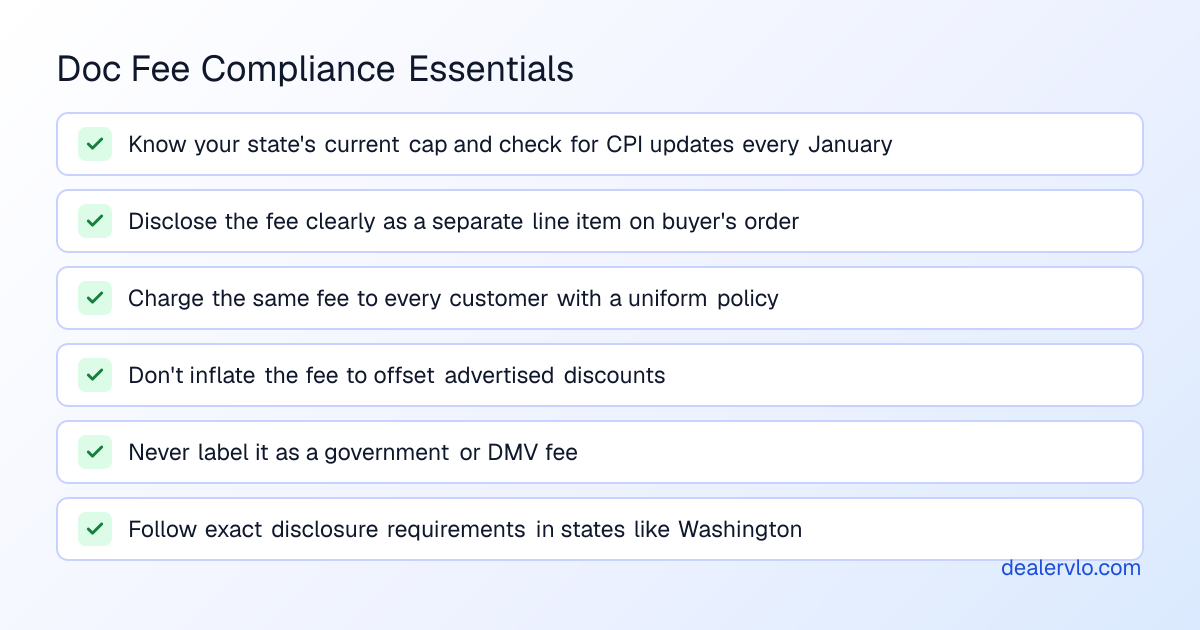
1. Know your state's current cap. If your state is CPI-indexed, check the figure every January. If you're in a capped state, you cannot exceed the limit—even by a dollar.
2. Disclose the fee clearly. Whether your state requires it explicitly or not, list the doc fee as a separate line item on the buyer's order and make sure the customer initials or signs acknowledging it. In Washington, you must also state in writing that the fee is negotiable.
3. Charge the same fee to every customer. Inconsistent doc fees can trigger discrimination claims or UDAP violations. Pick a number and stick to it, or have a clear, documented policy (e.g., a lower fee for cash deals or repeat customers) that you apply uniformly.
4. Don't inflate the fee to offset advertised discounts. Advertising a car at $8,000 but then charging a $1,200 doc fee that isn't disclosed in the ad is a classic deceptive practice. The FTC and state regulators call this "junk fees," and it's a fast track to enforcement action.
5. Don't call it a government fee. The doc fee is your charge, not a DMV fee or a state fee. Labeling it otherwise is deceptive and illegal.
6. If you're in a disclosure-required state like Washington, follow the exact requirements. Bold, caps, or underlined text. Specific language. If the rule says you must disclose, you must disclose—no shortcuts.
If you're looking for a way to manage compliance alongside the rest of your deal paperwork, a good DMS can help. DealerVLO's dealer paperwork software includes state-specific forms and compliance checks that flag issues before you print the buyer's order.
Bottom Line
Documentation fees are a legitimate part of your per-unit gross, but they're also one of the most regulated aspects of a vehicle sale. If your state caps the fee, respect the cap. If your state requires disclosure, disclose. And if you're in an uncapped state, keep your fee reasonable relative to your market and document it clearly.
The regulatory environment is only getting tighter, and class actions over undisclosed or excessive fees are rising. Getting this right isn't just about compliance—it's about protecting your license and your reputation.
14-day free trial, then $29/mo · Cancel anytime