Is CarGurus Worth It for Dealers? How a Small Lot Decides With Its Own Numbers
Is CarGurus worth it for dealers? Skip cost per lead. Judge a CarGurus package by cost per car sold, how deal ratings work, and a 60 to 90 day test.
Part of the Listings, photos & merchandising guide: Where to list your cars for leads — and how to be on every site at once
If you list used cars, a CarGurus rep has probably called you about upgrading your package. The question every small lot ends up asking is simple: is CarGurus worth it for dealers like us, or is it a monthly bill that feels busy without selling cars? The search results won't settle it. You get CarGurus' own sales pages, a few forum threads, and some videos, but no way to decide with your own numbers.
This post is that way. The short version: judge CarGurus by cost per car sold, not cost per lead. Below is how to track it, what CarGurus actually publishes about pricing and deal ratings, a 60 to 90 day test you can run, and the questions to put to a rep before you sign anything.
14-day free trial, then $29/mo · Cancel anytime
Is CarGurus worth it for dealers? Judge it by cost per car sold
Every listing site reports leads, because leads always look good. Forty leads a month sounds like a channel that works. But you don't deposit leads. If those forty turn into one sale, that's an expensive car, and if they turn into five, it may be the cheapest channel you have.
So the real question is: what does each car sold to a CarGurus shopper cost you, and is that less than its gross and less than your other channels? The listing sites hub uses that lens for every marketplace, and marketing cost per car sold has the full method. This post applies it to one decision: pay, stay entry-level, or downgrade.
How much does CarGurus charge dealers?
CarGurus doesn't publish dealer package prices. As of October 3, 2026, its dealer listings page names packages such as Enhanced, Featured+, and Featured Priority+, and sends you to a contact form for details and pricing. So any number you see quoted on a forum is someone else's deal, in someone else's market, at some other time. Yours comes from a rep.
CarGurus also lists separate products on its dealer site, such as Digital Deal, PriceVantage, and VINMax. That's where surprise costs tend to come from: not a secret charge, but extras you didn't compare. Get the total in writing, with the term and renewal date.
What about free? CarGurus' own pages describe an entry-level tier called Restricted Listings, which limits each car to six photos. The pages we read on October 3, 2026 don't say what it costs or how leads are handled at that level, and the terms have changed over the years. Our post on where to list used cars for free covers the free channels in general. For CarGurus specifically, ask your rep exactly what's available to your lot today.
Some dealers report sales pressure to upgrade. That's normal for any ad platform, and the answer is the same: nothing counts until it's in writing.
Step 1: Tag the source on every sale
You can't divide by sales you didn't count. For every car you deliver, ask the buyer where they first saw it and write the answer on the deal: CarGurus, your website, Facebook Marketplace, a drive-by, a referral. Be strict. "Google" isn't a source if they clicked a CarGurus listing that came up on Google.
Count sales, not leads. The lead-source tracking guide has the full setup, including buyers who touched three channels.
In DealerVLO, every lead that comes through your dealer website lands in the lead inbox with its source recorded, so you can see which website leads came from a car page and which came from the contact form. CarGurus leads arrive through CarGurus' own lead delivery, not the DealerVLO inbox, so tag those sales at the desk.
Step 2: Do the cost-per-car-sold math
The formula is short:
Cost per car sold = monthly CarGurus spend divided by the cars you sold to CarGurus shoppers that month.
Here's a made-up example. The spend figure is not a CarGurus price, it's a round number to show the math. Say you pay $1,000 a month and tag four sales to CarGurus shoppers. That's $250 per car sold. On a $2,000 average gross, the channel eats about 12.5% of the gross on those cars. If the same $1,000 produced one sale, it would be $1,000 per car, half the gross.
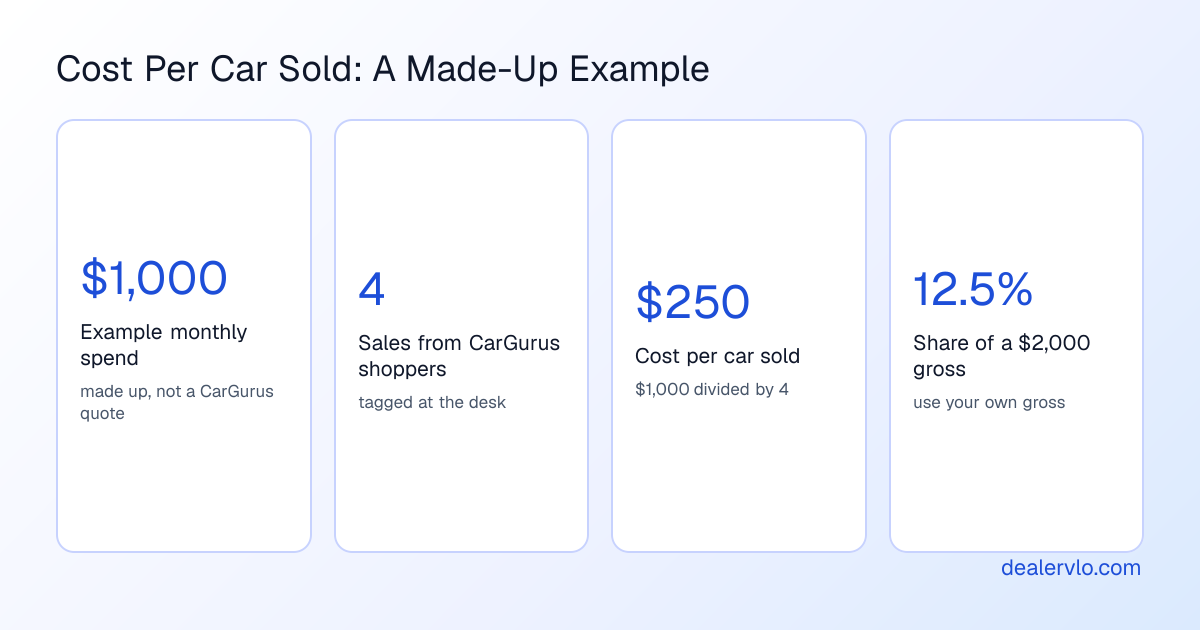
A channel that costs $250 a car can be worth keeping if it adds sales you wouldn't otherwise get. A channel that costs more than the gross it produces is underwater, however many leads it sends. The free calculator below runs your numbers and shows how many cars the spend must produce to break even.
Turn your ad spend into a cost per car sold and a real ROI — and see how many units the spend has to produce just to break even.
Open the Marketing ROI CalculatorIn DealerVLO, the sales report shows front- and back-end gross on every deal, so the gross side of this math is already done. Record the CarGurus bill as a recurring monthly expense in your profit and loss, and it sits next to your other overhead instead of hiding on a card statement.
Step 3: Price where the deal rating works for you
A CarGurus package buys you a seat at the table. Your price decides where you sit. Here's how CarGurus explains it on its own pages.
The deal rating. CarGurus' help page on IMV says its Instant Market Value is an estimated fair retail price based on comparable current and previous listings in your market, updated daily, and that it compares your asking price to that value to rate the deal Great, Good, Fair, High, or Overpriced. The same page says IMV and deal ratings are guidance, not a guarantee.
Visibility. CarGurus' default "Best Match" sort, described in a February 2024 dealer post, weighs price, mileage, and photos, plus the dealership's reviews and the services the dealer subscribes to. The most relevant Great and Good deals sit at the top of the organic results. So an overpriced car on a premium package can still be working against you.
Fees now count. CarGurus' fee transparency update, posted June 24, 2026, took effect July 14, 2026: used listings without disclosed fees are labeled No Rating and move lower in search, and deal ratings are calculated on the all-in price including disclosed fees. You set this in the Dealer Fee Setup tool in your CarGurus dashboard. Their pricing policy also requires listed prices to be full cash prices available to any shopper, not conditional on dealer financing or a down payment. If you skip fee disclosure, any test you run is rigged against CarGurus before it starts.
Reviews matter too. Per CarGurus' dealer review rules, shoppers who contact you through CarGurus are invited to review you, reviews older than two years drop out of your rating, and CarGurus says it won't remove negative reviews because a dealer advertises.
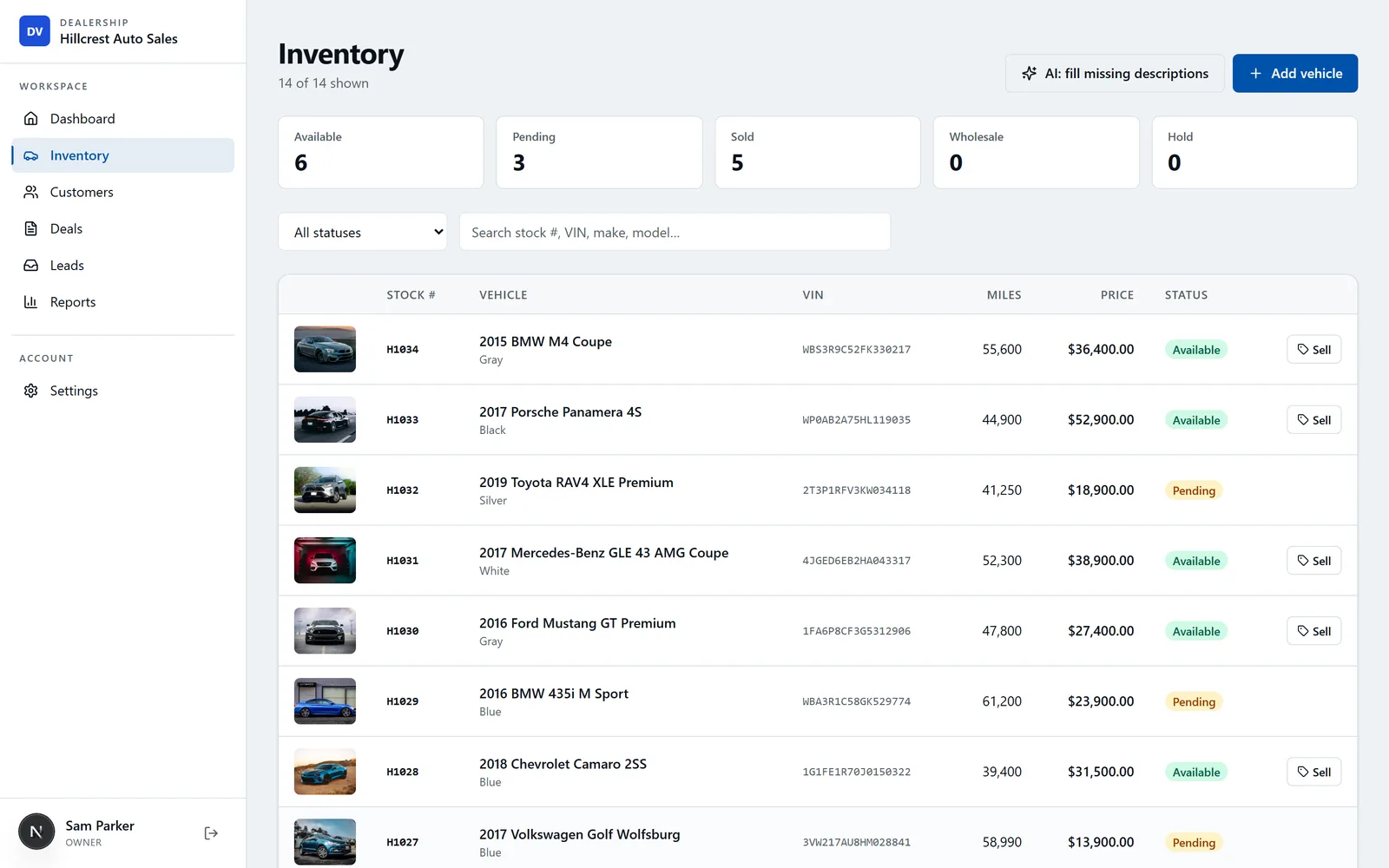
DealerVLO keeps every car's price, photos, and status in one inventory list, and the same record feeds your website and your CarGurus listing once you enroll. For pricing, its AI price suggestion shows a range from live comparable listings plus a target price for selling in about 30 days. It doesn't read CarGurus' IMV or predict your deal rating, but it's a quick market check before you list. And your default doc fee is set once in Settings and pre-fills every deal, so you know the all-in number a shopper will actually see.
14-day free trial, then $29/mo · Cancel anytime
Step 4: Run a 60 to 90 day test, then decide
One month is noise. A few slow weeks or one big trade-in swings it. Give the test 60 to 90 days so you have enough sales to divide by.
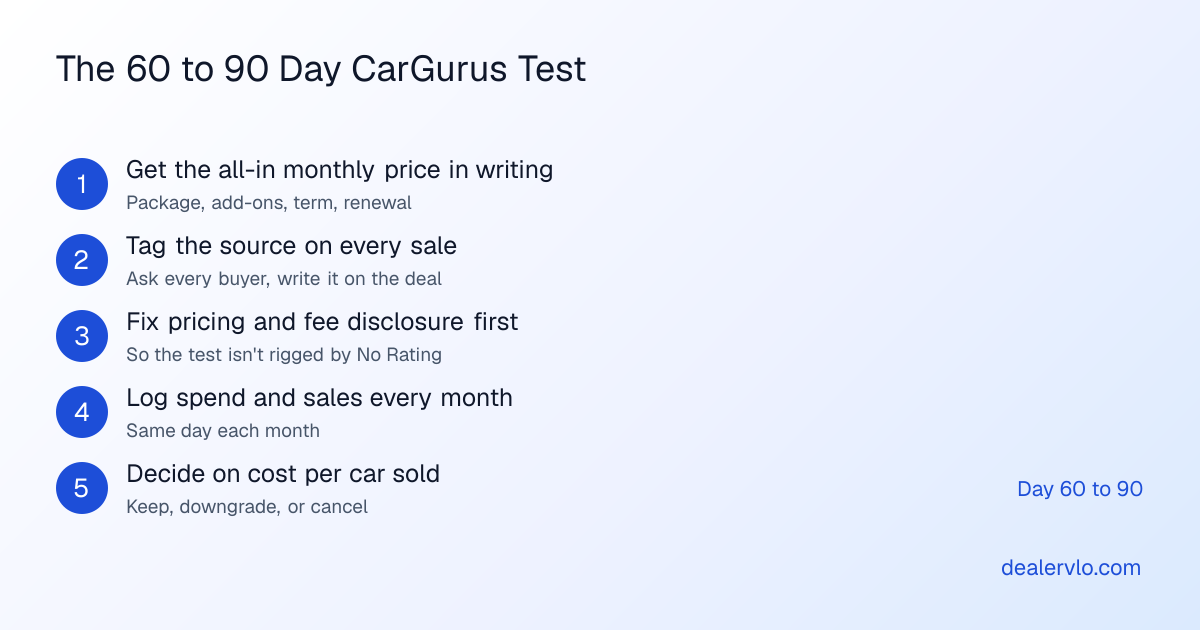
Before day one, disclose your fees, price against the market, and get decent photos on every unit. Then change nothing else big. Launch a new website the same month and you won't know which one moved the number.
At the end, three outcomes:
- Well under your gross and your other channels: keep it, and consider whether one package up adds sales at a similar cost.
- Close to your gross, or above other channels: downgrade, or renegotiate with your numbers in hand.
- Above your gross: it's underwater. Cancel or drop to whatever entry option CarGurus offers you.
DealerVLO's inventory aging report buckets cars 0-30, 31-60, 61-90, and 90+ days, so you can also see whether the test changed how fast cars move, not only how many sold.
Questions to ask a CarGurus rep before you sign
Treat it like any vendor. The demo matters less than the paper.
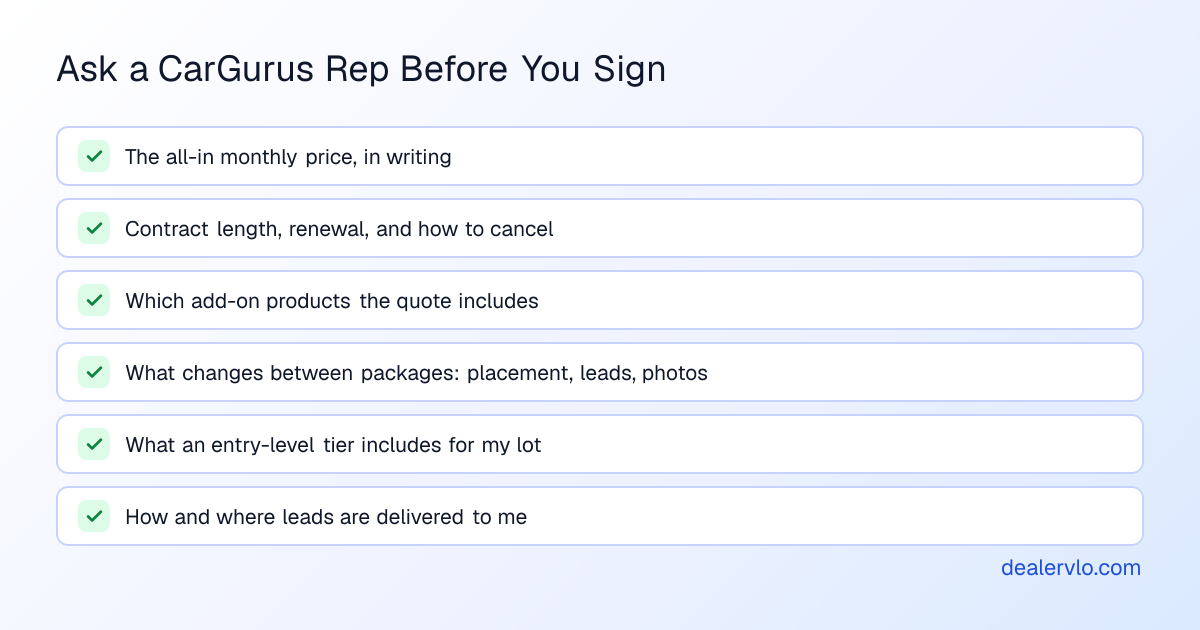
Two matter most. The cancellation terms, because a 60 to 90 day test only works if you can act on the result. And what actually changes between packages, in writing, so you can test one step up instead of jumping two.
CarGurus vs Autotrader, and the channels that cost less
There's no general answer to "is Autotrader better than CarGurus?" It depends on your market, your cars, and each quote. Run the same test on both and keep the one with the lower cost per car sold.
Before you add paid reach, make sure the cheaper channels are working:
- Your own website. The one channel you own, with no per-listing cost once it exists.
- Facebook Marketplace, by hand. Car by car; the Marketplace guide covers what Meta allows.
- Google Business Profile. Free; the setup guide walks through it.
If cars aren't appearing on a marketplace at all, that's a feed problem, not a value problem. Work through why cars don't show on listing sites before you judge the channel.
DealerVLO includes a dealer website in the $29 a month, and inventory posts to it automatically. When a buyer sends a lead through it, DealerVLO emails your dealership and, if they gave an email, sends the buyer an automatic confirmation. For Marketplace, each car has a "Post to marketplace" kit with the photos in one download and every field ready to copy.
Where DealerVLO fits
End to end, for the CarGurus decision:
- Listing feed to CarGurus, Cars.com, and Autotrader once you enroll with each. You still pay each site's own fees; DealerVLO doesn't reduce them.
- Pricing: the AI price range and 30-day target, days in inventory on every car, and an aging flag at 60+ days.
- Gross and spend: front- and back-end gross per deal, and a profit and loss where your CarGurus bill is a recurring expense.
- Your own channel: the included website, with web leads in one inbox with their source.
What it doesn't do: receive CarGurus' leads into its inbox, tag a sale's source for you, predict CarGurus deal ratings, or track phone calls. Use CarGurus' dashboard for its leads and ratings, and a note on each deal for the source. It's $29 a month flat, unlimited users, in a browser.
Frequently asked questions
How much does CarGurus charge dealers?
CarGurus doesn't publish dealer package prices. As of October 3, 2026, its dealer listings page sends you to a contact form for package details and pricing, so the number comes from a rep quote. Get the all-in monthly price in writing, including any add-on products and the renewal terms, before you compare it to anything.
Is CarGurus worth it for a small used-car lot?
It's worth it if the cars you sell to CarGurus shoppers cost you less, per car, than the gross they produce, and less than your other channels. You only know that by tagging the source on every sale for 60 to 90 days and dividing the monthly spend by the CarGurus-sourced sales. Lead counts alone won't tell you.
Does CarGurus have hidden fees?
The risk for a dealer is less hidden fees than unquoted extras. CarGurus lists several separate products on its dealer site beyond listings, so ask which ones your quote includes and get the total in writing. On the shopper side, CarGurus now requires dealers to disclose doc and dealer fees: since July 14, 2026, used listings without disclosed fees show No Rating and move lower in search, and deal ratings are calculated on the all-in price including disclosed fees.
Does CarGurus still offer free listings for dealers?
CarGurus' own pages describe an entry-level tier called Restricted Listings, which limits each car to six photos, but the pages we read on October 3, 2026 don't say what it costs or what limits apply to leads. The terms have changed over the years, so ask your rep exactly what's available for your lot and get it in writing.
Is Autotrader better than CarGurus?
Not in general. It depends on your market, your inventory, and the price each one quotes you. Run the same test on both: tag every sale's source, divide each channel's monthly cost by the cars it actually sold, and keep the one with the lower cost per car sold.
How does the CarGurus deal rating work?
CarGurus compares your asking price to its Instant Market Value, an estimated fair retail price built from comparable current and previous listings in your market, and rates the deal Great, Good, Fair, High, or Overpriced. Its default Best Match sort puts the most relevant Great and Good deals at the top of the organic results, so price affects visibility as well as appeal.
Bottom line
CarGurus is worth it for a dealer when the cars it sells cost less than the gross they make, and less than your other channels. Don't decide on lead counts or a rep's pitch. Disclose your fees, price to the market, tag the source on every sale for 60 to 90 days, and divide the spend by the sales.
I built DealerVLO for my own lot in Tewksbury, and it keeps the pieces of that decision in one place: the listing feed, pricing against live comparables, gross on every deal, and a website of your own that costs nothing extra. Try it free for 14 days.
14-day free trial, then $29/mo · Cancel anytime