CarGurus Deal Ratings and IMV: How to Price for a Good Deal Without Giving Away Gross
How CarGurus Instant Market Value and deal ratings work, why undisclosed fees now cost you the rating, and how to price for Good without giving away gross.
Part of the Listings, photos & merchandising guide: Where to list your cars for leads — and how to be on every site at once
Switching from another DMS? Compare DealerVLO to DealerCenter, Frazer, or Lot Wizard, or see what DealerVLO's car dealer management software includes.
Every small dealer on CarGurus has had this argument with themselves: the car shows Fair, a $500 cut would probably make it Good, and that $500 is a quarter of the gross you were counting on. Cut it and you might sell it this week. Hold and you might sell it for more, or watch it sit.
There's no universal right answer, but there is a right way to think about it. Here's how CarGurus' Instant Market Value and deal ratings actually work, what changed this year with fees, and how I decide which rating a car is worth chasing. Everything about CarGurus comes from its own help pages, dealer blog and SEC filings, read November 10, 2026.
What IMV is, and what goes into it
CarGurus defines Instant Market Value as an estimated fair retail price "based on a detailed analysis of comparable current and previous car listings in your market." It's recalculated daily from the make, model, trim, year, mileage, options and vehicle history, and CarGurus is clear it's not an appraisal or a guarantee. Its consumer pages add location and seller type, and its annual report adds condition.
Two things follow from that. IMV is built from listings, so it moves when the cars around yours change price. And trim and options matter: a car listed as the base trim gets compared to base-trim cars. CarGurus tells dealers to fill in trim and options in its dashboard pricing tool for that reason. In DealerVLO, the VIN decode fills year, make, model and trim when you add the car, so the feed starts with the right trim instead of whatever got typed in a hurry.
The ratings, and what nobody publishes
Every used listing gets one of five ratings against IMV: Great, Good, Fair, High or Overpriced. CarGurus' own descriptions are qualitative: Great is "significantly favorable," Good is favorably below, Fair is generally in line, High is above and Overpriced is well above. It also says only a small percentage of cars earn Great or Good.
What CarGurus does not publish is the cutoff: how many dollars or what percent under IMV makes a car Good instead of Fair. You'll find percentages floating around online; none of them come from CarGurus, so I wouldn't price to them. Shoppers see the gap in dollars ("$X below market") on the listing. On the paid tiers, CarGurus' "Next Best Deal Rating" tool shows the smallest price cut that reaches the next rating, which is the closest thing to a published threshold, car by car.
A sixth state matters more than any of them: No Rating.
Fees: the change that's costing dealers ratings
Since July 14, 2026, any used listing without disclosed fees is rated No Rating and moves lower in search. CarGurus' dealer pricing policy, dated October 13, 2026, spells out what has to be included: every mandatory dealer-imposed fee, including the documentation fee, reconditioning, processing and electronic-filing fees, market adjustments and mandatory add-on packages. Only tax, title, license, registration and other government fees stay out. The price also can't depend on financing with you, a trade-in, a down payment or a rebate the buyer has to qualify for, and CarGurus says it can pull ratings or listings from dealers who game the fee setup.
How to comply, per CarGurus:
- Set your fees in the CarGurus dealer dashboard under Settings → Dealer Fee Setup (new, used and CPO can differ).
- If you charge no dealer fees, turn off "My dealership charges dealer or document fees."
- If the price in your feed already includes your fees, turn on "Fees included in my inventory feed," or you can still lose ratings.
The rating then runs on the all-in price, so a $499 doc fee counts against you in the comparison just like $499 of sticker. That's not a reason to hide it; it's a reason to know your all-in number before you price.
One honest note on DealerVLO here: our CarGurus feed sends each car's price (its internet price, or the asking price if none is set), not a separate fee breakdown. So set your fees once in CarGurus' Dealer Fee Setup, and keep the internet price in DealerVLO as the vehicle price. Your default doc fee lives in DealerVLO Settings for the deal paperwork, so use the same number in both places. The same all-in rule shows up across the industry this year; here are the FTC price-transparency questions dealers keep asking.
14-day free trial, then $29/mo · Cancel anytime
How the rating moves you up the page
The rating isn't just a label. CarGurus' default sort, Best Match, puts Great and Good deals at the top of the organic results, and since November 2024 it mixes in some Fair deals alongside them. The sort also weighs mileage, trim, options, photos (listings without photos rank lower), dealer reviews and the services a dealer pays for.
That last part is worth reading carefully. CarGurus says paying never changes your rating. But paying does change placement: Featured+ and Featured Priority+ dealers get guaranteed top-three spots for their Fair, Good and Great deals. So a Fair car on a paid package can sit above a Good car on the free tier. If you're on the free tier, the rating does more of the work, which is one more reason to start there and measure before you pay (the free-tier route).
Pricing without giving away gross
Here's the trap: chasing a better rating with $500 steps feels small, but it comes straight off gross. An example with made-up numbers, not CarGurus thresholds:
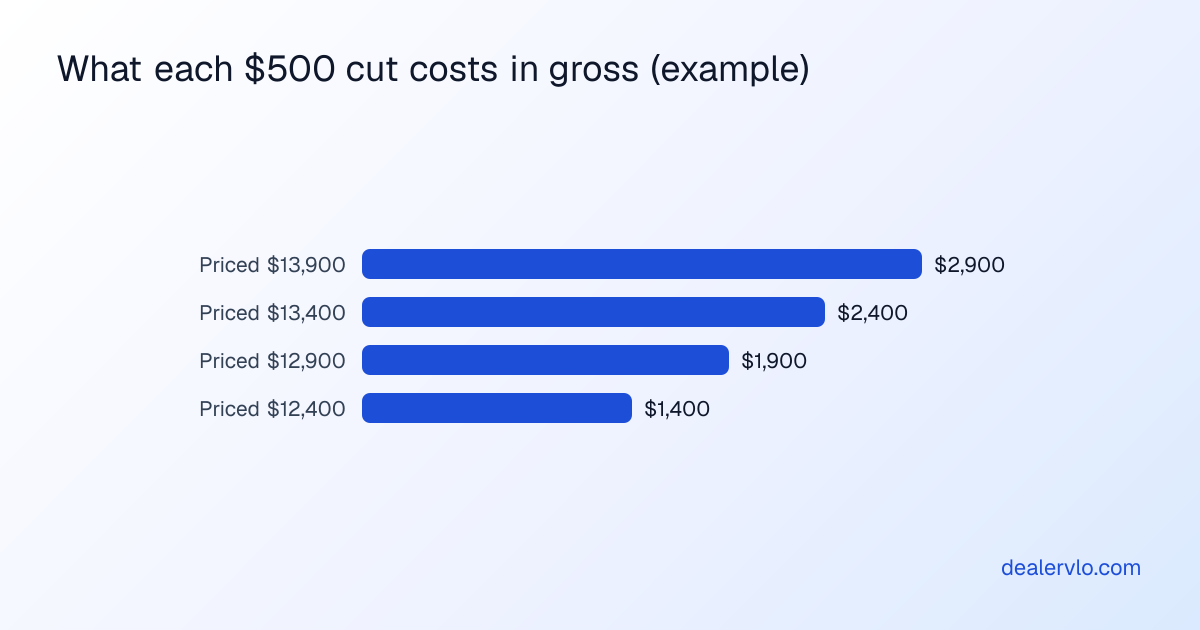
Three $500 cuts take that car from $2,900 to $1,400 gross, about half. Sometimes that's the right trade. Usually it isn't on day one. How I decide which rating a car needs:

- Know your all-in cost. Buy price, auction fees, transport and recon. In DealerVLO every car carries its acquisition cost plus its cost lines, so the gross at any price is one subtraction.
- Price from live comps, same trim, similar miles and history, in your market. DealerVLO's AI price suggestion shows a range from live comparable listings plus a target price for selling in about 30 days, which is a good sanity check against IMV. More on pricing from market comps.
- Disclose your fees in CarGurus so the car gets rated at all.
- Pick the rating this car needs. A fresh, clean, one-owner car, or one that's hard to find in your area, can sell at Fair or Good with strong photos. A common car with a dozen twins nearby needs Good to get seen. A car that's been sitting is where the Great price belongs.
- Review on a schedule, not on a feeling. Every car in DealerVLO shows its days in inventory and gets an "aging, consider repricing" flag at 60 days. Look at the rating again at 30 and 45, and make a real decision at 60.
Two things shoppers can see change how you cut. CarGurus listings show price history and days on CarGurus, so a string of tiny cuts reads as a car nobody wants. And shoppers who saved the car get an alert when the price drops. One meaningful cut that crosses into the next rating does more than three small ones. If you'd rather not cut at all, there are other levers: remerchandise an aging car first, and make sure it has a full photo set, since CarGurus says listings with 21 to 30 photos are most likely to get leads (how many photos to shoot).
When you change a price in DealerVLO, your website shows it within about a minute and CarGurus, Cars.com, Autotrader and Carfax.com get it with the next daily feed, so the cut lands everywhere at once and no site shows the old price.
Keep the "below market" claim true
On October 5, 2026, New York City's consumer-protection department sued CarGurus, alleging that some Great and Good ratings were misleading because fees sat in disclaimers. Those are allegations, not findings, but the direction is clear: the rating, the "below market" amount and the price a buyer actually pays have to line up. Disclose every fee, don't make the price conditional, and make sure the number on CarGurus is the number on your website and your buyer's order.
14-day free trial, then $29/mo · Cancel anytime
Frequently asked questions
What is CarGurus Instant Market Value (IMV)?
CarGurus' estimate of a fair retail price for a car, built from comparable current and previous listings in your market. CarGurus says it recalculates daily using make, model, trim, year, mileage, options and vehicle history, and that it's not an appraisal or a guarantee.
What percentage below market is a Great Deal on CarGurus?
CarGurus doesn't publish the cutoffs. Its own descriptions are qualitative: a Great Deal is significantly below the estimated fair market value, Good is favorably below, Fair is generally in line, High is above and Overpriced is well above. Paid subscribers get a tool showing the smallest price cut that reaches the next rating.
Why does my car show No Rating on CarGurus?
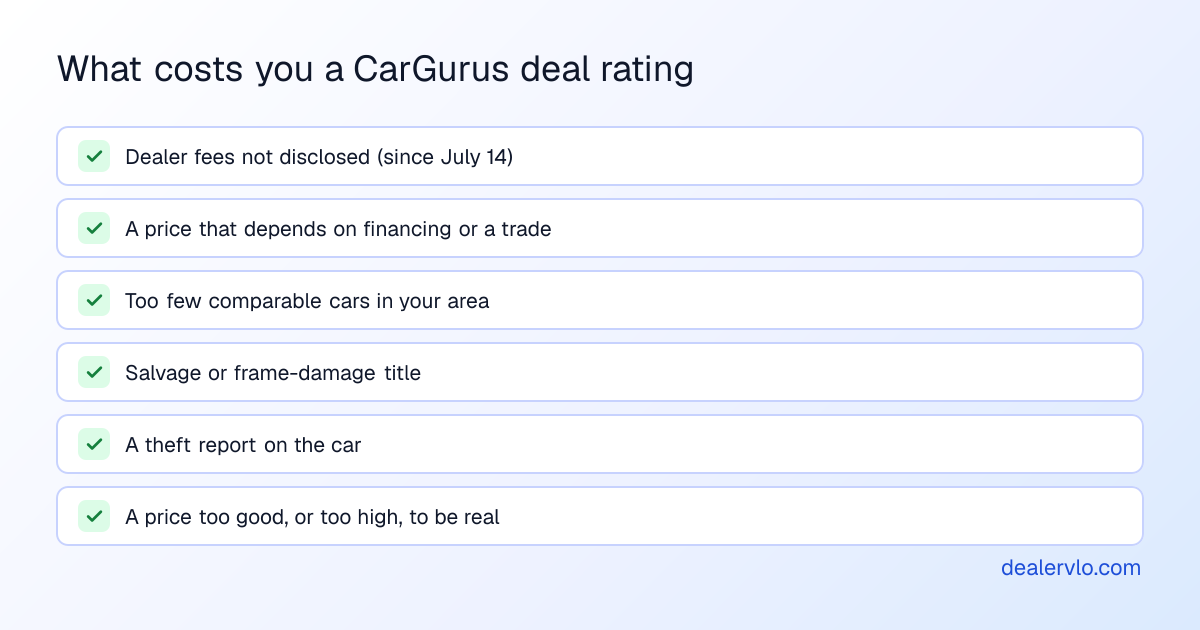
The common causes CarGurus names are undisclosed dealer fees (used cars since July 14, 2026), too few comparable cars in your area, a salvage or frame-damage title, a theft report, or a price that looks too good or too high to be real. New cars don't get deal ratings at all.
Does the doc fee count toward the CarGurus deal rating?
Yes. CarGurus' dealer pricing policy, dated October 13, 2026, requires the listed price to include all mandatory dealer-imposed fees, naming the documentation fee among them. Only tax, title, license, registration and other government fees are excluded. Set your fees in the CarGurus dealer dashboard under Settings → Dealer Fee Setup.
Does paying CarGurus improve my deal rating?
No. CarGurus says a dealer's relationship with it never changes the deal rating. Paying does affect placement: its sort considers the services a dealer subscribes to, and Featured+ and Featured Priority+ dealers get guaranteed top-three spots for Fair, Good and Great deals.
Should I price every car for a Great Deal?
No. A Great Deal usually means pricing well under the market, which comes straight out of gross. Price fresh, clean or hard-to-find cars at Good or Fair, and save the Great price for cars that are aging or that you need to turn.
Bottom line
CarGurus grades every used car against a market value built from the listings around it, and since July it grades the all-in price, doc fee included. Disclose your fees so the car gets a rating at all, price from real comps, and choose the rating each car needs instead of chasing Great on everything. Your gross is in the gap between Good and Great, so spend it only on the cars that need to move.
DealerVLO keeps the numbers behind that decision on every car (cost, days on lot, a price suggestion from live comps) and sends one price to CarGurus, Cars.com, Autotrader and Carfax.com for $29 a month. Start the 14-day free trial and price your next car with the gross in front of you.
Punch in cost, recon, holding days, and sale price to see your true net gross and margin.
Open the Profit Margin Calculator