How to Re-Merchandise Aging Inventory Without Cutting Price: Fresh Photos, Video & Listing Tactics
Aging cars need fresh photos, video, and rewritten listings—not markdowns. Make a 60-day unit look new to the algorithm and to buyers.
Part of the Listings, photos & merchandising guide: Where to list your cars for leads — and how to be on every site at once
Why a 60-Day Car Doesn't Need a Price Cut—It Needs Better Merchandising
Most dealers treat aged inventory as a pricing problem. A car hits 60 days, the weekly report shows it in red, and the immediate instinct is to knock $500 or $800 off the asking price. But here's the thing: many aged vehicles were never re-merchandised—they got one set of photos on day one and have looked identical ever since. The listing that generated zero interest at 15 days won't suddenly work at 60 just because you dropped the price.
The real issue is visibility and freshness. Marketplace algorithms—Facebook, CarGurus, Cars.com—all reward new listings and penalize stale ones. A car that's been sitting with the same photos, the same description, and the same presentation for two months isn't just aging on your lot; it's aging in the algorithm. It gets buried in search results, shown to fewer buyers, and treated as less relevant than the unit your competitor posted yesterday at the same price.
The solution isn't to cut your gross. It's to remerchandise used car inventory: fresh photos, a video walkaround, a rewritten description, maybe even a different showroom position or a detail. Make that 60-day car look and feel new to both the algorithm and the buyer, and you'll often move it at the price you wanted in the first place.
This post walks through exactly how to do that—the merchandising tactics that reset algorithmic ranking, rebuild buyer interest, and let you hold your margin while you move aged cars.
Note: This article covers merchandising tactics and market positioning, not legal compliance requirements. If your state has specific disclosure rules around reconditioning, prior damage, or title brands, confirm those with your state motor vehicle authority before you list.
When a Car Becomes "Aged"—and What It Costs You
Most dealers treat a unit as aging somewhere around 45 days on the lot, and a real problem past 60. The exact line matters less than having one and checking it every week.
The longer a car sits, the more it costs: floor plan interest (if you're financed), insurance, lot rent or mortgage allocation, opportunity cost, and depreciation on top. The daily number is different for every lot, so put a figure on yours with our free holding cost calculator before you decide a markdown is cheaper than a refresh.
And here's the worst part: front-end gross often collapses after 30–45 days in stock. Not because the market moved—because you panicked and dropped the price, or because the car's been listed so long that buyers assume something's wrong with it.
The root causes of aging aren't mysterious. Delayed photos, incomplete listings, or generic descriptions kill early interest. If an aged car's listing has drawn only a handful of vehicle detail page (VDP) views, that's underexposure, not overpricing. Most dealerships treat inventory age as a pricing problem when it's actually a merchandising and workflow problem.
In DealerVLO, every car shows its days on the lot right on the inventory screen, and anything past 60 days gets flagged automatically so you can spot it before the weekly meeting. That gives you time to remerchandise before you're forced into a markdown.
The Algorithm Problem: Why Stale Listings Get Buried
Marketplace algorithms don't care that your 2019 CR-V is a good deal. They care about engagement velocity, listing quality, and freshness. A listing that looked fine 45 days ago is invisible today—not because the photos got worse, but because the algorithm decided your listing is stale and stopped showing it.
Facebook Marketplace doesn't publish how it ranks listings, but dealers who post a lot describe the same pattern: a new listing gets its best visibility in its first day or two, then slides unless something signals that it's active, such as a reply to a message, a price change, a photo swap, or a relist. Fast replies matter too, if only because the buyer messaging you is messaging three other lots. And reposting the identical listing over and over tends to do less each time.
Starting fresh with a new listing at a reduced price gets you that early visibility again, but here's the thing: you can often get the same bump without the price cut by changing one photo, rewriting the lead sentence, or shooting a 30-second video and adding it to the listing.
CarGurus and Cars.com work differently but reward the same behavior. Neither publishes its full ranking formula, but both reward complete, current listings. CarGurus incorporates mathematical models that track selling patterns and calculates an Instant Market Value (IMV) for each listing—great deal, good, fair, or overpriced. But a "great deal" badge won't do much if the photos and description haven't changed in 60 days. And on any of these sites, an incomplete listing (missing options, vague description, short photo count) gives a shopper less reason to click than a complete one at the same price.
The takeaway: a listing refresh gives the car a second first impression. New photos, new video, or a rewritten description give the platforms something new to show, and give the shoppers who scrolled past it a reason to look again. That's what generates the next round of leads.
You can read more about how listing feeds work—and how to push updates to every site at once—in our guide to vehicle inventory feeds.
14-day free trial, then $29/mo · Cancel anytime
Fresh Photos: What to Shoot and How to Make It Look New
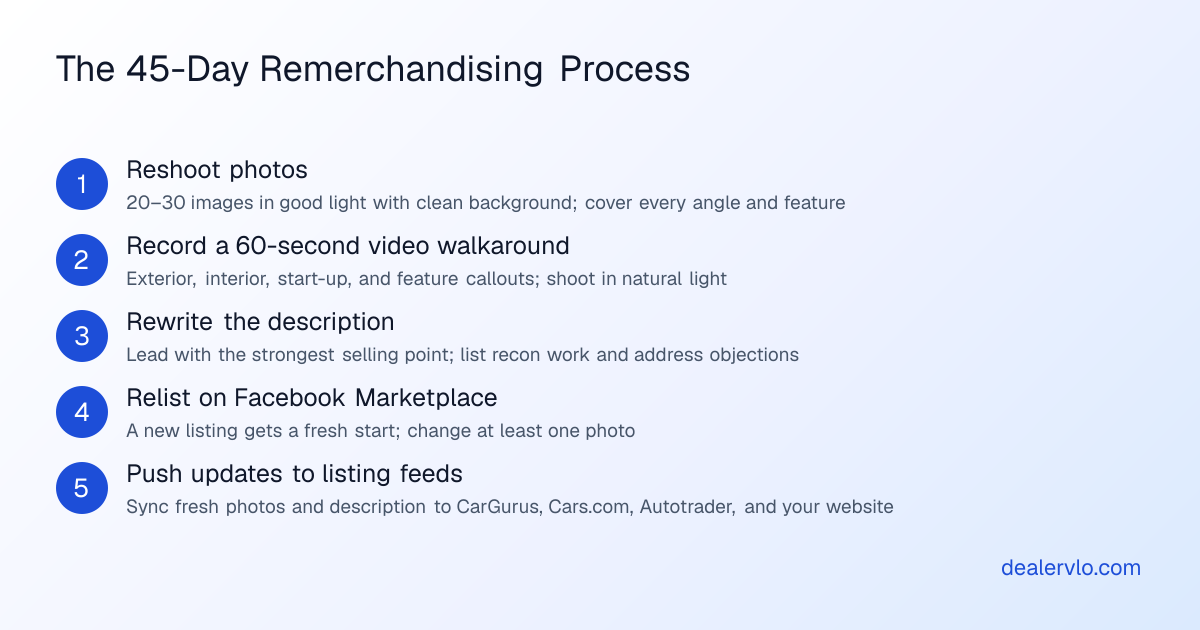
The single most effective way to remerchandise a car is to reshoot the photos. Not because the first set was bad—though it might have been—but because a new set of photos signals freshness to the algorithm and gives the buyer a reason to look again.
Here's what a refresh should include:
Quantity and Coverage
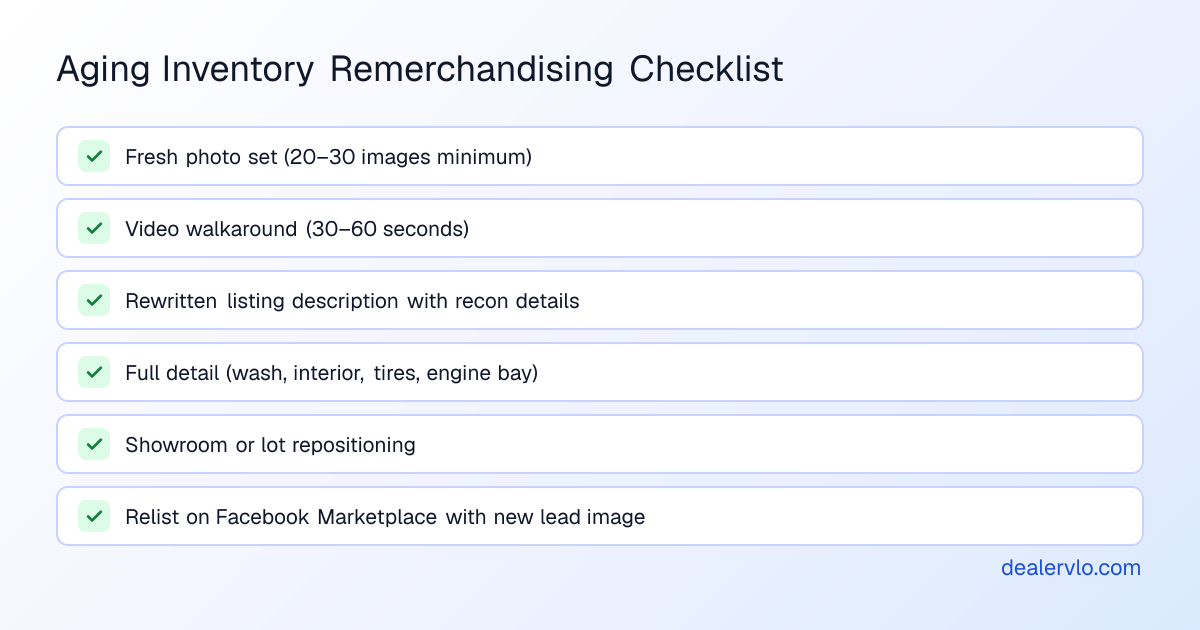
Aim for 20–30 total images covering every angle and feature. The goal is transparency: the more a buyer can see online, the more confident they are about making the trip. If your aged unit has 12 photos and your competitor's fresh listing has 35, you lose on completeness alone.
Shoot:
- All four corners and a straight-on front and rear
- Both sides in profile
- Interior from multiple angles: front seats, rear seats, dash, center console, and any third row
- Engine bay
- Trunk or cargo area, open and loaded if it's an SUV
- Close-ups of features: touchscreen, sunroof, heated seats, tow hitch, aftermarket stereo, bed liner
- Close-ups of condition: any wear on the driver's seat bolster, steering wheel, shift knob
- Underbody and frame if the buyer demographic cares (trucks, off-road SUVs)
- Tires and wheels
- Window sticker or build sheet if you have it
Background and Lighting
Situate the car in front of a clean background—a blank wall works well, preferably one that doesn't match the color of your car. An outdoor setting free of trees, bushes, and clutter is even better. Early morning and late afternoon are the best times; midday sun creates harsh shadows and reflections.
If you shot the original photos in front of the service bay with a dumpster in the background, a clean outdoor set will make the car look entirely different—even if it's the same unit.
DealerVLO offers an optional AI photo enhance that puts the car on a clean backdrop without altering the car itself—no Photoshop, no manual editing, just a professional look in seconds. You upload the raw lot photos, and the system generates a clean version you can use across all your listing sites. Learn more about dealer photo software that speeds up this process.
Detail and Transparency
Only use high-resolution, professional photos of the actual vehicle. Don't be tempted to use stock images unless you're doing so temporarily while a vehicle is in transit—and even then, label it clearly. Buyers can tell.
If the car has a story—prior rental, minor paint repair, replaced windshield, new tires at your expense—photograph the work and call it out. Transparency builds trust and pre-qualifies the buyer. A car that sat because buyers wondered why it was priced $600 below book will move once you show them the CarFax, the repair invoice, and the fact that it's a perfectly good car with a cosmetic repaint on one panel.
DealerVLO decodes the year, make, model and trim from the VIN when you add a car to inventory, so the basics are right from the start. You can also use our free VIN decoder tool to check what a VIN decodes to before you buy.
Video Walkarounds: The Single Highest-ROI Merchandising Upgrade
If you're not shooting video on every car yet, start with your aged inventory. A short video tour brings the car to life in ways photos can't. Even a 30-second clip showcasing condition, features, and personality makes you stand out, and the engagement numbers prove it works.
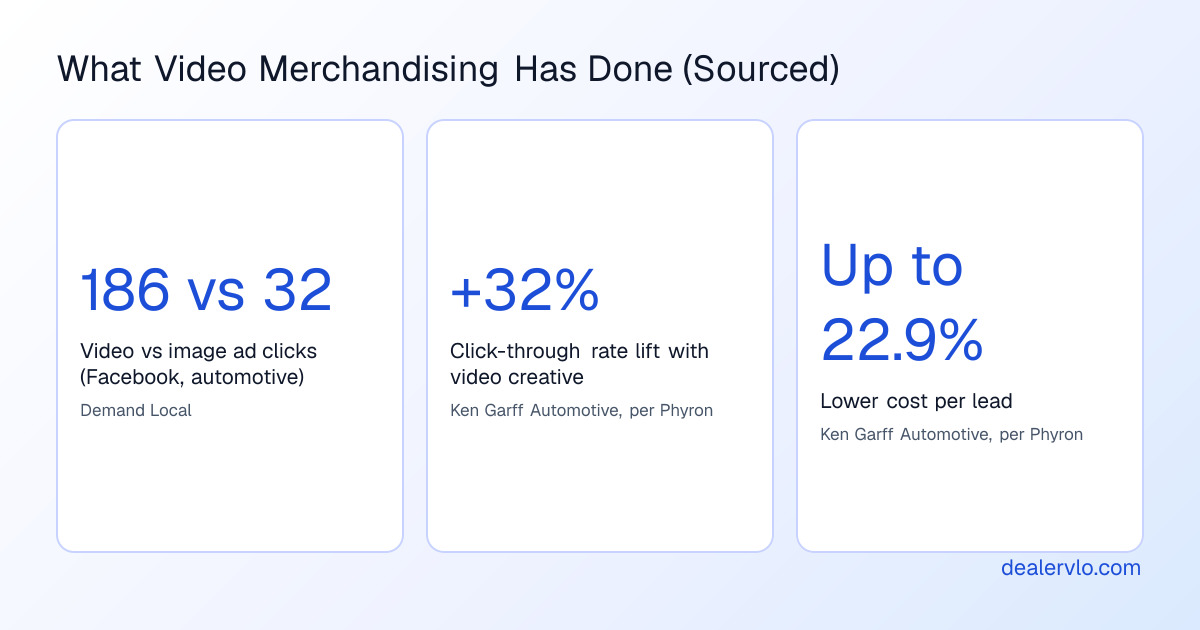
Video marketing generates 93% positive ROI for automotive marketers, according to Demand Local. Facebook video ads achieve 186 clicks versus 32 for identical image ads in automotive—a 5.8x performance advantage, per the same source.
Ken Garff Automotive saw a 32% increase in click-through rate and up to 22.9% lower cost per lead after rolling out video creative across Meta inventory ads, according to Phyron.
That's not branding fluff—that's bottom-line performance on aged units.
What to Shoot
A walkaround video for an aged car should cover:
- Exterior walk from front to rear on both sides
- Interior pan across the dash, center console, and rear seat
- A start-up and idle (buyers want to hear the engine)
- A quick feature callout: backup camera, Bluetooth, leather, sunroof, tow package
- Any reconditioning you did—new brakes, fresh detail, replaced headlight lens
Keep it short. Sixty seconds is plenty. Longer is fine if the car has a story, but don't let the camera sit still—keep it moving and keep talking.
Lighting and Audio
Look for decent natural light: the first hour after sunrise or the last couple of hours before sunset. A video shot inside a garage or just as the sun is setting will be too dark to be useful. Record in a quiet spot so the viewer can hear you, and hold the phone steady or use a gimbal if you shoot a lot of video.
Consider creating a 360-degree walkaround as a powerful sales solution—these help customers "inspect" the vehicle just as they would if they were actually at the dealership.
Where to Post It
Add the video to the listing on every platform that accepts it: Facebook Marketplace, your dealer website, Cars.com, CarGurus if they support it, and your own social feed. Short-form video is no longer just branding content; it has become inventory-level merchandising, with dealers creating quick VIN-specific walkthroughs and feature highlights as standard practice.
We wrote a full how-to on video walkaround strategy, including equipment, scripts, and posting tactics—if you're starting from scratch, that's the guide to follow.
Rewrite the Description: Tell the Story You Didn't Tell the First Time
An aged car often has a generic description that could apply to any 2019 CR-V in the country. If that's what you posted 60 days ago, rewrite it now with the specifics that make this particular unit worth buying.
A good used-car listing description should:
- Lead with the single most compelling feature or selling point (one owner, low miles, recent tires, clean history, popular trim)
- List reconditioning and service work you completed: brakes, alignment, detail, replaced windshield, new battery
- Call out options and features by name: blind-spot monitoring, heated seats, Apple CarPlay, tow package, remote start
- Address common objections: prior rental (but perfect service history), minor cosmetic flaw (priced accordingly), higher miles (highway, well-maintained, runs strong)
- End with a clear next step: call, text, or come see it
Avoid jargon, hype, and filler. "Runs great, won't last long, priced to sell" is noise. "New front brakes and rotors, detailed inside and out, one owner with full CarFax" is signal.
If the car didn't sell the first time, something in the story didn't connect. Maybe buyers didn't know it had a warranty left. Maybe they didn't realize you replaced the tires. Maybe the price made sense but you never explained why it's $800 less than the identical unit across town. A 2019 Honda CR-V with 68,000 miles that's been sitting for 45 days doesn't need to drop $800; it needs better photos, a clean title explanation, a detailed reconditioning history, and the right pricing from day one based on actual market data.
DealerVLO's AI price suggestion shows you a range from live comparable listings plus a target price for selling in about 30 days, so you can confirm your pricing is still competitive before you rewrite the description. If comps have moved and you're now $600 high, that's a pricing issue. If comps are flat and your car still isn't moving, that's a merchandising issue—and a rewrite will close the gap faster than a markdown.
We have a full template and guide on how to write used-car listing descriptions if you want the structure and examples.
Before you authorize the work: see whether a repair earns back its cost plus the holding days it adds.
Open the Recon ROI CalculatorShowroom and Lot Repositioning: Physical Merchandising Still Matters
Online visibility matters most, but physical placement still influences walk-in buyers and creates opportunities for fresh content.
If a car has been sitting in the back row for 60 days, move it to the front. Park it by the door. Put it next to your best seller. Reposition it under better lighting for evening drive-by traffic. A car that looks like it's been there forever has been there forever—change the scenery and it looks new again.
Detail it. A car that was clean on day one has 60 days of dust, fingerprints, and lot grime now. Run it through a full detail—exterior wash, clay bar if needed, interior vacuum and wipe-down, windows, tires dressed, engine bay cleaned. It'll look better in the new photos, it'll show better to walk-ins, and it gives you another story to tell in the rewritten description: "just detailed, showroom ready."
If it makes sense for your lot, add a banner, flag, or window sticker that calls out a feature or benefit: "one owner," "new tires," "highway miles," "warranty remaining." It's not a gimmick if it's true, and it gives the eye something to catch in the new set of photos.
Some dealers rotate aged units into their website's homepage featured inventory or their Facebook page cover photo. It's free visibility and it signals to the algorithm (and to your audience) that this is a car you're actively promoting.
14-day free trial, then $29/mo · Cancel anytime
Relisting on Facebook Marketplace: How to Do It Without Getting Buried
Facebook Marketplace is the single highest-volume free listing platform for most small lots, and it's also the most temperamental. The algorithm can bury you fast, but it can also reward a smart relist.
Here's how the platform handles changes:
Editing an existing listing to drop the price will show the price reduction, and Facebook sends an automated notification to anyone who previously saved your car. That's good if people saved it. But if your ad has been active for 60+ days, the algorithm has likely buried it deep in search results, so the price drop won't generate much new traffic.
Starting fresh with a new listing at the current price (or a reduced price if you decide to drop) is usually more effective for aged units. A new listing tends to get its best visibility in its first day or two, which puts your car back in front of local shoppers and leaves the old post's stale history behind.
The downside: you lose any saved/favorited status from the old post. The upside: you get a fresh start in search, and if you've added fresh photos and video since the original post, the new listing will perform better than the old one ever did.
A few algorithm-friendly tactics:
- Change at least one photo. If you relist with the identical photo set, the algorithm may recognize it and suppress your boost. Swap the lead image, add a new angle, or drop in your new video thumbnail.
- Rewrite the lead sentence. Even a small change—leading with a different feature or calling out your new detail—helps signal freshness.
- Respond fast. Once the listing is live, answer every message within 30 minutes if possible. Fast replies keep a buyer from moving on to the next lot, and by most dealers' accounts they help the listing too.
- Price competitively from the start. A fresh listing priced well above live local comps won't draw many messages no matter how good the photos are, and relisting at the same price won't change that. If you're going to relist, make sure your price is defensible against those comps.
For the manual posting process, DealerVLO generates a "Post to marketplace" kit for each car: all photos as one download, every field ready to copy, and a written description with an optional AI rewrite. It doesn't post automatically (Meta ended dealer partner feeds in 2021), but it saves retyping every field for each post.
You can read our full troubleshooting guide if your listings aren't getting views: Why aren't my cars showing up on the listing sites?
When to Remerchandise vs. When to Drop Price
Remerchandising works best when the problem is visibility, completeness, or presentation. It won't overcome a pricing problem.
Remerchandise first if:
- The car has fewer than 20 photos, no video, or a generic description
- Its VDP views are low next to your other units (underexposure, not overpricing)
- Comparable units at the same price are selling and yours isn't
- You've made reconditioning improvements since the original listing (new tires, brakes, detail)
- The listing has been live for 45+ days with no updates
Drop the price if:
- Live comps have fallen $500+ since you listed, and your car is now priced high
- The car has strong merchandising—great photos, video, detailed description—and still isn't getting inquiries
- You're past 60 days, comps are moving, and yours isn't
- Holding costs are eating more margin than a $300–$500 price drop would
The most effective approach is often both, in sequence: remerchandise at 45 days, reassess at 60, and drop price at 75 if the refresh didn't move it. That way you've tried the zero-cost fix first, and if you do mark it down, the markdown lands on a fresh, fully merchandised listing that's primed to convert.
DealerVLO's aging flag kicks in at 60 days, so you have a built-in review point. You can also track per-car recon costs line by line, which roll into that car's all-in cost and margin—so when you're deciding whether to markdown or wholesale, you're looking at real numbers, not guesses.
For a deeper look at when markdown makes sense and how to structure it, see our day-by-day inventory aging markdown playbook.
Action Bands: A 30/45/60/90 Remerchandising Policy
Most dealers don't remerchandise because they don't have a policy that triggers it. Here's a simple action-band framework:
0–30 days: No action. Let the listing run. Monitor engagement (views, saves, inquiries) but don't touch it unless a comp drops significantly or you finish reconditioning work you hadn't completed at listing time.
30–45 days: Review market positioning and engagement metrics. If the car has strong traffic and interest but isn't converting, the price might be slightly high or the buyer demographic might be thin—consider a small drop or a financing callout in the description. If traffic is weak, remerchandise: add photos, shoot video, rewrite the description, and refresh the listing on Facebook Marketplace.
45–60 days: Implement your first strategic remerchandising push if you haven't already. Fresh photos, video walkaround, rewritten description, and a showroom move. Relist on Facebook. Push updates to your feed so CarGurus and Cars.com pull the new content.
60–75 days: Aggressive repricing if remerchandising didn't work, or a second remerchandising effort if new information has come to light (you found the window sticker, the previous owner sent you service records, you replaced something). This is also the point to evaluate wholesale: if you're into the car for $9,200 all-in and wholesale bid is $8,800, the decision is whether another two weeks of holding cost plus a $400–$600 markdown will get you to retail, or whether the $400 hit to wholesale it now is the better play.
90+ days: Wholesale evaluation with clear decision criteria, or a final "fire sale" markdown if you're confident the car is solid and the market just needs a lower entry point.
This policy works as store routine. You're not reacting emotionally to the weekly aged report; you're following a plan. DealerVLO tracks days on the lot for every car, and its inventory aging report buckets them 0–30, 31–60, 61–90 and 90+ days, so you can batch your remerchandising work: "today I'm refreshing everything in the 45–60 bucket."
For more on turn rate, benchmarks, and how to calculate your ideal inventory count, see our guides on inventory turn rate and ideal inventory count.
Connecting Remerchandising to Your Listing Feeds
If you're manually copying and pasting listing updates to five different sites, remerchandising becomes a multi-hour project and you won't do it. The fix is a listing feed: one inventory source that pushes to every site automatically, so a single update in your system flows everywhere at once.
DealerVLO includes listing feeds to CarGurus, Cars.com, and Autotrader once you enroll with each platform (you still pay those sites' own fees), plus a Facebook vehicle catalog feed for Meta's paid automotive inventory ads and a CSV export for any other use. When you upload new photos or edit the description in DealerVLO, the feed updates and the listing sites pick up the fresh content on their next sync. The video walkaround goes up on each site directly.
Your dealer website is included and inventory posts to it automatically, so the remerchandised listing is live on your own site the moment you save it.
For a full explanation of how feeds work, what data flows through them, and how to troubleshoot sync issues, read our guide on what is a vehicle inventory feed. And if you're setting up your first connection, our step-by-step on connecting inventory to Autotrader and Cars.com walks through the enrollment and feed setup process.
Frequently asked questions
How long should I wait before remerchandising an aging car?
Most dealers see the best results when they remerchandise between 45 and 60 days. At 45 days, the listing has had time to reach its initial audience, and if it hasn't moved, the problem is likely visibility or presentation rather than market timing. Waiting until 60 or 75 days means you've already absorbed weeks more holding cost (floor plan interest, insurance, lot space), so earlier action preserves more gross. A simple policy: review engagement and comps at 30 days, remerchandise at 45 if traffic is weak, and reassess pricing at 60 if the refresh didn't work.
Do I need to relist the car on Facebook Marketplace, or can I just edit the existing post?
Starting fresh with a new listing is usually more effective for aged units. Dealers who post a lot find that a new listing gets its best visibility in its first day or two, which puts your car back in front of local shoppers and leaves behind the stale engagement history of the old post. Editing an existing listing to drop the price will notify anyone who saved your car, but if the listing has been buried by the algorithm for weeks, that notification won't generate much new traffic. When you relist, change at least one photo or rewrite the lead sentence so the algorithm recognizes it as fresh content rather than a duplicate.
How many new photos do I need to make a listing refresh work?
Aim for 20–30 total images covering every angle and feature. If your original listing had 12 photos and you're adding 8 more—close-ups of the interior, the engine bay, the tires, and any reconditioning work—that's usually enough to signal completeness to both the algorithm and the buyer. The key is coverage and transparency: the more a buyer can see online, the more confident they are about making the trip. If you're below 20, a refresh that gets you into the 20–30 range closes the most obvious gap.
Does video really make a difference, or is it just extra work?
In ad tests, video has outperformed still images. Facebook video ads achieve 186 clicks versus 32 for identical image ads in automotive—nearly six times the performance, according to Demand Local. Even a 30-second walkaround showing the exterior, interior, and a start-up gives buyers confidence that the car is real, the condition matches the description, and you're a credible seller. For aged inventory specifically, video is one of the fastest ways to reset buyer perception: it makes a 60-day car feel newly listed.
When should I drop the price instead of remerchandising?
Drop the price if live comparable units have fallen $500 or more since you originally listed, or if your car has strong merchandising—great photos, video, detailed description—and still isn't getting inquiries after 60 days. Remerchandising works best when the problem is visibility, completeness, or presentation; it won't overcome a pricing problem. The most effective sequence is to remerchandise first at 45 days, reassess market comps at 60, and drop the price at 75 if the refresh didn't generate leads. That way you've tried the zero-cost fix before you cut into your gross, and when you do markdown, it lands on a fresh, fully merchandised listing that's positioned to convert.
Can I remerchandise without reshooting photos?
You can, but fresh photos are the single highest-impact change. If reshooting isn't possible, focus on adding any photos you didn't include the first time—close-ups of options, the engine bay, the trunk, wear points, and reconditioning work—and pair that with a new video walkaround and a rewritten description. Changing the lead photo, adding a video, or swapping the photo order can also make the listing look new to shoppers who scrolled past it. But if the original photo set was incomplete or low-quality, you'll see much stronger results by taking a new set in good lighting with a clean background. A half-hour photo session on a 60-day car costs a lot less than a $500 markdown.
Bottom line
Aging inventory isn't a pricing problem—it's a visibility and freshness problem. A car that's been sitting for 60 days with the same photos, the same description, and the same presentation has aged in the algorithm as much as it has on your lot. Fresh photos, a video walkaround, a rewritten description, and a relist on Facebook Marketplace will reset both algorithmic ranking and buyer perception, and it can often move the car at or near your original price without the margin hit of a markdown.
The key is having a policy that triggers remerchandising before you're forced into a discount. Review engagement and comps at 30 days, remerchandise at 45 if traffic is weak, and reassess at 60. That way you're working the problem with merchandising tools first, and if you do eventually drop price, it's a strategic decision backed by data, not a panic move.
DealerVLO tracks days on the lot for every car, flags anything past 60 days, and lets you update photos, descriptions, and pricing in one place—then pushes those changes to your website and listing feeds automatically. Start your free trial at DealerVLO and build an aging-inventory routine that protects your gross while you move your cars.