Your Used-Car Listing Photos Are the Whole Sale
Online, your photos sell the car before a buyer ever calls. Why a clean, consistent lead shot drives clicks and faster turn — and how to get a studio look without a photo booth or misleading anyone.
The photo is the click — everything else is downstream
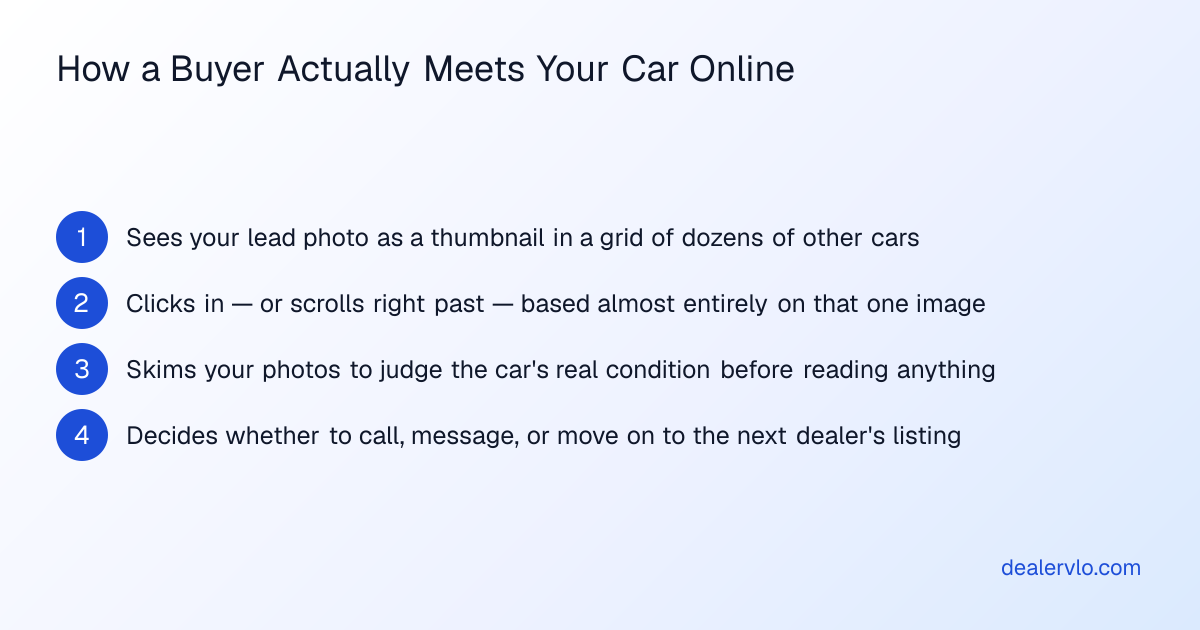
A shopper never meets your car the way you do. You see it on the lot, keys in hand, clean title in the folder. They meet it as a thumbnail the size of a business card, sitting in a grid next to thirty other cars that all cost about the same. In that half-second, one thing decides whether they click: the photo.
That's the part a lot of operators underrate. You can price the unit right, have low miles and a solid inspection, and it won't matter, because the price and the miles and the inspection are all behind the click. If the lead photo looks like you shot it at dusk behind the service bay, the click never happens, and none of your other advantages ever get seen. Good photos don't just make a car look nice — they're the gate everything else has to pass through. This isn't about how to hold the camera (we cover that in how to detail and photograph used cars); it's about why the quality of that image is one of the highest-leverage things on your whole lot.
Consistency is the tell most small lots miss
Here's the thing buyers feel but can't name: consistency. Scroll the inventory page of a big franchise store and every car sits on the same clean background, framed the same way, lit the same way. It reads as one professional operation that has its act together. Now scroll a lot where one car was shot in the sun, the next in the rain behind the building, the next half-cropped in a gravel lot with a competitor's banner in the corner — even if each car is fine, the set reads as scattered and amateur. That impression rubs off on your prices and your trustworthiness before a buyer has read a single word.
The big stores solve this with a photo booth: a physical bay with controlled lighting and a seamless backdrop, so every car comes out identical. It works, and it costs real money and floor space that an independent lot usually can't justify. But the booth was never the point. The point is the result — a clean, uniform look across your whole inventory — and there's now more than one way to get there.
Turn your ad spend into a cost per car sold and a real ROI — and see how many units the spend has to produce just to break even.
Open the Marketing ROI CalculatorWhat actually drags your photos down
Before you fix anything, it helps to name what's hurting you. On most small-lot listings, it isn't the camera — modern phones are more than good enough. It's the stuff around the car and the conditions you shot in.
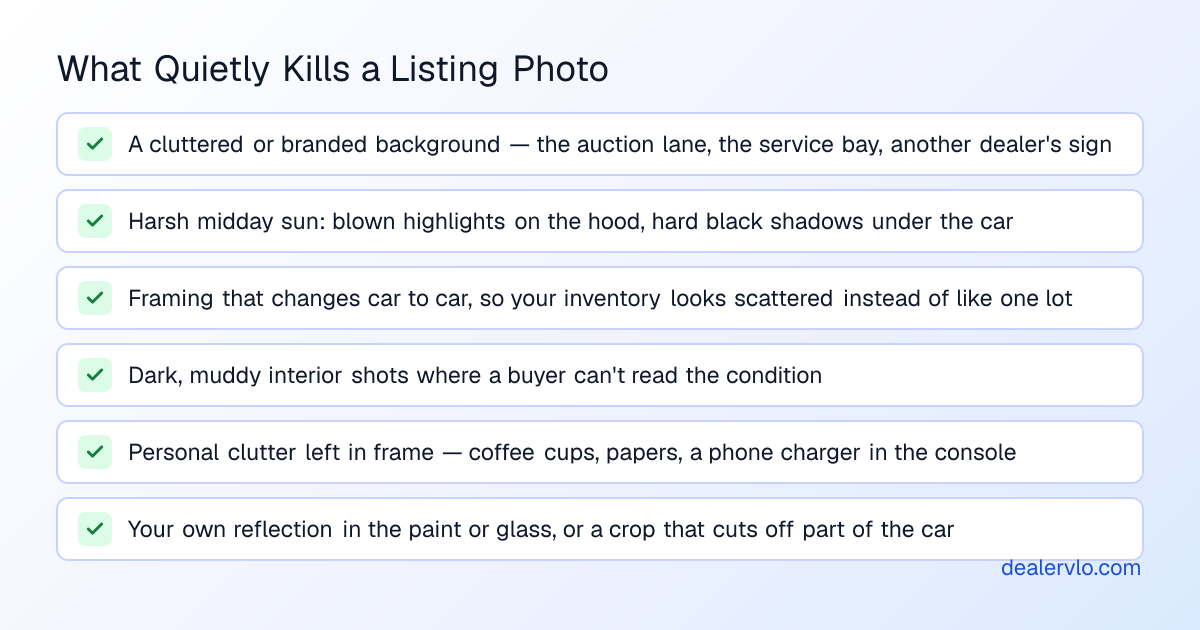
None of these require a better camera to fix. A cluttered background, midday glare, and inconsistent framing are the three that do the most quiet damage, and they're exactly the ones that are hardest to control when you're shooting a dozen cars on a working lot between customers.
The honest line: fix the photo, not the car
This is the part that matters most, and it's where the temptation lives. Editing software can do anything now — including erase a dent, smooth a scratch, or swap a set of curbed wheels for clean ones. Don't. The moment an edit changes the car instead of the photo, you've crossed from merchandising into misrepresentation, and it's both a trust problem and a compliance one. It also just doesn't work: the buyer drives an hour, sees the real curb rash you painted out, and now every other honest thing in your listing is suspect too.
The honest line is simple. Improving presentation is fair — brightness, color, a clean background, consistent framing. Improving the car is not. Every flaw that's on the vehicle should still be on the photo.
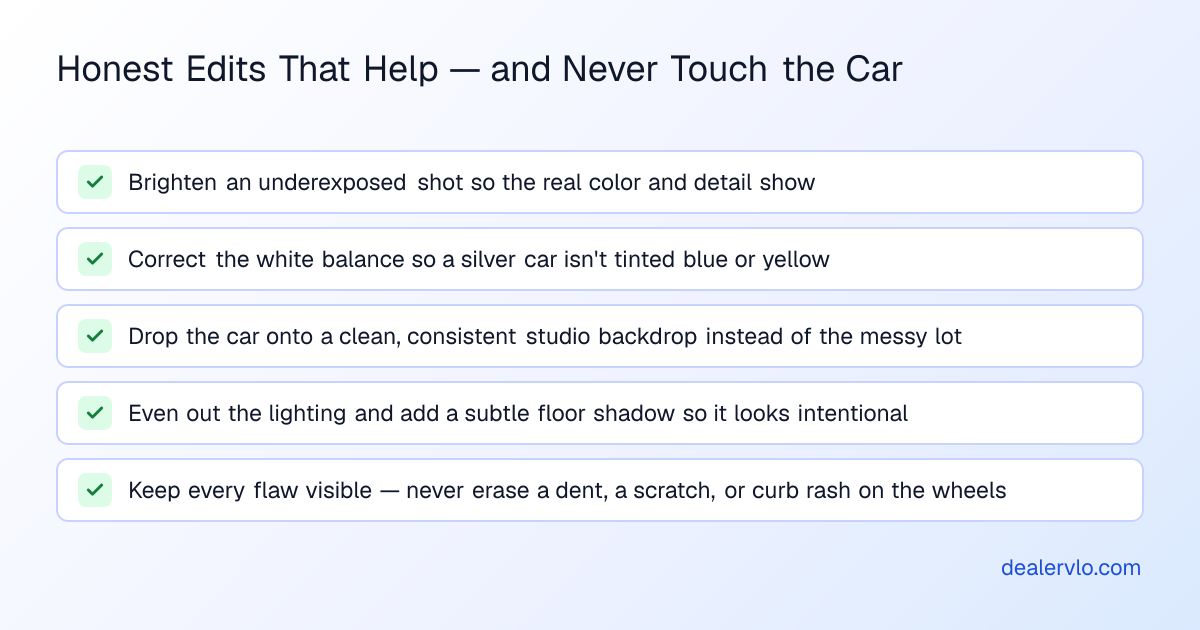
Keep your edits on the left side of that line and you get the best of both: listings that look sharp and a walk-around that matches, so the buyer arrives already trusting you.
The studio look without the $10,000 booth
This is exactly why we built photo enhancement into DealerVLO. You shoot the car the way you always would — a clean walk-around on your phone — and with one click the car is placed on a clean studio backdrop (white, dark, or showroom) with a soft shadow and floor reflection, in about four seconds. Every car on your lot comes out with that same consistent, professional look, without a booth, a backdrop rig, or an editing subscription.
The design choice we care about most: it only changes the background and the lighting. It never regenerates the car itself, so it can't smooth a dent or fake a wheel — the honest line above is built into the tool, not left up to willpower. Your original photo always stays; the enhanced version is just another photo you can set as the primary. It's part of the flat $29/month, with no per-image meter.
What clean photos do for your numbers
Follow the chain. A clean, consistent lead photo earns more clicks. More clicks put more real shoppers in front of your price, your mileage, and your clean title — the things that actually close. More qualified eyes on a car is what shortens the time it sits, and a car that sells sooner never reaches the aging bucket where you start giving up gross to markdowns and holding cost. None of that replaces buying right and pricing right — but photos are the cheapest lever in that chain, and the one most small lots leave on the table.
Photos also do the quiet work of screening. Clear, honest, complete images answer condition questions before they're asked, so the leads that do come in are warmer and the tire-kickers who'd have driven out to be disappointed screen themselves out. Pair sharp photos with a listing that reads straight (see writing used-car listings that actually sell) and push them everywhere your buyers are, including Facebook Marketplace, and you've done most of the online merchandising job.
Bottom line
Online, your photos aren't a nice-to-have — they're the front door, the handshake, and the first pitch, all in one image a shopper sees for half a second. You don't need a photo booth to compete with the big stores; you need clean, consistent, honest photos across your whole lot. Shoot the car well, keep every flaw visible, and let a consistent studio backdrop do the rest. It's the cheapest way to make a small lot look like a serious operation — because to the buyer scrolling past, the photo is the lot.
Want your inventory to look like that without the booth? Start a free trial and enhance your first car in a click.