Why aren't my cars showing up on the listing sites? A dealer's fix-it guide
Your car is on your site but not on CarGurus, Autotrader, or Cars.com — here's the dealer's triage: feed enrollment, missing data, sold cars left live, and how to stop it.
You added the car, it's live on your own website, the photos look great — and then a shopper calls and says they couldn't find it on CarGurus. Or you notice a unit that's been in stock two weeks has pulled zero leads from Cars.com while everything around it is getting calls. A car that's "listed" but invisible is one of the most frustrating problems in this business, because nothing looks broken. It's just quietly not working.
The good news: it's almost never mysterious. A missing car comes down to a short list of causes, and you can walk them in order in about five minutes. Here's the triage I run, why each one happens, and how to stop playing whack-a-mole with it every week.
First, what "showing up" actually requires
Getting a car into a marketplace's search results isn't one switch — it's a chain. Your inventory has to reach the platform (the feed), the car has to carry the data the platform needs, and the platform has to accept and index it. Break any link and the car is technically in your system but absent from search. Start by making sure the car even qualifies:
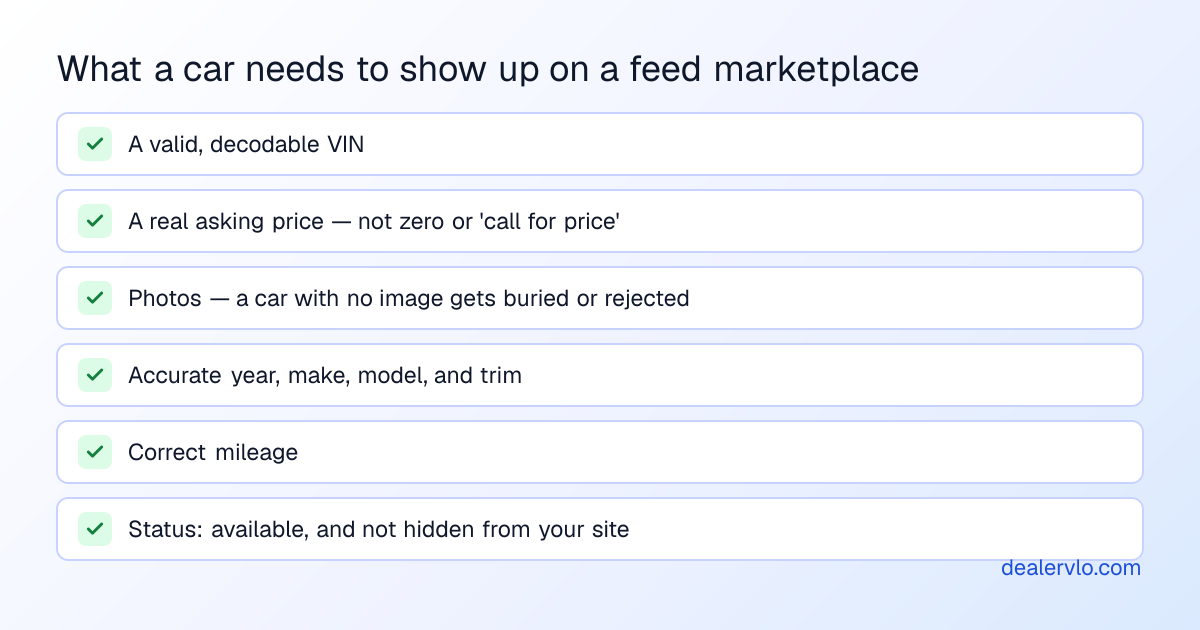
The two that catch dealers most often are price and photos. A car sitting at $0 or "call for price" gets filtered out where the platform wants a real number, and a car with no images usually gets buried or rejected outright — the marketplace doesn't want a blank tile any more than a buyer does. If you enter cars in a hurry and backfill photos later, you've built a window where the car is live but unlistable. In DealerVLO, a VIN scan fills the year/make/model/trim/spec fields the moment you enter the car, so those are never the blank that holds a listing back — but whatever system you run, treat "complete data before it goes live" as the rule.
The five-minute triage
When a specific car is missing, don't guess — check these in order. The first one that's wrong is usually your answer:
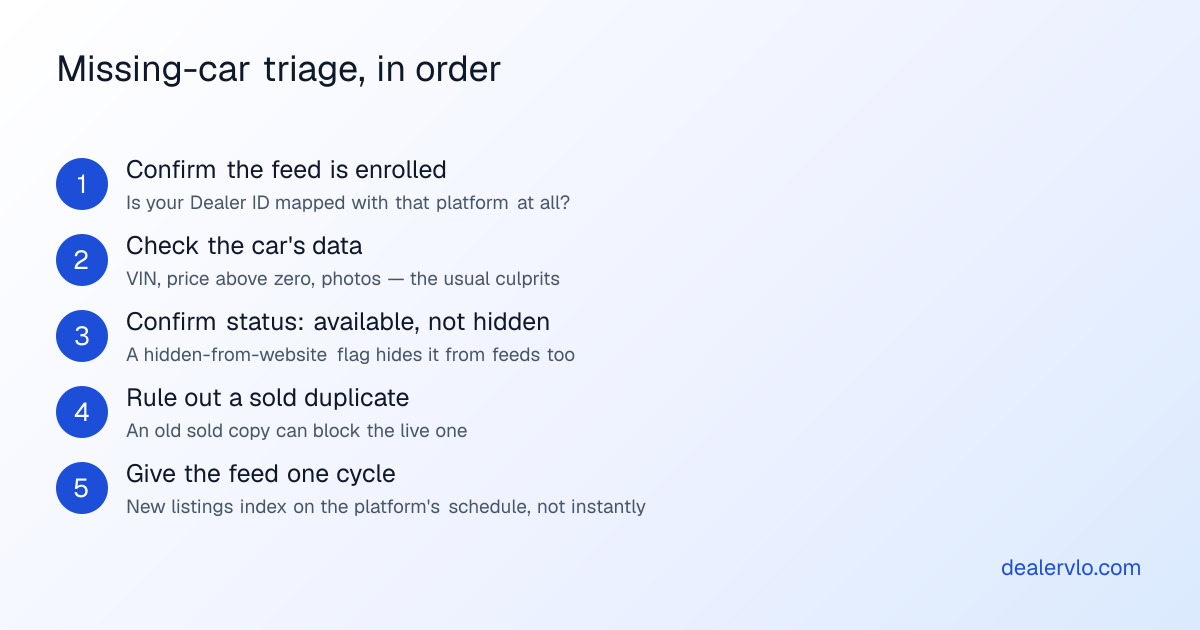
1. Is the feed even enrolled? If nothing from your lot shows on a given site, it's not a per-car problem — your feed isn't accepted there yet, or your Dealer ID isn't mapped. Every marketplace ties a feed to your account with an ID you get from them; until that handshake is done, the feed goes nowhere. (This is the setup step I walk through in the syndication section of the listing-sites guide.)
2. Does the car have the data? Back to the checklist above — VIN, real price, photos. This is where most single-car mysteries end.
3. Is it available and not hidden? A car marked sold, pending, or flagged "hide from website" won't feed. That hidden-from-site toggle is a common trap: dealers use it to park a car and forget it also pulls the car from every downstream channel.
4. Is a sold duplicate blocking it? If you have two records for the same VIN — one sold, one live — the platform can hang onto the stale one. One clean record per car avoids this entirely.
5. Is it just new? Feeds publish on a schedule, not instantly. A listing missing an hour after you entered it is normal; missing after a full day points back to steps 1–4.
Turn your ad spend into a cost per car sold and a real ROI — and see how many units the spend has to produce just to break even.
Open the Marketing ROI CalculatorThe Facebook Marketplace asterisk
One channel deserves its own note: Facebook Marketplace. Its rules for dealer inventory have changed repeatedly over the years — catalog feeds, business-page listings, and partner-feed paths have each been turned on, off, and reworked — so if cars vanished specifically from Marketplace while your other channels are fine, that's usually a platform policy shift, not a broken feed on your end. Confirm the current dealer path in Facebook's own resources and our Marketplace guide before you go hunting for a bug that isn't there. The feed marketplaces — CarGurus, Cars.com, Autotrader — are far more stable, which is why the triage above is really about them.
The real fix: stop it from happening
Triaging one car is fine. Triaging the same class of problem every week is a sign the setup is fighting you. Almost every cause above traces back to one root: inventory that lives in several places at once, drifting out of sync. Blank fields, $0 prices, sold cars left live, duplicate VINs — those are all symptoms of hand-maintaining copies across sites.
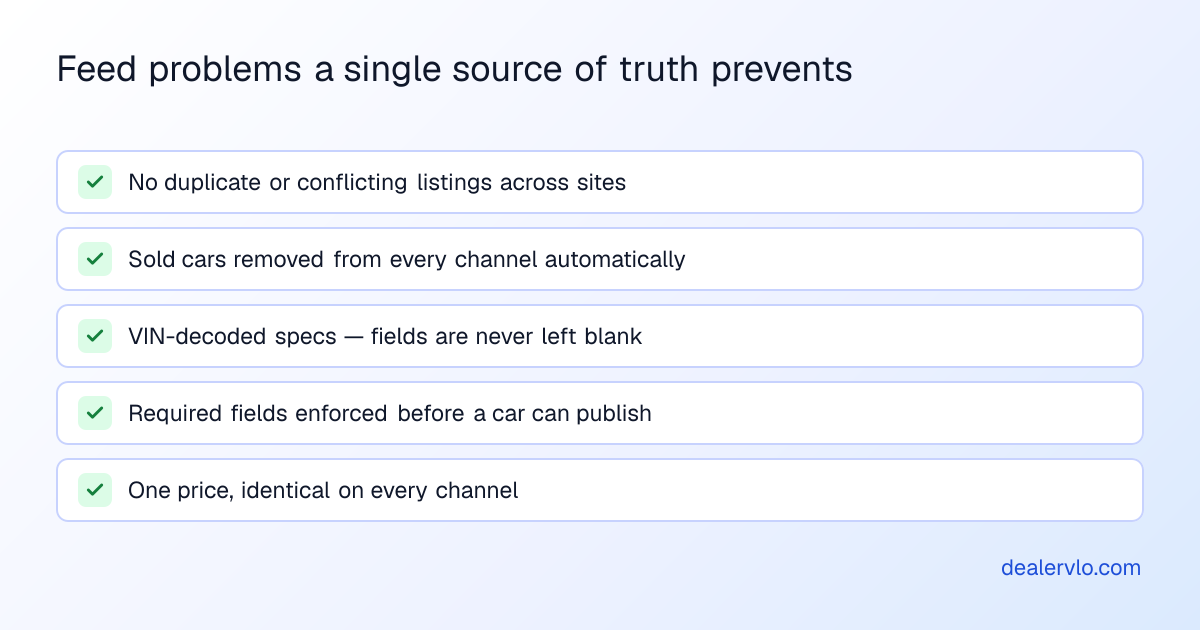
When your inventory has one source of truth, the whole category disappears. Enter the car once with complete data, and the same clean record feeds every channel. Mark it sold, and it drops off all of them at once — no ghost listing pulling a call three days later. This is exactly what DealerVLO is built to do: one record per car, VIN-decoded so fields aren't blank, published to your site and out through one feed to CarGurus, Cars.com, and Autotrader — and pulled everywhere the moment it's sold. The visibility problems above mostly stop being problems you check for and become problems you don't have.
Frequently asked questions
Why isn't my car showing up on CarGurus or Cars.com?
Usually one of five things: the feed isn't enrolled / your Dealer ID isn't mapped, the car is missing a valid VIN or a real price or photos, it's not marked available (or it's hidden from your site), a sold duplicate is blocking it, or it's simply new and hasn't been pulled in the next feed cycle. Work them in that order.
How long until a new car shows up on the listing sites?
Feeds publish on the platform's schedule — a few times a day to once a day — then index on their own time. Missing in the first hour is normal; missing after a full day is usually a data or enrollment problem, not timing.
My cars disappeared from Facebook Marketplace — what happened?
Marketplace's dealer-listing rules have changed repeatedly, so a Marketplace-specific disappearance is usually a platform policy change. Confirm the current path in Facebook's dealer resources and our Marketplace guide before assuming your feed broke.
Why did a sold car still get me a call?
It was still live on a channel you didn't pull it from. Selling off one site's lead doesn't remove the car elsewhere unless your system removes it everywhere for you.
What data does a car need to appear in search?
A valid, decodable VIN, a real price (not $0 or "call" where a number is required), and photos, plus accurate year/make/model/trim, mileage, and an available, not-hidden status.
Bottom line
A car that's listed but invisible almost always fails one of five checks — feed enrollment, missing data, wrong status, a sold duplicate, or plain timing — and you can find which in about five minutes. But the dealers who never fight this aren't better at triage; they've removed the root cause. One clean record per car, complete before it publishes, feeding every channel and dropping off the moment it sells, is the difference between checking your listings and trusting them.
That single-source setup is the whole idea behind DealerVLO: enter a car once, VIN-decoded and complete, and it flows to your site and out to the marketplaces automatically — $29/month flat, unlimited users, with a free 14-day trial that a card starts, no charge until day 14. You still enroll with each marketplace for their own account, but the blank fields, stale prices, and ghost listings stop being your problem to chase.