Facebook Marketplace Shadow-Bans: How to Diagnose Lost Reach and Get Your Dealer Account Back to Normal
Facebook Marketplace shadow ban symptoms, real causes, and the recovery steps a dealer can actually confirm — without buying a new account.
Part of the Listings, photos & merchandising guide: Where to list your cars for leads — and how to be on every site at once
Switching from another DMS? Compare DealerVLO to DealerCenter, Frazer, or Lot Wizard, or see what DealerVLO's car dealer management software includes.
Your Marketplace clicks fell off a cliff, nothing in your process changed, and Facebook hasn't sent you a single notice explaining why. That's the exact shape of what dealers call a "facebook marketplace shadow ban" — and the honest answer is that Meta has never confirmed a feature by that name. What's really going on is usually one of three things: a policy-based restriction you can see and appeal, a quiet eligibility change tied to your account's posting pattern, or a seasonal dip you're misreading as a penalty. This post walks through how to tell them apart and what to actually do about each one.
Before anything else: don't buy a replacement account. It's the most common fix passed around on dealer forums, and it's also exactly the behavior Meta names as grounds for restricting an account in the first place.
14-day free trial, then $29/mo · Cancel anytime
First, rule out the policy change that already killed "shadow bans" for a lot of dealers
A huge share of "my reach disappeared" complaints trace back to a structural change, not a penalty. Since early 2023, Meta no longer supports vehicle listings created from a Facebook business Page — along with the vehicles tab and inventory management tab that used to come with it. Existing Page-based vehicle listings were removed after that cutoff. If your dealership has been posting (or trying to post) inventory from your business Page and wondering why reach cratered, that's not a shadow ban — it's a channel that no longer exists for that posting method. Organic vehicle listings on Marketplace now have to come from a personal profile, which is also why salespeople end up posting cars from their own accounts in the first place.
This matters for diagnosis because it changes where you even look. If you're still routing inventory through a Page, the fix isn't an appeal — it's moving posting to a personal profile or working within whatever paid/feed options are actually available to businesses now. For the mechanics of posting correctly today, the Marketplace posting guide and the broader Facebook Marketplace playbook for dealers cover that groundwork — read them before you assume anything is being suppressed.
The three things Meta actually distinguishes (even if dealers don't)
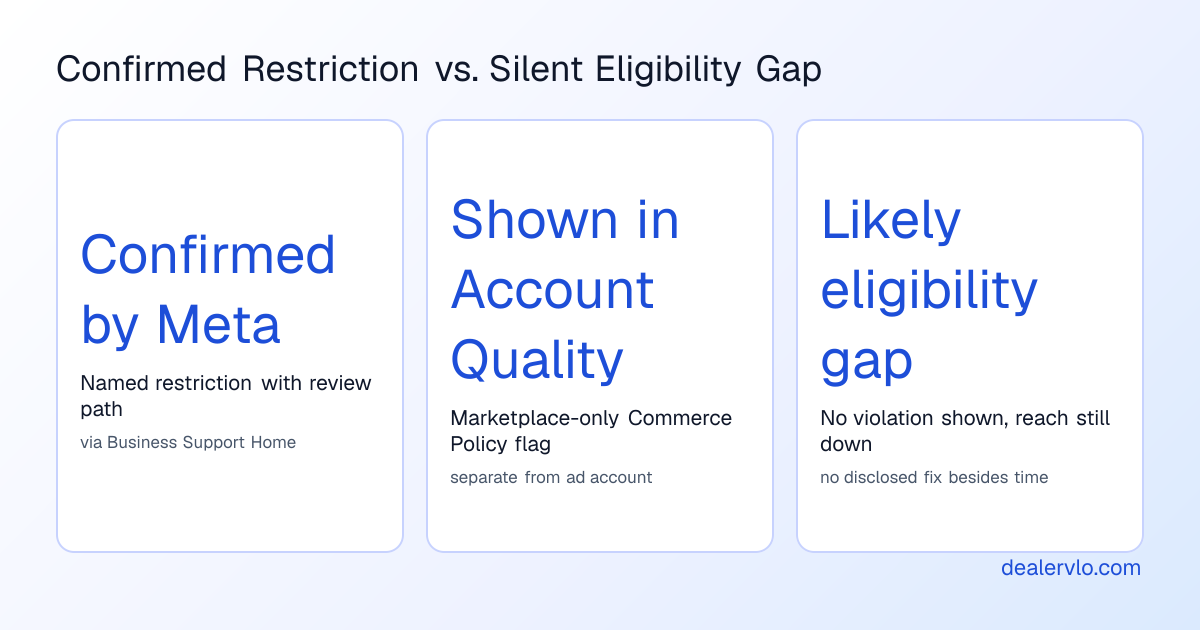
Meta's own ad policy page lays out what triggers an account or asset-level restriction: severely or repeatedly violating policy, evading or attempting to evade a review or enforcement action, setting up business assets with inauthentic accounts, or managing assets connected to other assets Meta has already taken down. Meta also describes a defined appeal path — you request a review in Business Support Home, you're notified by email, and if the review finds the activity acceptable, the account is reinstated.
That's the one place where "ban" has a confirmed mechanism and a confirmed way back. Two other things dealers lump into the same bucket are different:
- A Marketplace-specific restriction on a personal profile. This is reported consistently across independent dealer-tool guides as living in Settings & Privacy → Account Quality (sometimes reached directly at facebook.com/accountquality), where Meta shows whether a restriction is tied to Commerce Policy (Marketplace-only) or to broader Community Standards (the whole account). A "Request Review" option shows up there when Meta is actually offering one — it doesn't always.
- An eligibility gap with no violation at all. New accounts, thin posting history, or an account Meta hasn't "trusted" yet can simply get less visibility — no warning, no named reason, just quieter reach. This is the pattern that actually looks like a shadow ban, because there's nothing to appeal.
The practical tell: a real policy action usually names a reason and offers a review path. An eligibility gap doesn't give you either — it just reduces what the account can do.
Is it a shadow ban or a seasonal dip? Check these first
Before you treat a reach drop as an account problem, rule out the boring explanations:
| Signal | Points to account/policy issue | Points to normal dip |
|---|---|---|
| Account Quality page | Shows a named restriction or review option | Shows nothing unusual |
| Timing | Started right after a burst of fast reposts or a new tool | Lines up with a slow season, holiday, or market-wide pattern |
| Scope | All your listings underperform at once | One or two listings underperform, others are fine |
| Listing hygiene | Duplicate posts of the same VIN, mismatched category, placeholder pricing | Listings are clean, priced, and unique |
| Posting method | Recently switched to an auto-poster, API tool, or bulk scheduler | Posting hasn't changed |
If your Account Quality page is clean and the dip only hit a couple of units, you're probably looking at normal market variation, not a penalty. If it hit everything at once right after a change in how or how fast you posted, keep reading.
What actually seems to trigger lost reach (treat this as field pattern, not Meta policy)
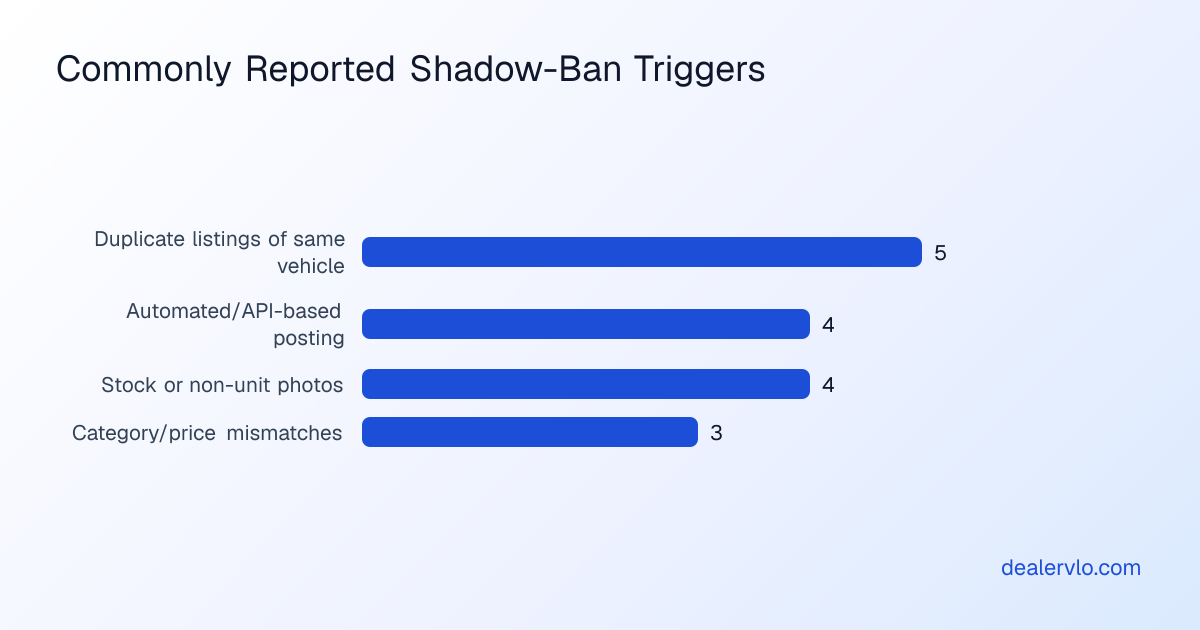
Meta hasn't published a rulebook here, and the numbers floating around dealer blogs — "5 vehicle listings a month," "10 a day," "1 a day for new accounts" — contradict each other badly enough that none of them should be treated as fact. What is consistent, across multiple independent operational guides written by people who run this daily, is a short list of patterns that correlate with reach dropping or listings getting pulled:
- Duplicate listings of the same vehicle. Reposting the same VIN instead of editing or refreshing the original listing is repeatedly named as a top trigger. The fix described across sources is simple: one live listing per vehicle, delete the old one before reposting.
- Category or vehicle-type mismatches. Posting under the wrong category, or using a generic "for sale" listing instead of the vehicle category, is reported to suppress reach.
- Placeholder or inconsistent pricing. "$1," "call for price," or a price that doesn't match what's listed elsewhere gets flagged consistently across vendor guides as a problem, though the exact enforcement mechanics aren't something Meta has confirmed publicly.
- Stock or scraped photos instead of real unit photos. This one is widely repeated, though the specific claim that Facebook runs reverse image search to catch it is a single-source claim and should be read as plausible, not confirmed.
- Automated or API-based posting at volume. A live DealerRefresh thread on this exact question has an experienced poster noting that anything posting through Facebook's API tends to get buried, and that posting method and pacing matter more than any feature checklist. That's forum consensus from people doing this work, not a Meta-published rule — but it's consistent enough to take seriously.
If you're using a third-party tool to post or manage inventory on Marketplace, the risk tradeoffs between browser-based and API-based tools are worth understanding on their own — see the separate breakdown of Marketplace auto-posters and what's actually safe.
One thing DealerVLO can't do here: it doesn't post to Facebook Marketplace automatically, because Meta shut down automated dealer feeds into Marketplace years ago — free listings there have to be posted by hand, one car at a time. What DealerVLO does give you is a per-car "Post to marketplace" kit — all of that car's photos as one download, every field laid out to copy, and a written description with an optional AI rewrite — so the posting itself is fast and the listing content is clean and consistent every time, which is exactly the hygiene that seems to matter for reach.
14-day free trial, then $29/mo · Cancel anytime
The recovery sequence that's actually defensible
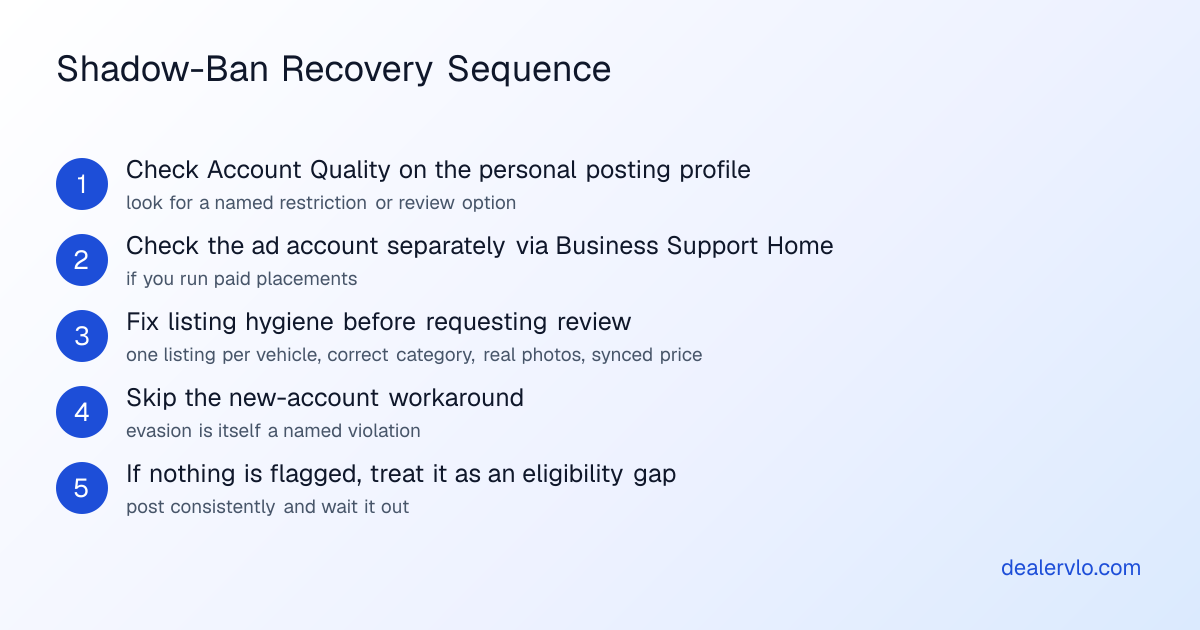
Skip the "new account" advice. Here's the order that's backed by what Meta itself describes and by the independent guides that converge on the same mechanics:
- Check Account Quality on the personal profile doing the posting, not just the business Page or ad account. Look for whether it names a Commerce Policy action (Marketplace-specific) or a Community Standards action (whole account), and whether a "Request Review" option is offered.
- Separately check the ad account if you run paid placements. The confirmed path there is Business Support Home — request a review, Meta responds by email, and if they find the activity acceptable, the account is reinstated.
- Fix the listing pattern before you request any review. One live listing per vehicle, correct vehicle category, real photos of the actual unit, pricing that matches what's on your other channels, and posting at a human pace rather than a burst.
- Don't create a new profile or business asset to route around a restriction. Meta names evading enforcement, and using inauthentic accounts to set up business assets, as explicit grounds for restricting an account — so a replacement account isn't a clean workaround, it's a second violation waiting to happen.
- If there's genuinely no violation shown anywhere, you're likely looking at an eligibility gap tied to account age or thin posting history rather than a penalty. There's no published fix for that beyond consistent, clean posting over time — patience is the actual lever.
Why Marketplace shouldn't be your whole lead strategy anyway
Marketplace reach is genuinely outside your control in a way your own dealer website isn't. If a personal profile gets restricted, every listing tied to it goes quiet at once — and on a small lot, that can be most of your online presence overnight. Spreading inventory across more channels caps the downside of any one of them acting up.
DealerVLO posts your inventory to your own dealer website automatically, and it feeds CarGurus, Cars.com, and Autotrader once a day once you've enrolled with each site and entered your dealer ID — none of which depend on a personal Facebook profile's standing. It also builds a Google vehicle ads feed for Merchant Center if you run paid Google listings. None of that replaces Marketplace, but it means a Marketplace account issue doesn't take your whole lead flow down with it. The full rundown of where to list cars and how to cover every site at once is worth reading if Marketplace has become more than half your pipeline — that's a concentration risk worth fixing regardless of account health.
It's also worth checking whether a slow Marketplace stretch is actually a pricing sync problem rather than an account problem — if you dropped a price and it isn't showing up where buyers are looking, that's a different fix entirely, covered in the stale-price sync audit.
Turn your ad spend into a cost per car sold and a real ROI — and see how many units the spend has to produce just to break even.
Open the Marketing ROI CalculatorTracking leads so you're not guessing which channel is actually working
Part of why "is this a shadow ban" is so hard to answer on gut feel is that most dealers don't have a clean read on where leads are actually coming from day to day. DealerVLO's lead inbox records each lead's source — the dealer website form it came through, whether that's a vehicle inquiry, a general contact form, financing, or a credit application — with status tracking from New through Converted or Lost. That won't tell you about a Marketplace-specific reach drop, since Marketplace leads don't flow through your website's lead forms, but it does let you see clearly whether your website-driven leads are holding steady while Marketplace wobbles — which is useful context for deciding how much weight to put on any one channel.
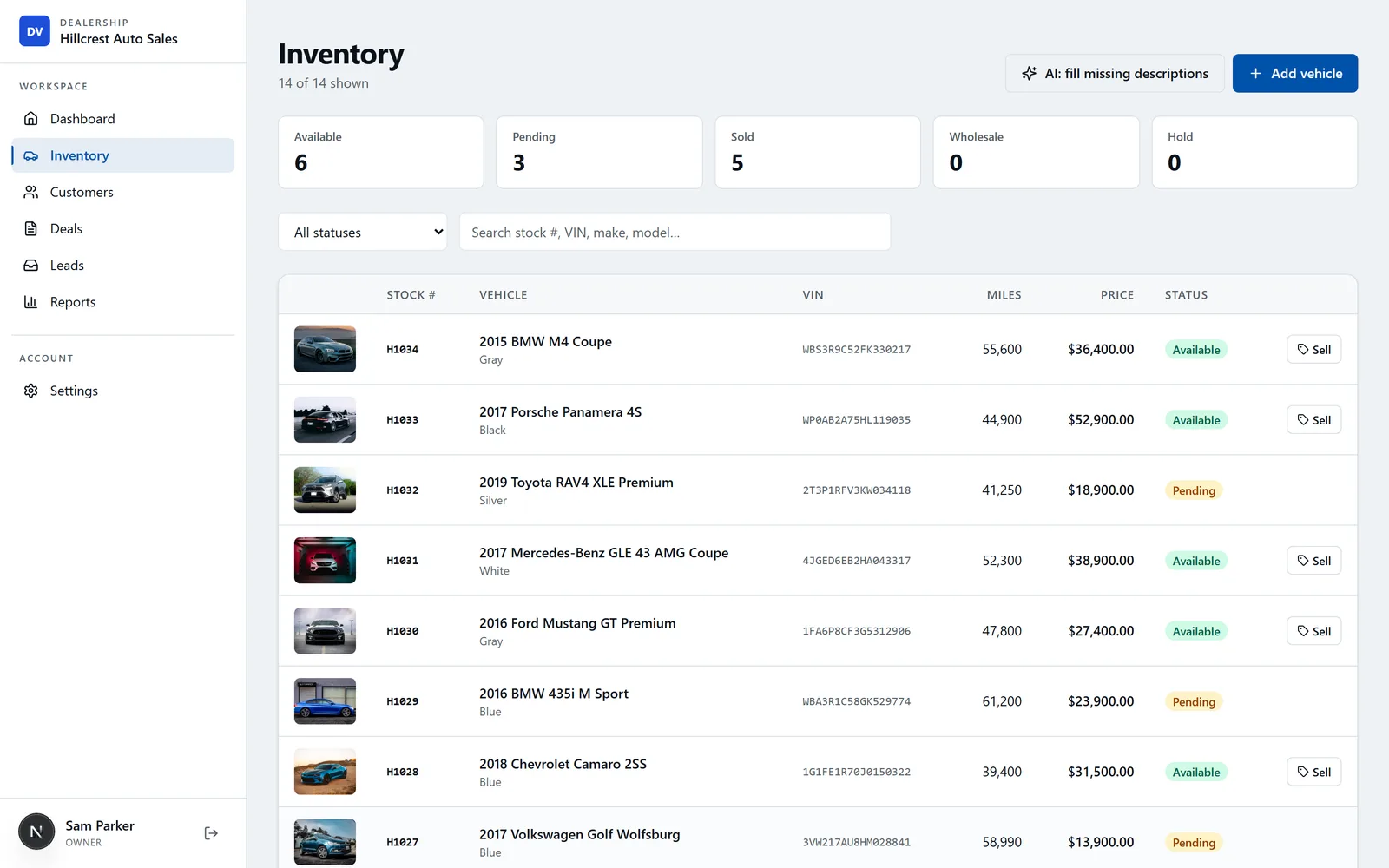
If you're deciding whether to lean harder into your own site while a Marketplace account issue sorts itself out, it's worth confirming your dealer website is actually worth the investment versus relying on Marketplace alone — for a lot of small lots, the answer is both, with the website as the channel you fully control.
14-day free trial, then $29/mo · Cancel anytime
What to do while you wait
Appeals and eligibility recovery aren't instant, and there's no confirmed timeline from Meta for either path. While you wait:
- Keep inventory current and clean everywhere else — a stale price or missing photo on your own site is a problem you can fix today, unlike a Marketplace restriction.
- Make sure photos are genuinely yours. If background cleanup is part of your routine, an enhancement tool that cuts out the real car rather than generating a new one keeps you on the safe side of the "stock photo" pattern that gets flagged.
- Double-check VIN and trim data feeding your listings. A mismatched trim level from a bad VIN decode doesn't cause a shadow ban, but it does cost clicks and credibility the same week you can least afford it.
- Resist the urge to mass-repost everything at once to "test" if the account is still working — that's the posting pattern most consistently tied to reduced reach in the first place.
Frequently asked questions
What does a Facebook Marketplace shadow ban actually look like?
There's no Meta feature officially called a "shadow ban" — dealers use the term for a sudden, unexplained drop in listing reach with no notice from Facebook. Check Settings & Privacy → Account Quality on the profile doing the posting: if it shows a named restriction, that's a confirmable policy action you can potentially appeal. If it shows nothing, you're more likely looking at an eligibility gap or a normal market dip.
Why did my Facebook Marketplace reach drop suddenly?
The most consistently reported causes across independent dealer guides are duplicate listings of the same vehicle, posting under the wrong category, placeholder or mismatched pricing, stock photos instead of real unit photos, and fast or automated posting that reads as bot-like. None of these are confirmed in a published Meta rulebook, but they're the pattern that recovery guidance consistently points to.
How do I recover a restricted Facebook Marketplace account?
Check Account Quality on the personal profile first to see whether the restriction is Marketplace-specific or affects the whole account, and separately check your ad account through Business Support Home if you run paid placements — Meta describes requesting a review there, with reinstatement if the activity is found acceptable. Fix the underlying listing pattern (one listing per vehicle, correct category, real photos, synced pricing) before requesting any review.
Should I create a new Facebook account if my dealership's account is restricted?
No — Meta explicitly names evading enforcement and using accounts to set up business assets after a restriction as grounds for further action, not a sanctioned fix. It's a common workaround suggested on dealer forums, but it carries real risk of compounding the problem rather than solving it.
Can Facebook business Pages still post vehicle listings on Marketplace?
No. Since early 2023, Meta stopped supporting vehicle listings created from a Facebook business Page, along with the vehicles tab and inventory management tab that came with it, and existing Page-based listings were removed. Organic vehicle listings now have to come from a personal profile.
Is there a daily or monthly limit on Marketplace vehicle listings?
Meta hasn't published one. Vendor guides circulate wildly different numbers — some say roughly 10 a day for established accounts, others say a handful per month — and these figures contradict each other closely enough that none should be treated as a real rule. What's consistent across sources is that newer or thinner-history accounts get noticeably less posting headroom than established ones, without a disclosed ceiling.
Bottom line
Most "shadow ban" panic breaks down into one of three boring answers: you're still posting from a business Page that lost vehicle-listing access years ago, you tripped a listing-hygiene pattern that's fixable today, or you're reading a normal slow stretch as a penalty. Check Account Quality before you do anything else, fix your listing pattern regardless of what you find, and don't buy a new account — it solves nothing and adds risk. Keep your other channels — your own website, the daily feeds to the major listing sites — healthy enough that one Facebook account's mood swings can't take your whole pipeline down with it.
14-day free trial, then $29/mo · Cancel anytime