Why Your Price Drops Aren't Reaching Facebook Marketplace: A Stale-Listing Sync Audit
Facebook Marketplace price sync fails because of Meta's plumbing, not your pricing — here's how to audit it weekly.
Part of the Choosing dealer software guide: The best DMS for independent used-car dealers in 2026 — an honest list from a dealer
Switching from another DMS? Compare DealerVLO to DealerCenter, Frazer, or Lot Wizard.
You cut $800 off a unit Monday morning. By Wednesday a shopper calls asking about "the car that's $800 more on Marketplace than what you just told me." You didn't lie to them — your listing did, because the price drop never made it from your desk to the listing they were looking at. That gap between what you quoted and what's posted is a Facebook Marketplace stale-price sync problem, and it's worth understanding why it happens before you assume someone on your team forgot to update something.
A poster on the DealerRefresh forum who builds Marketplace-posting software for dealers claimed that in their own data, 22.6% of dealer listings changed price after going live — roughly one in four or five. Every one of those is a stale listing unless someone went back and edited it. That's one vendor's self-reported, unaudited figure shared in a public forum thread, not an independent study, so treat it as a plausible order-of-magnitude warning rather than gospel. But the mechanics behind it are real and well documented, and they explain why this keeps happening even to lots that are disciplined about repricing.
14-day free trial, then $29/mo · Cancel anytime
The 22.6% number — what it is and isn't
The figure comes from a DealerRefresh thread where the same poster also referenced the FTC's settlement with Greenway Auto Group, where the agency alleged that in over 92% of transactions, customers paid more than $3,350 above the advertised price on average, through administrative, dealer, delivery, and processing fees added at the desk. The proposed order, announced October 8, 2026, still needs a federal judge's approval. That case was about undisclosed fees inflating the price a customer actually paid versus what was advertised — not about stale Marketplace listings. The forum poster drew an analogy: if fee-stacking creates an advertised-vs-actual gap that draws regulatory attention, a stale listing creates the same kind of gap for a completely different reason — plumbing instead of pricing policy.
So don't read the 22.6% as "22.6% of dealers are breaking a rule." Read it as a vendor who watches Marketplace feeds all day telling you that a meaningful share of what's live doesn't match what the desk would quote today. The thread's own practical suggestion is simple and worth running literally: pull ten live Marketplace listings and compare them to what you'd actually quote a walk-in right now. On a 20-30 car lot, ten listings is a real sample of your board.
If your pricing policy itself — not the sync — needs tightening, the FTC's price transparency FAQs piece covers what independent dealers now have to think about in how they advertise a total price in the first place. This isn't legal advice — confirm anything FTC-related with your own counsel or state dealer association before you change your ad practices.
Why this is a plumbing problem, not a pricing-discipline problem
Here's the part that actually explains the gap, and it comes straight from Meta's own documentation, not vendor speculation. Facebook changed how dealer inventory reaches Marketplace twice, and both changes matter:
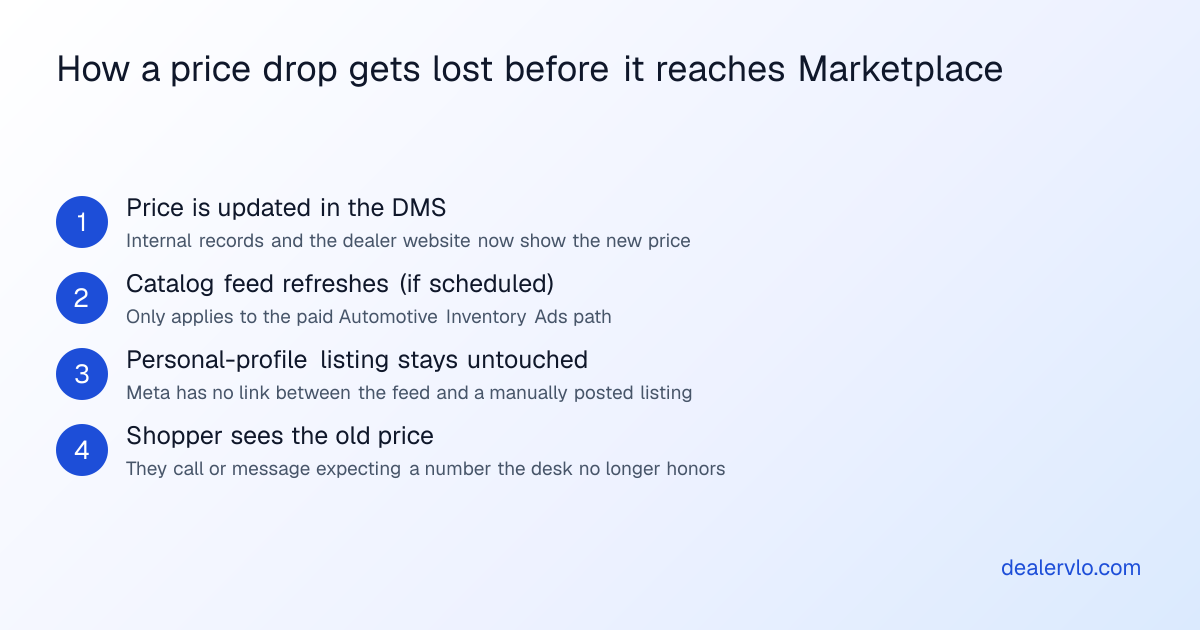
Around September 2021, Meta stopped letting partner catalog feeds generate free, organic Marketplace listings. A feed-uploaded vehicle would only show up in Marketplace if it was running as a paid, promoted ad.
In January 2023, Meta went further and ended the ability for any business Page to create vehicle listings at all — the Vehicles tab and Manage Inventory tab were shut off for business accounts, and existing business-page vehicle listings were deleted. What survived: paid Automotive Inventory Ads built from a vehicle catalog, and a human manually posting a car from their own personal profile. Those are the only two paths left.
That split is the root of the sync problem. A catalog feed and a manually-posted personal listing are two separate systems that don't talk to each other. A dealer's price change can update a catalog feed that feeds paid ads, while the listing a salesperson posted by hand from their own Facebook three weeks ago sits completely untouched. The price drop was real. It updated the feed. It never touched the listing the shopper is actually looking at. Nobody did anything wrong — the two paths were never connected.
Meta's catalog documentation backs this up on the mechanical side too: a vehicle feed can be uploaded as a one-off file or set up as a scheduled feed, and Meta recommends scheduling so new prices reach it without someone re-uploading by hand. A one-off upload stays exactly as it was sent until someone uploads a new file — a price drop made afterward can't reach it, no matter how good internal repricing discipline is.
For background on the broader landscape of posting tools and what's actually safe to use, the Facebook Marketplace auto-poster guide walks through which tools touch your account directly and which carry account risk, and the how to sell cars on Facebook Marketplace guide covers the manual-posting workflow itself since that's still the only free organic path for a single car.
Why staleness compounds faster right now
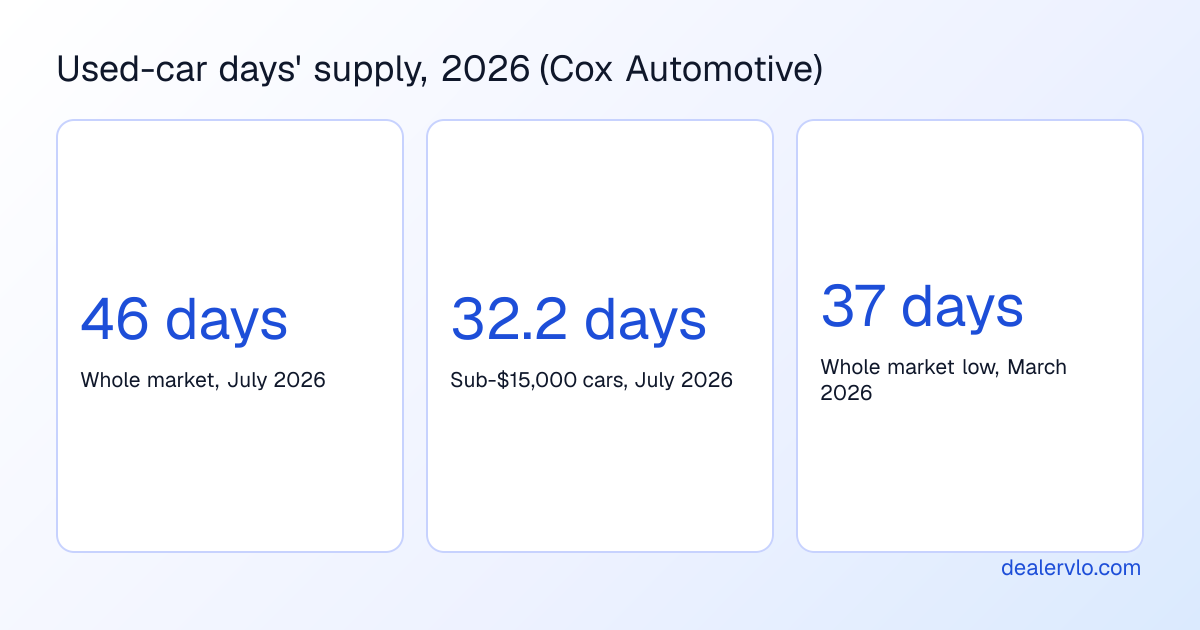
A sync gap that sits for two weeks is a lot more dangerous in a market that turns inventory quickly than in one that doesn't. Cox Automotive's monthly inventory data shows used vehicle days'-supply moving around in the high-30s to high-40s through 2026 — 48 days in January, 42 in February, down to 37 in March, and back up to 49 by September. That's the market-wide average. Vehicles priced under $15,000 turn meaningfully faster than that — Cox Automotive reported just 33 days' supply in June and 32.2 in July for that segment, versus a market average of 47 and 46 days those same months.
Put plainly: if a sub-$15,000 unit sits with a stale price for even a week, a real chunk of that car's entire expected life on the lot has been spent showing a shopper the wrong number. That's the segment to check sync on most often: the shorter a car's expected time on the lot, the more of it a stale price eats.
Average used listing prices also moved a fair amount within 2026 — Cox Automotive had the average around $25,500 in January and around $27,000 by July — which is one more reason a price set even a month ago on a given car may already be out of step with where the market and a lot's own repricing plan have moved.
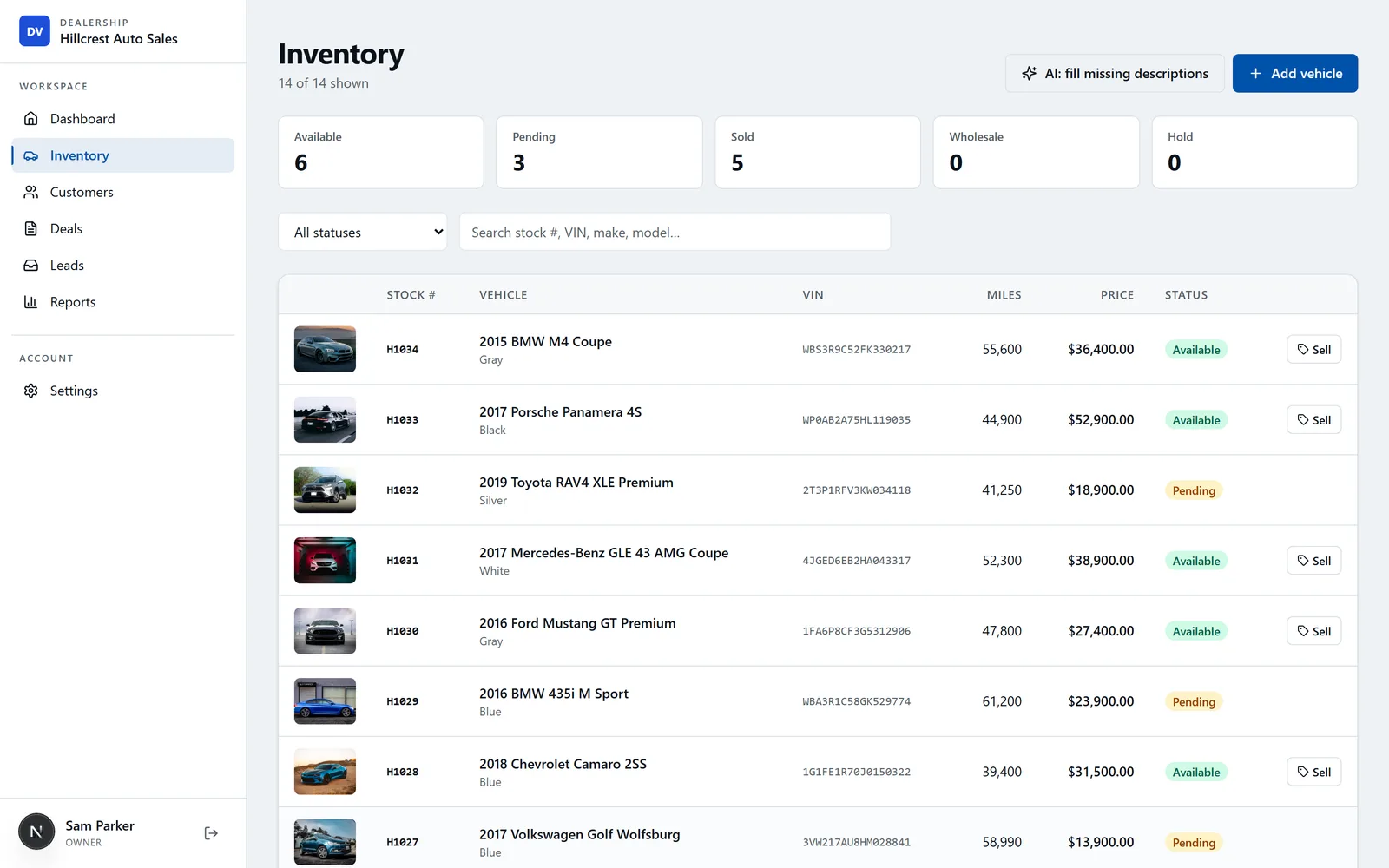
A lot of small lots don't need a separate alert system to know which cars are old enough to need a fresh look — they just need to see days on the lot without digging. In DealerVLO, every car's days in inventory is tracked automatically, and the dashboard shows a count of cars that have hit 60 or more days on the lot, so a dealer knows how many units are in that aging bucket before deciding which ones need attention — on pricing, on Marketplace, or both.
Get your annual turn rate and days' supply — and see what the same inventory could make at a faster turn.
Open the Inventory Turn CalculatorWhere DealerVLO fits and where it doesn't
It's worth being precise here, because the honest answer is DealerVLO doesn't solve the Marketplace half of this problem — and no DMS can through a path Meta supports, since Meta only allows a human-posted personal listing or a paid catalog feed, and the free path has no bulk sync tool.
14-day free trial, then $29/mo · Cancel anytime
For the manually-posted side, DealerVLO builds a per-car "post to marketplace" kit — all the photos in one download, every field ready to copy, a written description with an optional AI rewrite — so when a car does get posted or reposted by hand, the specs and price are pulled straight from the car's record instead of retyped from memory. The physical step of going back into that listing to edit the price is still on the dealer, because that's the nature of the free, personal-profile path Meta left in place; DealerVLO removes the busywork of rebuilding the listing from scratch, it doesn't make the manual edit disappear.
The weekly self-audit checklist
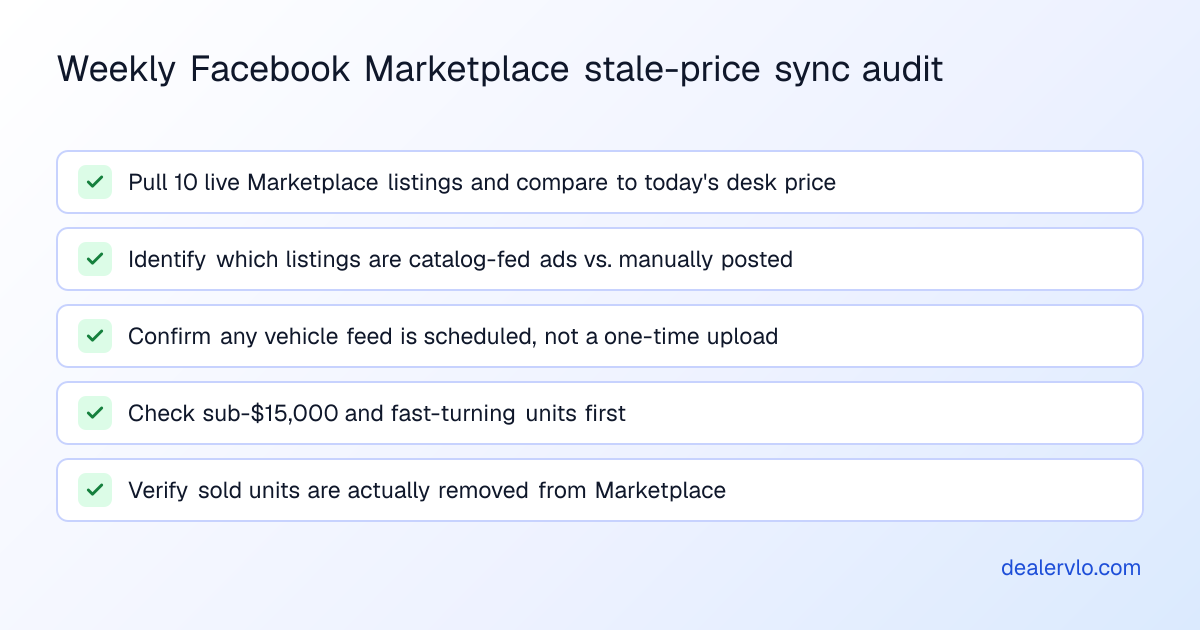
Run this once a week, more often on anything under $15,000:
- Pull ten live Marketplace listings and compare them to what the desk would quote today. This is the exact move the forum thread recommended, and it's the cheapest way to find out if there's a gap at all before looking for a cause.
- Check which path each listing came from. A catalog-fed paid ad can update automatically when the feed refreshes; a listing posted by hand from someone's personal profile can only be fixed by hand. Know which is which before assuming a price change "should have" gone out.
- Confirm any vehicle feed set up is on a recurring schedule, not a one-time upload. Meta's documentation allows either option. A one-time upload keeps its old prices until someone uploads a new file.
- Prioritize sub-$15,000 and fast-turning units first. These carry noticeably lower days' supply industry-wide, so a stale price on one of them burns more of its expected time on the lot.
- Verify sold units are actually gone from Marketplace, not just marked sold in the DMS. The manual-posting path has no automatic delisting tied to back-end inventory status — a sold car can sit live on Marketplace generating calls on a car that isn't there anymore.
A manually-posted Marketplace listing still has to be taken down by hand, since that path isn't connected to any inventory system.
A dealer running a 20-30 car lot can realistically get through steps 1, 2, and 4 in fifteen minutes or so on a Friday — the same kind of routine spot-check a lot should already be running on its own website and listing feeds, just pointed at a channel it doesn't fully control.
If you're also chasing sync problems on your actual listing sites
This same split-path logic — a feed that updates automatically versus a manual process that doesn't — is worth checking everywhere inventory shows up, not just Marketplace. If cars aren't appearing or updating correctly on CarGurus, Cars.com, or Autotrader, the why aren't my cars showing up on listing sites guide is a more complete fix-it walkthrough for that specific set of feeds, which — unlike Marketplace — do support a direct automated daily feed from DealerVLO.
14-day free trial, then $29/mo · Cancel anytime
It's also worth checking who's touching those listings. If a third-party posting tool has access to a dealer's business account, it's worth understanding what that access means for account risk, which the auto-poster risk guide breaks down directly — not every tool that claims to "sync to Marketplace" is actually using a path Meta still supports for dealers.
Frequently asked questions
Why is my Facebook Marketplace price not updating after I change it in my DMS?
Because a catalog feed (which drives paid Automotive Inventory Ads) and a manually-posted personal-profile listing are two separate systems that don't talk to each other. A price change can update a feed without ever reaching a listing someone posted by hand from their own Facebook account — that listing only changes when someone manually edits it.
Is the 22.6% price-change figure a verified industry statistic?
No. It comes from a single poster on the DealerRefresh forum whose company builds Marketplace-posting software, describing their own unaudited internal data — not a peer-reviewed study or an independent audit firm. Treat it as a plausible warning sign worth checking on your own lot, not a confirmed industry-wide rate.
Does Facebook penalize or suppress stale or price-mismatched listings?
There's no documented rule from Meta showing that stale or mismatched listings get algorithmically demoted or suppressed. The real risk isn't a platform penalty — it's a shopper showing up expecting a price you no longer honor, which wastes their time and yours.
Can I bulk-upload or auto-update free Marketplace listings the way I can with CarGurus or Autotrader?
No. Since January 2023, Meta only supports two paths: a paid vehicle catalog feed for Automotive Inventory Ads, or a human manually posting from a personal profile — and the manual path has no bulk-upload or CSV tool for vehicles. Unlike Marketplace, sites like CarGurus, Cars.com, and Autotrader can take an automated daily feed from dealer software, DealerVLO included.
How often should I check my Marketplace listings against my actual asking prices?
Weekly is a reasonable baseline, and more often for anything priced under $15,000, since that segment turns fastest, so a stale price there eats a bigger share of the car's time on the lot. Pulling ten live listings and comparing them to what the desk would quote today is a quick, repeatable check that takes roughly fifteen minutes.
Was the FTC's Greenway Auto Group settlement about stale Marketplace listings?
No. That case was about undisclosed fees stacked onto the advertised price at the desk, not about stale online listings. A forum poster drew an analogy between that fee-stacking gap and a stale-listing price gap, but the FTC action itself targeted price transparency in fees, not Marketplace sync.
Bottom line
A stale Marketplace price almost never means a lot's markdown discipline failed — it usually means the car's price lives in a system that was never connected to the listing a shopper is actually looking at. Pull a sample of live listings against today's desk price, know which path each one came from, and prioritize the fastest-turning units for the check. The side of this a dealer can fully control — one internet price on each car that the website and the CarGurus, Cars.com, and Autotrader feeds all read, with the listing sites picking up changes in their once-a-day feed — is worth locking down with DealerVLO so the manual Marketplace check is the only piece left to do by hand. Try it and see how much of the sync headache disappears on its own.
14-day free trial, then $29/mo · Cancel anytime