Where do your car leads actually come from? Lead-source tracking for a small lot
How an independent used-car lot can track which channel every lead — and every sale — actually came from, without enterprise attribution software. The 30-second habit and the one number that matters.
Ask most dealers which channel sells their cars and you'll get a confident answer that's usually a guess. "CarGurus, mostly." "Facebook, I think." The honest version is: they don't actually know, because the leads and the sales live in different places — or in nobody's records at all — and the loudest channel gets the credit whether it earned it or not.
That guess is expensive. It's how a lot keeps paying for a platform that floods the inbox with tire- kickers while the channel that quietly sends three buyers a month gets no budget and no attention. You don't need an enterprise attribution suite to fix it. You need to know, for every car you sell, where that buyer came from — and that's a habit plus a place to write it down.
Leads and sales are not the same thing
The single most useful idea here: a lead source and a sale source are different numbers, and only one of them pays rent. A channel can send you fifty leads that never buy and look like a hero on the report. Another sends six that all close and looks quiet. Count leads and you'll fund the first one. Count sold cars per source and you'll fund the second.
So the goal isn't just "track leads" — it's to carry the source all the way to the sale. First, though, you have to know what your sources even are, because most lots lump half of them together:
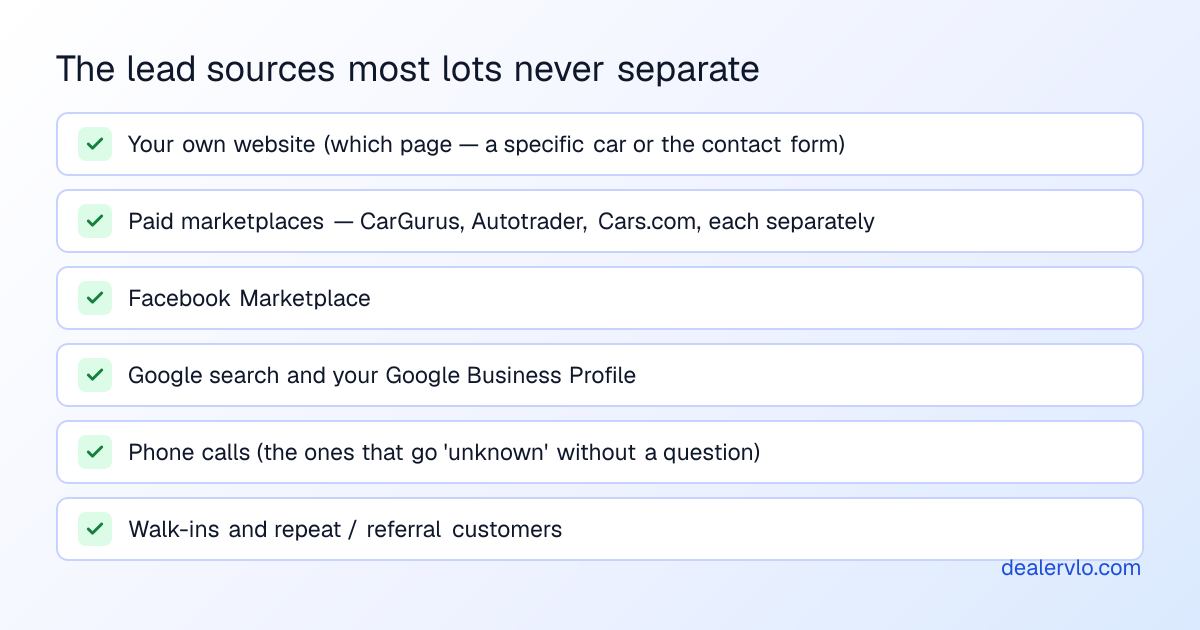
Notice how many of those are invisible by default. A web form tags itself. A phone call or a walk-in doesn't — and those are often your best buyers. If your records are full of "unknown," it's almost always phone and foot traffic going unasked.
The setup — no enterprise tools required
Here's the whole system. It's boring, which is why it works:
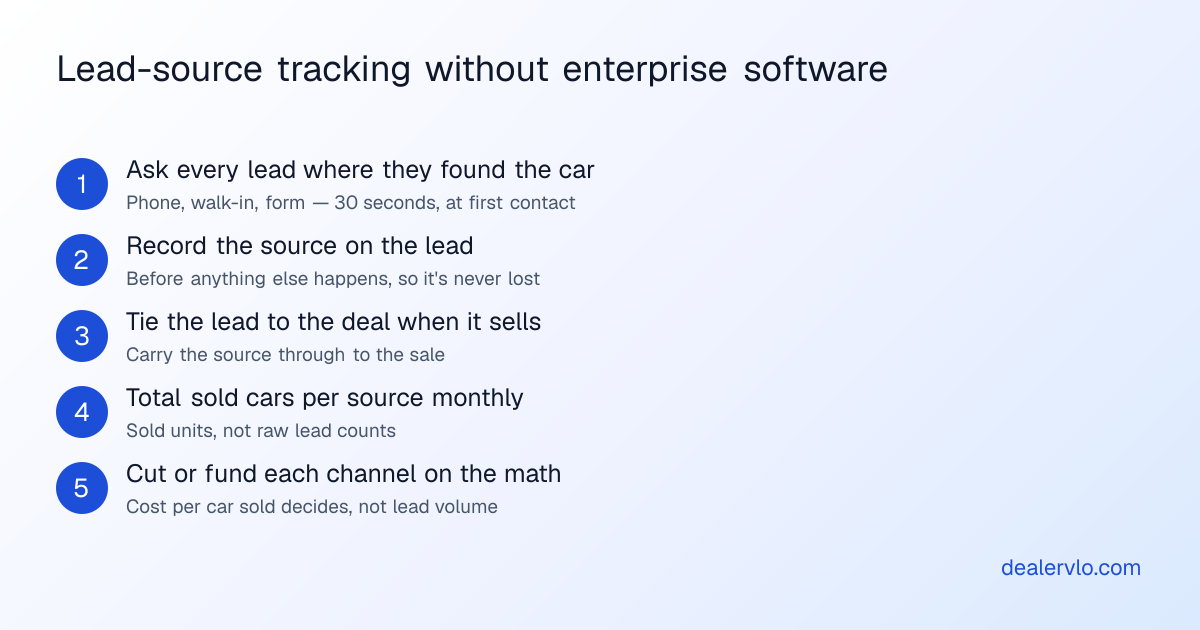
The make-or-break step is the second one: record it immediately. Source recorded at first contact is worth ten times a source you try to reconstruct a week later. This is where a CRM earns its place over memory — in DealerVLO, a lead that comes off your own website lands in the lead inbox already tagged with where it came from, down to the specific vehicle page or the contact form, so those never go "unknown." For phone and walk-in leads, you log them with a source in the same inbox in a few seconds, so every lead — not just the web ones — carries its origin. However you do it, the rule is the same: no lead gets saved without a source.
Then the part almost everyone skips: tie the lead to the deal. When that lead becomes a sale, the source has to follow it, or you're back to counting leads. DealerVLO links a lead to the customer and the deal it produced for exactly this reason — so the funnel measures real sales, not button clicks, and answers "cost per car sold, by source" instead of "how many leads did we get." If you're on a spreadsheet, add a column for the sold deal and its source, and reconcile it monthly.
Work out the most you can bid at the lane and still hit your target margin.
Open the Auction Profit CalculatorThe one number: cost per car sold, by source
Once the source rides all the way to the sale, the payoff is a single honest number per channel — what it cost divided by the cars it actually sold. That's the same discipline behind the cost-per-car-sold marketing math and the free-vs-paid listing decision; lead-source tracking is just the missing input that makes those calculations real instead of gut-feel.
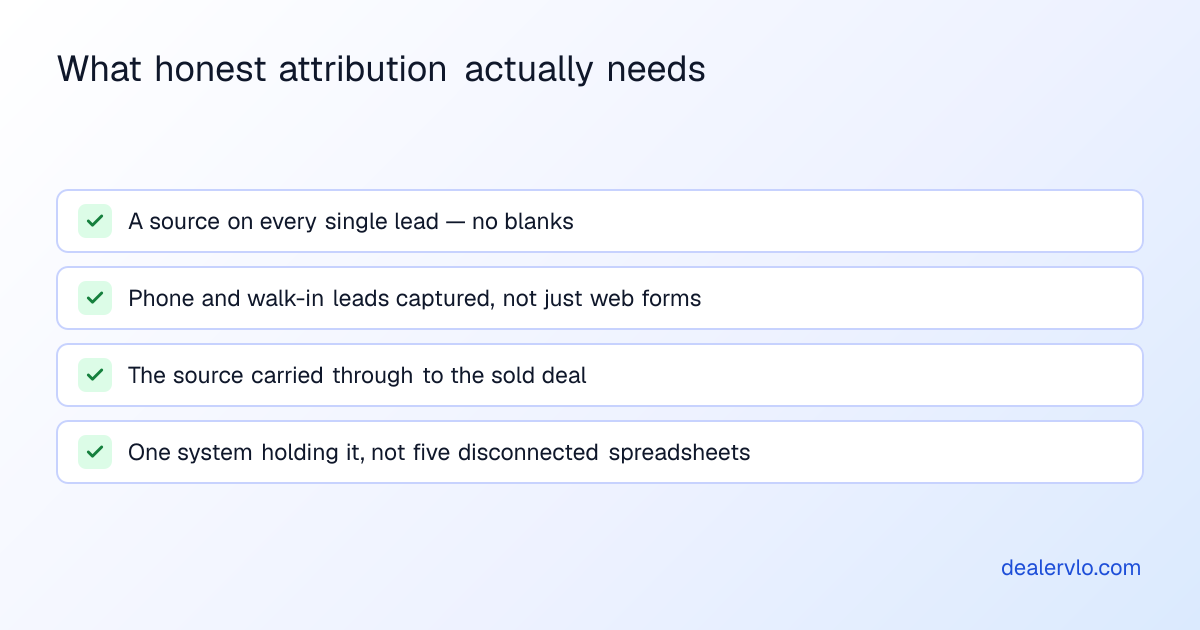
And this is where being on more channels at once finally pays off honestly: when your listings are consistent everywhere and every lead is tagged, you can compare channels fairly and keep only the ones that produce buyers. Tracking without distribution is half-blind; distribution without tracking is expensive. You want both — and then the fast part, turning those leads into appointments, is what actually closes the loop.
Frequently asked questions
How do I track lead sources without expensive software?
A habit plus a place to write it down: ask every lead where they found the car, record the source immediately, and tie it to the sale when it closes. A CRM that auto-tags website leads and links them to the deal does the recording for you; a disciplined spreadsheet does it free.
What's the difference between a lead source and a sale source?
A lead source is where a contact came from; a sale source is where a buyer came from. Count sold cars per source, not raw leads — the loud channel and the profitable channel are often different.
Why are so many of my leads 'unknown'?
Phone and walk-in traffic. Web forms tag themselves; callers and walk-ins don't unless you ask and record it at first contact.
Should I use call tracking numbers?
They help capture phone leads automatically, but the free version — ask every caller where they saw the car and log it — gets most of the value. Add call tracking if your phone volume is high.
How does this help me sell faster?
It helps you spend right, which frees budget for the channels that actually turn cars — so a fixed marketing dollar moves more metal.
Bottom line
You can't fix what you can't see, and most lots can't see where their sales come from — they can only see where their leads come from, if that. Close the gap with one habit (ask and record the source on every lead) and one discipline (carry it to the sold deal), and the guesswork turns into a number you can act on: cost per car sold, by channel.
The reason that's usually so hard is that leads, customers, and deals live in different tools. Keeping them in one is the point of DealerVLO: website leads land tagged by source, phone and walk-in leads log in seconds, and every lead links to the deal it becomes — so your lead-source ROI is a report, not a reconstruction. $29/month flat, unlimited users, free 14-day trial that a card starts with no charge until day 14. Track it for ninety days and you'll stop guessing which channel sells your cars — you'll know.