Do You Need Call Tracking at a Small Used-Car Lot? Start With the Free Version
Call tracking, call monitoring, call recording: what each one does, the free way to count missed calls first, and when paid software finally earns its keep.
Part of the Marketing, leads & your website guide: Used Car Dealer Marketing: What a Small Lot Should Do First — and What to Skip
The phone is the lead source you can't see
Every online lead at a small lot leaves a trail: a form submission, a message, a name and a source. The phone doesn't. A call rings, you answer or you don't, and unless you write something down, it's gone. You have no idea how many you missed, how long you took to call back, or whether that call came from your Marketplace post or your Google listing.
That's why "call tracking" comes up on every dealer forum. But the software category is sold mostly to stores with call centers, and at a 10-to-50-car lot the right first move isn't software at all. It's counting. This post walks the ladder from free to paid, so you only climb as far as your lot needs.
I covered lead-source tracking for the online side already. This is the phone half.
Three terms that get mixed up
Vendors use these words loosely, so here are the plain versions:
- Call tracking tells you which source each call came from. Usually each source gets its own number, or the number on your website changes depending on how the visitor arrived. It logs when the call came in and how long it lasted. It doesn't capture what was said.
- Call recording stores the audio, and often a transcript.
- Call monitoring is listening to those recordings, live or later, to see how your people handled the calls.
Tracking is a marketing tool. Recording and monitoring are coaching tools. If you answer your own phone, you already know how the calls go. What you don't know is how many you missed and where the rest came from.
Rung one: the free numbers you already have
You can get real data today with no signup. Three numbers:
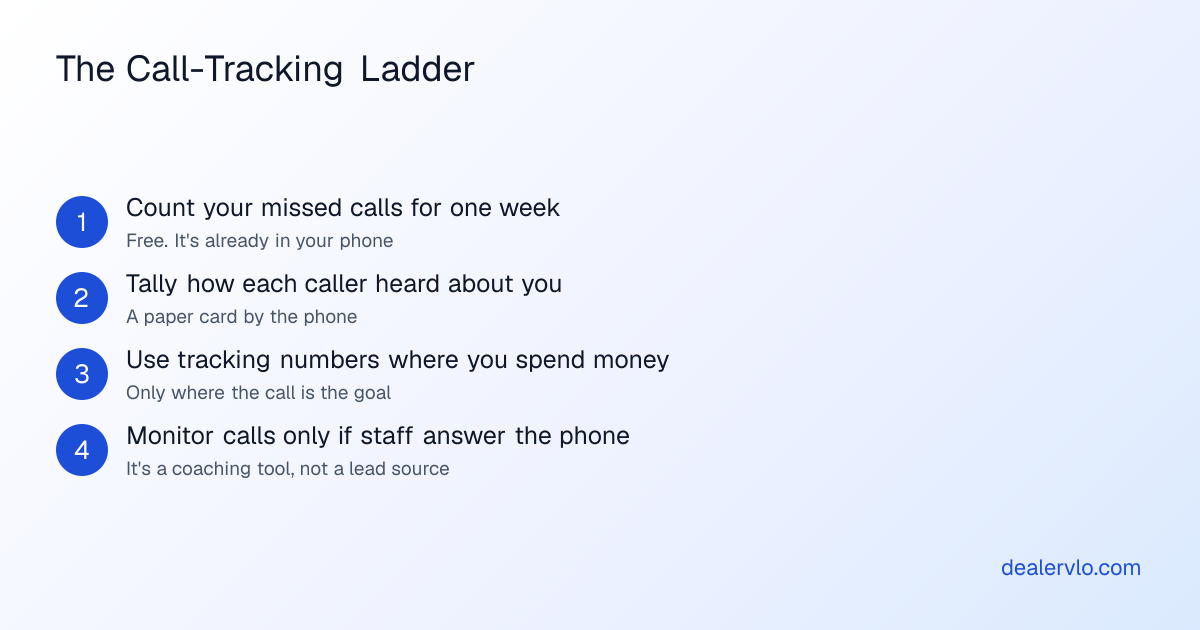
1. Missed calls this week. Open your phone's call log. Count the calls you didn't pick up. Not "a few," the actual count.
2. Callback time. For each missed call, how long until you called back, if you did at all? Write it next to the number. This one stings a little, and it's the most useful one.
3. Your Google Business Profile "Calls" number. In the Performance section of your profile, Google reports how many times people tapped your call button. That's a count of taps, not of connected calls. Google retired the per-call history that used to show individual calls in 2024, so the tap count is what's left, and it's still a useful trend. If your profile isn't set up well, this setup guide is where I'd start.
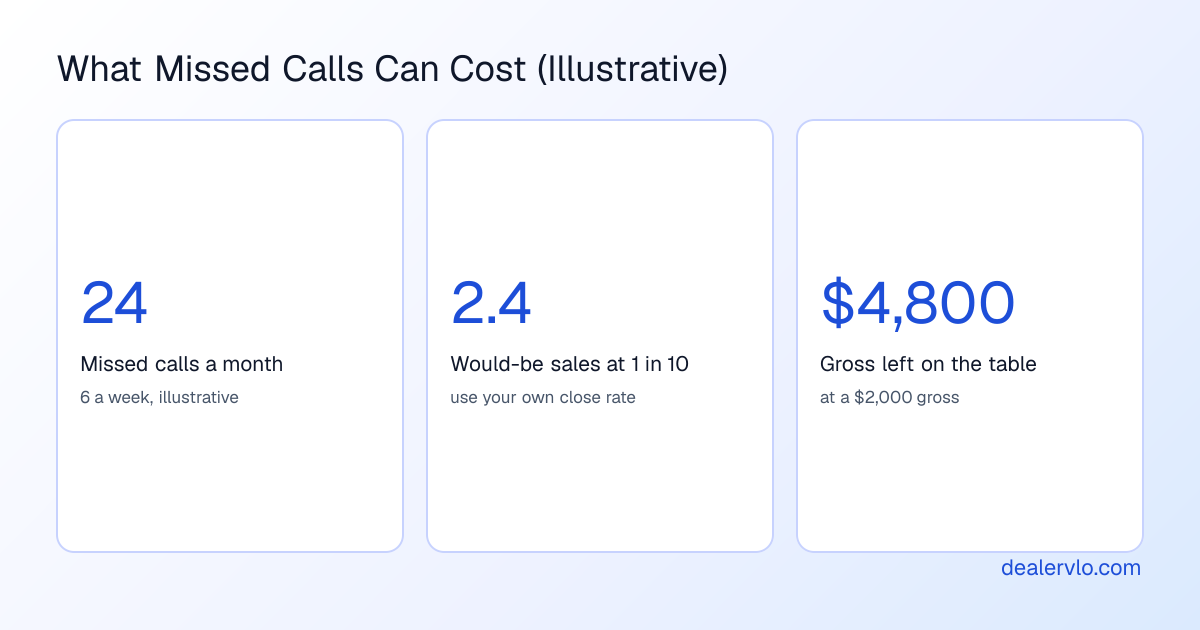
Now put a rough dollar figure on the misses. Here's an illustrative run, so bring your own numbers. Say you miss six calls a week: that's about 24 a month. If one in ten of those callers would have bought, that's roughly 2.4 sales. At a $2,000 gross, call it $4,800 a month. Your close rate and gross will differ, and some missed callers will call again, so treat the result as a size check, not a forecast.
If the number comes out small, you've just saved yourself a subscription. If it comes out big, you've found the problem, and the fix might be a routine, not a tool: a fixed time to return calls, or a voicemail that says when you'll call back. Getting to leads fast is worth its own effort. I cover it in turning online leads into appointments.
Rung two: a paper tally by the phone
Next, where the calls come from. For two weeks, keep an index card by the phone. Every time someone calls, ask "how did you hear about us?" and make a tick mark under Google, Marketplace, a listing site, a friend, a sign, or "other."
It's crude. Callers forget, and some say "Google" when they mean the listing site that came up on Google. But it costs nothing, and it tells you which two or three sources matter, which is all you need to know at this size. Pair it with the sources your web leads report and you have the whole picture.
This is where I'll be honest about DealerVLO: it doesn't answer, track, or record phone calls, and it has no phone system. What it does cover is the web half of the picture. Every lead through your DealerVLO website lands in your lead inbox with a source attached, showing which form it came from, so the phone is the only blind spot left, and the card by the phone fills it. (For how to read those sources, see the lead-source post.)

14-day free trial, then $29/mo · Cancel anytime
Rung three: tracking numbers, where the call is the goal
Paid call tracking earns its keep in one situation: you're spending money somewhere the point is for the phone to ring, and you can't tell which spend works.
The simplest example is Google's own. When you run call ads, Google Ads can use a Google forwarding number that routes to your real phone and reports the time, duration, and caller area code of each call. It's the first thing I'd try before buying anything else.
Beyond that, third-party tools give each place you advertise its own number, or swap the number on your website by traffic source. That can be worth it if you buy call-focused ads on several platforms and can't tell them apart. It's overkill if your calls mostly come from a Marketplace post, a Google listing, and word of mouth.
If you do shop, treat it like any vendor decision. Pricing varies by vendor, so the all-in number in writing matters more than the demo. The checklist below is the whole method:
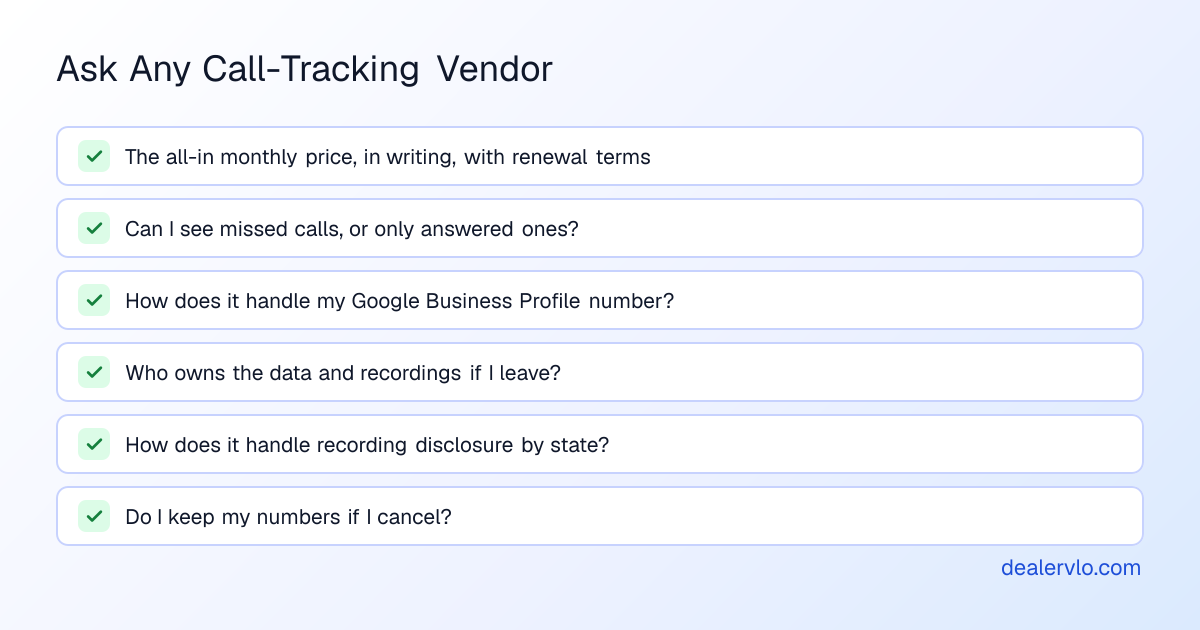
Note the second question. The calls you missed are the ones costing you, so check that the tool shows them and not only the ones you answered. If you want to know whether the ad spend is paying off, the marketing ROI calculator turns spend into a cost per car sold.
Turn your ad spend into a cost per car sold and a real ROI — and see how many units the spend has to produce just to break even.
Open the Marketing ROI CalculatorRung four: monitoring, only if other people answer the phone
Call monitoring is a coaching tool. It makes sense when a salesperson or a receptionist answers your calls and you want to hear how they're handled: whether they ask for the appointment, whether they give away the price too soon. If you're the person who answers, you're the coaching subject, and a recording of yourself is a strange way to learn something you can hear in the moment.
One caution before recording anything. Rules about telling callers they're being recorded differ from state to state, and I'm not the right source for them. Get the answer for your state (and where your callers are) before you turn it on, and make any vendor show you how they handle the disclosure.
Which rung is yours?
Here's how I'd map it, from one operator's view rather than any industry standard:
- You answer your own phone, mostly walk-ins and Marketplace: stay on rungs one and two. A missed-call count and an index card tell you nearly everything.
- You spend on call-driven ads: add Google's forwarding number, then a paid tracker only if you run several platforms you can't otherwise separate.
- Others answer your phones: monitoring starts to earn its cost, but fix the routine first: who answers, and how fast.
And remember the phone isn't the only door. Some buyers would rather not call at all, so a contact form and a financing request on your site give them a way in that doesn't depend on someone picking up. If you're not sure that form even reaches you, that's a ten-minute test worth running today. A DealerVLO site emails the dealership address on each web lead, and your lead inbox keeps the record.
14-day free trial, then $29/mo · Cancel anytime
Frequently asked questions
What is call tracking for a car dealership?
Call tracking is software that tells you which marketing source each phone call came from. It usually works by giving each source its own phone number, or by swapping the number shown on your website depending on how the visitor arrived, and it logs details like time and call length. It tells you where calls come from, not what was said on them.
What's the difference between call tracking and call monitoring?
Tracking answers "which ad or listing made the phone ring." Monitoring answers "how did my people handle the call," which means listening to recordings or scoring them for coaching. One is a marketing tool and the other is a training tool, and a small lot that answers its own phone rarely needs the second.
How can I track calls to my dealership for free?
Start with what you already have. Count the missed calls on your phone for a week and note how long each callback took. Check the Calls number in your Google Business Profile performance report, which counts taps on your call button. Then keep a paper tally of how each caller says they heard about you. It's crude, but it gives you real numbers before you pay anyone.
Is call recording legal for car dealers?
It depends on the state, and the rules about telling callers they're being recorded differ from place to place. I'm not the source for that. If you record calls at all, get the answer for your state and the states your callers are in before you turn it on, and make sure any vendor you use handles the disclosure.
When does a small used-car lot need paid call tracking?
When you spend real money in places where the goal is a phone call, such as call ads, and you can't otherwise tell which ones work. If most of your leads are walk-ins, Marketplace messages, and the occasional call to a number you answer yourself, a paper tally and a missed-call count will tell you almost everything a paid tool would.
Bottom line
Don't buy call tracking to find out if you have a phone problem. Count first: missed calls this week, how long you took to call back, and how callers say they found you. Those numbers cost nothing, and they'll tell you whether the fix is a routine, a tally card, or, only for some lots, a paid tool.
DealerVLO doesn't handle phone calls, but it keeps the web half of your leads in one inbox with their sources. If that's the piece you're missing, start the free trial at /signup.