40+ ChatGPT Prompts for Car Dealers That Actually Work (From a Dealer Who Uses Them)
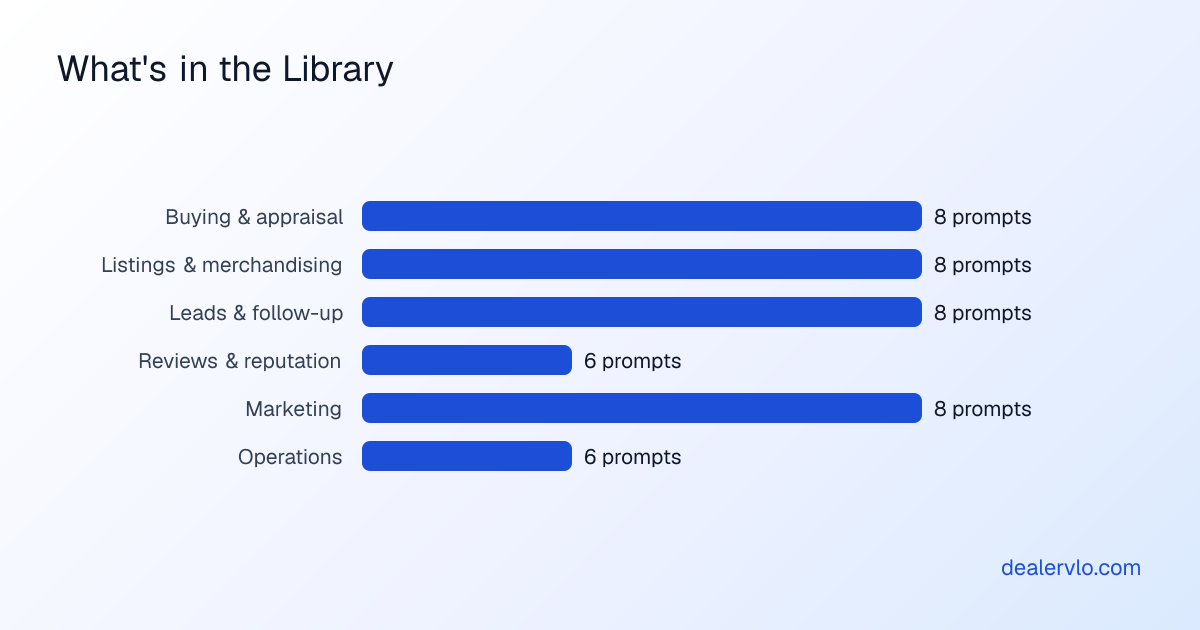
A prompt library for used-car dealers: buying and appraisal, listings, lead follow-up, reviews, marketing, and operations, with the rule that makes each work.
Part of the Marketing, leads & your website guide: Used Car Dealer Marketing: What a Small Lot Should Do First — and What to Skip
Switching from another DMS? Compare DealerVLO to DealerCenter, Frazer, or Lot Wizard.
A library, not a lecture
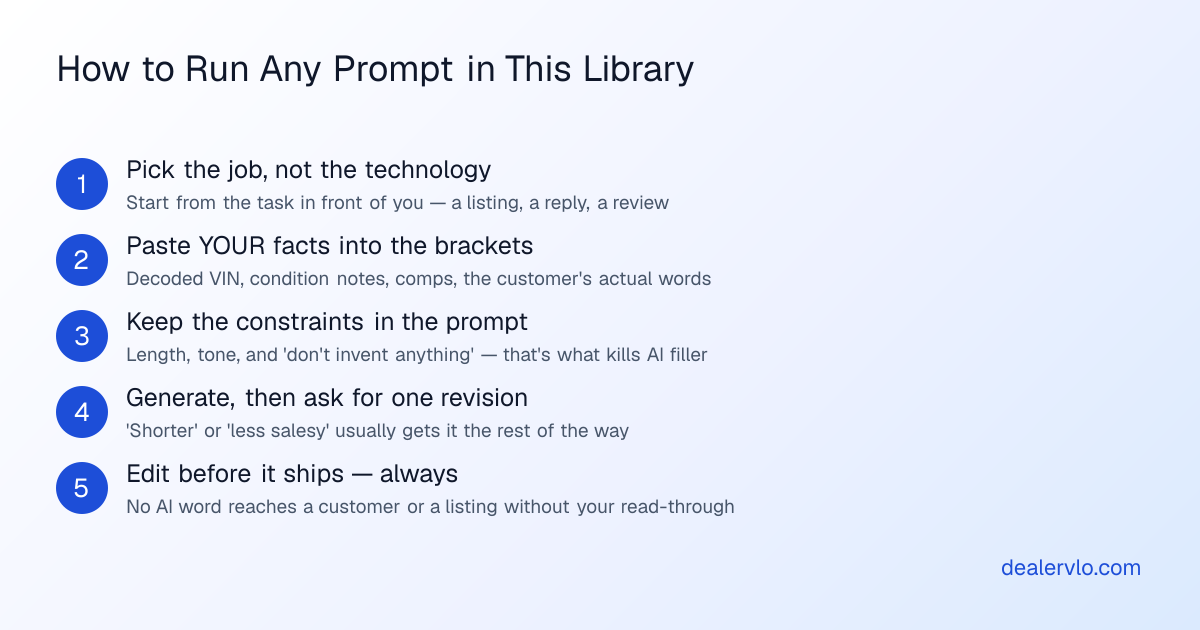
I covered the full system for using AI on a used-car lot — the short version is one rule: AI drafts, you decide. This post is the working half of that system: the actual prompts, organized by job, the way I'd hand them to another dealer.
Two things before you copy-paste. First, every bracket like [year make model] is where your real information goes — the prompts work because they carry your facts, and they produce filler without them. Second, notice what no prompt in this library does: none of them ask the model for a fact it would have to invent. No "what's this car worth," no "what does my state require." Your facts in, structure and speed out. That's the whole trick.
14-day free trial, then $29/mo · Cancel anytime
Buying & appraisal
Where the money is made — and where AI is a research assistant, never the appraiser. (The number is always yours: pair these with how you actually appraise a trade.)
1. Condition-report read. "Summarize this auction condition report in five bullets: biggest mechanical risks, cosmetic issues, and anything affecting retail-readiness. Flag anything that usually costs more to fix than it looks. [paste report]" — Turns a wall of codes into a lane decision.
2. Run-list triage. "Here's tomorrow's run list: [paste rows]. My lot sells [types] to [buyer profile] in [area]. Shortlist the ten units that fit, and say why in one line each. Don't estimate values — just fit." — Fit-sorting, explicitly walled off from valuation.
3. Comp organizer. "Here are comps I pulled for a [unit]: [prices, miles, days listed]. Build a table, flag outliers, and list three questions I should answer before pricing mine against these." — Structures your research; the price stays yours.
4. Appraisal write-up. "Turn my walk-around notes into a clean appraisal summary a partner could read: [paste notes]. Organize by mechanical, cosmetic, tires, interior. No conclusions — just organize." — Scribbles to document in ten seconds.
5. Trade-in questions. "Give me eight questions to ask a customer about their [year make model] trade before I see it — ordered so early answers tell me whether to keep digging. Plain language, not interrogation." — A phone-screen script for trades.
6. Devil's advocate on a buy. "I'm considering buying a [unit] at [venue]. Here's my reasoning: [paste]. Argue against the purchase as a skeptical partner would. Three strongest objections only." — Cheap second opinion before the paddle goes up.
7. Recon scope sanity check. "Here's the recon list my shop proposed for a [unit] I'll retail around [price band]: [paste]. Group it: safety/mechanical, cosmetic, optional. Which items would a margin-focused dealer question? Don't price anything." — Feeds straight into what not to fix.
8. Wholesale exit summary. "Write a two-line honest wholesale description for a [unit] I'm sending to auction: [known issues]. Factual, no polish — this is dealer-to-dealer." — Honesty travels in the lanes.
Listings & merchandising
The highest-return prompts on the lot. Feed them real specs — decode the VIN first so the facts are right.
9. The core listing draft. "Write a used-car listing for a [year make model trim], [mileage] miles. Decoded specs: [paste]. Condition notes: [your honest notes]. Likely buyer: [commuter / family / work truck]. Honest, specific, no hype, no equipment not in the specs. 150 words." — The workhorse. The no-invention clause is what keeps it safe.
10. Channel rewrite. "Rewrite this listing for [Facebook Marketplace / a classifieds site]: [paste]. Shorter, more conversational, keep every fact identical." — One listing, native everywhere, no copy-paste duplication.
11. Feature translation. "Rewrite these spec-sheet features as plain-language benefits a non-car-person understands: [paste features]. One line each, no jargon." — "Blind spot monitoring" becomes a reason to buy.
12. Photo shot list. "Give me a 12-shot photo checklist for a [body style] with [notable feature/flaw], ordered walk-around style. Include the honest flaw shot." — Consistency for whoever holds the phone; pairs with the photography workflow.
13. Title/headline options. "Give me five listing headlines for a [unit], each under 70 characters, each leading with a different real selling point: [list the points]. No all-caps, no exclamation marks." — Pick the one that sounds like you.
14. The aging unit refresh. "This listing has run [N] weeks without selling: [paste]. Rewrite it with a different opening angle and structure — same facts, fresh presentation. What buyer might the original framing have missed?" — Cheaper than a price drop; try it first.
15. Honest-flaw framing. "This [unit] has [flaw — e.g., cosmetic damage, high miles]. Write three ways to disclose it in the listing that are honest and matter-of-fact without leading with it or burying it." — Disclosure that builds trust instead of killing the click.
16. Description audit. "Here are three of my current listings: [paste]. What's repetitive across them? What's vague where it could be specific? Which claims carry no information? Be blunt." — The model is a merciless — and free — copy editor.
Decode any VIN free — year, make, model, trim, engine — straight from NHTSA.
Open the VIN DecoderLeads & follow-up
Speed-to-lead with your judgment intact. These draft; you read and send — the full pipeline thinking is in converting online leads to appointments.
17. First response. "A customer asked: '[paste inquiry]' about our [unit]. Draft a short, friendly reply that answers their exact question, offers [two appointment windows], and doesn't pressure them." — Answers the question they asked — most canned replies don't.
18. The no-show rebook. "A customer no-showed a [day] appointment for the [unit]. Draft a no-guilt text that assumes good intent and offers two new windows. Three sentences max." — Tone is everything; guilt kills the rebook.
19. Day-three follow-up. "Draft a follow-up text to a lead who asked about the [unit] three days ago and went quiet. One useful new fact ([price adjustment / new photos / similar unit]), one soft question. Not desperate." — The 'new fact' rule keeps follow-up from being noise.
20. The polite no. "A customer offered [amount] on our [unit] listed at [price]. Draft a respectful decline that keeps the door open, doesn't apologize for the price, and doesn't negotiate in text." — Holds the line without burning the bridge.
21. Out-of-stock save. "A lead wants the [unit] we just sold. Draft a reply that tells them straight, mentions the [similar unit] we have, and asks what mattered most about the one they missed." — The question at the end is the save.
22. Financing-question deflection. "A lead asked whether we can finance them with [situation]. Draft a reply that invites them in for a real conversation WITHOUT quoting terms, rates, or approval odds. Warm, zero promises." — The one lead reply where the constraint matters more than the copy.
23. Long-quiet revival. "Draft a 're-intro' text to a lead who went quiet [N] weeks ago after asking about a [type of unit]. Reference what they wanted, mention we turn inventory weekly, invite them to tell me what they're looking for now." — Works because it's about their want, not your stock.
24. Reply tone check. "Here's a reply I'm about to send a frustrated customer: [paste]. Where could this read worse than I intend? Suggest the minimal edit." — Thirty seconds of de-escalation insurance.
Reviews & reputation
The trust signals both humans and AI assistants read. Full system in how to get Google reviews.
25. The angry-review response. "Draft a calm, professional response to this review: '[paste]'. Acknowledge the specific issue, don't admit fault, invite them to contact me directly, under 80 words." — The reply you shouldn't write at 9 PM, drafted so you don't have to.
26. Thank-you batch. "Here are five positive reviews: [paste]. Draft a short, distinct response to each that references something specific from the review. No two openings alike." — Ten minutes of gratitude, batched into two.
27. The review ask. "Draft a text asking a customer who just picked up their [unit] for a Google review. Warm, one link placeholder, explicitly fine to say no. Two sentences." — Low-pressure asks get more reviews, not fewer.
28. Mixed-review response. "This review praises [X] but criticizes [Y]: '[paste]'. Draft a response that thanks them for the specific praise and addresses the criticism without being defensive." — Harder than the pure-negative reply, and more common.
29. Fake-review draft response. "This review appears to be about a different business / from someone who never shopped here: '[paste]'. Draft a measured public response that says so without attacking the reviewer, while I dispute it through the platform." — Public calm while the process runs.
30. Review-trend digest. "Here are my last [N] reviews: [paste]. What themes repeat — good and bad? Rank by frequency. What's the one operational fix the negatives point to?" — Reviews are free ops data; this reads it for you.
14-day free trial, then $29/mo · Cancel anytime
Marketing
Consistency beats cleverness — these make consistency cheap. Aim them at the channels that already work: local search and Marketplace.
31. GBP weekly post. "Write a Google Business Profile post about [this week's arrivals / a sold success / a lot update]: [details]. Two sentences, local and plain, one call to action. No hashtags." — The lowest-effort visibility rep there is.
32. Week-of-social batch. "Here's what's happening at the lot this week: [arrivals, sold units, anything human]. Draft five short social posts, varied in type — one inventory, one behind-the-scenes, one tip, one testimonial-style, one just human. Dealer voice, not brand voice." — A week of presence from one prompt.
33. The voice trainer. "Here are two things I wrote that sound like me: [paste]. Describe my writing voice in five bullets, then keep that voice for everything in this conversation." — Run this FIRST in any marketing session — it fixes the press-release problem.
34. Newsletter blurb. "Draft a 120-word email to my customer list about [what's new]: plain, useful, one soft invitation to visit. Subject line that states the value, not clickbait." — Emails people don't resent receiving.
35. Event/promo copy. "We're running [the promo — real terms]: draft the announcement three ways: a text to past customers, a social post, a GBP post. Identical facts, native shape each time." — One promo, three surfaces, zero drift in the details.
36. FAQ page builder. "Here are the ten questions customers actually ask us: [list]. Draft plain-English answers, 3-4 sentences each, honest about what varies. I'll correct facts before publishing." — Feeds humans, Google, and the AI assistants all at once.
37. Community post. "Draft a helpful, non-promotional post for a local Facebook group about [seasonal car topic — e.g., what to check before winter]. Genuinely useful, mentions nothing about my lot. Sign-off: [name], [town]." — The long game: be known as the dealer who helps.
38. Ad copy variants. "Here's a listing for a [unit] I'm promoting: [paste]. Write three short ad variants, each leading with a different real hook: [price point / feature / buyer fit]. Facts identical across all three." — Test angles, not fabrications.
Operations
The quiet ones that give you evenings back.
39. SOP writer. "Turn my rough description of how we [photograph a car / handle a delivery / intake a trade] into a numbered checklist a new hire could follow: [paste your steps]. Ask me about anything ambiguous." — Your process, out of your head, onto paper.
40. Training scenario. "Create a role-play script for training a new salesperson on [handling the first walk-in / presenting numbers]. Realistic customer objections, no closing tricks — our style is low-pressure and honest." — Rehearsal without the awkwardness.
41. Job posting. "Draft a job post for a [role] at a small independent used-car lot. Honest about the work and hours, plain about pay range [range], zero corporate filler. Why this beats a big-store job." — Honesty recruits better than buzzwords.
42. Meeting digest. "Turn these notes from our Saturday huddle into: decisions made, who owns what, open questions. [paste notes]" — The five-minute version of following up.
43. Vendor email. "Draft a firm, professional email to my [vendor] about [issue — e.g., recon turnaround slipping]. State the impact plainly, propose the fix, keep the relationship. No threats." — Firm and civil is a hard register to write angry — so don't.
44. Weekly numbers narrative. "Here are my numbers for the week: [units sold, leads, appointments, aging units]. Write a five-line summary a partner could read: what moved, what stalled, the one thing to fix next week. Use only these numbers." — The 'only these numbers' clause keeps it honest.
What every one of these has in common
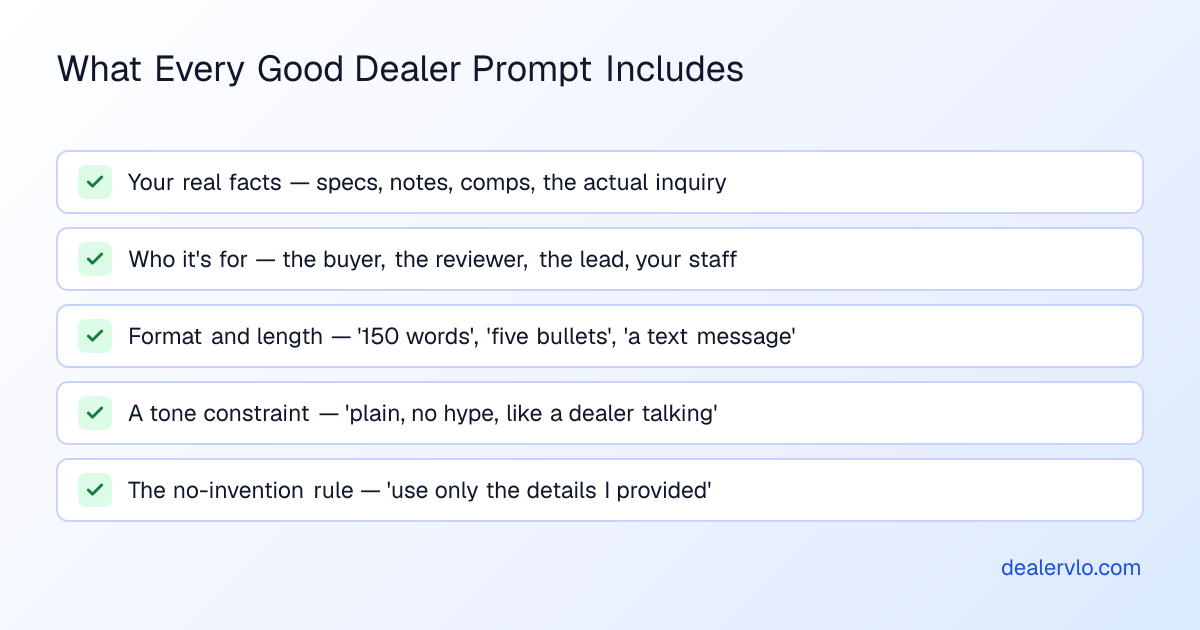
Look back through the library and the skeleton repeats: your facts, a named audience, a format, a tone constraint, and the no-invention rule. That last one is the difference between AI that helps and AI that embarrasses you — the prompts never ask the model to know something; they ask it to shape something you know.
And the rule that sits above the library, from the full guide: nothing the machine drafts reaches a customer, a listing, or a document without your read-through. Pricing, compliance answers, and financing promises never go to the machine at all. Keep those lines and this library is pure time back; cross them and no prompt can save you.
One privacy line worth repeating from the FAQ: treat consumer AI tools as public. First names and questions, yes. SSNs, license numbers, credit apps — never.
Frequently asked questions
How do I write a good ChatGPT prompt for my dealership?
Every prompt that works has the same skeleton: hand the model YOUR facts (the decoded VIN, your condition notes, your comps, the customer's actual question), tell it who the output is for, set the format and length, constrain the tone, and tell it not to invent anything you didn't provide. Vague in, garbage out; specific in, usable draft out. The prompts in this library all follow that skeleton — swap your details into the brackets.
Do I need the paid version of ChatGPT for these prompts?
No. Every prompt in this library runs fine on the free tiers of ChatGPT, Claude, or Gemini. Paid tiers get you faster responses, longer context, and fewer usage limits — worth it once AI drafting becomes a daily habit, but not required to start. Try the free tier for two weeks first; if you hit the limits regularly, that's your signal the subscription pays for itself.
Can I use these prompts with Claude or Gemini instead of ChatGPT?
Yes — these are model-agnostic. The prompts describe the job, the facts, and the constraints, which is what every major assistant responds to. Dealers tend to settle on whichever assistant they like the voice of; the library works the same in all of them.
Is it safe to paste customer information into ChatGPT?
Treat consumer AI tools as public. Never paste a customer's SSN, driver's license number, credit application, date of birth, or anything else you wouldn't put in an email to a stranger. For lead-reply prompts, use the customer's first name and their question — nothing more. The prompt works identically with the sensitive details left out, so there's no upside to including them and real downside if you do.
Will using ChatGPT to write my listings and posts hurt my SEO?
Unedited AI filler can — search engines and AI assistants both read past generic text. Edited AI drafting doesn't: the workflow that works is machine-drafts-dealer-finishes, where you feed real specs and real condition notes in and add what only you know before publishing. The content that wins is specific and honest; AI just gets you to specific-and-honest faster.
Bottom line
Forty-four prompts, one skeleton: your facts in, structure out, your read-through before anything ships. Steal the library, run the voice-trainer first, and keep the decisions — pricing, compliance, promises — where they belong.
The other half of the workflow is the system that feeds these prompts accurate facts and executes the results: the VIN decode that makes listing drafts truthful, the inventory that syncs to your website and feeds, the lead inbox the replies go to. That's what DealerVLO does for $29/month — AI for the words, the DMS for the facts, you for the judgment. Start with the full AI guide if you haven't read it.
14-day free trial, then $29/mo · Cancel anytime
Work out the most you can bid at the lane and still hit your target margin.
Open the Auction Profit Calculator