Do You Actually Need an AI BDC? A Small Dealer's Decision Framework
Every AI BDC review is written by a vendor. The neutral version for independent dealers: what an AI BDC does, when the math works, and a demo checklist.
Part of the Marketing, leads & your website guide: Used Car Dealer Marketing: What a Small Lot Should Do First — and What to Skip
Switching from another DMS? Compare DealerVLO to DealerCenter, Frazer, or Lot Wizard.
Every review of these tools is written by someone selling one
Search "AI BDC for car dealerships" and look at who wrote the results: the vendors. Every "top 7 AI BDC solutions" list is published by a company on its own list. That doesn't make the products bad — some are genuinely capable — but it means nobody in the conversation has an incentive to tell you not to buy one.
I run a small independent lot. I use AI every day, and I'm bullish on it — I wrote the working guide on it. This post is the piece missing from that search page: the neutral version, from an operator, on when an AI BDC is worth real money at a 10-to-50-car lot — and when it's a subscription-priced solution to a ten-minute problem.
14-day free trial, then $29/mo · Cancel anytime
What an AI BDC actually does
Strip the branding and the category does four things: it answers new leads within seconds, at any hour. It runs follow-up sequences over text and email so no lead goes quiet by neglect. It answers routine questions and tries to convert the conversation into an appointment. And it re-engages aged leads that went cold months ago.
That's different from a website chat widget, which only talks to whoever's on your site right now. A real AI BDC works your whole lead flow — the Marketplace inquiry at 11 PM, the lead from three Tuesdays ago, the no-show who never rebooked. The pitch, honestly stated, is: the follow-up work you know you should be doing but aren't, done relentlessly by software.
The pitch is real. The question is whether the gap it fills, at your volume, is worth what it costs.
The math is about your lead volume, not the technology
Here's the framework, and it's arithmetic more than judgment. Take your actual leads per month and ask what the response burden really is.
Run the illustrative math on a small lot: a lead a day — call it 30 a month — with an AI assistant drafting replies you review and send, is maybe ten minutes of daily work. The draft-and-review workflow handles it at close to zero cost, with your judgment on every message. An AI BDC pointed at that volume is automation looking for a job — you'd be paying a subscription to avoid ten minutes a day, and handing a machine your customer conversations to do it.
Now run it at ten times that. Three hundred leads a month is ten a day, arriving at all hours, and half of them deserve a follow-up sequence nobody has time to run. At that volume the leak isn't discipline — it's arithmetic. You physically can't respond to the 11 PM lead at 11 PM, and speed of first response genuinely decides whether an online lead becomes an appointment. That's where the category earns its look.
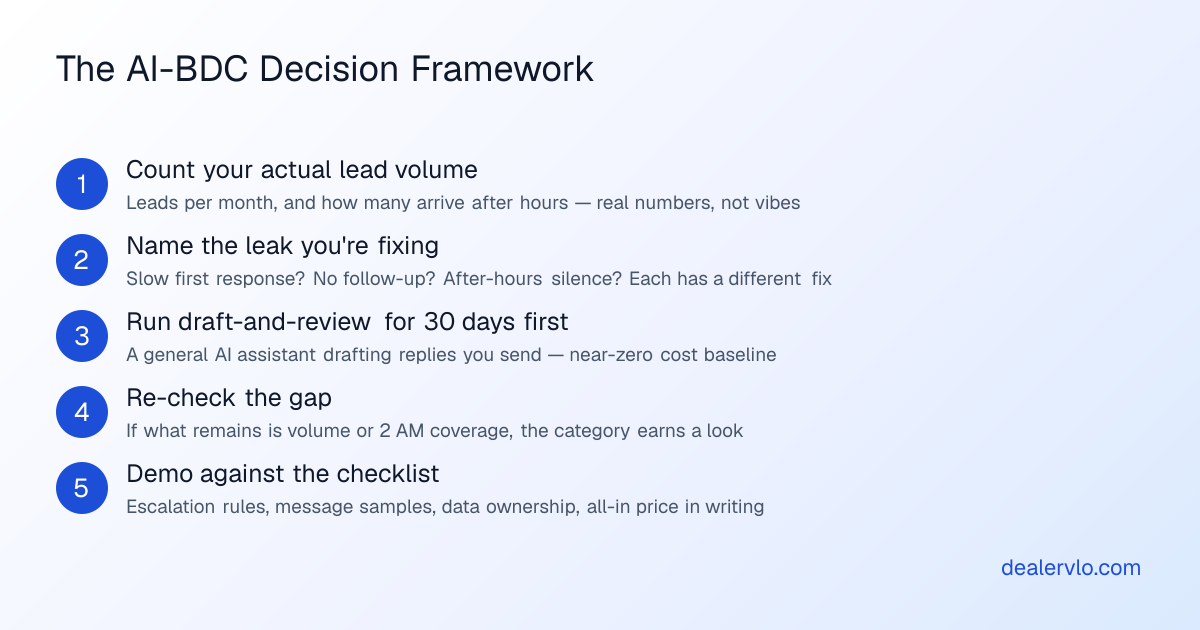
Most independents I know sit far closer to the first picture than the second. The honest first move at almost any volume: run draft-and-review seriously for thirty days, then look at what's still leaking. If the remaining gap is after-hours coverage or raw volume, shop the category. If the remaining gap is "I don't like reading leads," no subscription fixes that.
Turn your ad spend into a cost per car sold and a real ROI — and see how many units the spend has to produce just to break even.
Open the Marketing ROI CalculatorWhere an AI BDC genuinely shines
Fairness demands the strong cases, and there are three. After-hours first response — a real share of internet leads arrive when the lot is dark, and answering at 8 AM is answering second; software that responds in seconds at 2 AM does something you structurally cannot. Aged-lead reactivation at scale — if you have hundreds of dead leads in a CRM, a polite automated re-engagement pass is work no human was ever going to do, and anything it revives is found money. Consistency where no one owns follow-up — if leads route to whoever's free, and follow-up depends on who remembers, a system that never forgets beats a process that doesn't exist.
Notice what the three have in common: they're all cases where the alternative isn't "you doing it better" — it's nobody doing it at all.
14-day free trial, then $29/mo · Cancel anytime
Where it burns you
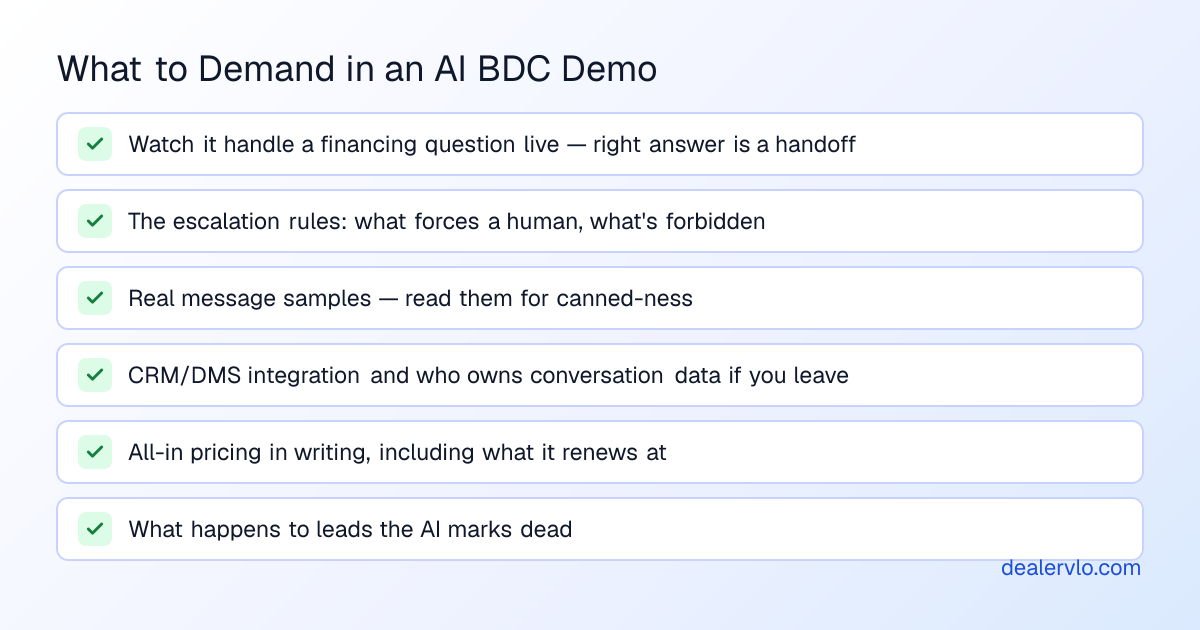
The unreviewed-promise problem. This is the one that matters most. An AI talking to your customers with no human review will eventually misstate equipment, imply approval odds, or answer a compliance question — in writing, under your dealership's name. Financing conversations are regulated territory; "the software said it" is not a defense you want to test. Whatever you buy, the escalation rules — what the machine must hand off and what it's forbidden to discuss — are the product. Demo those, not the dashboard.
The canned-feel tax. Buyers have gotten good at smelling automation. A capable system with your voice trained in can pass; a lazy deployment texts like a robocall reads, and every customer it touches learns your lot sends robots. Ask to read real message threads before you sign — not the demo script, real ones.
Paying volume prices for a trickle. Most vendors quote per rooftop, don't publish pricing, and price for dealers with real lead flow. At low volume you're buying a fire truck for a candle.
Data and switching costs. The conversations, the lead statuses, the learned context — ask who owns them and what exports if you leave. A tool that gets smarter on your data you can't take with you is quiet lock-in.
The brand question nobody asks. At a 15-car independent lot, the fact that a human answers — the owner, often — is the differentiation from the big stores. Automating your first impression away is a real trade, even when it's the right one.
If you do shop the category
Then do it like a vendor decision, not a demo experience. The checklist above is the whole method: make them handle a financing question live (the right answer is a graceful handoff, not an answer), read real message samples, pin down escalation rules and data ownership, and get the all-in price in writing including renewal. Vendors in this category range from established platforms to companies younger than your aged inventory — month-to-month terms are your friend, and any vendor who won't start there is telling you something.
One more filter: the AI BDC sits downstream of your lead flow. If the listings feeding it are weak, you're paying to follow up faster on leads you're generating badly. Listing quality and showing up where buyers search are upstream fixes that make every downstream tool — human or AI — work with better raw material.
The decision, compressed
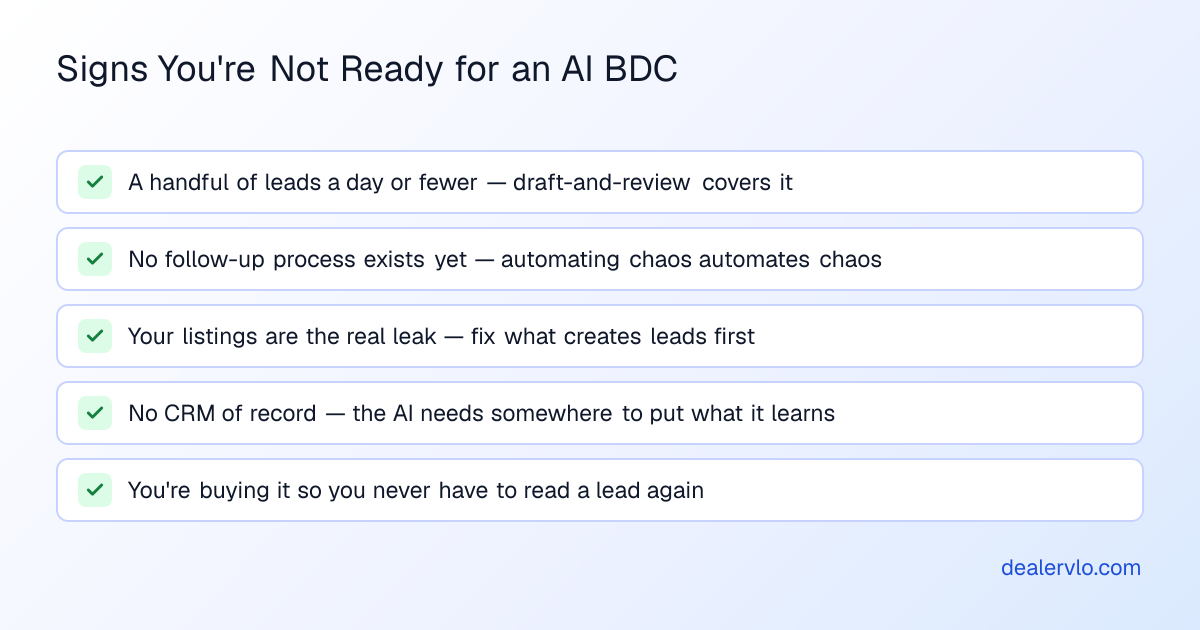
These are the rough lines I'd draw — judgment from a small lot, not an industry standard, so bend them to your operation:
A few leads a day or fewer: draft-and-review with a general assistant. Near-zero cost, your judgment on every message, and the prompt library makes it a ten-minute habit. An AI BDC at this volume is overkill you'll resent paying for.
Volume where leads genuinely slip — you're missing after-hours inquiries, follow-up sequences aren't happening, aged leads pile up untouched: the category deserves a serious demo, run against the checklist, with escalation rules as the deciding factor.
Any volume, but no process at all: fix the process first. An AI BDC amplifies whatever lead operation it's pointed at — including a broken one.
Frequently asked questions
What is an AI BDC for a car dealership?
An AI BDC (business development center) is software that works your leads the way a human BDC department would: it responds to inquiries within seconds, texts and emails on a follow-up sequence, answers routine questions, tries to set appointments, and re-engages leads that went quiet — around the clock, without staffing. The category ranges from smart auto-responders to systems that carry on full conversations. What separates it from a website chat widget is that it works your existing lead flow across channels, not just visitors currently on your site.
How much does an AI BDC cost?
Most AI BDC vendors don't publish pricing — expect a demo call and a per-rooftop quote, often with setup fees and terms that vary by lead volume. That opacity is itself worth noting: treat it like any vendor decision, get the all-in number in writing including what it renews at, and compare it against the honest cost of your alternative — which for a small lot is often a general AI assistant plus ten minutes of daily draft-and-review, at close to zero.
Can an AI BDC replace my BDC staff or salespeople?
It replaces the repetitive first-touch work — instant responses, follow-up sequences, appointment scheduling — not the selling. Someone still has to take the handoff, run the test drive, and close. On a small independent lot where the owner is the BDC, the more accurate framing is that an AI BDC replaces work that currently isn't happening at all: the 11 PM first response, the day-five follow-up nobody sent. Whether that gap justifies the subscription is the real question.
Is it safe to let an AI text my customers without review?
It's the biggest risk in the category. An unreviewed AI will eventually misstate equipment, promise something about financing, or answer a compliance question wrong — in writing, to a customer. If you evaluate an AI BDC, make escalation rules the center of the demo: what topics force a human handoff, what the AI is forbidden to discuss, and whether you can review conversations. Financing terms, approval odds, and legal questions should never be answerable by the machine.
What should I ask in an AI BDC demo?
Six things: watch it handle a financing question live (the right answer is a deflection to a human, not a quote); see the escalation rules and what's configurable; read real message samples for canned-ness; confirm how it integrates with your CRM or DMS and who owns the conversation data if you leave; get all-in pricing in writing including renewal; and ask what happens to leads the AI marks dead. A vendor who dodges any of these is answering your question.
Bottom line
The AI BDC category is real, and at real lead volume it fixes a leak no amount of discipline can. But the people telling you every lot needs one are the people selling them. Count your leads, name your leak, run draft-and-review for a month, and let the remaining gap — not the demo — make the call.
And whichever way you go, the layer underneath has to hold: leads landing in one inbox, customer records in one place, the facts about every car accurate and current. That's the part DealerVLO covers for $29/month — the system of record that makes your follow-up, human or AI, work from the truth. Start with the full AI guide for everything else the machine can do on your lot.
14-day free trial, then $29/mo · Cancel anytime