How to take deposits and down payments without eating fees or chargebacks
Every card swipe costs you 2.5–3.5% and a chargeback can claw it all back weeks later. How to decide which payment method for which amount, hold a car cleanly, and paper a deposit so a dispute doesn't cost you the car and the money.
Nobody starts a lot thinking about how they'll take the money down. You take a card because the buyer has a card, you take cash because cash is cash, and you don't think about it again — until you notice your card processor skimmed a few points off every down payment all year, or a buyer disputes a $3,000 charge six weeks after they drove off and your bank yanks it back out of your account.
How you take money down is a real line item and a real risk, and both are avoidable with a little upfront thinking. This is the operator's version: what each method actually costs you, how to hold a car cleanly, and how to paper a deposit so a dispute doesn't cost you the car and the money. (One thing this post won't do is tell you what's legal to keep in your state — that's a your-lawyer question, not a blog question. It'll tell you how to protect yourself whichever way your terms fall.)
The real cost of how you take money down
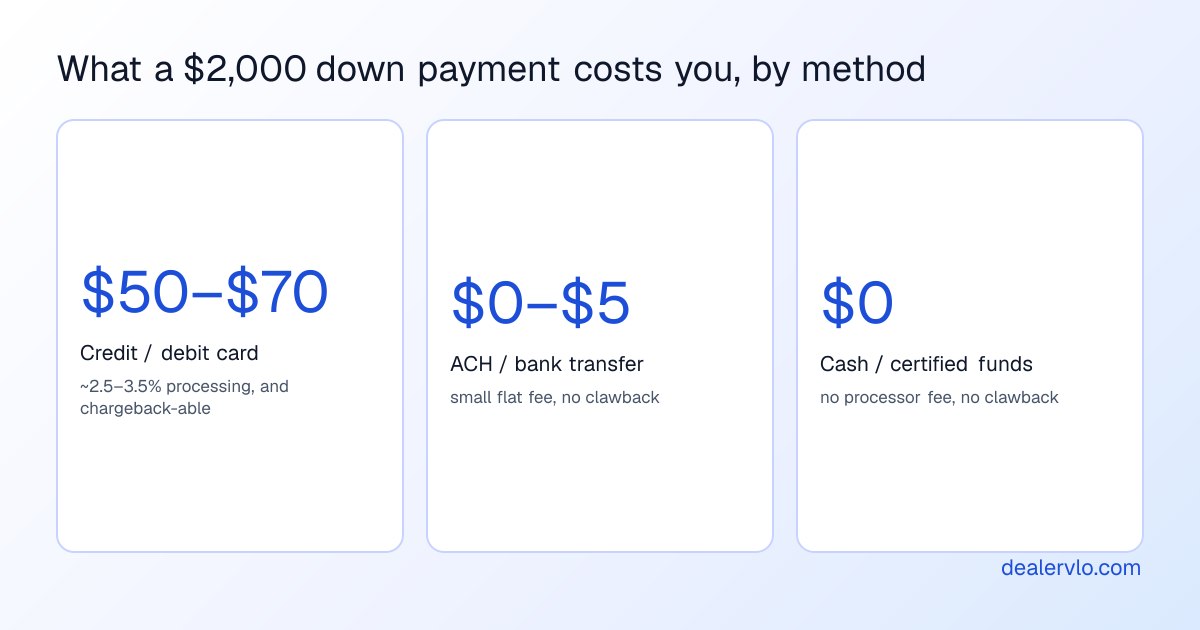
Every payment method has a price, and the card is the expensive one. Card processing typically runs somewhere around 2.5% to 3.5% depending on your processor, the card, and whether it's swiped or keyed — so a $2,000 down payment quietly costs you fifty to seventy bucks, and a bigger one costs proportionally more. Do that on every deal and it's a meaningful chunk of your F&I gross going to a processor for nothing but convenience.
The other costs are lower but they're not zero, and they're not all money. Cash costs you nothing to accept but carries handling and safety considerations. ACH or a bank transfer usually costs a small flat fee and can't be clawed back. A card is fast and easy and it's the only method on this list a buyer can reverse weeks later with a phone call to their bank. So "what does this cost me" isn't just the fee — it's the fee plus the risk. Decide with both in view.
Cash, card, ACH, certified funds — when to use which
You don't need a complicated policy, you need a policy. The pattern most solid lots settle into:
- Small amounts / convenience — card is fine. A few-hundred-dollar hold deposit on a card costs you a couple bucks in fees and saves the friction. Worth it.
- Larger down payments — steer to cash, certified funds, or ACH. A $3,000-plus down payment on a card is $90-plus in fees and a chargeback exposure you don't need. A bank transfer or certified funds is a few dollars and final.
- Anything you're nervous about — off the card. If a deal feels shaky, the last thing you want is the down payment sitting on a reversible card charge.
The mistake is having no line at all — taking whatever the buyer pulls out, on whatever method, at whatever size. Set a dollar threshold above which you don't take cards, tell your salespeople, and stick to it. It's the single easiest way to stop leaking F&I gross to a processor.
Holding a car with a deposit (and making the terms stick)
A deposit to hold a car is a good tool — it separates the serious buyer from the one who's "definitely coming back Saturday" and never does, and it protects you from pulling a car off the market for a ghost. But a hold is only as good as the terms, and the terms only exist if they're written down and signed.
Before you take a hold deposit, put four things in writing: how much, how long the hold lasts, what happens to the deposit if the buyer proceeds, and what happens to it if they walk. Have them sign it. That's the difference between a clean transaction and an argument in your showroom two weeks later — and it's the same paperwork discipline that makes the rest of the deal jacket hold up.
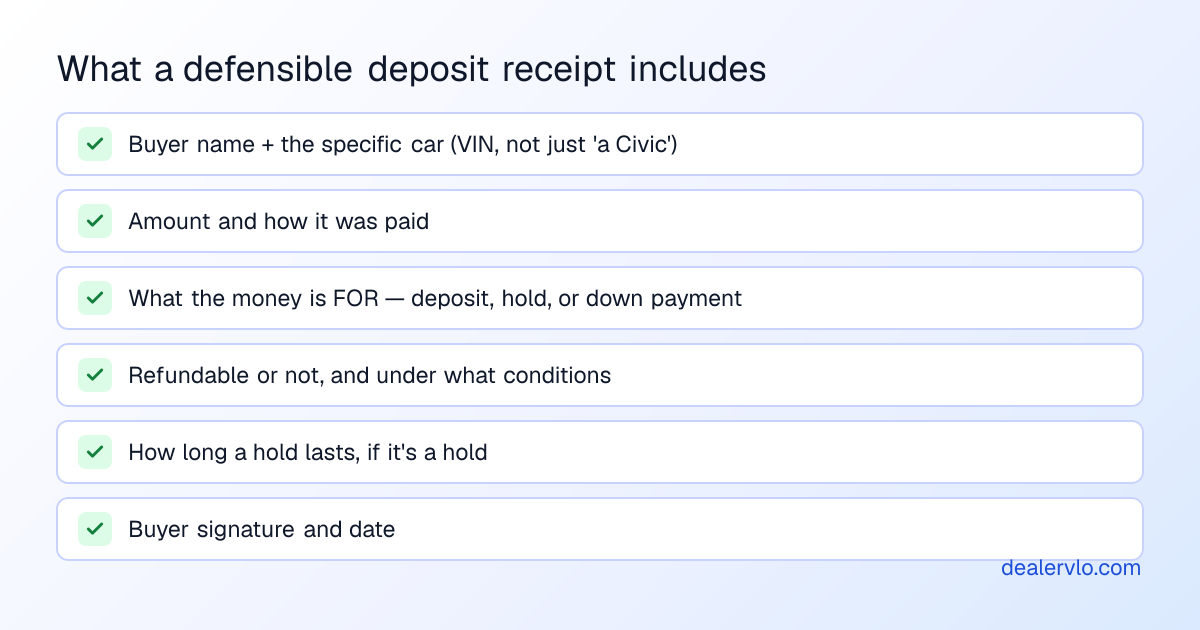
Whether a deposit is refundable, and when, is yours to set and your state's to constrain — I'm not going to pretend there's one rule across fifty states, because there isn't. What travels everywhere is this: decide your terms, write them down, disclose them plainly, and get a signature. A vague "deposits are non-refundable" scrawled on a sticky note protects nobody. A specific, signed receipt protects you.
Chargebacks: how dealers lose them, and how not to
Here's the part that catches new dealers off guard: a card payment isn't final. Weeks after the sale, a buyer can call their bank, dispute the charge, and your processor pulls the money back out of your account while it sorts out — and if you can't produce evidence by the deadline, you lose by default. On a down payment, that can be thousands of dollars gone after the car's already down the road.
You don't beat chargebacks by hoping. You beat them two ways: keep the big, reversible sums off the card in the first place, and document the card payments you do take well enough to win a dispute. When one comes:
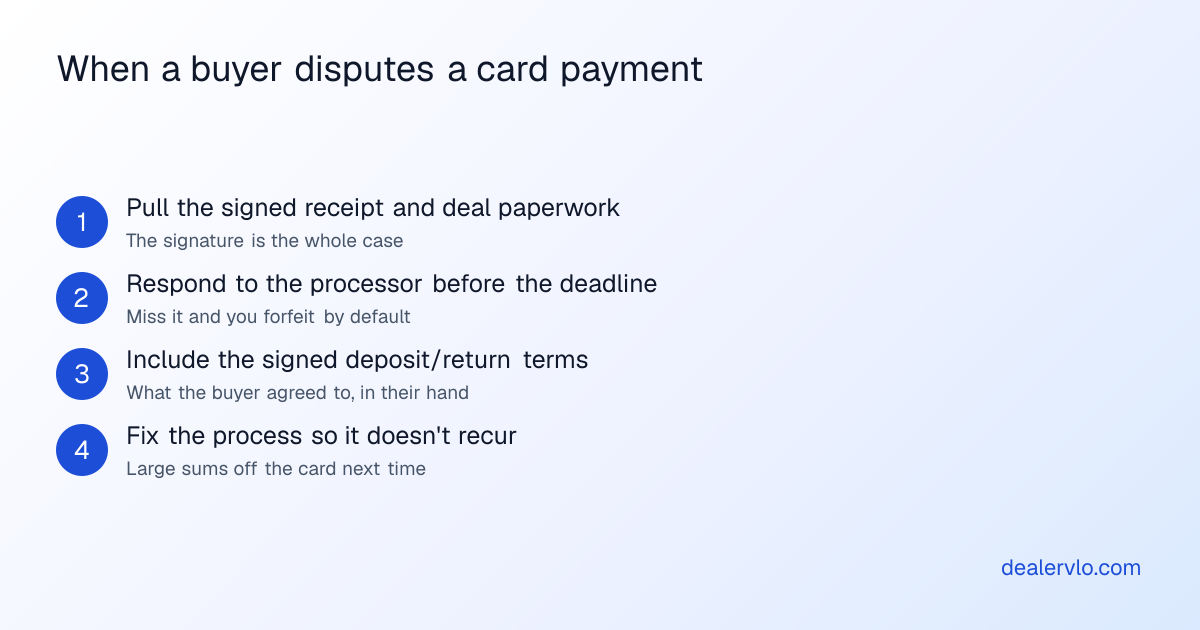
Pull the signed receipt and the deal paperwork, respond before the processor's deadline (miss it and you forfeit automatically), include the signed deposit and return terms so the buyer's own agreement is in front of the bank, and then fix your process so the next big down payment doesn't ride on a reversible card at all. A dispute you documented is winnable; one you didn't is just a loss with extra steps.
Writing a deposit & down-payment policy your staff can follow
None of this works if it lives only in your head. The lots that don't get burned have a one-page policy the whole team follows: the card threshold, which methods for which amounts, the standard hold agreement, and the rule that no car comes off the market without a signed deposit receipt. Write it once, and a green salesperson can't accidentally take a $5,000 card down payment on a shaky deal or hold a car on a handshake.
That's the same reason a standardized deal desk and consistent F&I process matter — the point of a policy is that it protects you even on the days you're not the one at the desk. Pair it with signed, dated documents and the money side of your deals stops being a source of surprises.
Frequently asked questions
How do used-car dealers take down payments?
A mix: cash and certified funds for larger amounts (no fee, no clawback), card for smaller/convenience (fast, but ~2.5–3.5% and reversible), and ACH for a low-flat-fee middle ground. Decide which method for which dollar amount in advance.
Can a dealer keep a deposit if the buyer backs out?
It depends on your written terms and what your state and card processor allow — there's no universal answer. Protect yourself by putting the terms in writing, stating refundability clearly, and getting a signature before you take the money.
How much do card fees cost a dealer on a down payment?
Roughly 2.5–3.5% depending on processor and card — about $50–$70 on a $2,000 down payment, more on larger sums. It's why many dealers cap card down payments and steer bigger amounts to cash, certified funds, or ACH.
How do dealers avoid chargebacks?
Take large sums by a method that can't be reversed (cash, certified funds, ACH), document card payments with a signed, specific receipt, keep return terms in writing and signed, and respond to any dispute before the deadline with that paperwork.
Should a dealer take a deposit to hold a car?
Yes — it filters serious buyers and protects you from ghosts. Just make the terms explicit up front (amount, how long, what happens either way), get a signature, and take it by a method that fits the amount.
Bottom line
How you take money down is a decision, not a default. Set a card threshold and steer big down payments to cash, certified funds, or ACH so you stop leaking F&I gross and stop carrying chargeback risk you don't need. Take deposits to hold cars — but only with written, signed terms that say exactly what happens whether the buyer proceeds or walks. And document everything, because a deposit dispute is won or lost on the paperwork, not the principle.
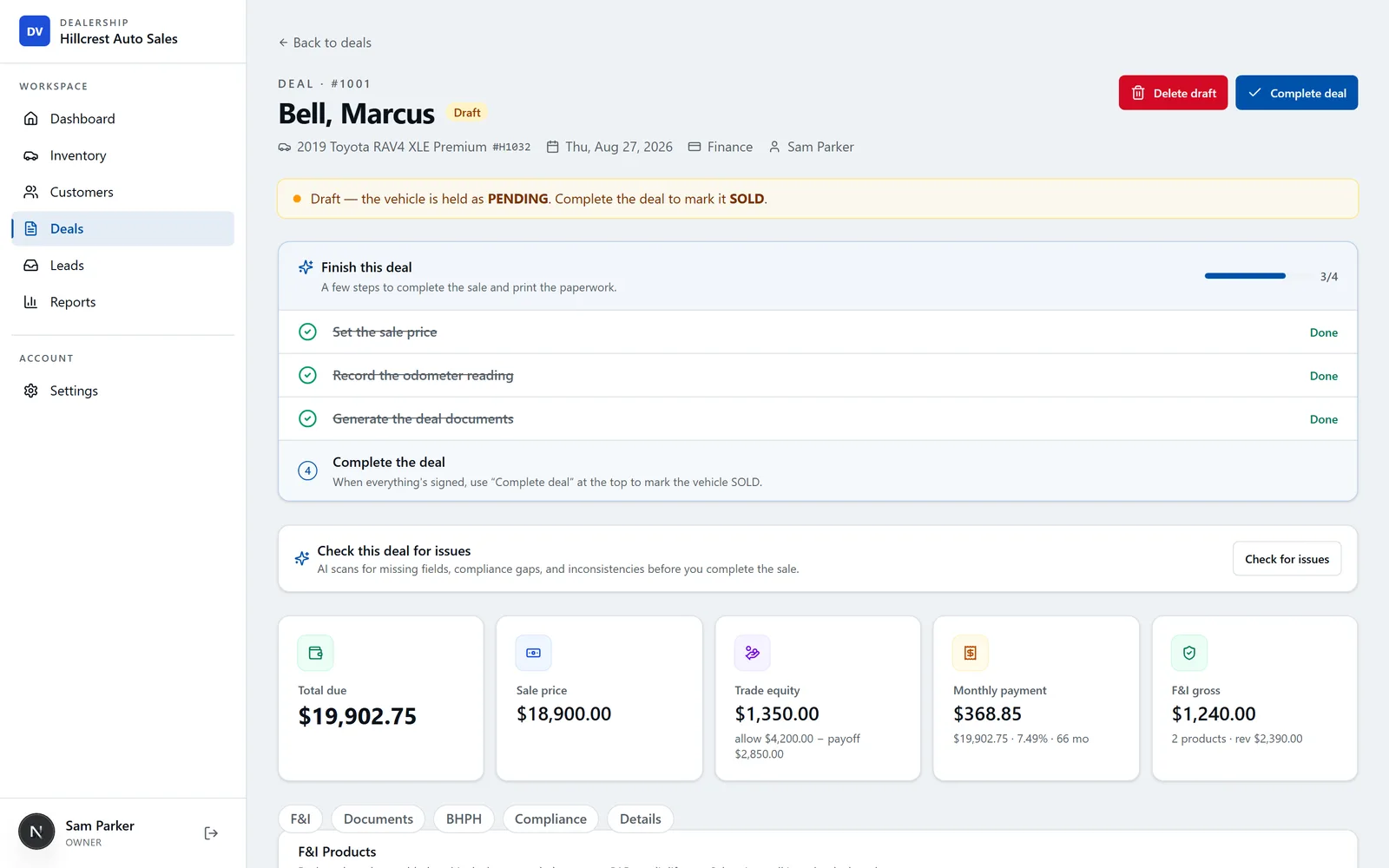
The through-line is that the money side of a deal should live on the deal, not on a sticky note. That's how DealerVLO handles it: the down payment is recorded on the deal jacket, it flows into the numbers and the paperwork, and the signed documents are stored and re-printable when someone asks two months later. One record per deal, money included — $29/month flat, 14-day free trial.
Structure an in-house note — payment, total interest, and what it collects per month — for any weekly, bi-weekly, or monthly term.
Open the BHPH Payment Calculator