F&I Products for Independent Used Car Dealers: Which to Offer & How to Present
F&I strategy for independent used-car dealers: which products fit your inventory, how to price without captives, Q1 2026 benchmarks, and reinsurance basics.
Part of the BHPH, financing & F&I guide: How to Run a Buy Here Pay Here Dealership: The Whole Loop, From Approval to Payoff
Switching from another DMS? Compare DealerVLO to DealerCenter, Frazer, or Lot Wizard.
Which F&I Products Fit Your Inventory
Finance and insurance products aren't just for franchise stores. If you're selling cars on payments—whether you hold paper or work with third-party lenders—you have a real opportunity to add margin and give buyers protection they actually need. The trick is matching the product to your inventory mix and presenting it without the captive-finance infrastructure the big dealers lean on.
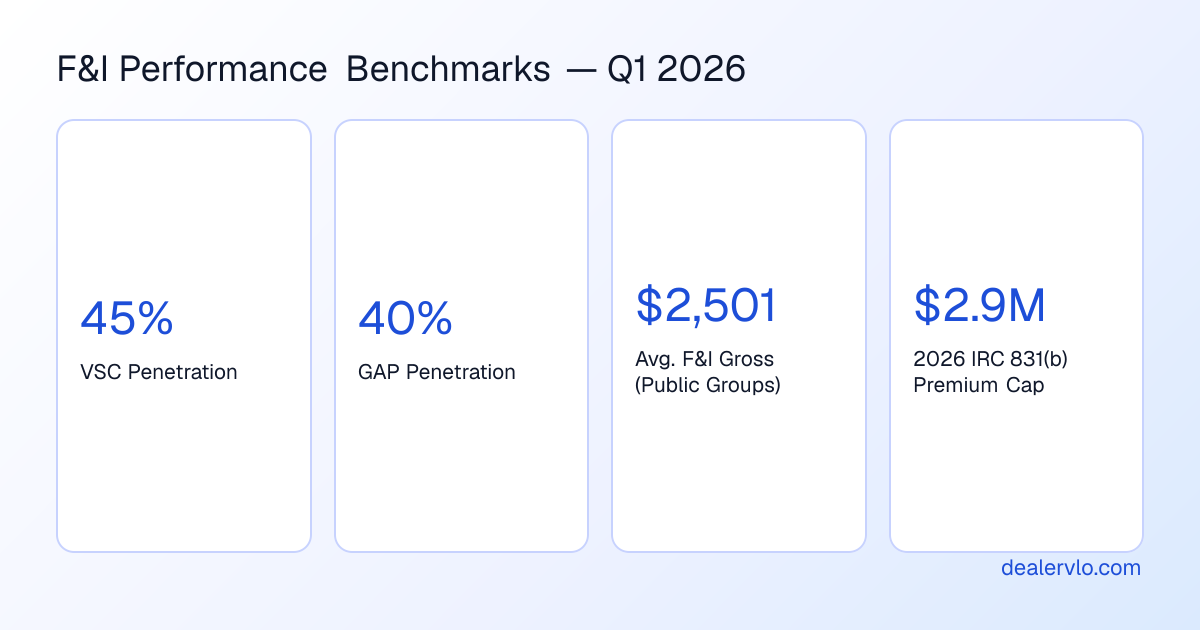
Independent dealers who get F&I right are hitting vehicle service contract penetration around 45% and GAP protection around 40% as of the first quarter of 2026. Meanwhile, publicly traded dealership groups are booking north of $2,500 per retail unit in F&I gross. You won't match franchise numbers unit-for-unit if you're running a smaller lot, but the per-deal margin is there when you sell the right products to the right customers.
This post covers product selection, not legal advice. F&I is regulated by your state's insurance department, the FTC, and often your attorney general. Confirm your state's disclosure, licensing, and cancellation rules before you offer any of these products, and document every transaction so a regulator can read it two years later.
14-day free trial, then $29/mo · Cancel anytime
Vehicle Service Contracts: The Core Product
A vehicle service contract covers specific repairs after any factory warranty expires. It's not insurance—the IRS classifies dealer-sold VSCs as insurance contracts when your captive provides the financial backing, but to the customer it works like an extended warranty. You're selling peace of mind on a powertrain or a list of covered components, and you're getting paid a commission or a spread between cost and retail.
VSCs make sense on nearly every piece of inventory you finance, but they're critical on higher-mileage units where the buyer is stretching to qualify. If you're selling vehicles with 60,000 to 120,000 miles, a service contract is the difference between a happy repeat customer and a phone call three weeks later about a transmission you didn't break.
Coverage used to top out around 150,000 miles, but some providers now write contracts up to 200,000 miles, which opens the door for you to sell older trucks and SUVs that still have useful life. Match the term and mileage to the vehicle—don't sell a seven-year contract on a fifteen-year-old Accord. A three-year, 36,000-mile bumper-to-bumper plan on a late-model crossover is clean; a powertrain-only plan on a high-mileage pickup is realistic.
What VSCs don't cover: routine maintenance, wear items like brake pads, and consequential damage—if the engine blows and takes out the radiator, the contract may only pay for the engine. Some used-car contracts exclude wear-and-tear failures altogether and only cover manufacturing defects, so read the administrator's contract language before you price it. The customer will read it after the claim gets denied, and that's when you hear about it.
When you're explaining a VSC, lead with what breaks on this vehicle. If it's a German SUV, talk about the electronics and the cooling system. If it's a domestic truck, talk about the transmission. Don't read the brochure—tell the story of the last similar unit that came back with a $1,800 repair. That's the sale.
GAP Protection: High Loan-to-Value, Long Terms
Guaranteed Asset Protection covers the gap between the insurance payout and the remaining loan balance if the vehicle is totaled or stolen. It's structured as a waiver or an addendum to the finance contract, not a standalone insurance policy, which is why it integrates cleanly into the deal.
GAP makes sense when the loan-to-value is above 100%—common when you're rolling negative equity, taxes, fees, or another F&I product into the amount financed—and when the term stretches past 48 months. If your buyer put 20% down and financed the rest over 36 months, they probably don't need it. If they put zero down, financed $18,000 on a $14,000 car, and took 72 months, they need it.
Used-vehicle GAP is more volatile than VSC because the depreciation curve is steeper and less predictable. A three-year-old sedan loses value differently than a ten-year-old truck, and the insurance adjuster's valuation can swing a few thousand dollars depending on local comps. Some administrators have tightened underwriting or raised the cost on older, higher-mileage inventory, so confirm your program's age and mileage limits before you quote it.
The product is optional—don't let anyone tell you the lender requires it. Present it as optional, show the math (loan balance minus trade value), and let the customer decide.
Tire & Wheel, Paintless Dent, Key Replacement
Ancillary products—tire and wheel protection, paintless dent repair, windshield coverage, key replacement—are lower-cost add-ons that appeal to a different buyer than VSC and GAP. They're easier to understand, they cover annoyances rather than catastrophes, and they carry almost no claims volatility, which makes them attractive for reinsurance if you go that route.
Tire and wheel covers repair or replacement when a pothole blows a sidewall or bends a rim. Most plans have no deductible, cover cosmetic damage, and run up to 72 months or unlimited miles. If you're in a market with rough roads or harsh winters, this product sells itself—especially on low-profile performance tires that cost $250 each to replace.
Paintless dent repair covers dings up to four inches in diameter that can be fixed without sanding, filler, or paint. The plan pays for a PDR tech to massage the panel from behind, which works on accessible body surfaces but not on creases, sharp dents, or areas where the paint is already chipped. A small door ding costs $75 to $150 to fix at a PDR shop; a plan that covers unlimited repairs for three years typically retails for $400 to $600. It's a budget-friendly product that keeps your cars looking clean.
Key replacement reimburses the customer when they lose a key or the fob dies. Dealer key replacement runs $300 to $1,500 depending on the vehicle, and many plans bundle roadside assistance, which gives you two benefits in one product. This one works well on anything with a proximity key or a transponder—basically everything built after 2010.
Windshield protection combines a chemical coating with a repair-or-replacement benefit. If a rock chips the glass, the plan pays to fill it; if the crack spreads, it pays to replace the windshield. Depending on your market, this can be a tough sell or an automatic yes—ask what your insurance agents see in claims frequency.
None of these products require underwriting or a credit pull, so you can quote them on cash deals, which is something VSC and GAP don't give you. If a buyer declines the service contract, offer tire and wheel or PDR as a fallback. You're still adding margin, and the customer is still getting value.
GPS Theft Recovery: A Niche That's Growing
Vehicle theft has climbed over the last few years, and GPS-based recovery systems have become a legitimate F&I product in 2026, especially in urban markets. The product works like this: you install a small GPS module on the vehicle before delivery, the customer pays a one-time fee or a monthly subscription, and if the car is stolen the recovery service tracks it and works with law enforcement to get it back.
Some providers advertise recovery rates above 99%, and the benefit is usually capped—if the vehicle isn't recovered within a set number of days, the customer receives a fixed payout, often a few thousand dollars. That cap keeps claims predictable, which is why theft recovery is a popular product for dealer reinsurance programs.
The product fits high-theft models—Chargers, Challengers, Silverados, Tahoes, Wranglers—and younger buyers who are financing near or above retail. It's harder to sell on a fifteen-year-old Camry in a small town. Lead with local theft statistics if you have them, and demonstrate the app so the customer sees real-time tracking. This is a product that benefits from a physical install and a working demo, not a brochure.
Punch in cost, recon, holding days, and sale price to see your true net gross and margin.
Open the Profit Margin CalculatorPricing and Presentation Without a Captive
Franchise dealers have captive finance companies that bundle product cost, dealer markup, and lender reserve into one payment quote. You don't. You're either holding the contract yourself or selling it to a third-party finance company, and in both cases you need to show the customer a clean menu, explain what's optional, and document the decision.
The FTC sent warning letters to 97 dealership groups in March 2026 about deceptive pricing practices, and while the Combating Auto Retail Scams rule was vacated by a federal appeals court in early 2025, the underlying consumer-protection statutes—and your state's unfair-practices law—are still in force. That means you can't misrepresent a product as required, you can't bury the cost, and you can't charge for something the customer didn't agree to buy.
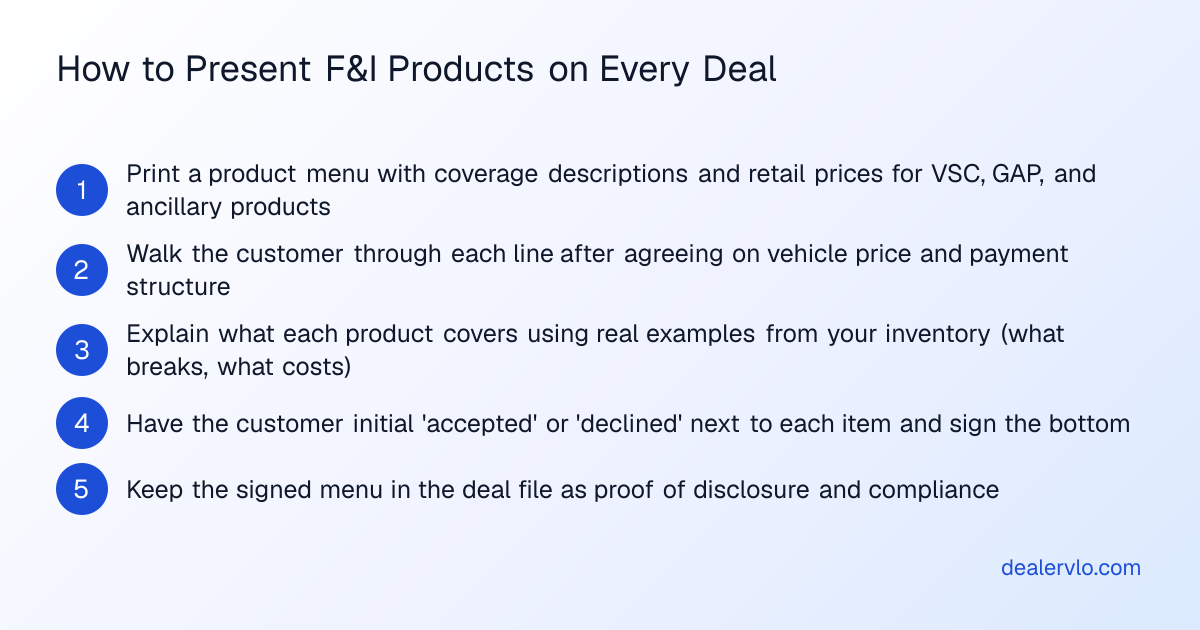
Use a printed menu with at least three columns: product name, coverage summary, and retail price. Walk through it line by line, explain what each product does, and mark "accepted" or "declined" next to each one. Have the customer initial each decision and sign the bottom. Keep that menu in the deal jacket forever, because if a regulator or a plaintiff's attorney comes asking, that signature is your proof of disclosure.
Don't rush the presentation. The dealers who get hit with chargebacks or complaints are the ones who flip the menu in fifteen seconds and assume the customer won't read it. Take the time to explain, answer questions, and let them say no. A declined product today is better than a cancelled contract and a chargeback next month.
If you're working with a third-party lender, find out whether they allow F&I products in the amount financed and whether they take a cut of the reserve. Some independent finance companies participate in product sales and split the backend; others don't care as long as the loan-to-value stays in their box. Ask before you structure the deal, because re-contracting after funding is a nightmare.
For dealers who track closely, a cloud-based DMS that integrates F&I product quoting and compliance documentation is worth the investment. You want every menu, every disclosure, and every cancellation request stored digitally so you can pull it during an audit. Paper gets lost; a timestamped PDF with an e-signature doesn't.
14-day free trial, then $29/mo · Cancel anytime
Penetration Benchmarks and Margin Targets
VSC penetration hit 45% and GAP hit 40% among financed retail units in the first quarter of 2026, according to industry data providers. Those numbers blend franchise and independent dealers, so your mileage will vary depending on inventory age, average loan-to-value, and how hard you present. A well-trained closer on a buy-here-pay-here lot can push 60% to 70% VSC penetration; a one-person shop that doesn't mention it until the customer asks will be closer to 15%.
If you're starting from zero, set a goal of 30% on VSC and 25% on GAP for the first ninety days, then adjust based on what's declining and why. Track declines by reason—price, didn't understand it, already has coverage elsewhere—and fix the objection that shows up most often. If half your declines are "too expensive," you're either selling the wrong coverage level or not building enough value before you quote the price.
Publicly traded dealership groups averaged better than $2,500 per vehicle in F&I gross profit in 2025, the highest level in five years. You won't hit that on every deal, but $800 to $1,200 per financed unit is realistic when you're selling VSC, GAP, and one or two ancillary products. Cash deals are harder—you're limited to products that don't require financing, and the customer is less motivated to protect a car they own outright—but tire and wheel, dent, and theft recovery all work on cash sales if you present them.
Track your F&I income separately from front-end gross. It's a different skill set, a different margin structure, and a different customer conversation. If you're not measuring it, you can't improve it, and you're leaving money every month that a disciplined competitor is keeping. Understanding your benchmarks across inventory turn, margin, and ancillary income is what separates a profitable dealership from one that's just moving metal.
Reinsurance Basics: Keeping More of the Profit
Reinsurance is a structure where you create a separate legal entity—a captive reinsurance company—that assumes a portion of the underwriting risk on the F&I products you sell. Instead of the product administrator keeping all the underwriting profit (premium collected minus claims paid), you participate in it. If claims are lower than expected, your reinsurance company earns the difference. If claims are higher, you pay.
The mechanic works like this: you sell a VSC for $1,800. The administrator takes a fee for administration, claims handling, and reserves, and cedes the rest of the premium—say $900—to your reinsurance company. At the end of the policy term, if the product didn't generate a claim, or if the claim was less than the premium, your reinsurance company keeps the profit. If the claim exceeded the premium, you cover the shortfall up to your policy limit.
For small independent dealers, the tax benefit is the real draw. Federal tax law allows certain small insurance companies to elect preferential treatment: premiums up to $2,900,000 in a calendar year are excluded from taxable income, and the reinsurance company pays the corporate tax rate of 21% only on net investment income. That's a significant advantage if your dealership is taxed as a pass-through entity and you're paying ordinary income rates on profit.
Reinsurance isn't for everyone. You need enough F&I volume to justify the setup cost—legal, accounting, state licensing, and administration—and you need the discipline to fund reserves and handle claims correctly. A dealer selling ten cars a month probably shouldn't set up a reinsurance company; a dealer moving fifty to eighty units a month with strong VSC and GAP penetration should at least run the numbers.
The products that work best in a reinsurance structure are the ones with predictable, low-frequency claims: tire and wheel, paintless dent, key replacement, and GPS theft recovery with a capped benefit. VSC and GAP can be reinsured, but the claims volatility is higher, so many administrators limit how much risk they'll cede to a dealer-owned captive. Ask your product providers what they allow and what the historical loss ratio looks like for your inventory profile before you commit.
If you go this route, work with a CPA and an attorney who specialize in captive insurance. The IRS and your state insurance regulator both have rules about capitalization, reserves, and related-party transactions, and if you structure it wrong you lose the tax benefit—or worse, you're on the hook for claims you can't pay. Done correctly, reinsurance is a powerful profit lever. Done poorly, it's an audit risk and a cash drain.
Compliance: FTC, State Regulators, and the Safeguards Rule
F&I is one of the most scrutinized parts of your operation. The FTC polices deceptive practices and unfair add-ons, your state insurance department regulates product licensing and rates, and your state attorney general enforces consumer-protection statutes. In 2026, enforcement is active—don't assume you're too small to get noticed.
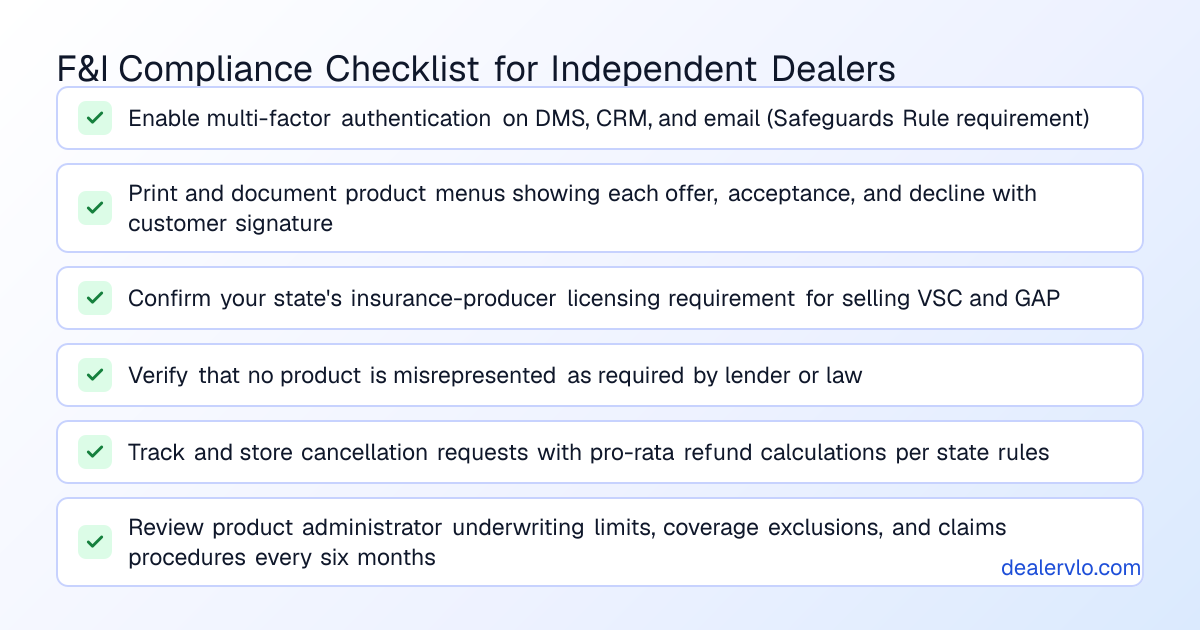
The FTC's Safeguards Rule, part of the Gramm-Leach-Bliley Act, requires dealers to implement a written information-security program that includes multi-factor authentication for any system that stores customer data. If you're still logging into your DMS, CRM, or email with just a username and password, you're out of compliance. Enable MFA on every platform that touches Social Security numbers, credit reports, driver's license images, or bank-account details. This is not optional, and the penalties for a data breach are substantial.
The industry generally recognizes twenty-one federal laws governing finance and insurance as of 2026, covering everything from truth-in-lending and equal credit opportunity to privacy and electronic signatures. You don't need to be a lawyer, but you do need a compliance checklist, and you need to train anyone who touches a deal file. Dealer paperwork software that includes compliance prompts and state-specific disclosures is a reasonable investment if you're doing volume, because a missed disclosure can unwind a contract or trigger a fine.
One emerging risk: income and employment misrepresentation. Industry fraud-detection providers estimate that income and employment misrepresentations account for roughly $4.4 billion in fraud exposure in 2026, and dealers who don't verify income documents are the ones holding the bag when the loan defaults and the lender discovers the fabricated pay stub. Use a verification service, pull tax returns on larger deals, and don't override your gut when the income looks too good for the job.
State insurance departments regulate F&I product rates, licensing, and cancellation procedures. Some states require the dealer or the F&I manager to hold an insurance producer license to sell VSCs; others don't. Some states mandate a pro-rata refund if the customer cancels within a certain window; others leave it to the contract. Confirm your state's rules with your insurance department or your product administrator before you start selling, and document the answer. If you operate in multiple states, the licensing requirements vary—what's legal in one state may not be in another.
Building F&I Into Your Margin Strategy
F&I isn't a bolt-on. It's part of how you make money on every financed deal, and it's one of the few profit centers that scales with volume without adding headcount. A dealership that sells fifteen cars a month and averages $1,000 per copy in F&I gross is generating $180,000 a year in high-margin income. That pays for software, marketing, and a salary.
Start by picking two core products—VSC and GAP are the default—and one ancillary that fits your market. Get trained on how to present them, build a clean menu, and track your penetration weekly. If you're below 30% after the first month, the problem is either product knowledge or process. Fix it before you add more products, because five products presented badly won't outperform two presented well.
Price your inventory with F&I margin in mind. If you're buying cars at auction and you know you can add $800 in backend profit, you can afford to be more aggressive on the front end. That faster turn compounds when you're measuring inventory turn rate and using the cash to buy again. The dealers who treat F&I as found money are the ones who under-invest in it; the dealers who build it into their pricing model are the ones who scale.
If you're a one-person operation, you're wearing the F&I hat whether you want to or not. If you're running a team, decide whether you present products yourself or whether you hand the customer to a dedicated closer. Both models work, but split responsibility—where the salesperson halfway presents and the manager finishes—creates confusion and kills penetration. Pick a lane and train to it.
Finally, review your product portfolio every six months. Administrators change coverage, raise rates, or tighten underwriting, and a product that worked great in 2025 might not pencil in mid-2026. If your VSC cancellation rate is climbing, find out why—maybe the claims process is broken, or maybe you're selling the wrong term. If GAP penetration is falling, check whether your loan-to-value mix has changed or whether a competitor is undercutting you. F&I is not set-and-forget.
Frequently asked questions
What F&I products should I offer on high-mileage used inventory?
Focus on vehicle service contracts and tire-and-wheel protection. A VSC covering powertrain or listed components is critical on anything above 80,000 miles, and many providers now write coverage up to 200,000 miles. Tire and wheel works well because older vehicles often have cosmetic wheel damage and worn suspension that makes road-hazard failures more common. GAP is less relevant on high-mileage inventory unless the loan-to-value is above 110%, because depreciation has already flattened. Avoid selling long-term contracts on very old vehicles—match the term to realistic ownership, usually three years or 36,000 miles.
How do I present F&I products without a finance captive or a dedicated F&I manager?
Use a printed product menu with three columns: product name, brief coverage description, and retail price. Walk the customer through it line by line after you've agreed on vehicle price and payment structure, explain what each product covers using a real example (what breaks on this type of vehicle), and have them initial "accepted" or "declined" next to each item. Don't rush—give them time to ask questions. If you're working with a third-party lender, confirm they allow products in the amount financed and find out if they participate in the backend. Keep the signed menu in the deal file as proof of disclosure. A one-person dealer can hit 30% to 40% VSC penetration with a clean process and consistent presentation.
What's the difference between VSC and GAP, and when does each one make sense?
A vehicle service contract covers the cost of specific repairs—powertrain, electrical, cooling, and other listed components—after any factory warranty expires. It makes sense on nearly every financed vehicle, especially anything with higher mileage or a history of expensive failures. GAP covers the difference between the insurance payout and the remaining loan balance if the vehicle is totaled or stolen. It makes sense when the customer puts little or nothing down, finances for 60 months or longer, or rolls negative equity into the loan. If the loan-to-value is below 100% and the term is 48 months or less, GAP is optional and harder to justify.
Can a small independent dealer set up a reinsurance company, and is it worth it?
Yes, but only if you have the volume and margin to justify the setup cost. You'll need legal and accounting help to create the captive entity, comply with your state's insurance-department licensing, fund the required reserves, and file the federal tax election. The tax benefit—being able to exclude up to $2,900,000 in annual premiums from taxable income and pay corporate rates only on investment income—is significant, but you need steady F&I sales and disciplined claims management to make it work. A dealer selling ten cars a month won't generate enough premium; a dealer moving fifty-plus units with strong VSC, tire-and-wheel, and theft-recovery penetration should run the analysis. Work with a CPA who specializes in captive insurance before you commit.
What are the current F&I penetration benchmarks for independent dealers?
VSC penetration was around 45% and GAP around 40% in the first quarter of 2026, blending franchise and independent dealers. Your actual penetration depends on inventory age, loan-to-value, term length, and how consistently you present. A dealer just starting F&I should target 30% VSC and 25% GAP in the first ninety days, then improve from there. Track declines by reason—price, didn't understand, already covered—and fix the most common objection. Well-run independents can hit 50% to 60% on VSC and 35% to 45% on GAP with training and a clean menu process.
What compliance rules do I need to follow when selling F&I products?
You're governed by the FTC, your state insurance department, and your state attorney general. The FTC prohibits misrepresenting any product as required or charging for something the customer didn't agree to buy. Your state insurance department regulates product licensing, rates, and cancellation refunds—some states require the dealer or the F&I presenter to hold a producer license. The Safeguards Rule requires you to protect customer data with multi-factor authentication and a written information-security program. Document every product presentation with a signed menu showing what was offered, what was accepted, and what was declined, and keep it in the deal file. If you're audited, that signature is your proof you disclosed correctly. Confirm your state's specific disclosure and licensing requirements with your insurance department or your product administrator before you start selling.
The bottom line
F&I products are one of the cleanest ways an independent dealer can add margin without increasing inventory cost or headcount. VSC and GAP are the foundation—if you're financing cars and you're not presenting those two on every deal, you're leaving a four-figure profit on the table. Tire and wheel, paintless dent, key replacement, and GPS theft recovery are the ancillary products that fit specific inventory types and buyer profiles, and they all contribute.
Penetration benchmarks in early 2026 show that VSC is landing on about 45% of financed deals and GAP on 40%, but those numbers only happen when you have a process, a printed menu, and a commitment to present every time. Track your declines, fix the common objections, and train yourself or your team to explain coverage in plain language using examples from your own lot.
Reinsurance is a real opportunity for higher-volume independents, but it's not a DIY project—work with professionals who understand captive structures, tax elections, and state insurance regulation. And no matter how many units you sell, compliance is not optional. The FTC, your state insurance department, and your attorney general are all watching F&I in 2026, so document everything, enable multi-factor authentication, and confirm your state's rules before you sell your first product.
Done right, F&I turns a $1,500 front-end deal into a $2,500 total gross, and it does it on every financed unit you deliver. That's the difference between paying your bills and actually making money.
14-day free trial, then $29/mo · Cancel anytime
Structure an in-house note — payment, total interest, and what it collects per month — for any weekly, bi-weekly, or monthly term.
Open the BHPH Payment Calculator