BHPH Underwriting & Approval Criteria: How to Structure Deals
A BHPH underwriting playbook: income verification, job stability, payment-to-income ratios, down payment guidelines, and structuring deals on ability to pay.
Part of the BHPH, financing & F&I guide: How to Run a Buy Here Pay Here Dealership: The Whole Loop, From Approval to Payoff
Switching from another DMS? Compare DealerVLO to DealerCenter, Frazer, or Lot Wizard.
The BHPH underwriting difference
Buy here pay here underwriting looks nothing like traditional auto lending. While captives and banks lean on three-digit credit scores, BHPH approvals are based primarily on verifiable income, employment stability, and demonstrated ability to make regular payments — not a three-digit number. Your job is to answer one question: can this customer realistically make the payment every week or every two weeks, and will they?
This guide walks through the approval process step by step — from what documents you need to see, to how you calculate a safe payment amount, to how you structure the deal so it works for both sides. Every BHPH dealer needs a documented underwriting policy, both for consistency and to prove fair lending compliance if regulators come calling. If you operate in Texas, Florida, California, or another state with specific BHPH licensing rules, note that you're held to the same federal standards as traditional lenders under the Truth in Lending Act and Equal Credit Opportunity Act — this isn't legal advice, so confirm your state's current requirements with your attorney and licensing authority.
14-day free trial, then $29/mo · Cancel anytime
Income verification: the foundation of every approval
Income verification is the single most important piece of BHPH underwriting. You need to confirm that the customer has regular, sufficient income to cover the payment plus their other obligations. Credit analysis goes beyond credit scores — you should review alternative data like utility payments and bank activity, but only after you've locked down the core income picture.
The gold standard is recent pay stubs, ideally covering at least one full pay period and showing year-to-date totals. If your customer is paid weekly, you want at least two or three consecutive stubs to confirm the pattern is stable. For self-employed or gig-economy customers, bank statements over the past two or three months work better — look for consistent deposits that match what they tell you they earn. Tax returns can back up the story but are usually too old to reflect current income; if someone changed jobs six months ago, last year's 1040 won't help you.
Applicants should prepare a government-issued photo ID and a valid driver's license, proof of income such as recent pay stubs or bank statements or benefit letters, and proof of address — typically a utility bill or lease matching the ID. Keep copies of everything. If a customer balks at providing documentation, that's a red flag; legitimate buyers with stable income have no reason to hide it.
For customers on Social Security, disability, or other fixed benefits, a benefit award letter or direct-deposit statement works. The key is that you can verify the amount and frequency. Seasonal or commission-based income requires extra scrutiny — average it over several months and be conservative in your estimate.
Modern dealer paperwork software can help you track what documents you've collected and flag incomplete files before you move to approval.
Employment and residence stability: are they staying put?
Stability matters. A customer who's been at the same job and the same address for two years is a different risk than someone who just started a new gig and moved in with a friend last month. You're not looking for perfect tenure — BHPH customers often have messy work histories — but you do need enough continuity to believe they'll still be reachable and employed in six months.
For employment, a common baseline is at least one month on the current job if they have solid previous job history. If it's a brand-new job with no prior track record, many dealers require around six months of tenure before approving the deal. The rationale is simple: new hires are on probation, and if they wash out in week three, your payment stream vanishes.
You should also ask about gaps. If someone worked at Company A for three years, was unemployed for four months, then started at Company B two months ago, you need the story. Were they laid off and actively searching, or did they quit without a plan? The answer shapes your risk assessment.
Residence works the same way. Someone who's lived at the same address for a year or more is easier to locate if payments stop. If they've been there less than six months, residency can still be acceptable depending on whether they lived in the area previously or moved to a more affordable place — just make sure you get solid proof of residency, especially if tenure is short. A lease agreement, utility bill in their name, or property tax statement all work. If they're staying with family, get a letter from the homeowner and verify the address.
For customers with thin employment or residence history, consider requiring co-signers or larger down payments to offset the added risk.
Payment-to-income ratio: the 10 to 20 percent rule
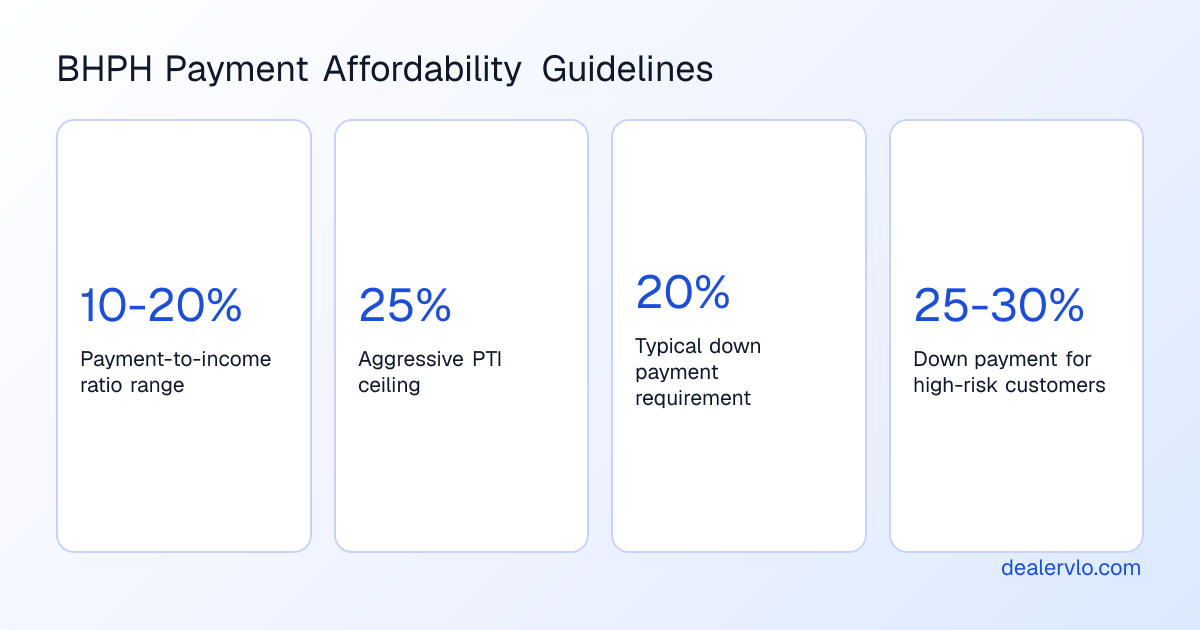
Once you've verified income and stability, you calculate how much payment the customer can afford. The most common guideline in BHPH underwriting is a payment-to-income (PTI) ratio of 10 to 20 percent of net income, depending on pay frequency, other obligations, and your dealership's credit policy.
Here's how it works in practice: if a customer brings home $2,800 per month paid biweekly, a target payment might be around $280 to $420 per month. That translates to roughly $140 to $210 per biweekly payment. If the customer has high rent, child support, or other fixed expenses, you stay closer to 10 percent; if obligations are light, you can push toward 20 percent.
Some dealers use a slightly higher cap — a benchmark from the lease-here-pay-here sector suggests most customers can typically afford a payment that is 25 percent of their net income — but that's aggressive and leaves little margin for error. Stick to the lower end unless you have hard evidence the customer's budget can handle it.
Always calculate PTI against net income (take-home after taxes and deductions), not gross. A customer who earns $4,000 gross but takes home $2,600 can't afford a $600 payment no matter how good the gross number looks.
If the initial vehicle choice pushes the payment above the guideline, you have three levers: suggest a similar car with a lower price, ask for a slightly higher down payment to bring the financed amount down, or extend the term if your policy allows it. The worst outcome is approving a deal the customer can't sustain — repos cost you time, money, and inventory condition.
Down payment guidelines: skin in the game
Down payments serve two purposes in BHPH underwriting: they reduce your loan-to-value exposure, and they signal the customer's commitment. A buyer who scrapes together $1,200 cash is less likely to walk away after three payments than someone who put down $200.
There is no standardized down payment requirement across all buy here pay here dealerships — each lot evaluates multiple factors to determine an appropriate amount. That said, you can generally expect a down payment requirement of around 20 percent or more of the vehicle's selling price. Many BHPH dealerships accept down payments in the range of 10 to 20 percent, and some may go as low as $500 to $1,000 for well-qualified customers with strong income and tenure.
Down payments require upfront payments to reduce default risk and encourage borrower commitment. If a customer has excellent job stability and verifiable income but limited savings, you might accept a smaller down payment paired with a shorter term or a lower-priced vehicle. Conversely, thin employment history or high PTI should trigger a higher down payment — sometimes 25 or 30 percent — to offset the added risk.
One real-world example: a North Carolina dealer requires 11 or more months on the customer's current full-time job with pay stub, and most down payments fall between $800 and $1,500 when that threshold is met along with other minimum requirements. That's a concrete data point you can benchmark against.
Cash, cashier's check, and verified money orders are standard. Personal checks are risky unless you hold the deal until they clear. Some dealers accept trade-ins as part of the down payment, but value them conservatively — use Kelley Blue Book or a similar tool and assume you'll need reconditioning dollars.
Track down payment amounts and vehicle values in your system so you can calculate loan-to-value ratios across your portfolio. High LTV deals (above 120 or 130 percent after fees) are the first to go underwater if the customer defaults early.
Structure an in-house note — payment, total interest, and what it collects per month — for any weekly, bi-weekly, or monthly term.
Open the BHPH Payment CalculatorDeal structuring: term, payment frequency, and amount
Once income, stability, and down payment are locked in, you structure the deal. BHPH financing is flexible by design — you customize loan terms according to the customer's financial situation, which means you can negotiate the duration of the loan and the payment amount that fits their budget.
Most BHPH customers make weekly or biweekly payments directly to the dealership. Weekly payments are easier for customers paid weekly, and they give you faster feedback if someone starts to struggle. Biweekly aligns with most salaried jobs. Monthly payments are less common in BHPH because they reduce touchpoints and make it easier for a customer to fall 30 or 60 days behind before you notice.
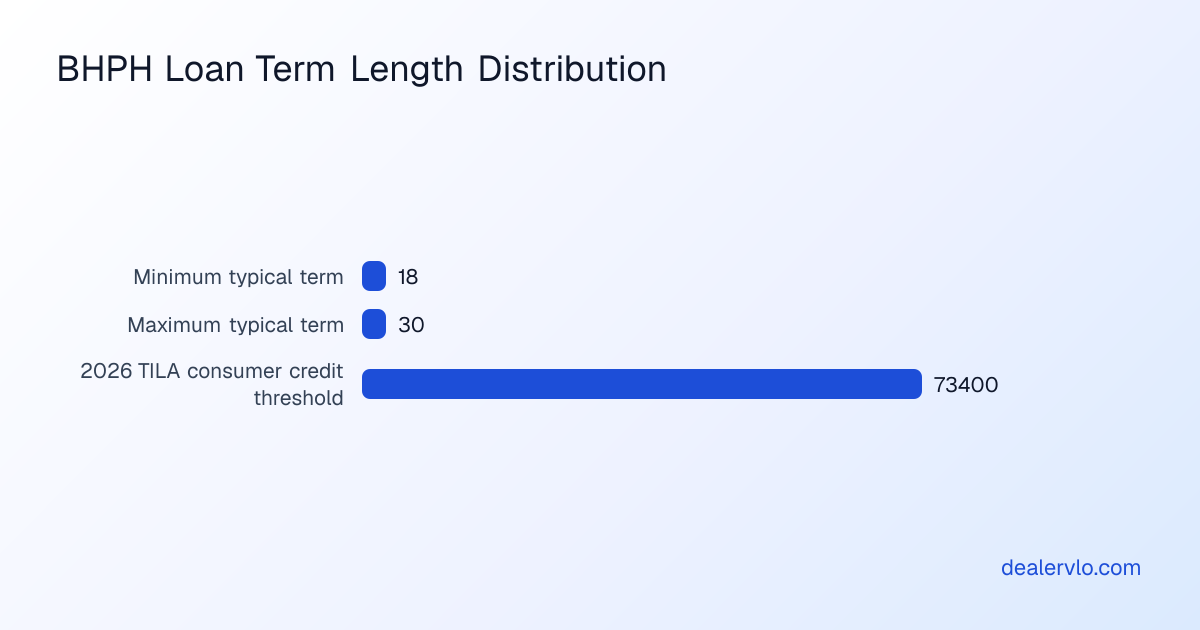
Term length varies. Many BHPH dealers keep terms between 18 and 30 months; longer terms reduce the payment but increase your risk exposure and the chance the vehicle needs expensive repairs while you still hold the note. Shorter terms mean higher payments but faster payoff and lower total risk.
When you quote a deal, show the customer the total cost, the payment amount, the payment frequency, and the number of payments. Transparency here is not optional — the Truth in Lending Act and Regulation Z require you to present clear, accurate APR and finance charge details in ads and contracts. Effective January 1, 2026, the consumer credit threshold under Regulation Z for transactions not secured by real estate increased to $73,400, up from $71,900 in 2025, so the vast majority of BHPH deals fall under full TILA disclosure requirements.
If a customer asks for a longer term to lower the payment, run the numbers and make sure the vehicle will last. The same income can qualify for different vehicles depending on price, mileage, and expected maintenance — a vehicle with lower mileage and a stronger service history may support slightly tighter payment terms because it reduces the risk of unexpected costs and complaints.
BHPH dealer software can automate payment schedules, calculate APR, generate TILA disclosures, and track which deals are inside or outside your PTI policy, saving hours every week and reducing compliance errors.
14-day free trial, then $29/mo · Cancel anytime
Collateral evaluation and vehicle match
Your underwriting isn't complete until you match the customer to the right vehicle. Assess vehicle value using tools like Kelley Blue Book and calculate loan-to-value (LTV) ratios for every deal. A customer approved for a $6,000 loan should be steered toward inventory you can confidently value at $6,000 or more retail, so your LTV stays at or below 100 percent before fees.
Underwriters look for the best fit that matches the customer's budget while aiming for a reliable ownership experience. For example, a high-mileage vehicle with a patchy service history might need $800 in deferred maintenance in month four — if that coincides with a tight month for the customer, you just created a repo risk. Better to put them in a slightly newer, lower-mileage unit with documented oil changes and fresh tires, even if it means a smaller margin on the front end.
Vehicle age and mileage also affect term. You generally don't want a 24-month note on a 15-year-old car with 180,000 miles unless you've done a bumper-to-bumper inspection and you're confident it'll hold together. Align the term with the vehicle's realistic service life.
Keep detailed records of the inspection, any reconditioning work, and the valuation sources you used. If you ever face a dispute or a regulatory audit, documentation of how you valued collateral and matched it to the customer's income protects you.
Credit policy documentation and compliance
Every BHPH dealer needs a written credit policy. It should define income verification standards, employment and residence minimums, PTI ratio caps, acceptable down payment ranges, collateral evaluation procedures, deal structure guidelines, and pricing logic. A documented credit policy protects your decisions and supports consistent, fair outcomes — and it's your first line of defense if a regulator or plaintiff's attorney questions whether you applied the same standards to every customer.
Federal and state oversight bodies like the CFPB and FTC have made it clear that in-house lenders are held to the same rigorous standards as traditional banks, particularly regarding Fair Lending and the Truth in Lending Act. Buy-here-pay-here dealers who regularly extend credit directly to consumers fall under direct CFPB authority, which means compliance with CFPB regulations is mandatory and carries the same enforcement risk as any other consumer finance company.
The regulatory landscape shifted significantly on July 21, 2026, when the CFPB's amendments to Regulation B went into effect. These changes narrowed the prohibition on "discouragement" and eliminated the "effects test" as a theory of liability under the Equal Credit Opportunity Act — but you still must use consistent credit criteria, document reasons for adverse action, and issue adverse action notices on time. Train your staff to avoid steering or discriminatory pricing across protected classes.
Under the Fair Credit Reporting Act, you need permissible purpose for credit pulls, accurate reporting to bureaus, dispute handling with timely investigation, and risk-based pricing or credit score disclosure notices as applicable.
State licensing adds another layer. In Texas, if a dealership sells vehicles and accepts the price over time, the dealership must hold a Chapter 348 license — the requirement applies regardless of whether you place liens, charge interest, or label the agreement as a retail installment contract. Texas dealers involved with any type of installment sales transactions must be licensed with the Office of Consumer Credit Commissioner.
In Florida, verify that your dealership holds the necessary licenses and permits, including the Motor Vehicle Retail Installment Seller License issued by the Office of Financial Regulation, as required by Florida Statute 520.02.
In California, a BHPH dealer is defined as a dealership that sells or leases vehicles and assigns less than 90 percent of such contracts to finance or leasing companies within 45 days of execution. A BHPH automobile dealer cannot do business in California unless licensed by the Department of Financial Protection and Innovation under the California Finance Lenders Law, and a dealer must obtain that license no later than six months after meeting the BHPH definition.
In New York, BHPH dealers must comply with state usury laws limiting interest rates, and charging interest requires clear disclosure in the sales contract.
Most states require a motor vehicle dealer license to sell cars and a consumer lending license to finance them. The dealer license process typically mandates a background check, a permanent business location, and a surety bond to protect consumers against fraud. The lending license requires proof of minimum net worth and compliance with state usury laws capping interest rates.
You must comply with local underwriting guidelines to ensure your contracts are legally binding and enforceable — failure to comply can result in significant legal and financial consequences for your business. Work with an attorney who understands BHPH and your state's rules, and update your credit policy whenever regulations change.
Putting it all together: the underwriting checklist
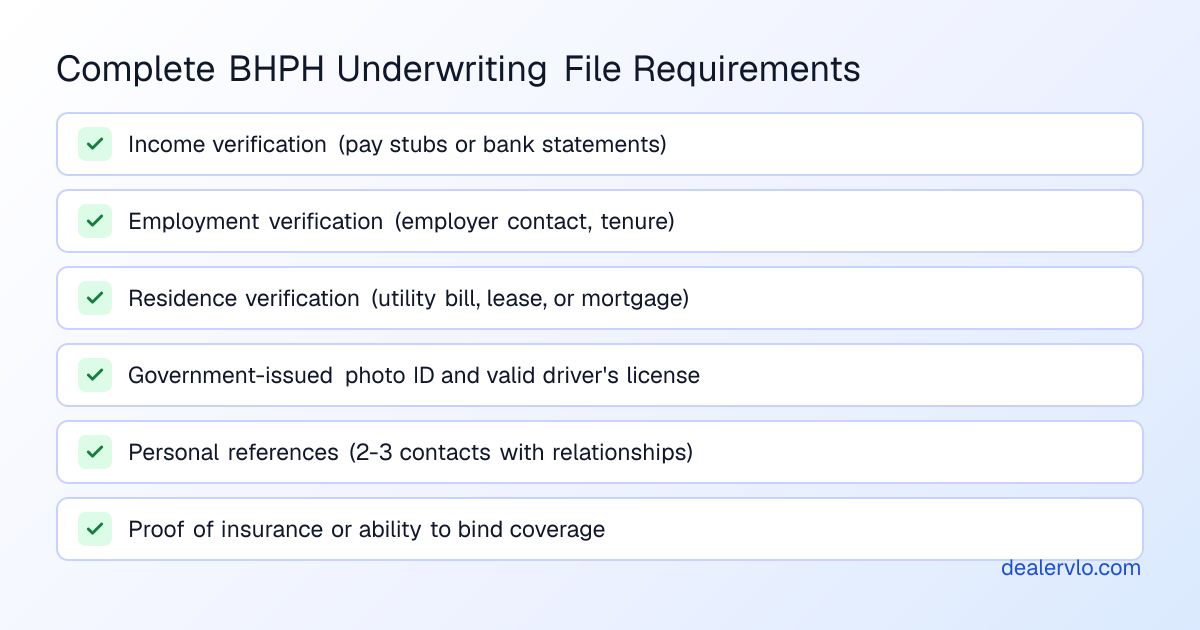
Here's what a complete BHPH underwriting file looks like before you approve a deal:
- Income verification: Recent pay stubs (or bank statements for self-employed), covering at least one full pay period, showing year-to-date totals. For benefit recipients, award letters or deposit statements.
- Employment verification: Name, address, and phone number of employer; length of time on the job; supervisor or HR contact. Call to confirm if the customer's tenure is short or the job seems unusual.
- Residence verification: Utility bill, lease, or mortgage statement matching the ID. Length of time at current address. If less than six months, ask for previous address and reason for the move.
- Identification: Government-issued photo ID and valid driver's license. Verify the name, address, and expiration date.
- Personal references: At least two or three references with names, phone numbers, and relationships (family, friend, coworker). You'll need them if the customer ghosts you after three payments.
- Insurance: Proof of current coverage or the ability to bind coverage before delivery. Full coverage is standard; some states allow you to require it as a loan condition.
- Down payment verification: Cash, cashier's check, or money order in hand. If accepting a trade-in, valuation documentation and title/lien release.
- Credit report: Even though you don't underwrite primarily on score, pull the report to check for open judgments, recent repossessions, active bankruptcies, and other red flags. Make sure you have permissible purpose and issue adverse action notices if required.
- Payment calculation worksheet: Documented PTI ratio, payment amount, payment frequency, term, total financed amount, APR, finance charge, and total of payments. Keep this in the file.
- Vehicle documentation: Inspection notes, valuation source (KBB, NADA, etc.), mileage, VIN, title status, and any reconditioning performed. Calculate and document LTV.
Underwriting is the review process that confirms the customer's ability to make payments, the right structure for those payments, and the risk profile for the dealership. Each store has its own credit policy, but the common areas are income verification, employment and residence stability, payment-to-income ratio, and vehicle match.
Used car dealer software built for BHPH can centralize this checklist, flag missing documents, and enforce your credit policy automatically, so approvals stay consistent even when you're busy or training new staff.
Bottom line
BHPH underwriting is about verifiable income, demonstrated stability, and a realistic payment structure — not a credit score. Collect the right documents, calculate PTI conservatively, require enough down payment to align incentives, match the customer to a vehicle that will last the term, and document every decision in writing. Stay on top of federal TILA and ECOA requirements and your state's licensing and usury rules, and update your credit policy as regulations evolve. Done right, underwriting protects your portfolio, keeps you compliant, and gives your customers deals they can actually complete.
Frequently asked questions
What is the most important factor in BHPH underwriting?
Verifiable income is the foundation of every BHPH approval. You need recent pay stubs, bank statements, or benefit letters that confirm the customer has regular, sufficient income to cover the payment plus their other obligations. Employment and residence stability matter, but if you can't document income, you can't structure a safe deal.
What payment-to-income ratio should I use for BHPH deals?
A typical range is 10 to 20 percent of net (take-home) income, depending on pay frequency, other obligations, and your dealership's credit policy. If a customer takes home $2,800 per month, target a monthly payment between roughly $280 and $420. Stay closer to 10 percent if the customer has high fixed expenses; you can approach 20 percent if their budget is clean, but don't exceed it without strong justification.
How much down payment should I require on a BHPH deal?
There is no universal standard, but most BHPH dealers require 10 to 20 percent of the vehicle's selling price, and many aim for 20 percent or more. Down payments reduce loan-to-value risk and signal buyer commitment. For customers with thin job history or higher payment-to-income ratios, consider requiring 25 to 30 percent down to offset the added risk. Some dealers accept as little as $500 to $1,000 for well-qualified buyers with strong income and tenure.
What documents do I need to collect before approving a BHPH customer?
You need government-issued photo ID and a valid driver's license, proof of income such as recent pay stubs or bank statements, proof of address like a utility bill or lease, employment verification (employer name, phone, length of tenure), personal references, proof of insurance or ability to bind coverage, and down payment verification (cash, cashier's check, or trade-in with title). Pull a credit report to check for judgments, bankruptcies, or recent repos, and document your payment calculation, PTI ratio, and vehicle valuation.
Do BHPH dealers need special licenses to offer in-house financing?
Yes, in most states. Texas requires a Chapter 348 license if you sell vehicles and accept payment over time. Florida requires a Motor Vehicle Retail Installment Seller License from the Office of Financial Regulation. California requires a Finance Lenders Law license if you meet the BHPH definition (assigning less than 90 percent of contracts within 45 days). Licensing requirements vary by state and typically include dealer and consumer lending licenses, surety bonds, background checks, and proof of minimum net worth. Confirm your state's current rules with your attorney and licensing authority.
How do BHPH compliance requirements compare to traditional lenders?
Buy-here-pay-here dealers who regularly extend credit fall under direct CFPB authority and are held to the same standards as traditional lenders under the Truth in Lending Act, Equal Credit Opportunity Act, and Fair Credit Reporting Act. You must provide clear TILA disclosures (APR, finance charge, payment schedule), use consistent credit criteria, issue adverse action notices, avoid discriminatory pricing, and comply with credit reporting and dispute procedures. Federal regulations apply regardless of state, and many states layer on additional usury caps, licensing, and disclosure rules.
14-day free trial, then $29/mo · Cancel anytime