How to Calculate a BHPH Payoff (Early Payoff, Trade, and Deficiency After a Repo)
A BHPH payoff isn't the remaining payments added up; it's the current balance plus per-diem interest. How to quote it right, and the deficiency after a repo.
Part of the BHPH, financing & F&I guide: How to Run a Buy Here Pay Here Dealership: The Whole Loop, From Approval to Payoff
Switching from another DMS? Compare DealerVLO to DealerCenter, Frazer, or Lot Wizard.
A buy-here-pay-here customer asks for a payoff at the worst possible time — they're refinancing, trading the car, it got totaled, or they're behind and trying to get straight. Whatever the reason, they want a number today, and the number you give them has to be right. Quote it too high and you've overcharged a customer and maybe stepped on a compliance rule; quote it too low and you eat the difference. And the most common way dealers get it wrong is the simplest to fix.
The payoff on an in-house note is not the sum of the remaining payments. It's the current balance plus the interest that's accrued since the last payment. This post walks through why, how to compute it, how to keep the quote honest with a good-through date, and how the same balance drives the deficiency math if the car comes back.
14-day free trial, then $29/mo · Cancel anytime
The payoff isn't the remaining payments
Add up the remaining payments and you're including a lot of future interest the customer hasn't been charged yet. On a normal simple-interest note, paying off early means they skip that future interest — so the real payoff is less than the remaining payments. Quote the remaining payments and you're overcharging them for interest they'll never owe.
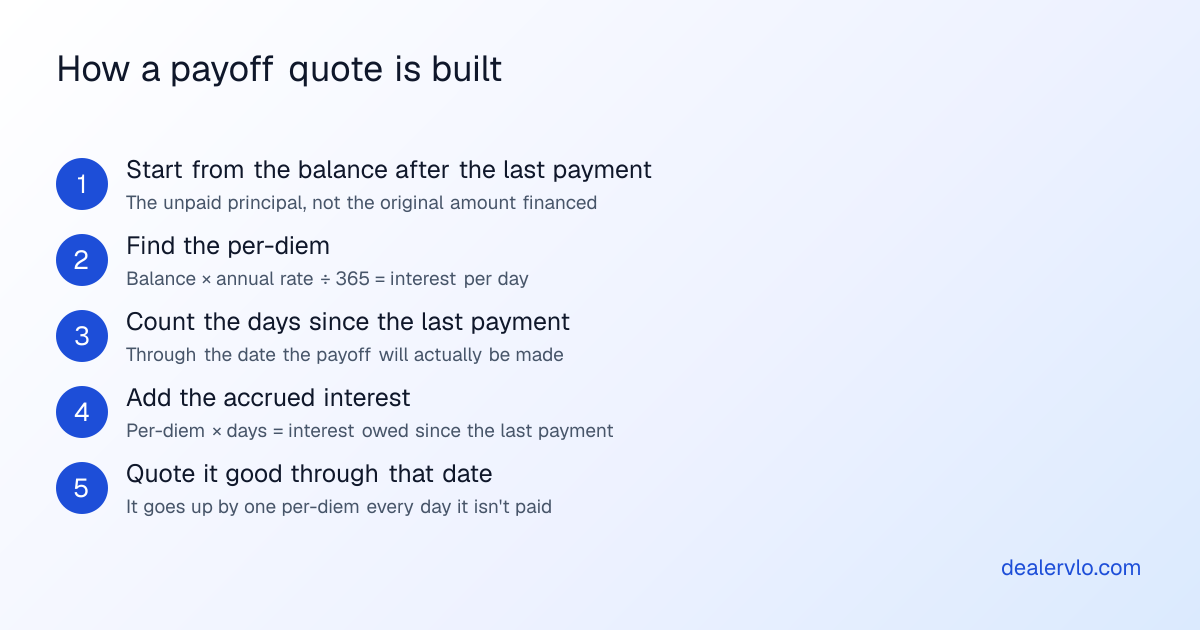
The correct payoff is the unpaid principal balance — the balance right after the last payment posted — plus the interest that's accrued on that balance since. That's a number you can defend to the customer, to a lender refinancing them, and to a regulator. If you're structuring these notes in the first place, the BHPH payment calculator shows the amortization the balance comes from.
The per-diem is the whole trick
The piece dealers miss is the per-diem — the interest the note earns each day. It's the current balance times the annual rate, divided by 365. On a $6,000 balance at 18%, that's about $2.96 a day.
So the payoff is: the balance after the last payment, plus the per-diem times the number of days since that payment, through the day the money will actually change hands.
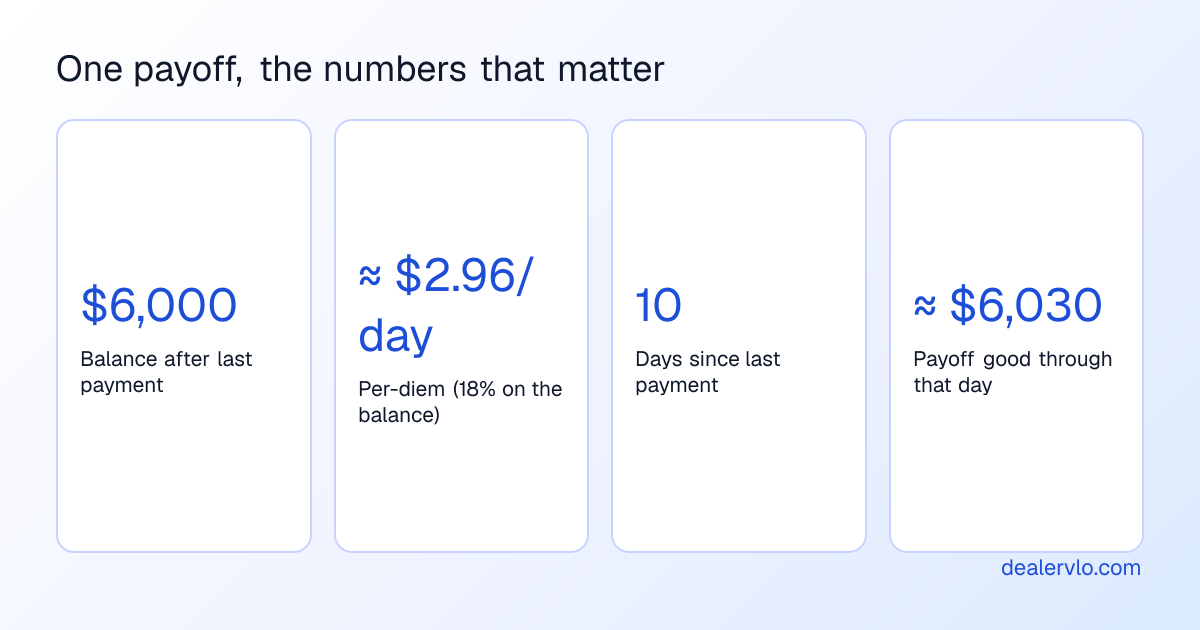
That per-diem is exactly why a payoff has to be quoted good through a specific date. A payoff you give on Monday is wrong by Thursday — it's short by three days of per-diem. Put the date on the quote, and if they don't pay by then, requote. It's a small thing that saves an argument at the counter.
Quote a payoff on an in-house note — current balance plus per-diem interest, good through a date.
Open the BHPH Payoff CalculatorKeep the quote honest — and dated
A clean payoff quote says four things: the balance it's based on, the per-diem, the date it's good through, and the total. Hand a customer that and there's nothing to dispute. Skip the date and you're either eating per-diem or chasing the customer for a few more dollars — neither is worth it.
One caution on rate and method: some states and some contracts use different interest methods (a few older notes are pre-computed rather than simple-interest, which changes the early-payoff math), and every state has its own rules on what you can charge. The mechanic above is the standard simple-interest case; if your paper is pre-computed, the payoff follows the rebate method in the contract, not a per-diem. Know which one your notes are.
14-day free trial, then $29/mo · Cancel anytime
When the car comes back: the deficiency
The same balance drives the number after a repossession. If a note defaults and you repossess and resell the car, the customer may still owe a deficiency — what's left after the sale. The math starts from the payoff balance at the time of repo:
- Payoff balance at repo (balance + accrued per-diem)
- plus your allowed repossession and resale costs
- minus the net the vehicle brought at resale (or its fair value)
- = the deficiency
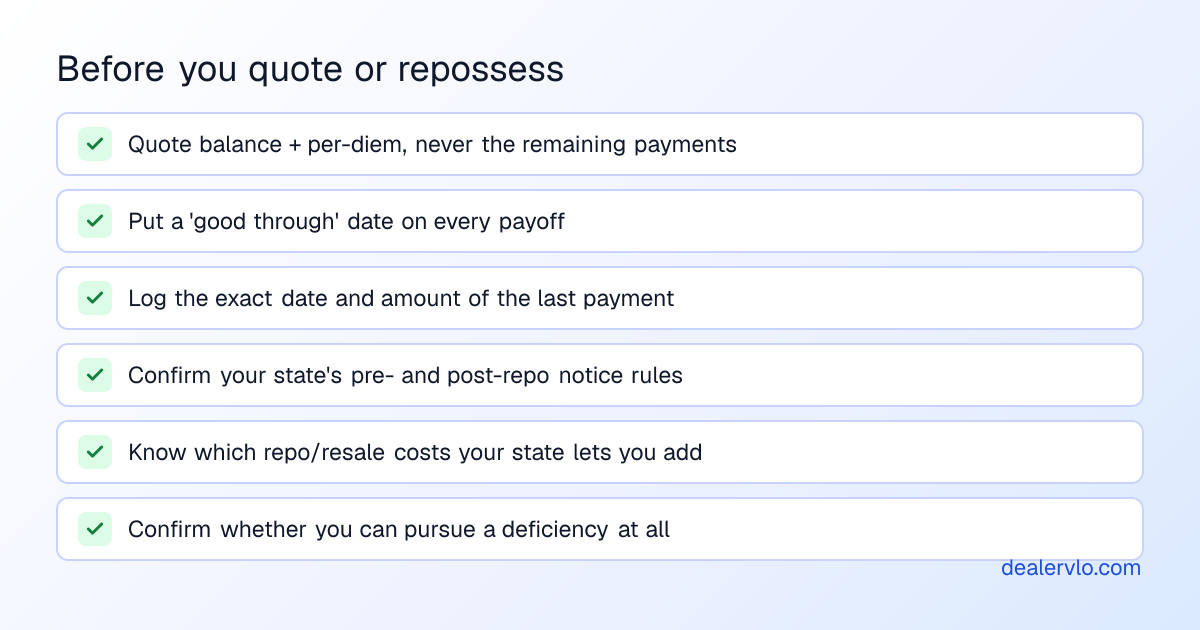
Whether you can actually collect that deficiency — and which costs you're allowed to add, and what notices you have to send before and after the sale — is entirely a matter of state law, and it varies a lot. Repossessions are running high across the subprime market right now, so this is live for a lot of note-holding lots; do not send a deficiency demand without confirming your state's rules first. The front-end side of avoiding these — sizing the deal so it holds — is in our BHPH tax-season down-payment and underwriting pieces.
Frequently asked questions
How do you calculate a BHPH payoff? Current unpaid principal balance (after the last payment) plus the per-diem times the days since that payment — not the sum of the remaining payments. Quote it good through a specific date.
Why not just add up the remaining payments? Those include future interest the customer hasn't been charged. On a simple-interest note, an early payoff skips that interest, so the real payoff is less — quoting the remaining payments overcharges them.
What's a per-diem? The interest the note earns per day: balance × annual rate ÷ 365. On $6,000 at 18% it's about $2.96/day. It's what you add per day between the last payment and payoff.
How do you figure the deficiency after a repo? Payoff balance at repo, plus allowed repo/resale costs, minus the net from the resale. State law governs the costs, the notices, and whether you can pursue it.
Bottom line
A payoff is the balance plus accrued per-diem, good through a date — never the remaining payments. Get that right and every payoff, trade, and refi goes clean; the same balance carries into the deficiency math if the car comes back. The only thing a calculator can't do is know your state's repo and deficiency rules — confirm those before you act.
DealerVLO keeps the running ledger on every in-house note, so the current balance and per-diem are already there when a customer asks — a payoff is a click, not a recalculation. Start a 14-day free trial and stop quoting payoffs by hand.
14-day free trial, then $29/mo · Cancel anytime