Best Aftermarket Warranty Companies for Used Car Dealers (and How to Choose)
How to choose a vehicle service contract administrator for your lot: claims reputation, insurer backing, mileage limits, and providers for independent dealers.
Part of the BHPH, financing & F&I guide: How to Run a Buy Here Pay Here Dealership: The Whole Loop, From Approval to Payoff
Switching from another DMS? Compare DealerVLO to DealerCenter, Frazer, or Lot Wizard.
Ask ten independent dealers which aftermarket warranty company to use and you'll get ten answers, half of them wrong for your lot. The problem isn't a shortage of options—there are dozens of administrators selling vehicle service contracts to used-car dealers. The problem is that most of the advice is either a kickback-driven recommendation or a brochure comparison that never touches the only thing that matters: does the company pay claims without a fight, and will it even cover the cars you actually sell?
I've sold service contracts on my own lot, and I've had the phone call every dealer dreads—a customer three weeks out with a failure, holding a contract, waiting to see whether the administrator makes it right or makes it miserable. That call is where you learn what you actually bought. This post is the framework I use to judge an administrator, the providers that genuinely serve independents, and how to present the product once you've picked one. It's product-selection guidance, not legal or insurance advice—confirm licensing and disclosure rules with your state insurance department before you sell.
14-day free trial, then $29/mo · Cancel anytime
Why the company matters more than the coverage
Every administrator's brochure looks the same: powertrain, "bumper-to-bumper," a menu of tiers, a list of covered components. Coverage comparisons feel productive, but they're mostly noise, because the contract is only worth as much as the company obligated to honor it.
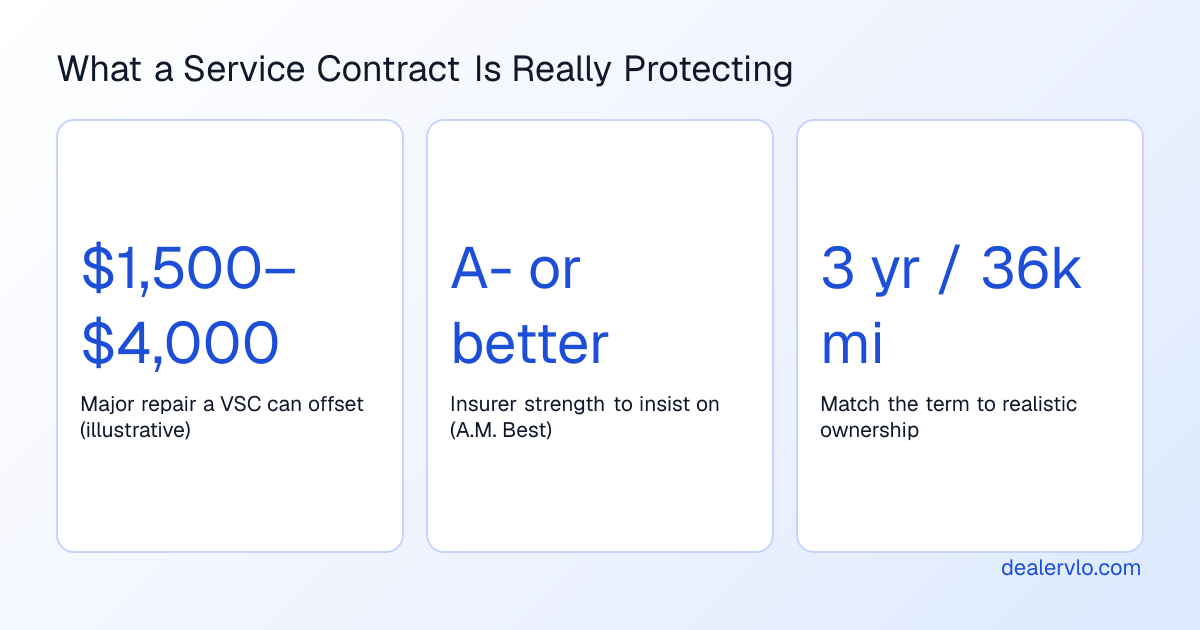
A vehicle service contract is a promise to pay for a future repair. Two things decide whether that promise holds: the claims-paying behavior of the administrator, and the financial strength of the insurer standing behind the paper. A generous-looking contract from a company that denies claims on technicalities is worth less than a plain powertrain contract from a company that pays. And if the administrator itself goes under, the only thing protecting your customer—and your reputation—is the insurance company backing the contract, which is why you insist on an A.M. Best-rated obligor with a contractual liability policy.
Get those two right and the rest is tuning. Get them wrong and it doesn't matter how good the coverage chart looked—you sold your customer a piece of paper that fails them at the worst possible moment, and they remember exactly who sold it.
How to vet a VSC administrator
Here's the checklist I'd run before signing with anyone. The order is deliberate: the first two are non-negotiable, and the rest are how you match a decent administrator to your specific lot.
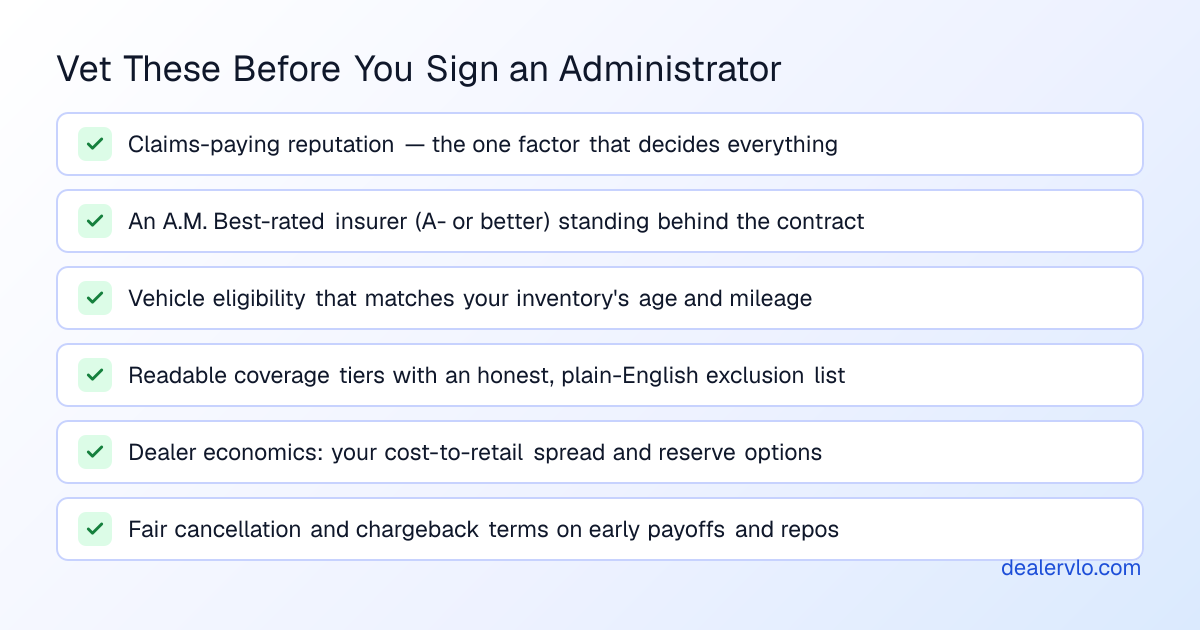
Claims-paying reputation. This is the whole game. Ask the administrator directly what their approval process looks like and what the most common denial reasons are—a straight answer tells you a lot. Then call the claims line yourself, the way a shop or a customer would, and time it. Best of all, ask other independent dealers in your market who they use and who they've fired. Dealers talk, and a company with a claims problem has a reputation problem you can find in an afternoon.
Insurer backing and financial strength. Find out which insurance company is the obligor on the contract and whether it carries an A.M. Best rating of A- or better. Confirm there's a contractual liability insurance policy (a CLIP) so claims are covered even if the administrator fails. This is the difference between a service contract and a promise you're personally exposed to.
Vehicle eligibility. Independents sell older, higher-mileage cars than franchise stores, and not every administrator will write them. Before anything else, confirm they'll cover your typical unit—age, mileage, and any excluded makes. A great program that caps at 100,000 miles is useless if your average sale is a 110,000-mile trade.
Coverage tiers and contract clarity. You want a clean ladder from powertrain up to an exclusionary "bumper-to-bumper" tier, and you want the exclusion list in plain English. Read the actual contract, not the sales sheet. If the exclusions are vague or buried, that's usually where claims get denied later. This ties directly to how you present F&I products—a contract you can explain in one sentence sells better and generates fewer angry calls.
Dealer economics. Understand your cost from the administrator versus the retail price you'll charge, and whether they offer a reserve or reinsurance option if you have the volume for it. Ask how and when you get paid, and what the admin fees are. A slightly higher cost from a company that pays claims cleanly is cheaper than a fat margin from one that generates chargebacks and complaints.
Cancellation and chargeback terms. This one bites buy-here-pay-here dealers hardest. When a customer pays off early or you repo the car, the unearned portion of the contract gets refunded, and part of that can come back out of your pocket as a chargeback. Understand whether refunds are pro-rata, how chargebacks are calculated, and how much of your compensation is exposed. On a lot with frequent early payoffs, this affects the deal structure more than the sticker price does.
Structure an in-house note — payment, total interest, and what it collects per month — for any weekly, bi-weekly, or monthly term.
Open the BHPH Payment CalculatorThe administrators independent dealers actually use
These are providers that actively serve the independent used-car market. I'm describing what each is generally known for—not ranking them, because the right one depends entirely on your inventory and state. Programs, mileage caps, licensed states, the insurer behind the paper, and dealer compensation all change constantly, so treat this as a starting list and confirm the current terms directly with each company.
GWC Warranty. One of the most visible names in the independent space. GWC built its business marketing straight to used-car dealers, and it's known for writing the older, higher-mileage inventory a lot of independents actually sell, plus dealer-side sales support. It's part of a larger F&I group, so the backing is substantial.
Preferred Warranties (PWI). A long-running, independent-focused administrator out of Pennsylvania. PWI is known for handling its own claims in-house rather than farming them out, and for a large network of approved repair facilities. Dealers who want a real person on the claims line tend to gravitate to it.
AUL Corp. AUL leans into coverage other administrators shy away from—higher-mileage and older vehicles—which makes it a common pick for lots selling budget and BHPH inventory. It administers its own contracts and markets itself as dealer-friendly on eligibility.
ASC Warranty. One of the older names serving independents and buy-here-pay-here dealers. ASC is known for flexibility on older, higher-mileage units and for programs aimed at smaller lots rather than franchise stores.
Royal Administration Services. A New England–based administrator that sells through dealers and agents and backs its contracts with a rated insurer. Being in Massachusetts, I pay attention to the regional players—worth a quote if you want a closer relationship than a national call center.
Protective Asset Protection. The example of scale and financial strength. Protective is a large, well-capitalized provider that writes both franchise and independent business. If insurer backing is your top priority, it belongs in your set of quotes.
That's not the whole market—there are strong regional administrators and agents everywhere—but it's a representative slate of companies that will talk to a small independent lot. The point isn't to pick from this list by name recognition; it's to run two or three of them through the vetting checklist above and see which one fits your cars.
14-day free trial, then $29/mo · Cancel anytime
How to choose the one that fits your lot
The decision comes down to matching an administrator to what you actually sell and how you sell it.
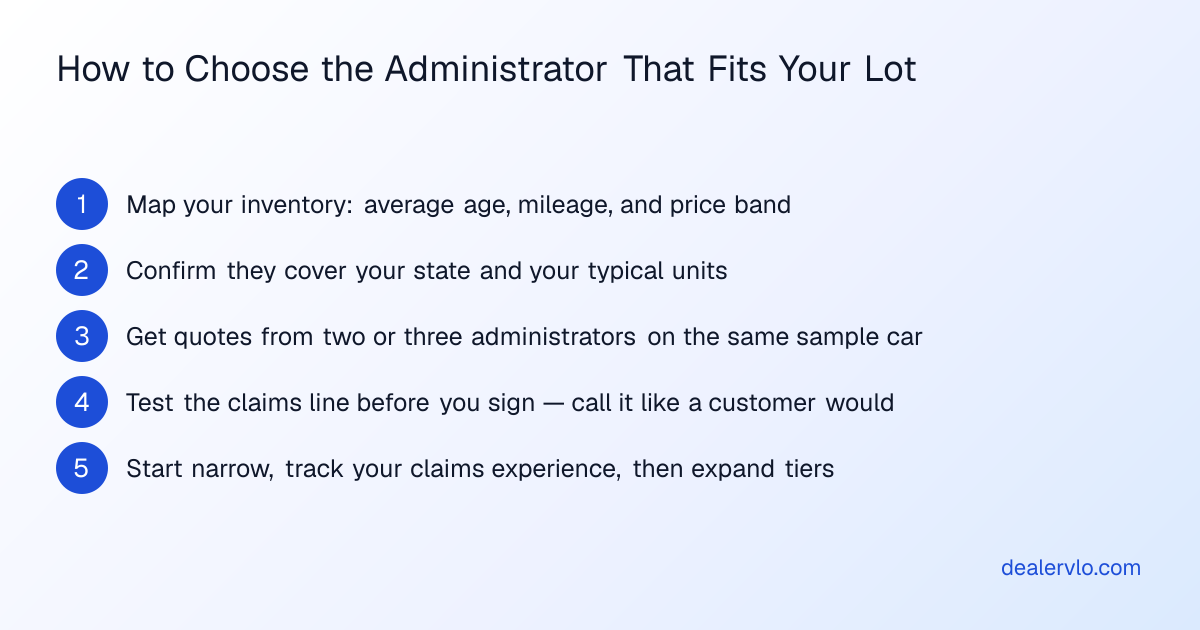
Start by mapping your inventory honestly: your average vehicle age, typical mileage, and price band. A lot moving $6,000 high-mileage cars needs a very different administrator than one retailing $18,000 late-model units. Then confirm each candidate covers your state and your typical vehicles—eligibility is the first disqualifier.
From there, get quotes from two or three administrators on the same sample car, so you're comparing cost, tiers, and terms on equal footing rather than against marketing. Before you commit, test the claims experience: call the line, ask a shop that's dealt with them, or find a dealer who uses them. Then start narrow—one or two tiers on the inventory where a service contract makes the most sense—track your claims experience for a few months, and expand once you trust how they pay. Your first choice doesn't have to be permanent; switching administrators is common, and the ones that earn your book earn it by paying claims.
If you retail late-model, lower-mileage inventory, dealer economics and clean coverage tiers may drive the pick. If you hold your own paper, eligibility on high-mileage cars and fair cancellation terms matter more, because the contract is protecting your collateral and your note, not just the customer.
Presenting it once you've picked one
Choosing the administrator is half the job; the other half is presenting the product so customers actually buy it and never feel tricked. Put it on a printed menu alongside your other products, walk the customer through what it covers using a real example from your inventory ("on a car with this mileage, a transmission is $3,000-plus—this covers it"), and have them initial accepted or declined. Keep the signed menu in the deal file.
The mechanics of a clean, compliant presentation are the same across every F&I product—I covered the full menu process in the F&I products guide, and the desk conversation itself is part of closing the in-person sale. The short version: agree on the car and the payment first, present products second, disclose the price, never call it required, and document the decision. A service contract from a company that pays claims practically sells itself when you present it honestly—because you're not selling a warranty, you're selling the customer a working car six months from now.
Frequently asked questions
What's the best aftermarket warranty company for a used car dealer? There isn't one universal best—it depends on your inventory, state, volume, and whether you retail or hold paper. The providers that serve independents heavily include GWC Warranty, Preferred Warranties, AUL Corp, ASC Warranty, Royal Administration, and Protective. Judge them on claims reputation, insurer strength, eligibility, coverage clarity, economics, and cancellation terms—then quote two or three and pick the fit.
How do I know if a warranty company will actually pay claims? Vet the claims process before signing. Ask about their approval process and common denial reasons, call the claims line yourself, ask other dealers who they use and who they dropped, read the exclusions in the real contract, and confirm an A.M. Best-rated insurer with a contractual liability policy backs it.
What mileage will aftermarket warranty companies cover? It varies by administrator and tier. Some cap around 100,000–125,000 miles; providers that specialize in independent and BHPH inventory will write considerably higher. If you sell budget or high-mileage cars, confirm eligibility first, and match the term to realistic ownership rather than the maximum offered.
Should a buy-here-pay-here dealer offer a service contract? Often yes—on a BHPH deal a broken car is a broken note. A contract keeps your collateral running so the payment stream survives. Pick an administrator that writes older, higher-mileage units and handles cancellations fairly on repos and payoffs, and never present it as required by the financing.
How does a dealer make money on a service contract? The spread between your cost and the disclosed retail price, and—at real volume—participation in underwriting profit through a reserve or reinsurance arrangement. Either way, disclose the product and price, get a signed accept/decline, and don't misrepresent it as required.
The bottom line
The best aftermarket warranty company isn't the one with the biggest ad or the fattest margin—it's the one that covers the cars you sell and pays claims without making your customer feel cheated. Run any administrator through the same six checks, quote two or three on the same car, test how they handle a claim, and let the ones that pay earn your book. A service contract that performs turns a nervous buyer into a repeat customer; one that doesn't turns into a review you can't undo.
Where DealerVLO fits: when you sell a car with a service contract, the coverage, term, and price live on the deal jacket alongside the payment math and the rest of your F&I menu, so the numbers on the contract match the numbers on the bill of sale and nothing gets re-keyed. If you're tired of running deals and paperwork out of disconnected tools, see how the deal jacket works—it's built by a dealer who takes these same phone calls.
14-day free trial, then $29/mo · Cancel anytime