How to Run a Buy Here Pay Here Dealership: The Whole Loop, From Approval to Payoff
How a buy here pay here lot really works: the capital it ties up, underwriting, deal structure, collections, payoffs, selling notes, and the compliance basics.
Learning how to run a buy here pay here dealership starts with one uncomfortable fact: you are no longer just a car dealer. You're the bank. On a cash or bank-financed deal the money lands at delivery and you move on. On a buy here pay here deal, the gross is on paper the day the car leaves, and the cash shows up one payment at a time over the next year or more. Whether the lot makes money is decided after the sale, not at it.
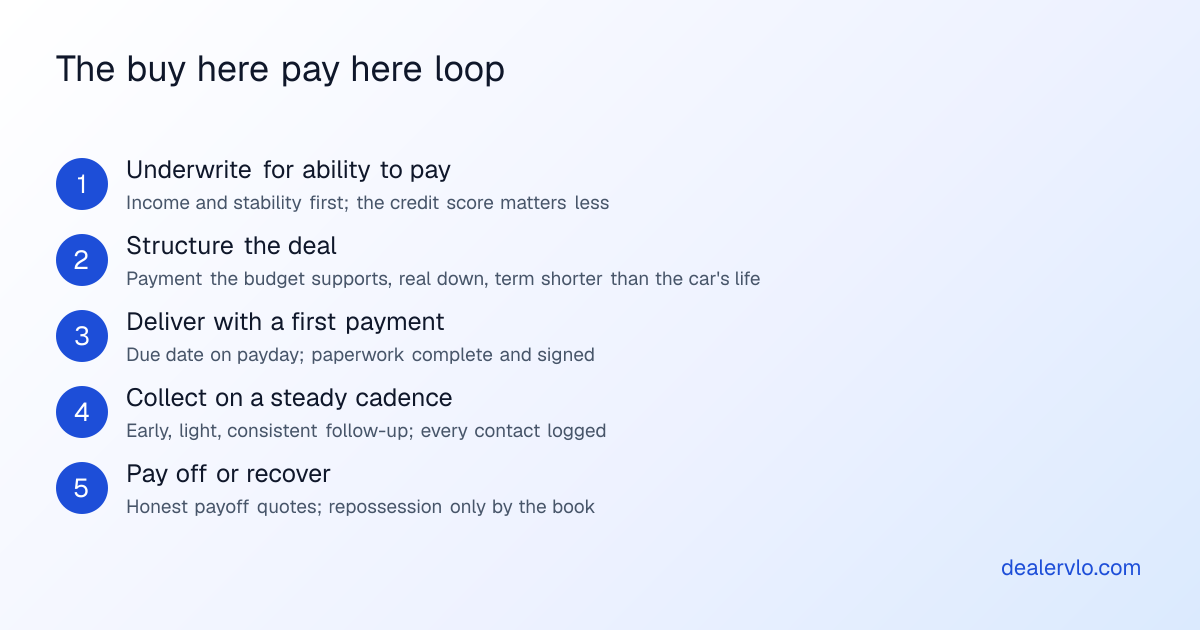
This is the whole loop in one place: what carrying your own paper does to your cash, how to approve and structure a deal, how to keep accounts current, what happens at payoff and repossession, when selling notes makes sense, and the compliance basics. Each step links to a deeper guide when you need the detail. One note up front: this isn't legal advice. Rate limits, required disclosures, and repossession rules vary by state — have a local attorney review your contracts and notices before you write your first note.
What changes when you carry the paper
Three things change the day you start financing in-house.
Your cash flow inverts. A retail lot turns a car into cash in weeks. A buy here pay here lot turns a car into a stream of payments, so every unit you finance keeps its cost tied up until the payments pay it back. Sell more, and you can end up with less cash on hand, not more — the faster you grow, the more money sits in customers' driveways.
Collections becomes the core job. The deal isn't done at delivery; it's done at the last payment. The dealers who make BHPH work are the ones who are boring and consistent about follow-up, month after month.
The risk is real. A May 2026 Federal Reserve analysis of buy-here-pay-here lending found BHPH borrowers fall behind and have cars repossessed far more often than borrowers at traditional lenders. That isn't a reason not to do it — it's the reason every step below exists.
Before you start: the capital question
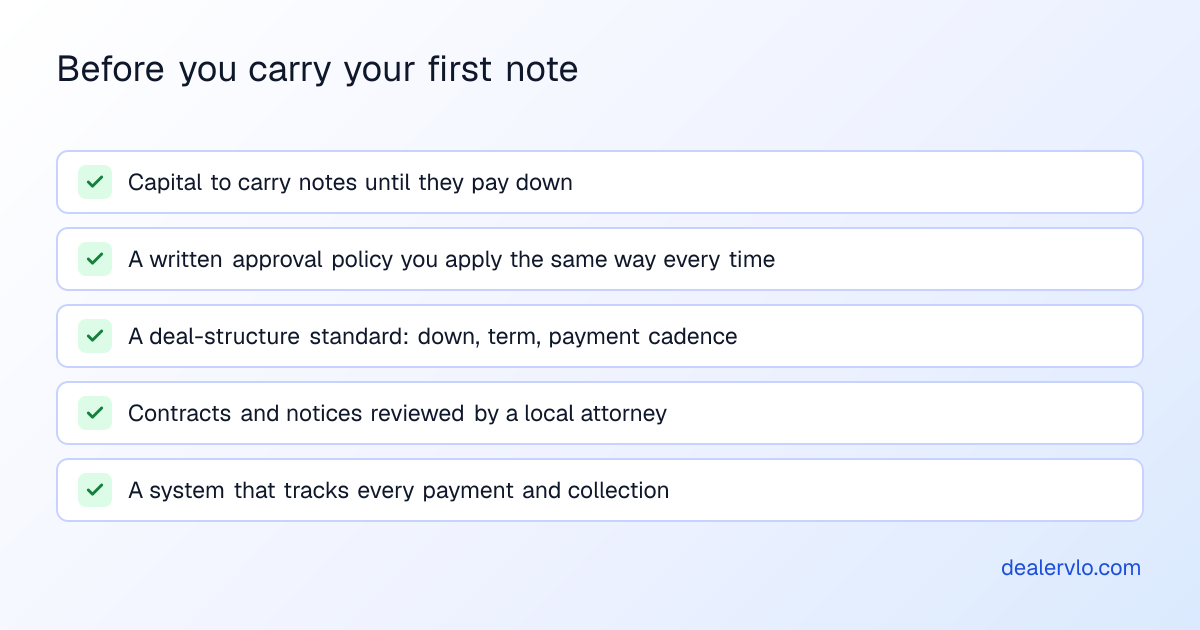
Buy here pay here takes more money than a retail lot of the same size, because you're funding the car and the loan. There's no honest single number for "enough," so model yours: take your expected cost per car, subtract a realistic down payment, and multiply by the number of notes you'll carry before the early ones start paying down. That's roughly the cash you'll have out in the street at once, on top of the inventory still on the lot.
If you floor plan your inventory, remember the floor plan wants its money when the car sells — but on a BHPH deal, "sold" doesn't mean "paid." Plan that gap before you're in it.
Step 1: Underwrite for ability to pay
Buy here pay here customers usually have thin or damaged credit — that's why they're on your lot — so the score tells you less than it would at a bank. What predicts whether a note pays is income, stability, and a payment that fits the budget: how long they've held the job, how long they've lived at the address, and what share of their income the payment eats. Write your approval rules down and apply them the same way to everyone; consistency protects you from bad notes and from fair-lending trouble.
The full playbook — verifying income, payment-to-income ratios, stability signals, and a written credit policy — is in BHPH underwriting and approval criteria.
Getting the application in early helps too. An online credit application lets a buyer start before they walk in, so you know what you can approve before you're standing at the car. DealerVLO can put an optional credit application on your dealer website: it collects the applicant, employment, income and housing details, deliberately leaves the Social Security number off the online form, and keeps applications encrypted and visible only to owners, admins and finance managers. DealerVLO doesn't pull credit or make the decision — that stays with you.
Step 2: Structure the deal so it can pay
Most "collections problems" are structure problems that showed up later. Build the deal from the payment backward:
- Start from the payment the budget supports, then find the car that fits — not the other way around. Working a deal backward from the monthly payment shows the method step by step.
- Take a real down payment. It recovers part of your cost immediately and gives the buyer something to lose. Tax season is when most BHPH buyers have cash; size the tax-season down payment to recover cost, not just to grab the biggest number.
- Keep the term shorter than the car's useful life. A note that outlives the car is a note that stops getting paid.
- Line the due date up with payday. The Federal Reserve note above flags that frequent schedules like weekly and biweekly create more opportunities to miss a payment — so pick the cadence that matches how the customer actually gets paid, not just the one that feels safest.
- Collect a first payment at delivery, and take deposits and down payments in a way that doesn't cost you in fees or chargebacks — see how to take deposits and down payments.
Structure an in-house note — payment, total interest, and what it collects per month — for any weekly, bi-weekly, or monthly term.
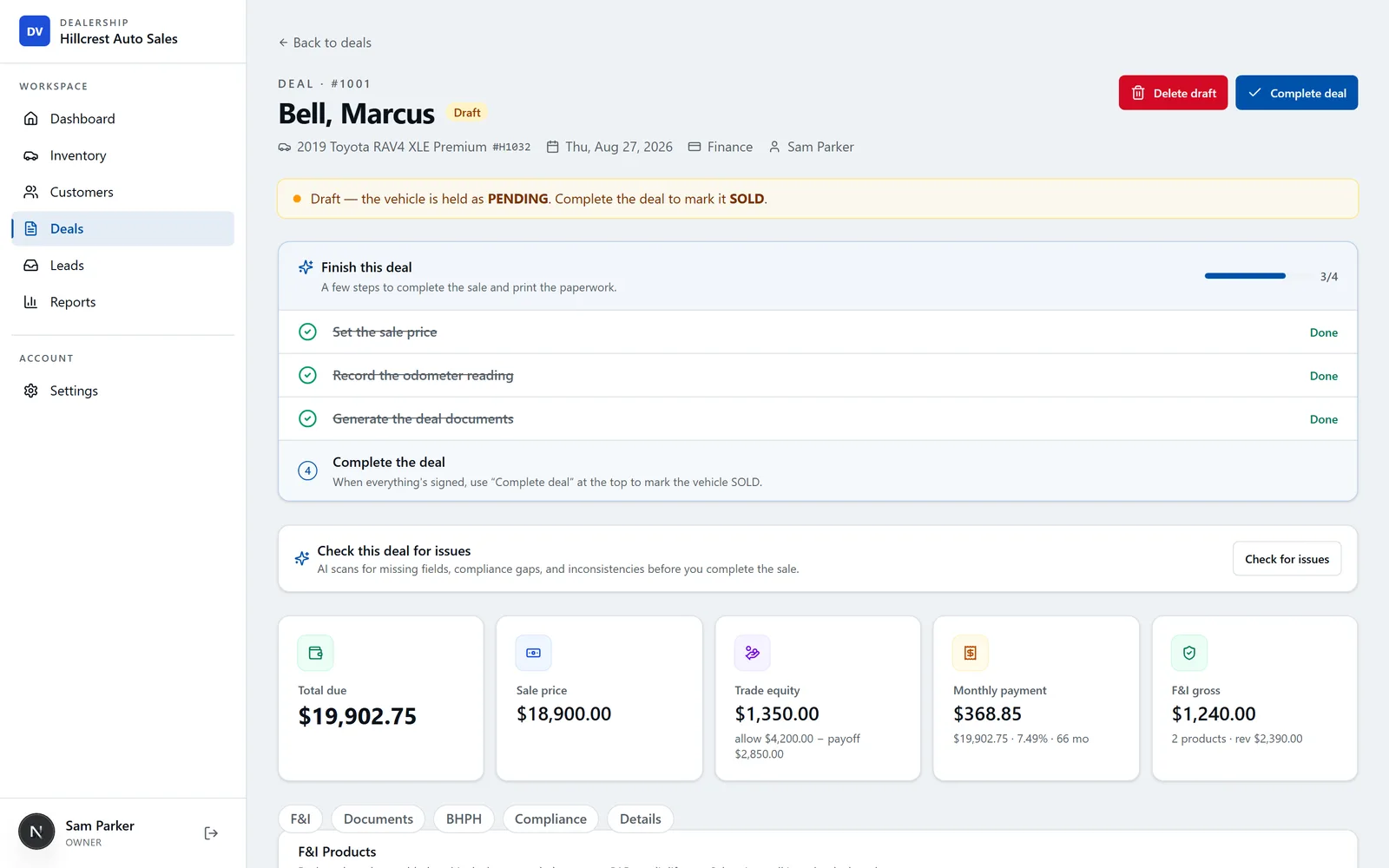
Open the BHPH Payment CalculatorIn DealerVLO the deal jacket computes the deal math as you type — totals, trade equity, the payment, and front-end and F&I gross — so you see what a structure does before you commit to it.
Step 3: Add-on protection, sold straight
A car that breaks down is a payment that stops. A service contract that actually pays claims can keep a BHPH buyer driving — and paying. But every add-on raises the payment, so it has to fit the same budget you underwrote. Which F&I products fit an independent lot covers what to offer and how to present it, and how to choose a service contract company covers vetting the administrator behind it. Never pack a product into a payment the customer didn't agree to.
14-day free trial, then $29/mo · Cancel anytime
Step 4: Collections — where the money is actually made
Keeping accounts current is the whole game. The cadence that works is early and light: a friendly reminder within a day or two of a missed due date, a real conversation if that goes unanswered, and a written plan if it's become a pattern. Hold firm when promises keep breaking; bend — in writing — when the problem is temporary and the customer is talking to you. The full routine, and how to read the signs a note is going bad, is in keeping BHPH accounts current.
The discipline underneath it is record-keeping: every payment posted, every contact logged, so anyone at the lot can see who's current and who's behind. DealerVLO tracks buy-here-pay-here payments against each note with a collections view, so that list isn't living in a spreadsheet. It doesn't text or call customers — the outreach itself stays with you.
Step 5: Payoffs, repossessions and deficiencies
Two moments end a note early. The good one is a payoff: the customer trades, refinances, or just pays it off. A payoff isn't the sum of the remaining payments — it's the current balance plus interest accrued since the last payment, quoted with a date. How to calculate a BHPH payoff walks through the per-diem math and how to keep the quote honest.
The bad one is a repossession. The notice requirements, the right to cure, how the car is sold afterward, and whether you can pursue a deficiency are all set by state law — this is exactly where you want your attorney's process written down before you need it.
Quote a payoff on an in-house note — current balance plus per-diem interest, good through a date.
Open the BHPH Payoff CalculatorStep 6: Manage the portfolio, not just the deals
Step back from individual accounts and look at the book as a whole. Once a month, know how much you're owed, how much of what came due was actually collected, and how many accounts are behind and by how much. Those numbers tell you whether your approval rules are working long before the repossessions do.
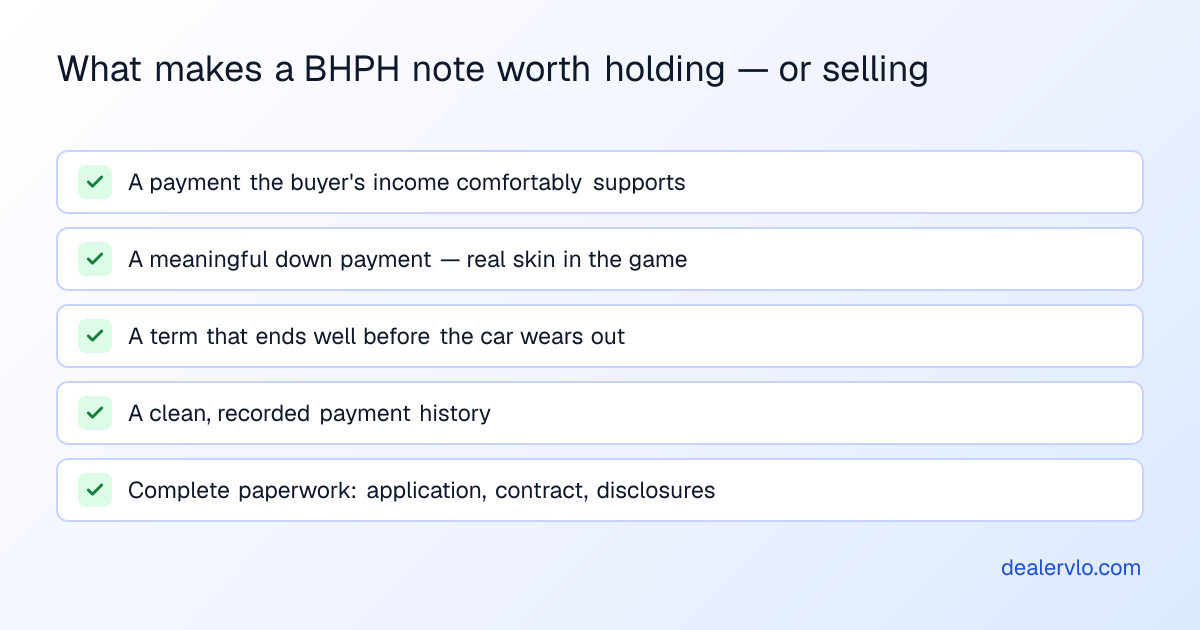
The portfolio is also an asset you can sell. Many dealers sell some or all of their notes to receivable buyers to free up cash for inventory, usually at a discount to the remaining balance. What a buyer will pay depends on how clean the paper is — payment history, down payments, terms and complete documentation — so the habits above are what make a portfolio worth something. Get more than one quote, and read the recourse terms closely: some deals require you to buy back accounts that go bad.
Compliance: the short list to take to your attorney
A BHPH dealer is a creditor, and that brings rules a cash lot doesn't face. The ones to raise with your attorney:
- Truth in Lending disclosures on every financed deal — the finance charge, APR, amount financed and payment schedule.
- State limits on interest rates and fees, plus state rules on late fees, notices and repossession.
- The FTC Used Car Rule — a Buyers Guide on every used car you offer for sale, BHPH or not.
- The FTC Safeguards Rule — you're holding applications full of personal financial data, so how you store customer data matters.
- Federal oversight — a dealer that holds its own paper can fall under federal consumer-finance rules that don't reach a dealer who assigns every contract to a bank, so ask your attorney where your lot stands.
Get your contracts, disclosures and collection notices reviewed once, up front. It's far cheaper than fixing them after a complaint.
Where software fits
You can run a small BHPH book on paper and a spreadsheet — until a payment gets posted to the wrong account or nobody can say who's behind. That's the job buy here pay here software exists to do: build the deal, track every payment against every note, and show you the collections picture at a glance. DealerVLO does that as part of the same system that runs your inventory, deals, paperwork and website, for $29 a month with unlimited users.
14-day free trial, then $29/mo · Cancel anytime
Frequently asked questions
How is running a buy here pay here lot different from a cash or bank-financed lot?
You're the lender. On a cash or bank-financed deal the money arrives at delivery and the car is gone; on a buy here pay here deal the gross is on paper at delivery and the cash arrives one payment at a time over the life of the note. That changes everything downstream: you need capital to carry notes, a written approval policy, a collections routine, and a way to track every payment against every balance. The lots that do well treat collections as the core of the business, not a chore after the sale.
How much money do you need to start a buy here pay here lot?
More than a retail lot of the same size, because every car you finance ties up its cost until the payments pay it back. There's no honest single number — it depends on your average cost per car, your down payments, your terms and how many notes you plan to carry at once. Model it before you start: take your expected cost per unit, subtract a realistic down payment, and multiply by the number of notes you'll carry before the early ones pay down. That's the cash you'll have sitting in customers' driveways.
What should a buy here pay here deal structure include?
A payment the buyer's income actually supports, a real down payment, a term that ends well before the car wears out, a due date that lines up with the buyer's payday, and a first payment collected at delivery. Every one of those protects the note. Structuring from the payment the customer can afford — and working backward to the car — prevents most of the defaults that look like collections problems later.
Can a buy here pay here dealer sell its notes?
Yes — many dealers sell some or all of their receivables to note buyers to free up cash, usually at a discount to the remaining balance. What you'll be offered depends heavily on how clean the paper is: payment history, down payments, terms and how well each deal is documented. Get quotes from more than one buyer and read the recourse terms carefully, because some deals make you buy back accounts that default. Good records are what make a portfolio sellable.
Does DealerVLO handle buy here pay here?
Yes, on the dealer's side of the ledger. DealerVLO tracks buy-here-pay-here payments against each note with a collections view, computes the deal math (including the payment) as you build the deal, and can put an optional online credit application on your dealer website. It is not a lender: it doesn't pull credit, make credit decisions, or text customers — those decisions and contacts stay with you.
Bottom line
Buy here pay here is a lending business with a car lot attached. Approve for ability to pay, structure every deal so it can pay, collect early and consistently, quote payoffs honestly, and keep records clean enough that the portfolio is worth something. Get those right and the gross you put on paper at delivery actually turns into cash.
Start your free 14-day DealerVLO trial and run your in-house deals, payments and collections from one place.