Lenders for Independent Auto Dealers: How a Small Lot Gets Signed Up and Stays Approved
How to get lenders for independent auto dealers: lender types, what dealer applications ask, how indirect deals get submitted and funded, and staying approved.
Part of the BHPH, financing & F&I guide: How to Run a Buy Here Pay Here Dealership: The Whole Loop, From Approval to Payoff
Plenty of buyers on a small lot ask about financing before they ask about the car. If the answer is "bring your own bank," a lot of them leave. So sooner or later every independent dealer goes looking for lenders for independent auto dealers, and finds lender marketing pages and very little about how a small lot actually gets signed up.
Here's the thing to understand first: lenders sign dealers, not deals. Before a lender will buy one contract from you, it has to decide you're a low-risk partner. This post is the playbook for that: the kinds of lenders, what a dealer application asks for, how deals get submitted and funded, and the habits that keep you approved once you're in.
14-day free trial, then $29/mo · Cancel anytime
Lenders sign dealers, not deals
Getting "signed up" means a lender approves your dealership, you sign its dealer agreement, and from then on you can send it your customers' applications. That's indirect lending: you arrange the financing, the lender makes the loan and buys the contract from you.
Two things people mix up with it:
- Floor plan finances your inventory, not your customers. I covered it in how dealer floor plans work. If you searched "how to get financing for my car dealership" and meant money to buy cars, that's the post you want.
- Buy here pay here means you carry the note yourself. Your capital is the lender. That's its own business model, laid out in how to run a buy here pay here dealership.
Plenty of lots run all three. This post is about the first.
The kinds of lenders for independent auto dealers
Not every lender wants every buyer, so you want a few in each lane. Roughly:
Banks. National and regional banks with indirect auto programs. They tend to want stronger credit and cleaner cars, and can be choosier about which independents they sign.
Credit unions. Many credit unions lend through dealers. Origence's CUDL network is one way they connect with dealers. A local credit union where your buyers already bank is worth a call.
National finance companies. These are the near-prime and subprime specialists, and they're the ones most open to independent lots. A few whose own dealer pages say they work with independents: Westlake Financial, which describes indirect financing "for any credit type"; Exeter Finance, which says it works with franchise and independent dealers; and Credit Acceptance, which says it has solutions for franchise and independent dealers. Naming them isn't an endorsement; read each dealer agreement yourself.
Regional finance companies. Smaller lenders covering a state or region. Ask dealers near you who they actually fund with.
Your own paper. For the buyer nobody will approve, in-house financing is the backstop. It ties up your cash, so go in with real underwriting, not hope.
With a mix, one lender's "no" isn't the end of the deal.
How to get lenders as a used car dealer: what the application asks
Every lender has its own process, so treat this as what's commonly asked. The online forms are short. Westlake's sign-up form starts with dealer type, entity type, and state. Exeter's dealer support page has a short form to request a dealer packet. The real application comes after, and it commonly asks for:
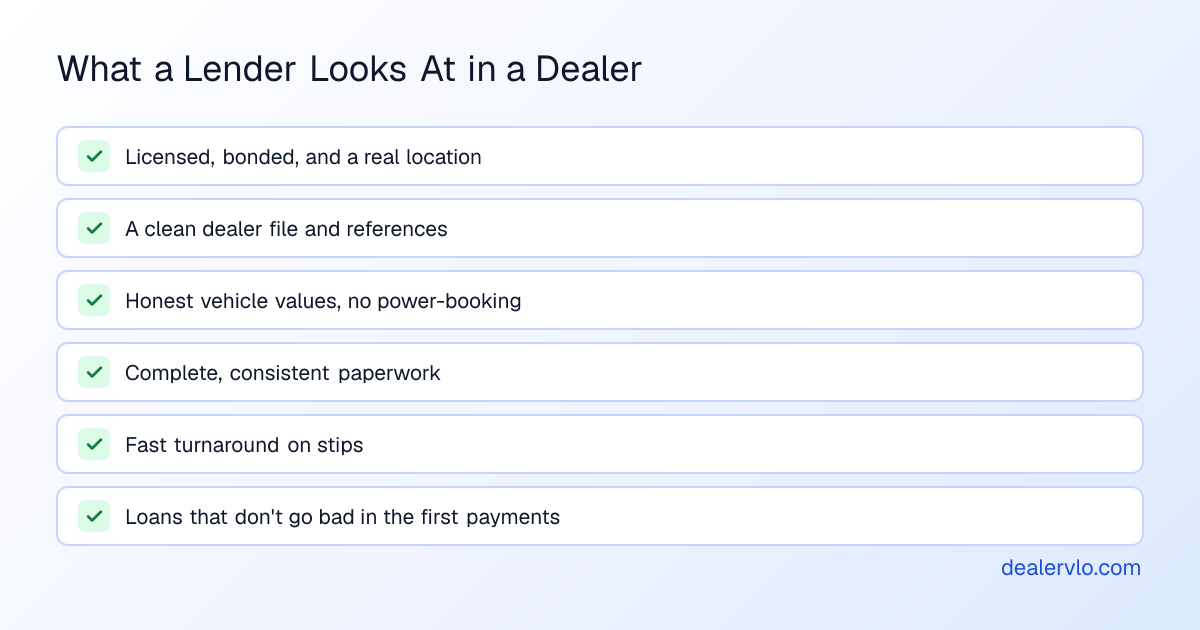
- Your dealer license and proof of your dealer bond
- Business entity documents and ownership information
- Business and trade references
- Sometimes financial statements
- Sometimes a visit to your lot, to confirm you're a real, operating dealership
Behind the paperwork, the lender is asking one question: will this dealer send us honest deals?
Brand new, with no funding history? Start where the door is open, usually the finance companies and a local credit union, and earn the rest with clean deals. Your lender rep decides whether a borderline deal gets a second look, so treat that relationship like a customer.
How indirect lending works: submitting deals through RouteOne or Dealertrack
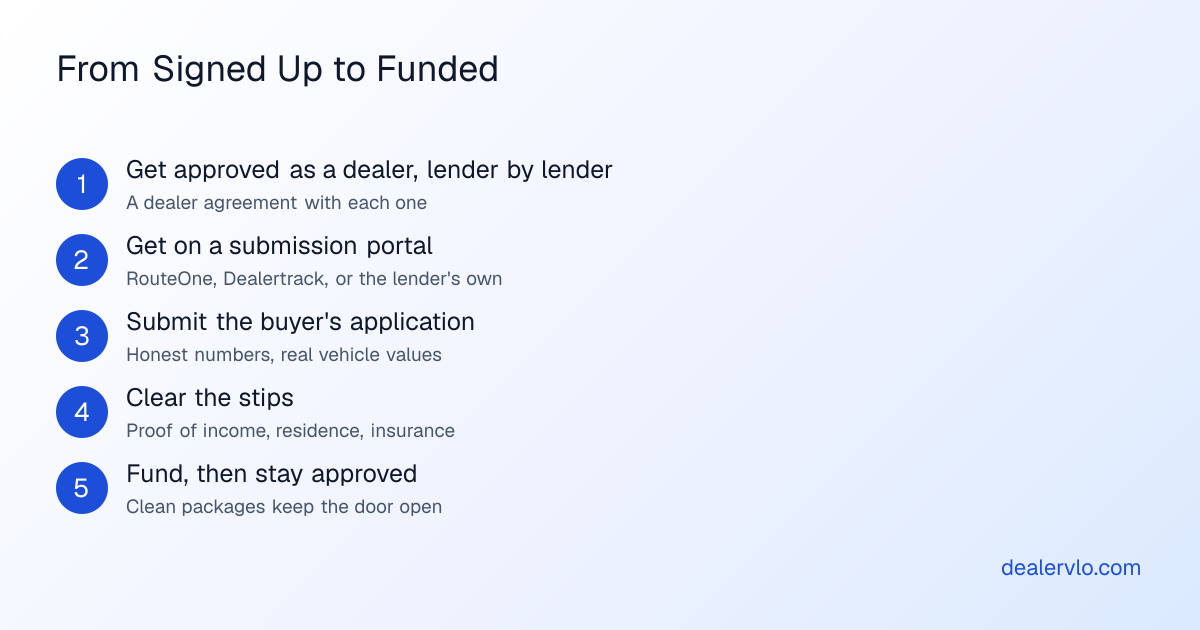
Once you're signed up, you need a way to send applications. Some lenders have their own portal; Exeter takes deals through its DealerPortal. Multi-lender networks let you send one application to several lenders:
- RouteOne. Its dealer page says the core credit application system is complimentary to dealers. The new-dealer steps are: submit a Dealer Participation Agreement, then arrange agreements with the finance sources you want, which RouteOne verifies before activating you.
- Dealertrack. Its credit application page describes submitting applications to over 1,500 finance sources and pulling credit bureau reports.
Notice RouteOne's step two: the portal is plumbing. You still need each lender's agreement first.
From there, you submit the buyer's application and a lender that approves quotes you a rate and its conditions. The CFPB calls the rate the lender quotes the dealer the buy rate. Then you structure the deal inside what the lender approved: price, down payment, term, and payment. If you work deals backward from what the buyer can pay, structuring a deal from the monthly payment walks through the math.
Work backward from a customer's monthly payment to the highest vehicle price you can structure.
Open the Deal Structuring CalculatorStart before the buyer arrives. In DealerVLO, every priced car on your dealer website shows a payment estimator (labeled as an estimate) with a button to your Financing page, where you can turn on an online credit application. It collects the applicant's details, income, down payment, and trade, but deliberately not the Social Security number. You collect that in person or by phone, then pull credit and submit through your lender portal. More in why financing belongs at the front of your website.
What lenders require for financing: the funding package and stips
An approval isn't money. The money comes when the lender accepts your funding package, and approvals usually come with conditions called stips (stipulations). What's requested depends on the lender and buyer, but these are common:
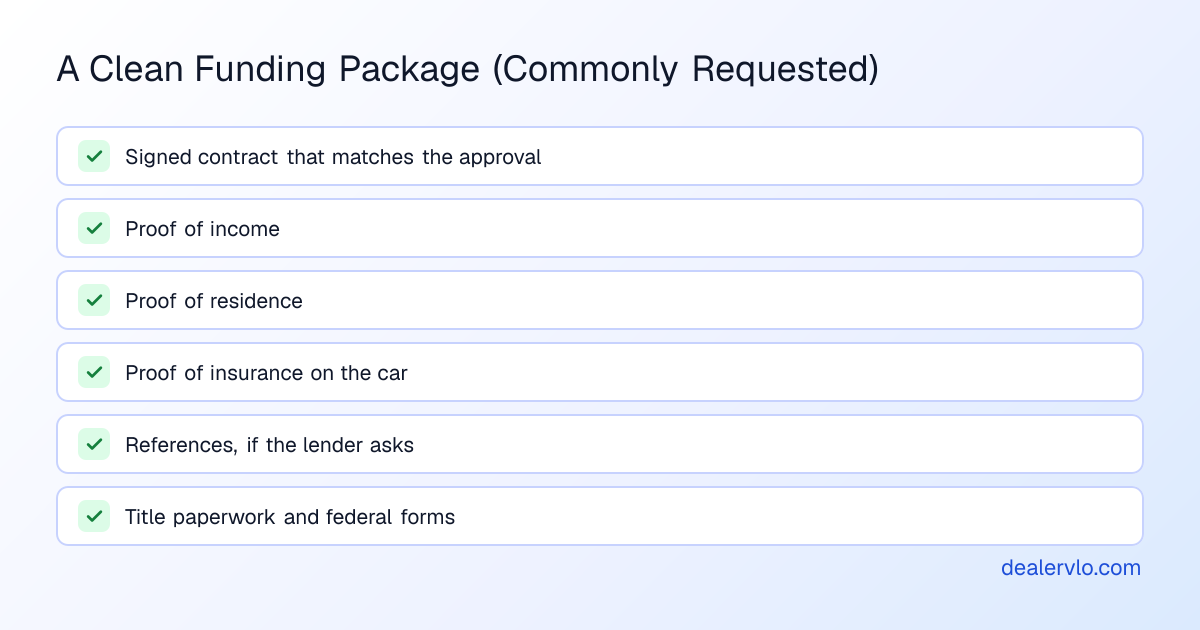
Deals usually sit unfunded for boring reasons: the contract says one amount and the approval said another, a fee shows up that wasn't in the structure, or a stip is missing. Get the stips at the desk before the buyer drives away, and check the contract against the approval line by line before you send anything.
This is the part DealerVLO is built for. The deal jacket computes the totals, trade equity, payment, and F&I gross live as you enter the deal, so the numbers you print are the numbers you structured. It auto-fills federal forms like the FTC Buyers Guide plus your state's title and registration paperwork from that same deal, so nothing gets retyped with a typo, and buyers can e-sign the deal documents.
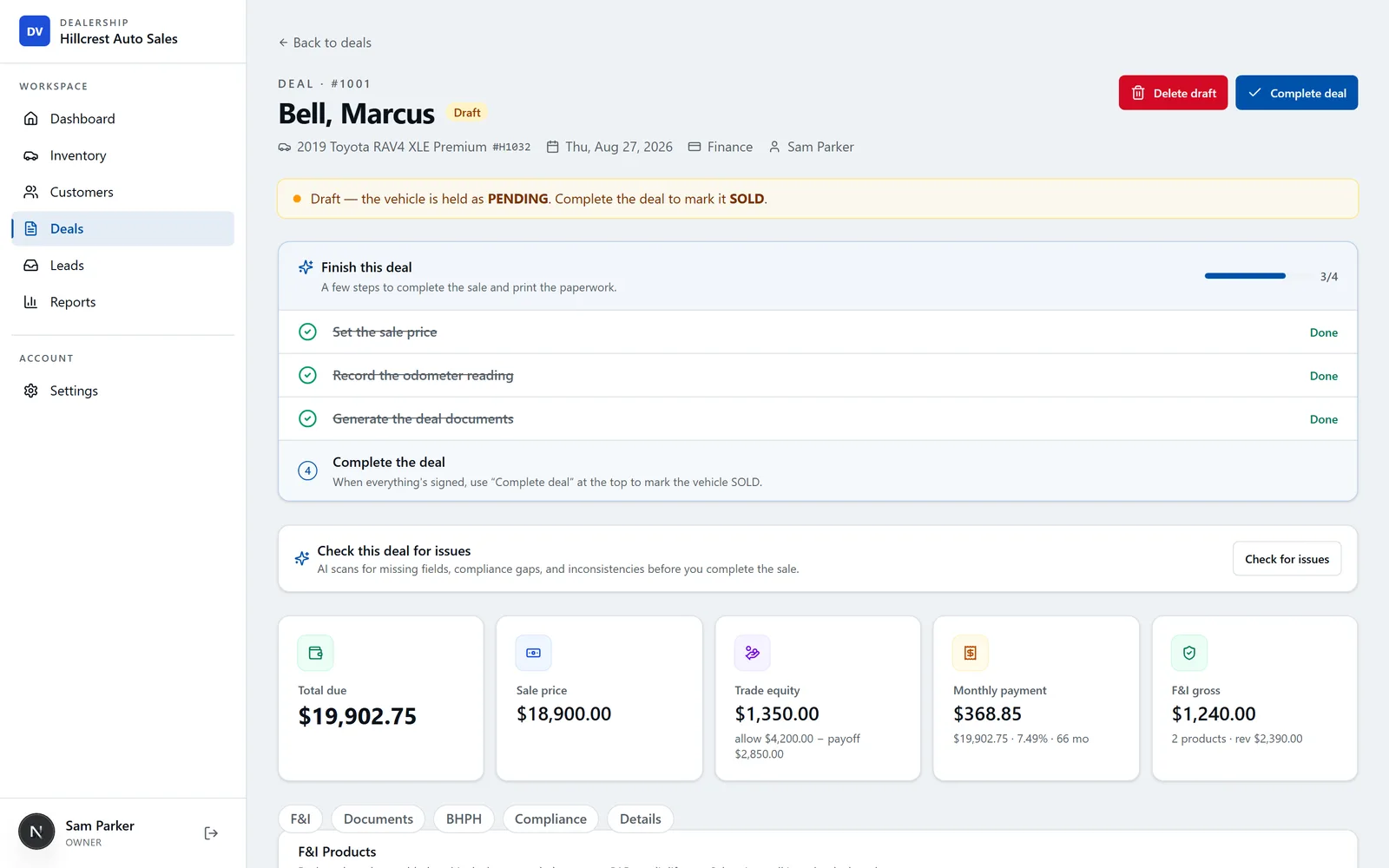
One deal, one set of numbers, every form filled from it.
14-day free trial, then $29/mo · Cancel anytime
The habits that keep you approved
Getting signed up is the easy part. Staying approved is a track record. The habits that matter:
Never power-book. Power-booking means inflating the vehicle's value or options to make the loan look safer than it is. It's the fastest way to lose a lender.
Never misrepresent the buyer. What you send has to match what the buyer told you and what the stips will show. If a deal only works with a fudged number, it doesn't work.
Turn stips around fast. A deal sitting a week on a missing pay stub costs you the lender's patience, and sometimes the deal.
Watch your early defaults. Loans that go bad in the first few payments are a red flag lenders commonly watch. Sell cars that fit the buyer's budget, not the biggest approval you can get.
Know which deals are worth doing. DealerVLO's sales report shows front- and back-end gross per deal, so you see which deals actually made money. If you sell add-on products on financed deals, F&I products for independent dealers covers offering them straight.
Dealer reserve and participation, explained
When a lender quotes you a buy rate, the contract rate the buyer signs can be higher; the CFPB's buy rate explainer describes that difference as compensating the dealer. That's what dealers call reserve, or participation. How much a lender allows, how it pays, and what happens if a loan pays off or goes bad early are set in each lender's dealer agreement. I won't quote numbers; they vary by lender and change. Read that section before you sign.
Two compliance notes, in passing, for your attorney:
- Lending rules. Fair-lending law (the Equal Credit Opportunity Act) applies to credit you arrange, and the FTC has guidance on adverse action and risk-based pricing notices, including special rules for some auto sales. Ask your lawyer about a written, consistent policy for how you set the rate.
- Customer data. The FTC's Safeguards Rule FAQ for auto dealers says dealers who finance, or help arrange financing, are financial institutions under the rule and need a written information security program. More in the Safeguards Rule and your dealer software.
In DealerVLO, each deal has a compliance checklist where you record steps like the OFAC screen and Red Flags review. It's a checklist you complete, not an automated screening service.
The downsides of indirect financing, and the deals no lender will take
The lender decides who's approved and on what terms. Guidelines tighten and loosen. A lender can end your agreement. And your cash is in the car until funding lands.
Some buyers won't fit any lender's box: thin file, recent repo, income that's real but hard to document. Pass, or carry the note yourself if you have the capital and the stomach for collections. If you do, DealerVLO tracks buy-here-pay-here payments with a collections view, so your notes don't live in a notebook. Either way, ask the qualifying questions early, so you know which lane a buyer is in before the test drive.
Where DealerVLO fits
DealerVLO is not a lender. It doesn't pull credit, give approvals, or send applications to lenders. Your lender agreements, your credit pulls, and your submissions live in RouteOne, Dealertrack, or each lender's own portal.
What DealerVLO handles is everything around that:
- Before the visit: a Financing page and optional online credit application on your dealer website, with no SSN collected online. Applications are encrypted, only owners, admins, and finance managers can open them, every view is logged, and each prints as a PDF with a blank SSN line.
- At the desk: the deal jacket with totals, trade equity, payment, and F&I gross computed live.
- For the funding package: federal and state paperwork auto-filled from the deal, plus e-signatures.
- After the sale: a sales report with front- and back-end gross, and BHPH payment tracking for the deals you carry yourself.
It's $29 a month, flat, with unlimited users, and it runs in a browser.
Frequently asked questions
How do I offer financing as a used car dealer?
Two ways. Arrange financing through outside lenders (indirect lending): sign a dealer agreement with each lender, submit the buyer's application, clear the lender's conditions, and the lender buys the contract. Or carry the note yourself (buy here pay here), where your own capital funds the deal. Most small lots start by signing up with a handful of indirect lenders across credit tiers.
How does indirect auto lending work?
The dealer sends the buyer's credit application to one or more lenders. A lender that approves quotes the dealer a rate (the CFPB calls it the buy rate) and conditions. The dealer writes the contract, collects the requested documents, and sends the funding package. The lender reviews it, pays the dealer, and services the loan.
What are the downsides of indirect financing?
The lender, not you, decides who gets approved and on what terms. Funding can stall on missing documents, a lender can tighten guidelines or end your agreement, and the agreement can include obligations that follow you after the sale, so read it first. Some buyers won't fit any lender's box at all.
What credit bureau do most car dealers use?
It varies. Each lender decides which bureau or bureaus it pulls for its own decision. Dealers who pull a report themselves often do it through their credit application portal; RouteOne and Dealertrack both offer credit bureau services. Ask each lender which bureau it uses.
What do lenders require from a dealer before they'll sign you up?
It differs by lender, but commonly: proof you're a licensed and bonded dealer, business entity details, and often references or a visit to your lot. Online sign-up forms, like Westlake's and Exeter's, start with basics such as dealer type and location; the full packet comes after.
Is getting lenders the same as floor plan financing?
No. Floor plan is a credit line that finances your inventory. The lenders in this post finance your customers. You can have either without the other. Floor plan is covered in its own post on how dealer floor plans work.
Bottom line
Lenders sign up a dealer that looks safe: licensed, bonded, real, and sending honest, complete deals. Start with the lenders whose doors are open to independents, get on a submission portal, and make every funding package boring. Boring packages fund, and the dealers who send them get the second look on the borderline deal.
DealerVLO won't get you approved by a lender, but it keeps the part you control clean: the application before the visit, the deal math at the desk, and paperwork that matches. Start the free 14-day trial and run your next financed deal through it.
14-day free trial, then $29/mo · Cancel anytime
Structure an in-house note — payment, total interest, and what it collects per month — for any weekly, bi-weekly, or monthly term.
Open the BHPH Payment Calculator