The best used cars for dealers to stock in 2026 (and why they sell)
The best car to stock isn't a model — it's a fit. A working independent-lot buy box, the six things that make a used car worth stocking, the segments to lean into in 2026, and the ones that quietly cost you money.

Every dealer wants the same answer to this question: just tell me which cars to buy. And every honest answer has to start by pushing back, because the best car to stock isn't a model — it's a fit. The exact vehicle that prints money on my lot in Massachusetts might sit for 90 days on yours, because your buyers, your lenders, and your local demand are different from mine.
So this isn't a ranked list of ten magic VINs. It's the thing that actually travels between lots: a buy box, a set of criteria, and the segments those criteria point to in 2026 — plus the ones quietly worth avoiding. Use it to build your own list against your own market.
Start with a buy box, not a model
Before you fall in love with any specific car, decide the box it has to fit in. Here's a working one for a typical independent lot — a starting point, not gospel; tighten it to your market and your lender.
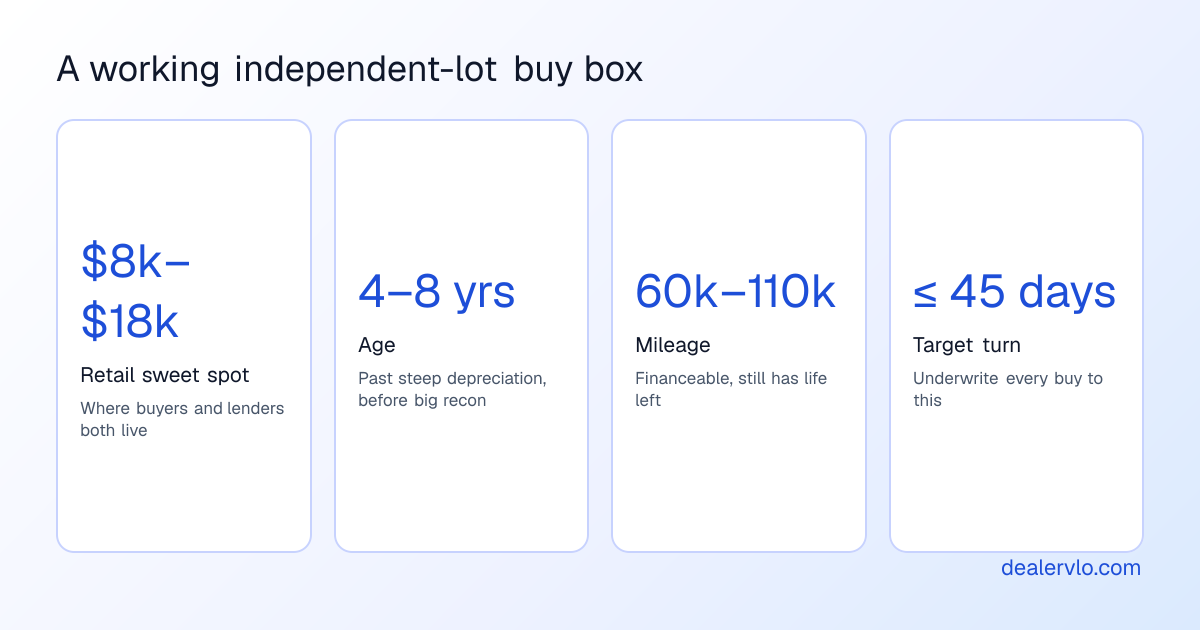
Why this band holds up in 2026: new-car prices are still high, which keeps pushing buyers into used; financing costs are still elevated, which makes the financeable price band matter more than it did a few years ago; and affordability pressure keeps the largest pool of buyers in the cash-reachable, sub-$20k range. Stock above your market's financeable ceiling and you're not competing for a smaller pool — you're competing for a thinner one, while carrying more floor-plan risk on each unit.
What makes a car worth stocking
Inside the box, a car earns a spot on your lot when it checks these off. None of them is about a specific model — they're the reasons the good models are good.
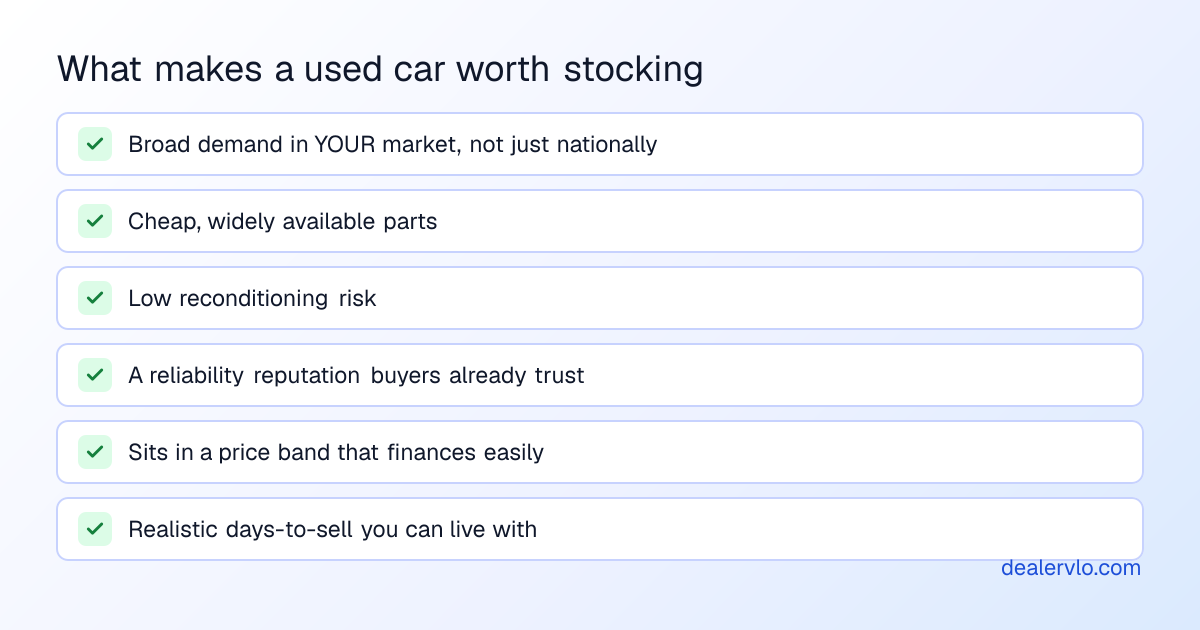
The one dealers underweight is your market. National "most reliable" lists are a fine tiebreaker, but the car that turns is the one your actual buyers walk in asking for. A work-truck town and a college town reward completely different inventory. Watch what sells off your own lot and what your local competitors keep restocking — that's your demand signal, and it beats any national ranking.
Get your annual turn rate and days' supply — and see what the same inventory could make at a faster turn.
Open the Inventory Turn CalculatorThe segments to lean into in 2026
Apply the box and the criteria, and the same handful of segments keep coming up. Here's roughly how I'd prioritize them for a general independent lot this year.
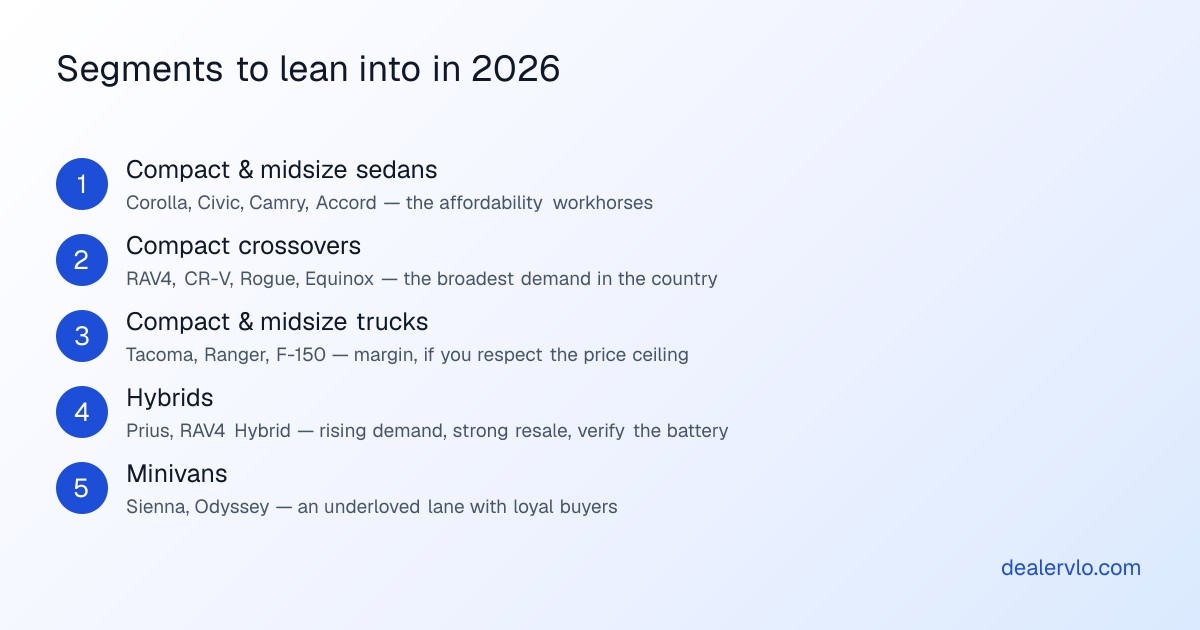
Compact and midsize sedans — Corolla, Civic, Camry, Accord and their peers. These are the affordability workhorses. They rarely carry the fattest gross, but demand never cools, parts are everywhere, recon is usually light, and they finance to almost anyone. In a high-price, high-rate environment they're the segment doing the quiet heavy lifting.
Compact crossovers — RAV4, CR-V, Rogue, Equinox, and the rest. This is the broadest demand segment in the country and the one most families default to. Reliable examples from trusted brands move fast and hold value, which protects you on the ones that sit a little longer.
Compact and midsize trucks — Tacoma, Ranger, Colorado, F-150, Silverado. Trucks carry real margin and loyal demand, especially in the right market. The discipline is the price ceiling: it's easy to buy a truck that's genuinely great and genuinely too expensive to finance to your buyer. We go deeper on this in sourcing used trucks for independent dealers.
Hybrids — Prius, RAV4 Hybrid, Camry Hybrid. Fuel-price sensitivity keeps pulling demand toward efficiency, and the established hybrids have strong resale and reliability track records. The catch is diligence: verify the hybrid battery's condition, because that's the one recon surprise that can erase the deal.
Minivans — Sienna, Odyssey. An underloved lane, which is exactly why it can pay. Families who need one really need one, the buyer pool is loyal and less price-shopped, and margins are often better than the crowded crossover lanes.
What to avoid in 2026
Knowing what to skip protects more gross than knowing what to chase:
- Out-of-warranty German luxury. The car photographs beautifully and then a suspension or electronics repair eats the whole spread. Parts and labor are a different universe. Buy these only if it's your specific niche and you know the repair math cold.
- First-year redesigns. Unproven reliability, scarce parts, and no track record to price against. Let someone else find the bugs.
- Known transmission and CVT problem children. A model with a reputation for driveline trouble is a reputation your customer already knows about too. It slows the sale and raises your recon risk at the same time.
- EVs, unless you can price the battery risk. Used EV values have been volatile and battery-health data is still hard to get at appraisal. For a small lot this is a specialist play — only if you know your local demand and can verify battery state of health — not a core-inventory bet.
- Anything above your financeable ceiling, and branded or salvage titles. Both shrink your buyer pool to a fraction. Great deal, wrong lot.
The honest bottom line
The best used cars to stock in 2026 aren't a secret list — they're whatever clears your buy box, checks the criteria, and matches the buyers actually walking onto your lot. Lead with the affordable, reliable, financeable core: sedans and compact crossovers for turn, trucks and minivans for margin, hybrids where your market rewards them. Stock to your buyer and your lender, buy every unit retail-back so the price does the work, and review your scoreboard monthly to see which segments are actually paying you.
Do that and the "which cars should I buy" question mostly answers itself — with your own data instead of someone else's list.
When your inventory, turn, and per-unit cost all live in one place, spotting which segments actually pay stops being a guess. DealerVLO tracks every car from buy to sale, so your buy box tightens itself over time.