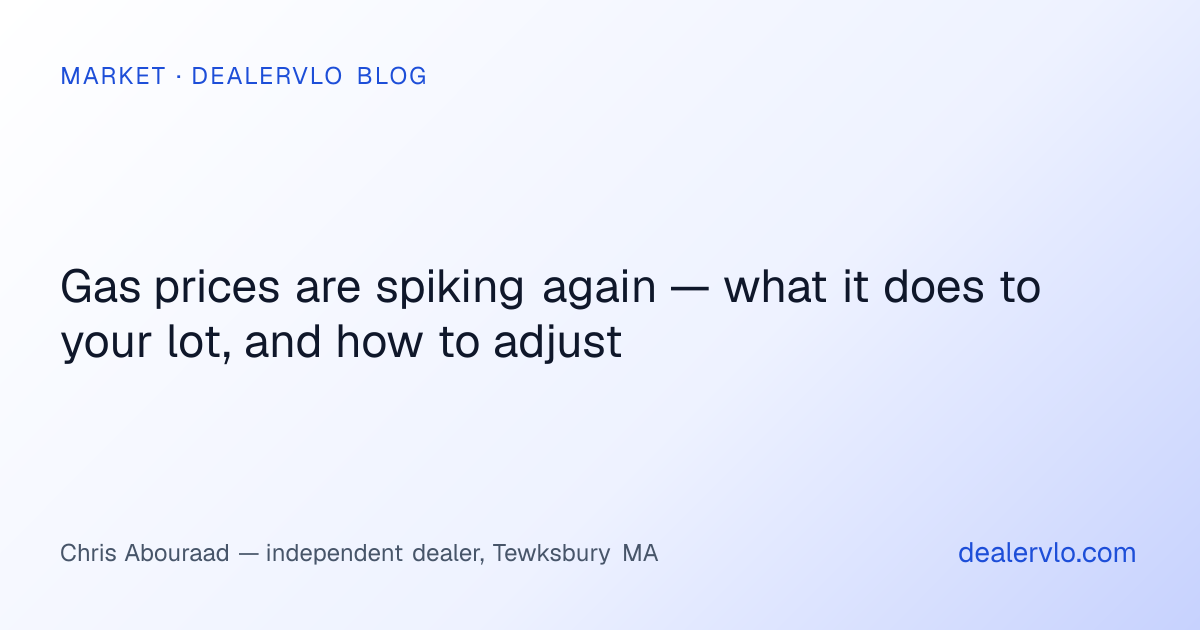
Gas prices are spiking again — what it does to your lot, and how to adjust
Oil jumped ~24% in a month and pump prices are climbing. Here's how a fuel spike moves used-car demand between trucks and economy cars — and the acquisition, pricing, and merchandising moves that keep your gross intact.
If you've filled up a vehicle this week, you already know the headline. Crude oil has jumped about 24% over the past month — WTI sat around $105 a barrel in mid-September 2026 after supply disruptions in the Middle East — and it's flowing straight to the pump: the EIA put the national average for regular at about $4.32 a gallon on September 14, up roughly sixteen cents in a single week. When gas moves like that, it doesn't stay at the gas station. It walks onto your lot.
Every time fuel spikes, the used-car market re-sorts itself, and the dealers who read it early protect their gross while everyone else gets caught with the wrong metal. This is the operator's version: what a fuel run-up actually does to demand, the math your buyers are suddenly doing, and the acquisition, pricing, and merchandising moves that keep you on the right side of it — without betting the lot on gas staying high.
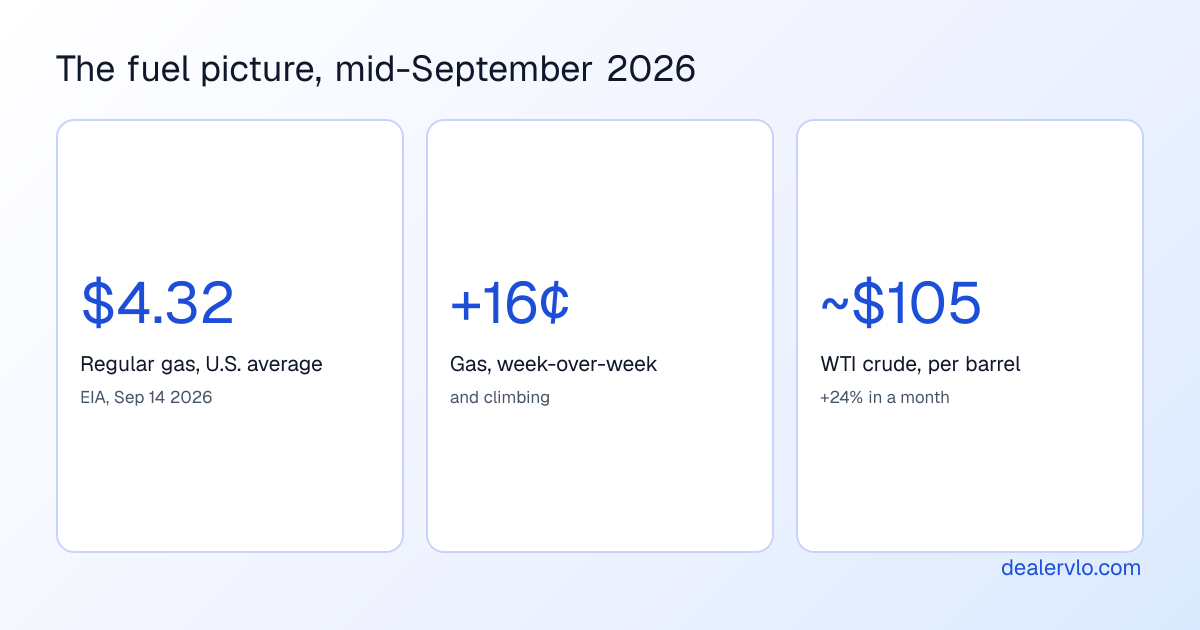
(Snapshot figures as of mid-September 2026, from the EIA gasoline update and public WTI crude quotes. Fuel prices move daily — treat the numbers as a moment in time, the playbook below as the durable part.)
How a fuel spike moves the used-car market
The shift is predictable in direction, even if the size varies: higher gas tilts demand toward fuel economy. Compacts, hybrids, and smaller crossovers get more shoppers and turn faster; full-size trucks and big SUVs draw fewer and sit longer. It's not that trucks stop selling — the buyer who needs to tow, haul, or fit three car seats is still a buyer — it's that the marginal shopper, the one who could go either way, starts leading with the MPG number.
That split shows up in two places on your lot before it shows up in the news. First, days-to-sell: your efficient units start moving quicker while the thirsty ones age. Second, wholesale and trade values: the auction and MMR react faster than retail, so fuel-efficient cars firm up (and get expensive to buy) while guzzlers soften — often a week or two before the retail market fully reprices. If you're watching your own turn by segment, you'll see it happening before a spreadsheet from a vendor tells you.
The math your buyers are suddenly doing
Here's why the shift happens, in dollars. At around $4.30 a gallon, the difference between a thirsty truck and an economy car isn't abstract — it's a real line in a household budget:
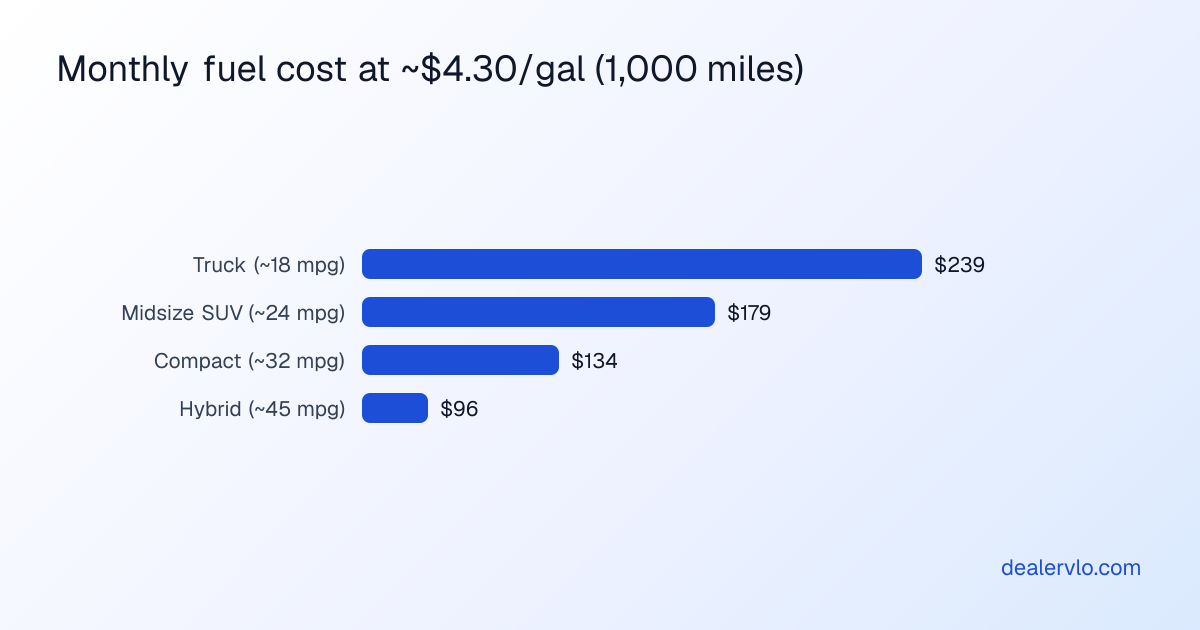
Run the math on 1,000 miles a month: an 18-mpg truck burns about 56 gallons — call it $239 — while a 32-mpg compact burns about 31, roughly $134. That's about $105 a month, or ~$1,260 a year, on the exact same driving. A hybrid at 45 mpg lands near $96. Your shopper is running some version of that calculation in their head whether or not you say a word — which is exactly why the MPG number belongs in your listing headline right now, not buried in the specs.
How to adjust what you buy
The biggest lever in a fuel spike is acquisition, because that's where the loss gets baked in. Two moves:
Don't overpay for the thirsty stuff. Big trucks and SUVs still sell, but into a softer, slower segment — so the price you can afford to pay dropped even if the auctioneer hasn't caught up. Bid more conservatively on guzzlers, and be honest with yourself about how long they'll sit. This is the moment the buy-it-right discipline pays off most.
Don't chase the efficient premium off a cliff, either. Everyone's bidding up compacts and hybrids right now, which is exactly when you overpay. Know your pricing and markup math cold, watch MMR on the efficient units, and let a car go rather than buy it at a number that leaves you no gross. And remember there are more places to buy than the lane — the off-auction channels where nobody's bidding against you are even more valuable when the auction is frothy on one segment.
Get your annual turn rate and days' supply — and see what the same inventory could make at a faster turn.
Open the Inventory Turn CalculatorHow to adjust what you price and merchandise
For the metal already on your lot, speed is the whole game.
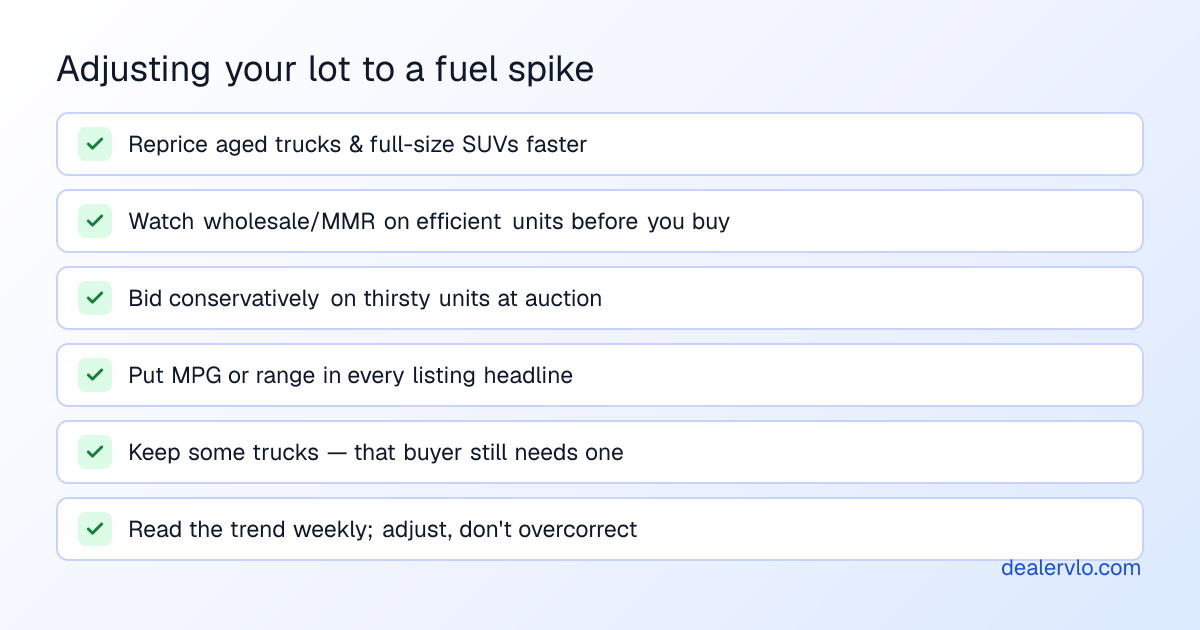
Reprice the aged trucks and big SUVs faster than you're comfortable with. A soft segment plus a unit that's already sitting is the classic recipe for a gross that quietly becomes a loss — every extra week is holding cost eating your margin. Get ahead of it with a tighter markdown cadence on the vulnerable segment specifically, not a blanket cut across the lot.
Merchandise to the moment. Put the MPG or electric range in the headline and the first photo caption on your efficient units — that's the number moving buyers this month. And don't punish the whole truck segment: the demand that's left is real, just thinner, so price the genuine work-truck buyer fairly instead of slashing every truck in a panic.
Don't overcorrect — gas is volatile
One caution, because it's where dealers lose the most: this is a spike, not a new permanent reality. The current run-up came from a supply disruption, and those reverse — sometimes as fast as they arrive. Dumping every truck on your lot at a loss because you're sure $4-plus gas is here to stay is how you get whipsawed when crude drops and truck demand snaps back in a month.
The skill is reading the trend and adjusting at the margin — tilt acquisition, tighten pricing on the soft segment, merchandise to the MPG number — while keeping a balanced lot that works whichever way fuel goes next. React to the market you're in; don't bet the business on the one you think is coming.
Frequently asked questions
How do gas prices affect used-car sales?
Higher pump prices tilt demand toward fuel economy — compacts and hybrids turn faster while big trucks and SUVs slow and take longer to sell. It's a marginal shift, not absolute (truck buyers still need trucks), and it shows up first in your days-to-sell and in wholesale/trade values, which move before retail.
Should dealers stop buying trucks and SUVs when gas rises?
No — stop overpaying for them. They still sell into real demand; what changes is the price you can afford at acquisition and how fast you need to turn them. Bid conservatively on thirsty units and keep them priced to move.
How much more does a guzzler cost a buyer per month now?
At ~$4.30/gal, on 1,000 miles a month, an 18-mpg truck runs about $239 vs. about $134 for a 32-mpg compact — roughly $105/month or ~$1,260/year on the same miles. A 45-mpg hybrid lands near $96. Buyers are doing that math, so headline the MPG.
How should I adjust pricing in a fuel spike?
Reprice aged trucks and full-size SUVs faster, watch MMR on efficient units so you don't overpay chasing the premium, put MPG/range in listing headlines, and still price the real work-truck buyer fairly rather than gutting the whole segment.
Are high gas prices permanent?
Usually not — this run-up is supply-driven and can reverse quickly. Adjust at the margin and keep a balanced lot; don't dump every truck at a loss betting that expensive gas is here to stay.
Bottom line
A fuel spike re-sorts your lot: efficient cars heat up, thirsty ones cool off, and wholesale moves before retail. The dealers who protect their gross read it early — bidding conservatively on guzzlers, not overpaying for the hot efficient units, repricing aged big metal fast, and headlining the MPG number buyers are suddenly fixated on. And they don't overcorrect, because gas is volatile and the truck market usually snaps back.
All of that runs on seeing your own numbers in real time — which segments are turning, what's aging, where your gross actually is by unit. That's what DealerVLO puts in front of you: days-on-lot and turn on every car, gross tracked per deal, so when the market shifts under you, you can see it on your own lot and act before it costs you. $29/month flat, 14-day free trial.
Before you authorize the work: see whether a repair earns back its cost plus the holding days it adds.
Open the Recon ROI Calculator