Should Used Car Dealers Sell EVs? Battery Reports, Pricing, and the Tax Credit
Should used car dealers sell EVs? How a small lot checks battery health at auction, prices a used EV from live comps, and answers the 2026 tax credit question.
Part of the Buying & sourcing inventory guide: How to buy at dealer auctions without getting buried
Should used car dealers sell EVs? Every independent dealer gets asked eventually, usually when a clean used EV rolls through the auction lane and looks cheap next to the gas car beside it. The car might be a bargain. It might also be a car with a tired battery that sits on your lot for three months while you explain to every shopper that the tax credit is gone.
This post is the operator's version of the answer: the honest case for and against stocking used EVs at a small lot, how to check battery health before you bid, how to price a used EV from live comps, what to say when a buyer asks about the used EV tax credit in 2026, and how to disclose the battery when you sell.
14-day free trial, then $29/mo · Cancel anytime
Should used car dealers sell EVs? The honest case for and against
There's a real case for it. Cox Automotive's EV Market Monitor, published Sept. 15, 2026, reported used EV sales of 44,350 units in August, up 14.7% from a year earlier. The average used EV listing price was $37,441, down 1% from July but up 8.2% year over year, and Cox credits growing off-lease returns with expanding supply. So there are buyers, and more of these cars are reaching the lanes.
The case against is specific to a small lot:
- The buyer pool is narrower. Plenty of shoppers still won't consider an EV, and some who would can't charge at home. A gas sedan at the same price has more people who might buy it.
- The battery is the expensive unknown. You can see a dent. You can't see a weak pack without a reading, and the battery is the one part that sets the car's value.
- You need to charge it. An EV delivered for a test drive at 12% charge is a lost sale. You need somewhere on your lot to keep it charged.
- Recon has new questions. Charging cables, charge ports, and software updates aren't things every independent shop handles.
- Time is the real risk. National averages hide wide spreads by brand. Our October stocking guide shows how differently Teslas and other EVs have been turning. An EV that doesn't fit your market sits, and every day it sits costs you.
None of these rule EVs out. They mean an EV has to be bought on purpose, not because it looked cheap.
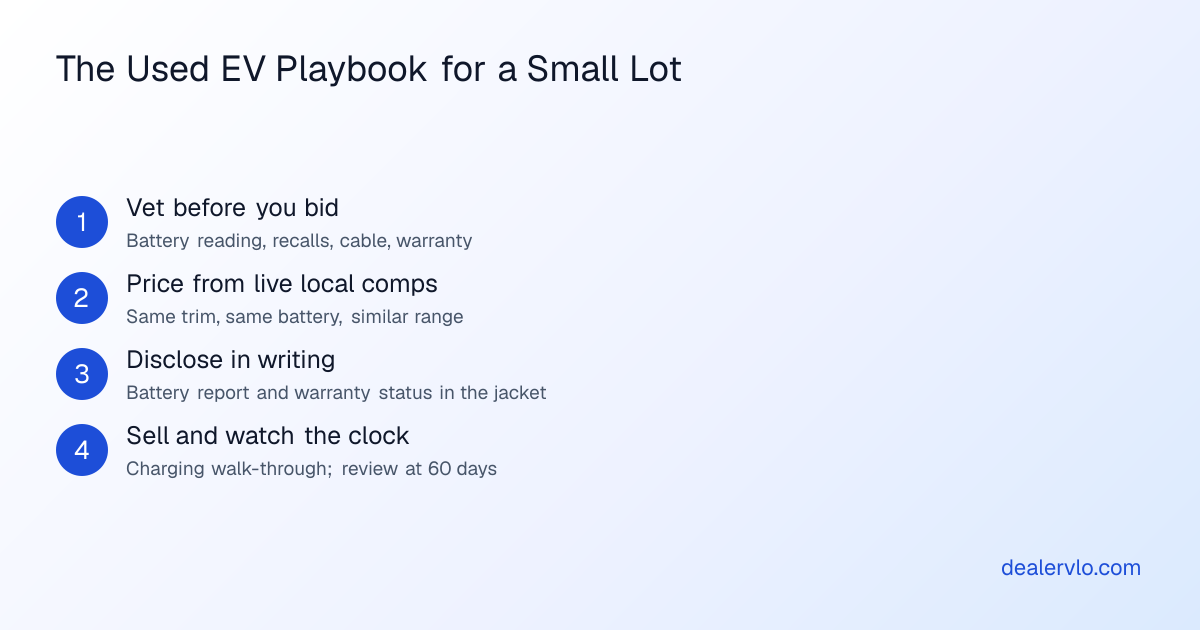
Because time is the risk, watch the clock from day one. In DealerVLO, every car shows its days in inventory, and at 60 days it gets an "aging, consider repricing" flag, so a slow EV can't hide on the back row. Run the daily math on your own unit first:
Put a real dollar-a-day number on every unit sitting on your lot.
Open the Holding Cost CalculatorIf you want the longer version of what aging does to gross, the holding costs post walks through it.
Buying a used EV at auction: what to check before you bid
Treat an EV like any other auction buy, then add the battery. Everything in the condition report red flags guide still applies. On top of it, check these:
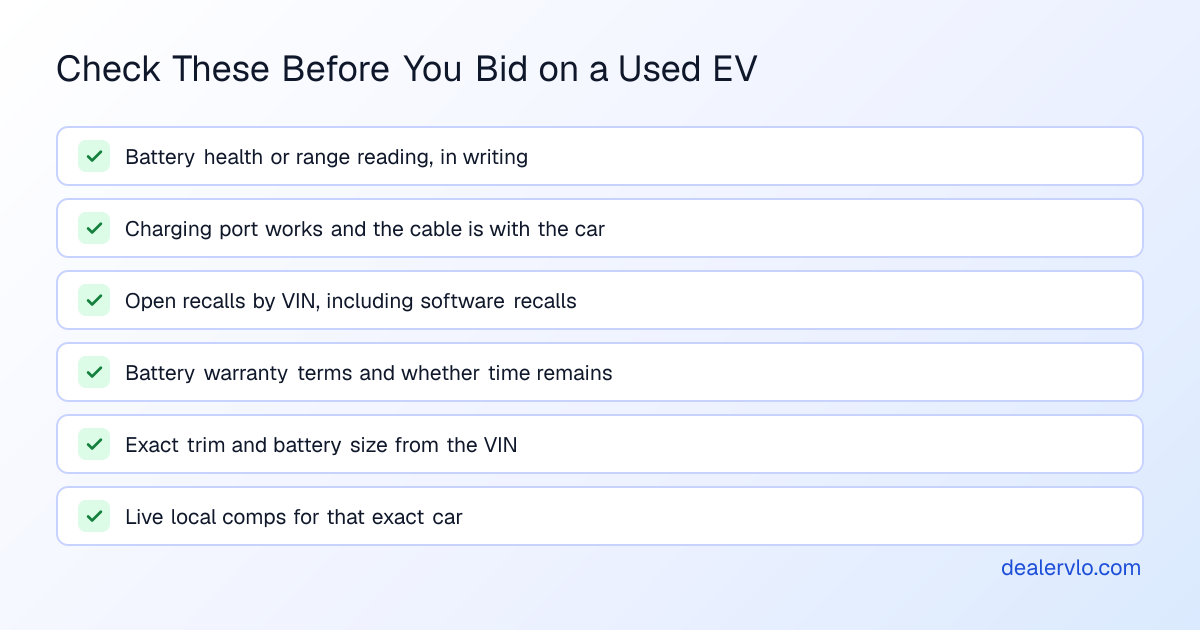
Battery reading. Look for it in the condition report before you look at anything else. Some auctions now include one: Manheim said in April 2024 that its EV condition reports and vehicle detail pages show estimated range at full charge compared with the range when the battery was new. If the car has no reading, bid as if the battery is the worst case, or pass.
Charging port and cable. Confirm the port door opens and the port isn't damaged, and check whether the charging cable is listed with the car. A missing cable is a cost and a hassle at delivery.
Recalls, including software. Run the VIN through NHTSA's recall lookup, which shows unrepaired safety recalls on a specific vehicle from the past 15 years. NHTSA notes it won't show recalls that are already repaired, and very recent recalls may not be loaded for every VIN yet, so check again before you sell.
Battery warranty. Many EVs carry separate battery coverage from the manufacturer. Check that manufacturer's battery warranty terms for the model year, what it covers, and whether time and miles remain. Remaining coverage is a selling point. Expired coverage is a pricing input.
Trim and battery size. The same model can come with different battery packs and very different range. Decode the VIN so you know exactly which car you're bidding on; our free VIN decoder is a quick first check.
Once you buy, DealerVLO's VIN decode fills in the car when you add it to inventory, and any recon you do, a new charging cable, a port repair, tires, goes on that car line by line and rolls into its all-in cost and margin.
Used EV battery health report: your options as a dealer
If the auction didn't give you a reading, or you bought the car off the street, you have a few ways to get one. Most report state of health, which is the battery's usable capacity compared with when it was new, or an estimated range at full charge.
- The brand's franchise service department. A dealer for that make can run a battery diagnostic with factory tools. Call ahead and ask what the report includes and what they charge, because it varies.
- OBD-II scan tools and apps. Many EVs report state of health through the diagnostic port, and some scan tools and phone apps can read it. Coverage varies by make and model, so confirm your tool supports the car before you rely on it.
- Third-party battery report companies. Recurrent, for example, says it earns revenue by offering battery and range reports in bulk to high-volume sellers like dealerships and auctions. It doesn't list prices on its site, so ask for a quote.
On cost, an EV battery health check ranges from free (your own scan tool on a supported car) to whatever a service department or report company quotes. Price it before you need it, so it's part of your buy math. Whatever you use, save the result for the deal jacket.
How to price a used EV from live comps
Price an EV the way you'd price anything, from live market comps, with two extra filters. First, match the battery and trim, not just the year and model, because range drives the price and a different pack can mean a different car. Second, weigh the battery reading: a car with a strong range reading and remaining battery coverage can sit at the top of the comp range, and one with a weak reading belongs lower, or at auction.
Don't anchor to last year's price trend in either direction. National averages moved month to month this year, and your local market can look very different, so pull comps the day you price and again if the car passes 30 days.
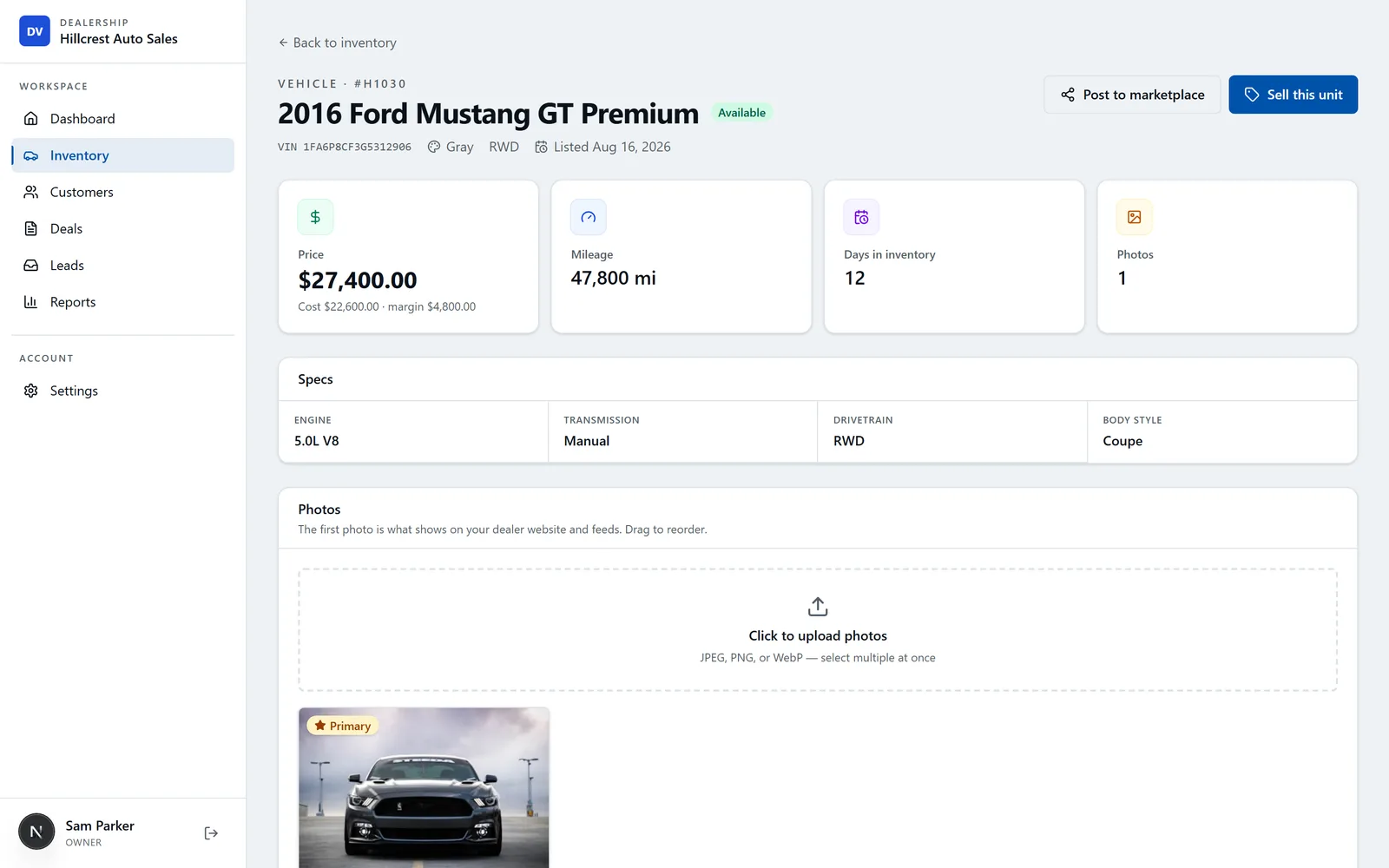
That vehicle page is where the EV math lives in DealerVLO: cost, margin, and days on lot next to the specs. The AI price suggestion shows a price range from live comparable listings plus a target price for selling in about 30 days, so you can see where an EV sits against the market before you post it. It doesn't read the battery for you; you weigh the battery report against that range yourself.
14-day free trial, then $29/mo · Cancel anytime
The used EV tax credit in 2026: what to tell buyers
This is the question every EV shopper asks, so get it right. The IRS page on the used clean vehicle credit says it plainly: the Previously-Owned Clean Vehicle Credit "is not available for vehicles acquired after Sept. 30, 2025." That was the federal credit under IRC 25E, worth 30% of the sale price up to $4,000.
So for a used EV bought from your lot in 2026, there's no federal used EV credit to claim, and nothing to transfer to you at the point of sale. The transfer option, where a buyer could hand the credit to the dealer for cash or a down payment, only mattered while the credit existed.
One edge case: the IRS explains in its FAQs that a vehicle is "acquired" when a written binding contract is in place and a payment has been made. A buyer who did that on or before Sept. 30, 2025 could still claim it when taking possession later. That won't describe a car you're selling today.
State incentives are a separate question. Some states have run their own EV programs, and they change. Don't quote one from memory. Send the buyer to their state's program, or to the Department of Energy's state laws and incentives list, and let them confirm it with the program and their tax preparer. You're a car dealer, not a tax advisor, and saying so is fine.
Selling a used EV: disclose battery health in writing
The battery is the part the buyer worries about most, so put what you know on paper. Hand over the battery report, explain what the number means, and keep a copy in the deal jacket. A buyer who sees the reading up front trusts the price more, and you have a record of what you disclosed.
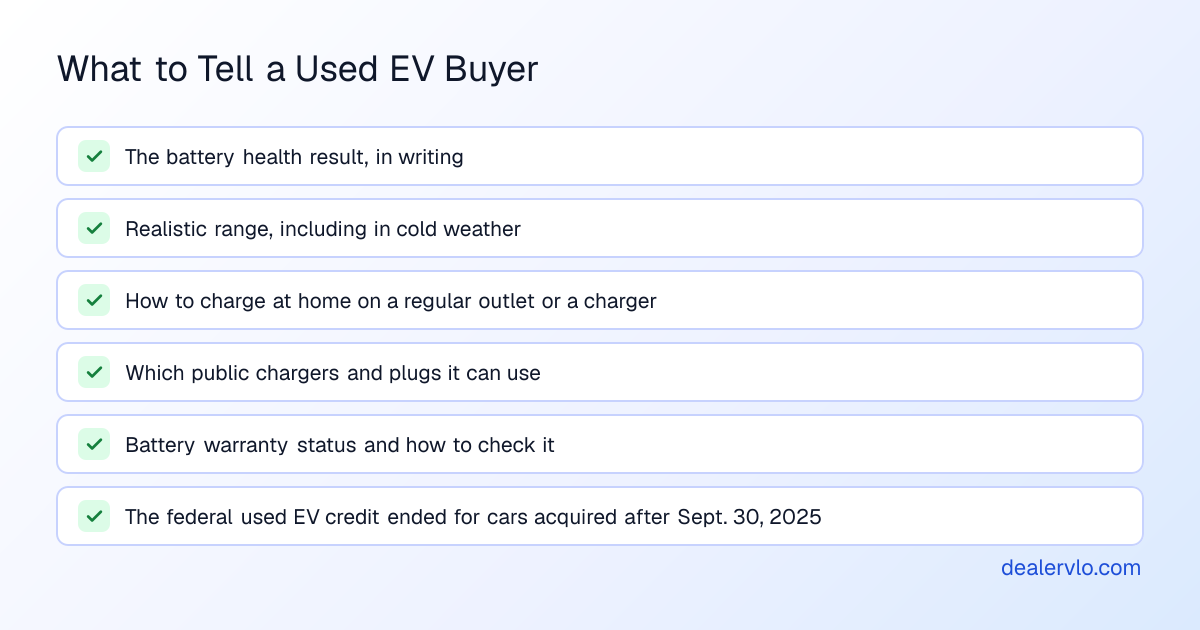
Charging basics. Many first-time EV buyers don't know how they'll charge. Walk them through it: a regular household outlet is slow but works for some drivers, a home charger is faster, and public fast chargers use specific plugs, so tell them which ones fit this car and whether they need an adapter. Mention that range drops in cold weather. A five-minute walk-through prevents the angry call in January.
Warranty on the Buyers Guide. If the manufacturer's battery coverage hasn't expired, the FTC Buyers Guide has a box for that. The FTC's dealer's guide to the Used Car Rule says you can check "Manufacturer's warranty still applies" even on an as-is sale, as long as the manufacturer's warranty is still in effect. Our Buyers Guide walk-through covers the rest of the form.
In DealerVLO, the FTC Buyers Guide fills from the deal, and the deal's documents can be e-signed, so the paperwork side of an EV sale is the same as any other car. Your photos post to your dealer website and to the CarGurus, Cars.com, and Autotrader feeds once you've enrolled with each; put the range in the description, since it's the first number EV shoppers look for.
Where DealerVLO fits
Here's the whole EV sale, end to end, and which parts DealerVLO handles:
- Buying: VIN decode fills in the car when you add it. Recon costs go on the car line by line, so the all-in cost and margin are real.
- Pricing: The AI price suggestion shows a range from live comparable listings and a target for selling in about 30 days.
- Holding: Days in inventory on every car, an "aging, consider repricing" flag at 60 days, and a dashboard count of units aged 60+ days.
- Listing: Photos, an optional AI photo enhance that puts the car on a clean backdrop without altering the car, your dealer website, and listing feeds.
- Selling: A deal jacket with live deal math, the FTC Buyers Guide filled from the deal, and e-signatures.
What it doesn't do: DealerVLO doesn't read battery health, run recall checks, or know anything about tax credits. Use an auction reading, a service department, a scan tool, or a battery report company for the battery, NHTSA for recalls, and the IRS and your state for incentives. It also doesn't mark prices down automatically or send aging alerts. The 60-day flag shows on the car; deciding to reprice is still your call.
Frequently asked questions
Are used EVs selling well?
Nationally, demand has held up in 2026. Cox Automotive's EV Market Monitor, published Sept. 15, 2026, reported used EV sales of 44,350 units in August, up 14.7% year over year, with the average used EV listing price at $37,441, up 8.2% from a year earlier. That is a national average, though. How fast an EV sells on your lot depends on the brand, the range, the price, and whether your local buyers want one, so check live comps in your own market before you buy.
Why do EVs have poor resale value?
The reasons usually given are uncertainty about the battery, newer models with more range making older ones look dated, and new-car price cuts that pull down what a used one is worth. Values aren't only going down, though: Cox Automotive reported used EV listing prices up 8.2% year over year in August 2026. The risk for a dealer is less about the long-term trend and more about buying one you can't verify or price, then holding it too long.
How can I check the health of a used EV battery?
Look for a battery reading in the auction condition report first. Manheim, for example, said in 2024 that its EV condition reports show estimated range at full charge compared with the range when the battery was new. If there's no reading, a franchise service department for that brand can run a battery diagnostic, OBD-II scan tools and apps can read state of health on many models, and third-party battery report companies sell reports to dealers and auctions. Get the result in writing and keep it with the car.
Are there any used EV tax credits available in 2026?
Not federally. The IRS says the federal used clean vehicle credit (the Previously-Owned Clean Vehicle Credit) is not available for vehicles acquired after Sept. 30, 2025, so a buyer purchasing a used EV from you in 2026 can't claim it. Some states have run their own EV incentives, so a buyer should check their state's programs. The Department of Energy's Alternative Fuels Data Center lists state laws and incentives by state.
Can I transfer my EV tax credit to a dealer?
While the federal used clean vehicle credit was available, a buyer could transfer it to the dealer at the point of sale in exchange for an equal financial benefit, such as a down payment. Because the IRS says that credit isn't available for vehicles acquired after Sept. 30, 2025, there is no federal used EV credit to transfer on a car bought from you today.
Should a small independent lot stock used EVs?
Only if you can verify the battery before you bid, price the car from live local comps, charge it on your lot, and afford to hold it if it doesn't sell fast. For a lot that can do those four things, a well-bought EV is just another car. For a lot that can't, it's a gamble on the one component you can't see.
Bottom line
Selling used EVs works for an independent lot that buys them on purpose: battery reading before the bid, price from live local comps, battery report and warranty status in writing, and a close eye on days on lot. Skip the car with no reading. Tell every buyer the truth about the federal credit. And don't let an EV that doesn't fit your market sit past 60 days. If gas prices are what's pushing shoppers your way, the gas prices post covers how to adjust the rest of the lot too, and the 2026 stocking guide covers what else belongs on it.
I built DealerVLO to run my own lot in Tewksbury, and it's built for exactly this kind of decision: what a car cost you all in, what the market says it's worth, and how long it's been sitting. Try it on your next EV, or your next anything, with the 14-day free trial.
14-day free trial, then $29/mo · Cancel anytime
Work out the most you can bid at the lane and still hit your target margin.
Open the Auction Profit Calculator