The Stocking Report — October 2026: What to Buy for Your Lot This Month
October 2026 dealer stocking guide: wholesale market data shows compact cars and hybrids gaining value while trucks and SUVs slide. What to buy now.
Part of the Buying & sourcing inventory guide: How to buy at dealer auctions without getting buried

What the wholesale market is telling us in October 2026
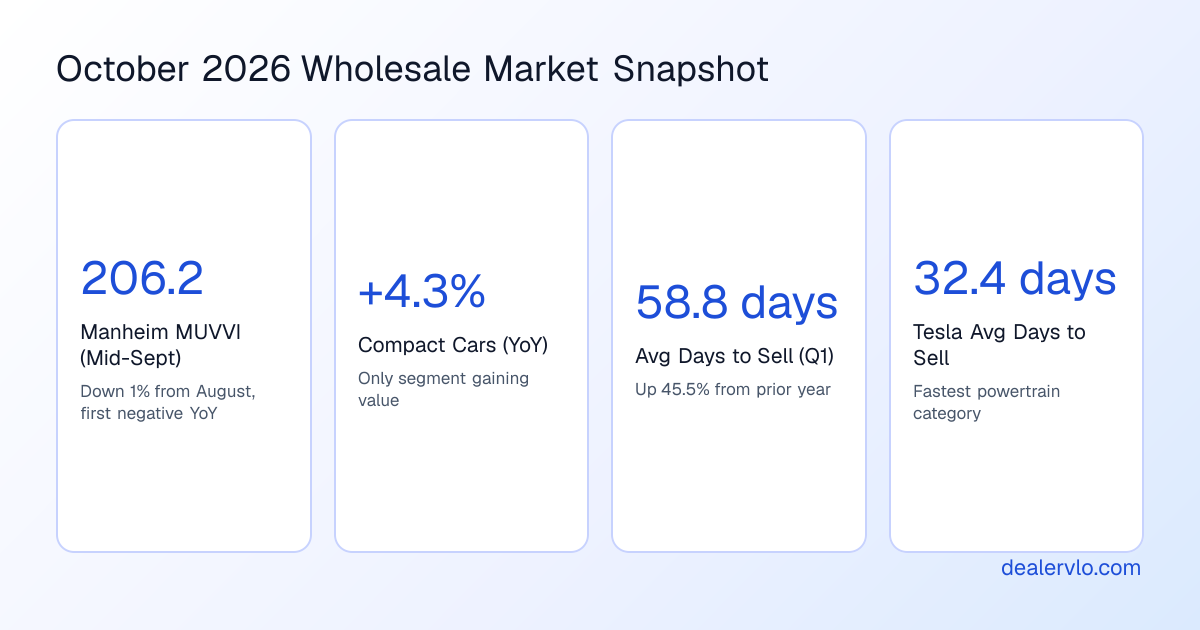
If you've been stocking pickups and midsize SUVs all year, the last sixty days have been uncomfortable. The September mid-month Manheim Used Vehicle Value Index came in at 206.2 — down 1% from August and down 0.4% year-over-year — marking the first negative year-over-year comparison in 2026 after a strong first half. Non-adjusted wholesale prices dropped 1.1% in the first half of September versus August and slipped 1.1% year-over-year.
But the headline number hides the story. The wholesale market is splitting cleanly in two, and the dividing line is fuel economy. Compact cars gained 4.3% in average wholesale price year-over-year in mid-September — the only traditional segment showing appreciation — while pickups, SUVs, and midsize cars all declined. Gas prices have been high all year, they're dominating the headlines, and buyers are pricing in real operating cost when they shop.
October stocking strategy comes down to this: small is profitable. The segments holding or gaining value are the ones that minimize the buyer's monthly fuel bill. The segments losing ground are the ones that used to be safe bets. This month's buy list reflects that reality.
For the broader framework behind segment selection, see the evergreen 2026 stocking guide. For step-by-step auction buying tactics, the dealer auction buying guide walks through the full process. This post is the October snapshot: what the data says to buy right now, and what to leave on the lane.
Segments to buy in October 2026
1. Compact cars — the only segment gaining value
Compact cars are up 4.3% year-over-year in mid-September wholesale prices, per Cox Automotive's Q3 analysis. That's not just holding steady — it's appreciation in a declining market. The reason is straightforward: high fuel prices are driving buyers toward smaller, more efficient cars, and compact sedans and hatchbacks deliver predictable, low operating cost.
The segment also turns fast. While the overall used-car market averaged 58.8 days on the lot in Q1 2026 — up 45.5% from a year earlier — compact cars have been moving meaningfully quicker than the market average. iSeeCars' February 2026 study of over 960,000 sales showed the market slowing to 53 days average, but compact models consistently undercut that number when priced right.
What to stock: Focus on the 2020–2024 model years. You want late enough to have standard safety tech (automatic emergency braking, lane-keeping) and clean enough to avoid deferred-maintenance risk, but not so new that your basis leaves no room for gross. The sweet spot is mid-trim — the SE, Sport, or EX — where equipment is present but you're not paying for sunroof-and-leather premiums that don't move the car faster at retail.
If you run a small lot and most deals are financed, compact cars are easy to structure: low price, low payment, low fuel cost. They pencil cleanly for the buyer who's stretching to qualify, and they don't sit long enough to burn holding cost. In DealerVLO, every car shows its days in inventory and flags at 60-plus days — compact cars stocked in October should never get close to that threshold.
For more on how to identify strong auction candidates across any segment, see the condition-report red flags guide and what each seller type at auction tells you before you bid.
2. Hybrids — demand up 41.8% and still climbing
Hybrid market share jumped 41.8% in Q1 2026 versus the prior year, and velocity reflects it. The Lexus RX 350h sold in an average of 27.6 days in Q1 2026 — half the overall market average. Three hybrids landed in the top 10 fastest-selling used cars in that quarter.
Hybrids solve the range anxiety that keeps many buyers away from full EVs, and they deliver real fuel savings without requiring a change in driving habits or access to a charger. That combination is resonating strongly in October 2026.
What to stock: Toyota and Lexus hybrids remain the safest bet — the Camry Hybrid, Highlander Hybrid, RAV4 Hybrid, and RX 350h all have deep buyer pools and consistent resale. The 2019–2023 model years offer the best balance of price and remaining warranty coverage. Honda hybrids — the Accord Hybrid and CR-V Hybrid — also turn well, though slightly slower than Toyota.
Avoid plug-in hybrids. The Volvo XC60 plug-in hybrid took 197.7 days to sell in Q1 2026 — 3.4 times the market average — and the Dodge Hornet plug-in was among the three slowest-selling used cars in February. Plug-ins combine the complexity of two powertrains with the charging infrastructure barrier, and buyers aren't paying for it.
DealerVLO pulls live comparable listings and suggests a target price for selling in about 30 days, so when you're deciding between a conventional model and a hybrid at auction, you can see whether the retail premium justifies the bid. Hybrids usually do; plug-ins rarely will.
14-day free trial, then $29/mo · Cancel anytime
3. Tesla — the only EV brand that moves fast
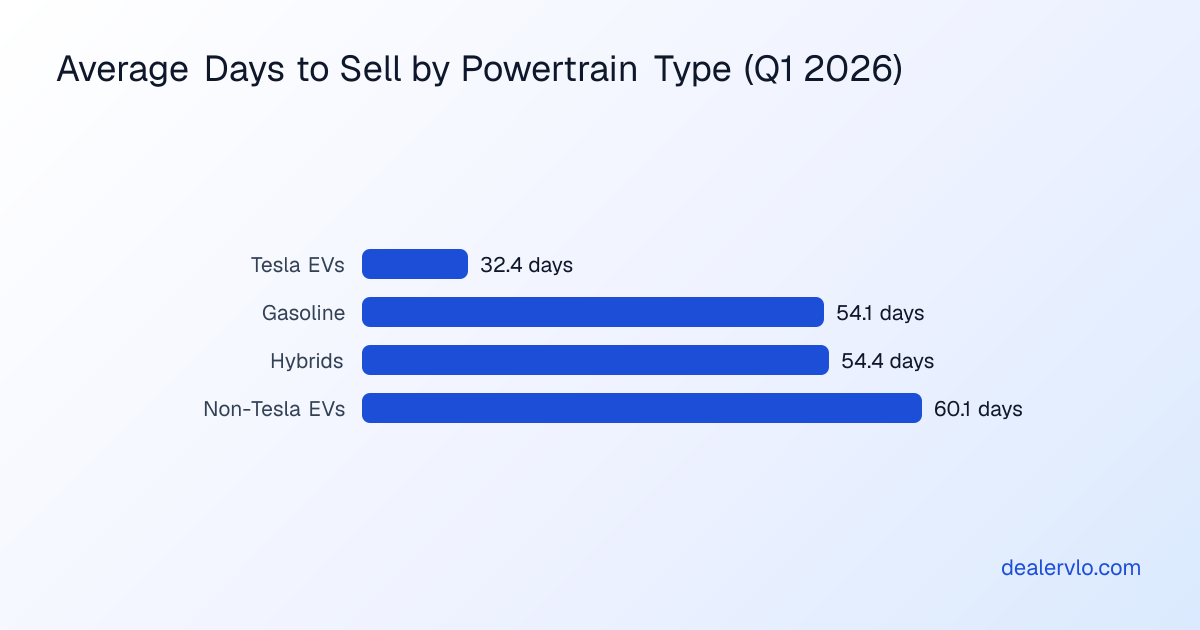
Tesla EVs averaged 32.4 days to sell in Q1 2026 — the fastest-selling powertrain category — with only a 3.8% slowdown versus the prior year. Four Teslas appeared in the top 10 fastest-selling used cars in February 2026, led by the Model X at 22.6 days and the Model 3. The Cybertruck, despite its polarizing design, sold in 27.4 days.
The broader EV market is struggling. Non-Tesla EVs took 60.1 days to sell in Q1 2026, slower than the overall market average, and models like the GMC Sierra EV (162.9 days), BMW i5, and Ford F-150 Lightning (78.4 days in older 2023 data) are sitting. But Tesla is insulated from that malaise because of its charging network, brand loyalty, and the fact that its depreciation curve has already compressed — Cox Automotive noted in August that older, more affordable EV units showed much less depreciation, and those trends highlight increasing demand for affordable used products.
What to stock: The Model 3 and Model Y in the 2020–2023 range. These are the volume models with the deepest buyer pools. Avoid the first-generation Model S and X (pre-2021 refresh) unless the basis is exceptionally low; battery degradation and repair cost scare off retail buyers. The Cybertruck is fast-moving but polarizing — only stock it if you have a buyer already asking or if the basis gives you room to discount without losing money.
Do not stock non-Tesla EVs unless you have a specific retail buyer lined up or the car is priced so low that you can afford to hold it for 90-plus days. The Kia EV6 took 95.9 days to sell, the Polestar 2 took 73.4 days, and the Hyundai Kona Electric took 61.4 days in older studies, and Q1 2026 data shows the category has only slowed further.
For a deeper dive on using live retail comps to set your ceiling before you bid, see how to price a used car from market comps and how to read MMR, Black Book, and auction pricing data.
4. Older affordable inventory (8+ years, sub-$10,000 retail)
This aligns with iSeeCars' finding that consumers are either hanging on to their current vehicle or shopping for older used models to save money.
If you're a small independent lot competing with franchise stores on newer inventory, the sub-$10,000 segment is where you have the advantage. You can inspect, recondition, and retail an older car profitably where a franchise lot would wholesale it. The buyer pool for affordable inventory has not shrunk — it's grown — and if the car is mechanically sound and priced right, it will turn.
What to stock: Late-2000s and early-2010s Honda Civics, Accords, Toyota Corollas, Camrys, and Mazda3s. These have deep parts availability, low repair cost, and buyer trust. Avoid anything with a CVT transmission older than 2015 unless you've confirmed the fluid was changed on schedule — Nissan Sentras and Altimas from this era are arbitration waiting to happen. Avoid German luxury from this age bracket entirely unless it's priced as a wholesale flip; repair cost kills retail margin.
In DealerVLO, reconditioning costs are tracked line by line and roll into each car's all-in cost and margin, so you can see in real time whether an older car with deferred maintenance will pencil after you fix it. For operational cost planning across the lot, see what it costs to run a used-car lot each month.
Segments to avoid in October 2026
Pickups and midsize SUVs — value compression and slower turns
Pickups and SUVs are down year-over-year in wholesale prices.
These used to be the bread-and-butter of independent lots — high retail prices, strong margin, reliable buyer demand. That's no longer true in October 2026. Full-size pickups and three-row SUVs are sitting longer and compressing at wholesale, and unless you have a specific buyer or you're in a rural market where trucks still move fast, you're taking on holding cost and the risk of another markdown.
What to avoid: F-150s, Silverados, Rams, and Sierras unless the trim is a base work truck priced for a commercial buyer. Avoid Tahoes, Suburbans, Expeditions, and Yukons. Avoid midsize body-on-frame SUVs like the 4Runner and Wrangler unless the basis is low enough that you can undercut the market and still make your number. The buyer who wants a big truck or SUV in October 2026 is comparison-shopping hard on fuel economy and monthly payment, and you will not win that comparison against a smaller, more efficient alternative.
Non-Tesla EVs — 60+ days on the lot is the norm
Non-Tesla EVs took 60.1 days to sell in Q1 2026, and several models stretched well beyond that: the GMC Sierra EV at 162.9 days, the Ford F-150 Lightning at 78.4 days, the Kia EV6 at 95.9 days, and the Polestar 2 at 73.4 days. The Volvo XC60 plug-in hybrid was the slowest-selling used car in Q1 2026 at 197.7 days.
These are not inventory aging issues you can solve with better photos or a price drop. The buyer pool for non-Tesla EVs is thin, range anxiety is real, charging infrastructure outside of Tesla's network is inconsistent, and depreciation has been severe enough that retail buyers worry about resale when they go to trade it in.
If you stock a non-Tesla EV in October, plan to hold it for 90-plus days, price it below market to move it faster, and accept that your margin will compress. Or don't stock it at all and put the capital into something that turns in 30 days.
The October 2026 run list — specific makes, models, and year ranges to buy
This is the working buy list for October 2026: specific vehicles that fit the segments above, with year ranges tied to equipment generations and target trims chosen for liquidity. The logic is the same as every month — buy the trim level that offers standard safety and convenience equipment without paying for options that don't move the car faster. For the detailed framework behind segment and trim selection, see the best used cars for dealers to stock in 2026.
Compact cars
-
Honda Civic (2020–2024, tenth and eleventh generation): Target the Sport or EX trim. The Sport adds the turbo engine and better styling; the EX adds Honda Sensing and a sunroof. Both turn faster than the base LX. Avoid the Touring unless the basis is low — it's too close to Accord pricing at retail.
-
Toyota Corolla (2020–2024, twelfth generation): The LE is the volume trim and the safest pick. The SE adds sportier styling and is worth stocking if the basis is similar. Avoid the base L — no alloy wheels, and it looks like a rental.
-
Mazda3 (2019–2024, fourth generation): Target the Select or Preferred trim. These have the 2.5L engine, better interior materials, and blind-spot monitoring. The base model feels cheap inside and turns slower.
-
Hyundai Elantra (2021–2024, seventh generation): The SEL is the sweet spot — standard safety tech, decent interior, and strong warranty. Avoid the base SE unless it's priced as a loss leader.
-
Volkswagen Jetta (2019–2024, seventh generation): The S or SE trim. The GLI is too close to GTI territory and narrows your buyer pool. The base S is fine if equipped with the convenience package.
Hybrids
-
Toyota Camry Hybrid (2018–2024): The LE or SE trim. The 2018–2020 models are the eighth generation; 2021-plus is the refreshed version with better tech. Both generations turn well. Avoid the XLE unless the basis justifies it — the premium doesn't move it faster.
-
Toyota RAV4 Hybrid (2019–2024, fifth generation): The XLE is the most common and the easiest to retail. The LE is fine but less equipped; the Limited and TRD are slower movers. The 2019–2021 models are slightly cheaper at auction and still under powertrain warranty if maintained.
-
Honda CR-V Hybrid (2020–2024): Target the EX or EX-L. The LX hybrid is rare and underequipped. Avoid the Touring unless you have a buyer asking for it.
-
Lexus RX 350h (2020–2024): This was the second-fastest-selling used car in Q1 2026 at 27.6 days. Target the base RX 350h or the Luxury trim. The F Sport adds cost without meaningfully expanding the buyer pool.
-
Honda Accord Hybrid (2018–2024): The EX-L or Sport trim. The 2018–2020 models are the tenth generation; 2023-plus is the eleventh. Both turn well, but the newer generation has better standard tech.
Teslas
-
Tesla Model 3 (2020–2023): The Standard Range Plus (now called Rear-Wheel Drive) and Long Range are the volume trims. Avoid the Performance unless priced as a wholesale flip — insurance and tire cost scare off most buyers.
-
Tesla Model Y (2021–2023): The Long Range is the most common and the easiest to retail. The Performance has the same buyer-pool problem as the Model 3 Performance.
Older affordable inventory
-
Honda Civic (2012–2016, ninth generation): Target the LX or EX. Avoid the CVT models with over 120,000 miles unless the fluid was changed on schedule.
-
Toyota Corolla (2014–2018, eleventh generation): The LE or S trim. These are bulletproof if maintained. Check for oil consumption on the 2014–2015 models.
-
Mazda3 (2014–2018, third generation): The i Touring or s Touring trim. The SkyActiv engines are reliable, and the manual transmission models are still desirable to a niche buyer.
-
Honda Accord (2013–2017, ninth generation): The LX, Sport, or EX. Avoid the V6 unless it's priced low — the buyer pool is narrow, and repair cost is higher.
-
Toyota Camry (2012–2017, seventh generation): The LE or SE. These run forever if maintained. Check the maintenance history and walk if it's missing.
The run list for your lot — current Manheim wholesale data and demand studies turned into specific units to buy, first thing each month. No spam, unsubscribe anytime.
Before you authorize the work: see whether a repair earns back its cost plus the holding days it adds.
Open the Recon ROI CalculatorHow to set your bid ceiling — and when to walk
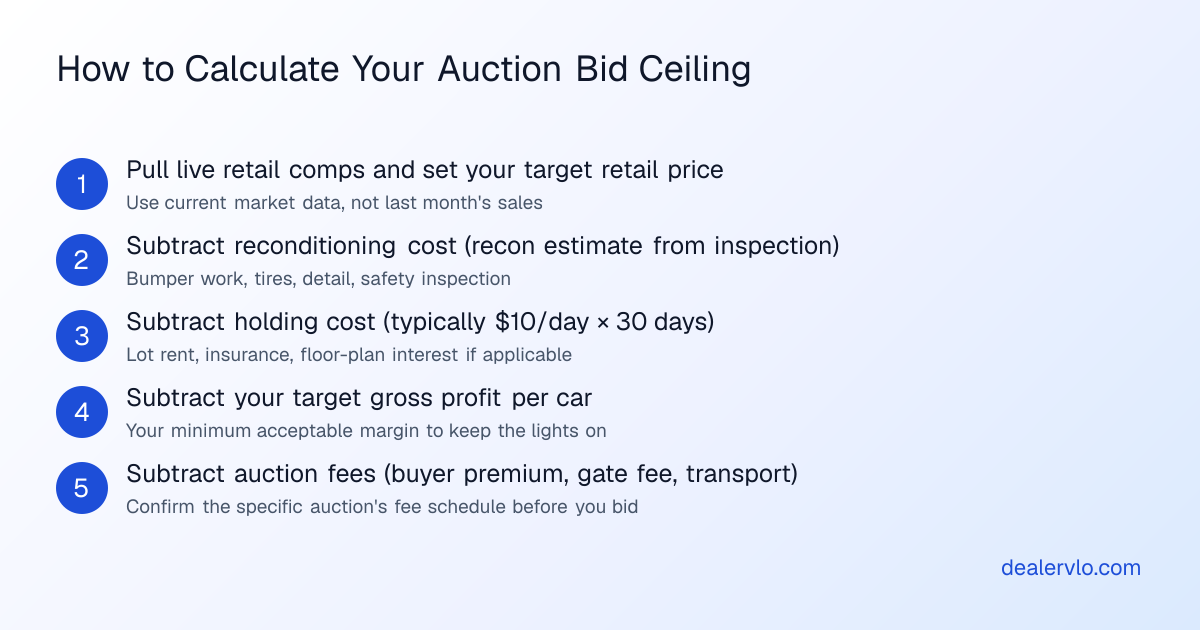
The segments and models above tell you what to buy. The bid ceiling tells you how much to pay. The math is the same every month: start at retail, subtract reconditioning cost, subtract holding cost, subtract your target gross, and what's left is the maximum you can bid and still make your number. If the lane goes higher, let it go.
Here's a worked example. Say you're looking at a 2021 Honda Civic Sport with 48,000 miles, clean history, and a condition report that shows minor front bumper scuffs and good tires. You pull live comps and see similar cars retailing between $18,500 and $19,200. You price yours at $18,800.
Retail price: $18,800
Reconditioning: $600 (bumper respray, detail, safety inspection)
Holding cost: $300 (30 days at $10/day — lot rent, insurance, interest if floor-planned)
Target gross: $2,000 (your minimum acceptable profit)
Auction fees: $400 (buyer premium, gate fee, transport — varies by auction, so confirm theirs before you bid)
Your bid ceiling: $18,800 − $600 − $300 − $2,000 − $400 = $15,500
If the hammer drops at $15,200, you buy it. If it runs to $16,000, you're out — someone else just bought your profit. This is not negotiable. The market does not care that you drove two hours to the sale or that you need inventory. If the math doesn't work, walk.
In DealerVLO, reconditioning costs are tracked per car and roll into the all-in cost automatically, so you can see your true basis and margin before you list the car. The AI price suggestion pulls live comps and shows you a target price for selling in about 30 days, so you're setting retail and your bid ceiling from the same data. For more on the bid-ceiling process and live comp pricing, see how to price a used car from market comps and the wholesale versus retail calculator.
Where to find these cars in October 2026
The segments and models above will show up at every major dealer auction in October — Manheim, ADESA, the regional independents. Compact cars, hybrids, and Teslas will be present in volume because lease returns and trade-ins are still flowing, but you'll be competing with other dealers who read the same wholesale data and see the same segment trends.
If you're bidding in lane, get there early and walk the cars before the sale starts. The condition report is a starting point, not the truth — see how to read condition reports and spot red flags for what to check. If you're bidding online, treat a condition-report grade of 3.0 or lower as a coin flip and only bid if the basis leaves room for surprise reconditioning cost.
Private-party acquisition is another option, especially for older affordable inventory. Sellers list on Facebook Marketplace, Craigslist, and OfferUp, and if you're patient and systematic, you can buy below wholesale and skip the auction fees. The process is slower — you're scheduling test drives, negotiating one car at a time, and handling title work yourself — but the margin can justify it. For the full private-party buying process, see how to buy a car off the street, from first message to title in hand.
For a detailed comparison of what different auction sellers (fleet, lease, dealer trade, repo) tell you about condition and why they're selling, see why cars are sold at auction and what each seller type means. For broader wholesale buying tactics that protect your margin across any source, see buying wholesale cars — the best practices that actually work.
How DealerVLO tracks what's working and what's sitting
When you stock a car in DealerVLO, the system starts counting days in inventory automatically. Every car shows how long it's been on the lot, and at 60-plus days you'll see an aging flag that tells you it's time to reprice or move it at wholesale before holding cost eats the margin. The dashboard shows a count of units aged 60-plus days, so you can see at a glance whether your stocking decisions are working or whether you're accumulating slow inventory.
Reconditioning costs are recorded line by line per car — the bumper respray, the tire swap, the brake pads — and roll into that car's all-in cost and margin. When you're deciding whether to bid on a car that needs work, you can model the recon cost in the profit calculator above, then track the actual spend in DealerVLO as the work is done. The system shows you whether your recon estimate was accurate or whether you underestimated, so you can adjust your bid ceiling next time.
The AI price suggestion pulls live comparable listings and shows you a target price for selling in about 30 days, so you're setting retail from current market data instead of from memory or a week-old comp search. When wholesale prices are moving — and they are in October 2026 — that live data keeps you from overpricing a car based on where the market was last month.
14-day free trial, then $29/mo · Cancel anytime
For more on how to use live comps and market data to set retail prices that actually move cars, see how to price used cars for your lot — markup strategy and market comps.
What October wholesale data means for the rest of Q4 2026
The September mid-month Manheim index at 206.2 is the lowest reading since May, and we're now in negative year-over-year territory for the first time in 2026. The official October MUVVI releases October 7, and unless fuel prices drop meaningfully between now and then, the trend will continue — compact cars and hybrids holding or gaining, trucks and SUVs compressing further.
This is not a temporary dip. Fuel prices have been elevated all year, and Cox Automotive has been consistent in linking the segment bifurcation to operating cost. The buyer who might have stretched for a Tahoe six months ago is now shopping RAV4 Hybrids, and that shift is reflected in both wholesale pricing and days on the lot. If you're still stocking pickups and SUVs in volume because that's what worked in 2024, October is the month to adjust.
Q4 traditionally sees stronger retail demand as tax refunds and year-end bonuses hit, but that demand will flow toward the segments buyers can afford to operate. Compact cars, hybrids, and affordable older inventory will turn faster in November and December than they did in August. Trucks and SUVs will not recover unless fuel prices fall sharply, and there's no indication that's coming.
Stock accordingly. Buy the segments the data says to buy, skip the ones losing value, and set your bid ceiling from current retail comps, not from what you paid for the same car three months ago. The market has moved — move with it.
Frequently asked questions
What cars should dealers stock in October 2026?
Compact cars, hybrids, and Teslas are the strongest plays in October 2026. Compact cars are up 4.3% year-over-year at wholesale and turning faster than the market average. Hybrids saw demand jump 41.8% in Q1 2026, with models like the Lexus RX 350h selling in 27.6 days. Tesla EVs averaged 32.4 days to sell, the fastest powertrain category. Focus on 2020–2024 model years for compacts and hybrids, mid-trims like the Honda Civic Sport or Toyota Camry Hybrid LE, and the Tesla Model 3 or Model Y Long Range.
Why are pickup trucks and SUVs slow in the used car wholesale market this month?
High fuel prices are compressing wholesale values for larger, less fuel-efficient vehicles. Mid-September wholesale data showed pickups and SUVs down year-over-year while compact cars gained 4.3%. Buyers are pricing in real operating cost, and unless you're in a rural market where trucks still move fast, these segments are sitting longer and taking markdowns.
How long are used cars taking to sell in October 2026?
The overall market averaged 58.8 days on the lot in Q1 2026, up 45.5% from a year earlier, according to iSeeCars analysis of over 6.7 million sales. By February 2026, the average rose to 53 days. Tesla EVs sold in 32.4 days, compact cars and hybrids consistently beat the average, while non-Tesla EVs took 60.1 days and some models like the Volvo XC60 plug-in stretched to 197.7 days. If you're stocking the right segments and pricing from live comps, you should turn inventory in 30 to 45 days.
Are hybrids or EVs better for independent dealer inventory right now?
Hybrids are safer and faster-moving than most EVs in October 2026. Hybrid demand jumped 41.8% year-over-year in Q1 2026, and models like the Toyota RAV4 Hybrid and Lexus RX 350h are turning in under 30 days. Tesla EVs also move fast — 32.4 days on average — but non-Tesla EVs are slow, averaging 60.1 days and often much longer. Stock Toyota and Lexus hybrids in the 2019–2023 range, or Tesla Model 3 and Model Y if you're comfortable with EVs. Avoid plug-in hybrids and non-Tesla EVs entirely unless you can hold them for 90-plus days.
What is the Manheim Used Vehicle Value Index telling dealers in October 2026?
The September mid-month MUVVI came in at 206.2, down 1% from August and down 0.4% year-over-year — the first negative year-over-year comparison in 2026. Wholesale prices are declining overall, but the index hides sharp segment divergence: compact cars are up 4.3% year-over-year, while pickups, SUVs, and midsize cars are down. The official October MUVVI releases October 7, and the trend is expected to continue through Q4 unless fuel prices drop.
How do I set a bid ceiling at auction in a declining wholesale market?
Start at your target retail price based on live comps, then subtract reconditioning cost, holding cost, your target gross, and auction fees. What's left is your maximum bid. If the hammer goes higher, walk. For example, if a car retails at $18,800, needs $600 in recon, costs $300 to hold for 30 days, you want $2,000 gross, and fees are $400, your ceiling is $15,500. In a declining market, use current retail comps — not what you sold the same car for last month — because wholesale and retail are both moving down. The auction profit calculator above models this math in real time.
Bottom line
October 2026 is a fuel-economy market. Compact cars and hybrids are gaining value and turning fast, pickups and SUVs are compressing and sitting, and the gap is widening. Stock the segments the data supports, set your bid ceiling from current retail comps, and walk when the lane runs past your number. If you're still buying trucks and SUVs because that's what worked last year, you'll be repricing them at 60 days and wishing you'd read the wholesale index first.
DealerVLO tracks days in inventory on every car, flags aging units at 60-plus days, and shows you all-in cost and margin so you know whether a car penciled or not. The AI price suggestion pulls live comps so you're pricing from the current market, and reconditioning costs roll in automatically so your margin is real, not optimistic. Start your free 14-day trial and see what's actually turning on your lot.
Dump it at auction now or retail it? Compare the two nets and find the break-even day.
Open the Wholesale vs. Retail Calculator