How to Read MMR, Black Book & Auction Pricing Data for Smarter Wholesale Buys
Learn how to read MMR, cross-verify with Black Book, use wholesale pricing tools, and decide when to trust the data vs. your instinct when buying at auction.
Part of the Buying & sourcing inventory guide: How to buy at dealer auctions without getting buried
Switching from another DMS? Compare DealerVLO to DealerCenter, Frazer, or Lot Wizard.
Why MMR matters when you're buying wholesale
If you're buying at auction or appraising trade-ins, you've already seen the Manheim Market Report figure on every listing. MMR is the wholesale benchmark most of the industry runs on, and knowing how to read it — really read it, not just glance at the number — makes the difference between a clean buy and an expensive mistake.
MMR tells you what dealers are actually paying for vehicles at auction right now, not what a retail buyer might pay six weeks from now. It's calculated from millions of recent wholesale transactions, weighted toward the most current sales, and updated every single night. That means the figure you're looking at this morning reflects yesterday's market, which is about as close to real-time as wholesale pricing gets.
But MMR is one data point, and the smartest buyers don't stop there. Black Book, vAuto's live tools, recent lane performance, and your own inspection all add context. This guide walks through how to read MMR, what the adjustments mean, when to cross-verify with other sources, and when your instinct should override the number on the screen.
This article explains how pricing data works and how dealers use it. It is not financial, legal, or appraisal advice. Vehicle values and auction conditions vary constantly; confirm pricing and condition before you commit to any purchase.
14-day free trial, then $29/mo · Cancel anytime
What MMR actually is and how it's built
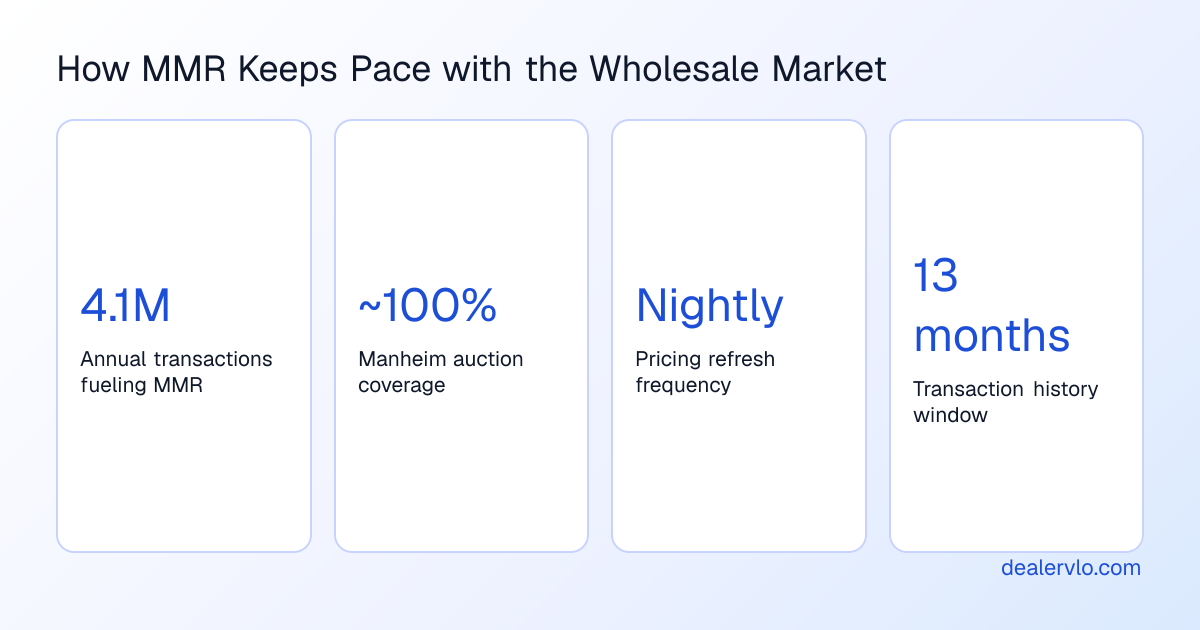
Manheim Market Report is produced by Manheim, one of the largest wholesale vehicle auction companies globally. It's the premier indicator of wholesale prices in the industry, and it's built from real transaction data — not opinions, not dealer surveys, not retail asking prices. The system pulls from millions of sales transactions over the previous thirteen months, with pricing calculations fueled by around 4.1 million annual transactions. Nearly all Manheim auction transactions feed into it, and the calculations run without subjective interpretation.
Every night, the system recalculates values to include the most recent sales. Recent transactions carry more weight than older ones, so MMR reflects seasonal trends and shifting market dynamics. That nightly refresh is why a hot-selling truck might show a tighter range this week than it did last month, and why you see a sedan's value slide in real time as spring inventory floods the lanes.
The Base MMR is the average wholesale price for a given year, make, model, and trim, excluding outliers. It reflects the average odometer reading, condition grade, and build quality of recent transactions for that vehicle. From that base, the system applies adjustments for mileage, region, condition grade, exterior color, and factory-installed options to arrive at an Adjusted MMR that's specific to the VIN you're looking at.
The MMR Range is a confidence interval: roughly seventy percent of sales with similar attributes will fall inside that range. If you see a range of fourteen to seventeen thousand, that's the zone where most wholesale transactions are closing. A listing priced at the top of that range or above it is either a strong example, overpriced, or someone testing the market.
The takeaway: MMR is not a single "book value" like you'd see in a retail guide. It's a model that recalculates every night based on what's actually selling, and it gives you a baseline and a range. Your job is to figure out where the specific car in front of you sits within that range, and whether the market will support the price the seller is asking.
How MMR is different from retail guides like KBB and NADA
KBB, NADA, and Edmunds all lean toward retail pricing — the number a consumer might pay at a dealership or through a private sale. They're useful when you're setting lot prices or explaining value to a buyer, but they don't tell you what you should pay at auction.
MMR is wholesale-focused. It reflects what dealers are paying each other in the lanes and at closed auctions, not what a retail customer will finance. The gap between wholesale and retail is where your margin lives, and confusing the two is how you end up underwater on a car that looked like a deal on paper.
MMR does publish estimated retail values for subscriber convenience, but it's explicit about the limits: those figures are mark-ups over wholesale values, and because Manheim doesn't collect retail transaction data, you should consult additional retail sources if you're trying to price for the lot. I use MMR to decide what I'll pay, then cross-check retail comps and how to price used cars with the right dealer markup strategy before I list it.
MMR shows three condition tiers — typically above average, average, and below average — with separate wholesale and retail estimates for each. It also shows historical pricing for the past year, six months, and two months, plus forward predictions for how the price is likely to move in the next month and year. That historical view is valuable when you're trying to decide if a model is peaking or still climbing.
As a rough market rule, dealer auctions tend to sell vehicles ten to twenty percent below private-party prices and fifteen to thirty percent below retail used-car-dealer prices. That spread varies by supply, demand, and vehicle type, but it gives you a sense of the wholesale discount you're working with.
What Black Book brings to the table
Black Book is the other major wholesale pricing guide you'll run into, especially if you're working with lenders or doing trade-in appraisals. It's published by National Auto Research, a division of Hearst Communications, and dealers and lenders have used it since 1955. Black Book is particularly well known for wholesale-market information, trade-in analysis, and VIN-specific valuations.
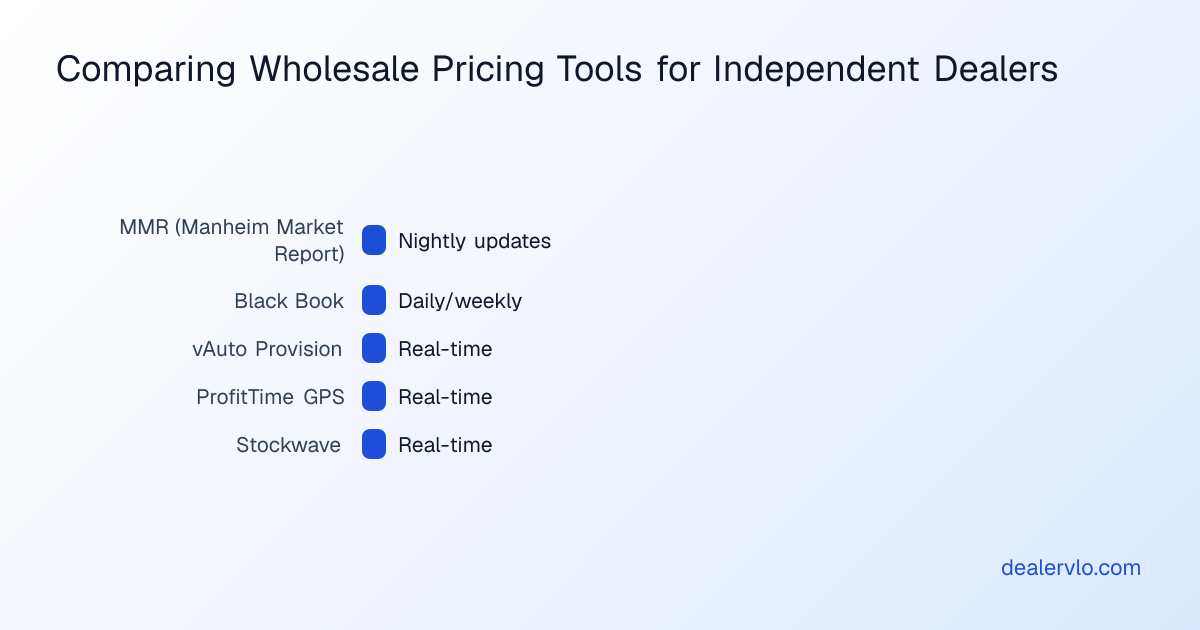
Where MMR is built almost entirely from Manheim's own transaction data, Black Book collects data by attending wholesale auctions in person and online, then applies adjustments and compares results against dealer advertised prices. It publishes updates daily, weekly, or monthly depending on the format — data feeds, web apps, mobile tools, and online appraisal services all pull from the same core data.
Black Book updates dealer invoice and MSRP figures weekly, which can be helpful if you're buying newer off-lease vehicles or evaluating trade-ins where a customer is still comparing new-car incentives. The more frequent update cadence on new-car pricing makes Black Book a useful cross-check when MMR feels stale on a current-model-year vehicle.
Access to Black Book requires a subscription, so it's less commonly available to the public than KBB or Edmunds. Most dealers who use it are either subscribing directly or accessing it through their DMS, lender portal, or appraisal tool. If you're doing serious volume or handling a lot of trade appraisals, it's worth having both MMR and Black Book available so you can compare.
I use Black Book as a second opinion when MMR shows a wide range or when I'm looking at a vehicle where recent auction volume is thin. If both guides agree on value, I'm confident. If they diverge by more than a few hundred dollars, I dig deeper — check recent lane results, pull a vehicle history report, and look at local retail comps to figure out which one is closer to reality.
For a full breakdown of how to evaluate trade-ins and reconcile book values with real-world offers, see our dealer trade-in appraisal guide.
Dump it at auction now or retail it? Compare the two nets and find the break-even day.
Open the Wholesale vs. Retail CalculatorLive market tools: vAuto, Provision, and the Cox ecosystem
If you're buying inventory at scale, you've probably encountered vAuto. It's part of Cox Automotive, the same company that owns Manheim, Autotrader, and Kelley Blue Book, so the data flows across the whole ecosystem. vAuto is built around what the company calls the Investment Value Method — treating every vehicle as an investment you manage for return, not just a piece of inventory you turn.
Provision is vAuto's appraisal and pricing tool. It uses live market data to deliver precise appraisals and pricing recommendations, pulling from virtually all the wholesale and retail transaction data Cox has access to. When you run a VIN through Provision, you're getting an adjusted valuation that accounts for current demand, days-to-turn benchmarks, and competitive retail pricing in your ZIP code. It's designed to help you avoid overpaying at auction and to price competitively once the car hits your lot.
ProfitTime GPS is the inventory-management layer. It delivers real-time pricing on identical or similar cars in your market and tells you how your pricing compares to the competition. It also tracks how long each VIN has been on your lot, flags aging units, and suggests markdowns before you're sitting on a sixty-day stale piece. If you're serious about turn rate and margin per unit, ProfitTime GPS is the tool that keeps you honest. For more on managing aged inventory, see our inventory aging and markdown strategy guide.
Stockwave is vAuto's wholesale sourcing platform. It connects you to vehicles across hundreds of marketplaces — Manheim, regional auctions, dealer trades, and off-lease channels — with live pricing and demand data on every listing. You can set buy criteria, get alerts when the right cars hit, and make proxy bids without driving to the lane. It's especially useful if you're sourcing outside your local auctions or trying to find specific units that are scarce in your region.
The advantage of the Cox ecosystem is that everything ties together: the MMR you see in Stockwave matches the valuation Provision uses, and ProfitTime GPS knows what you paid because it's all in the same platform. The downside is subscription cost, and for smaller independents, the full vAuto suite can be more than you need. But if you're turning twenty-plus units a month and buying at multiple auctions, the investment pays for itself in tighter buys and faster turns.
14-day free trial, then $29/mo · Cancel anytime
How to use MMR as your wholesale floor price
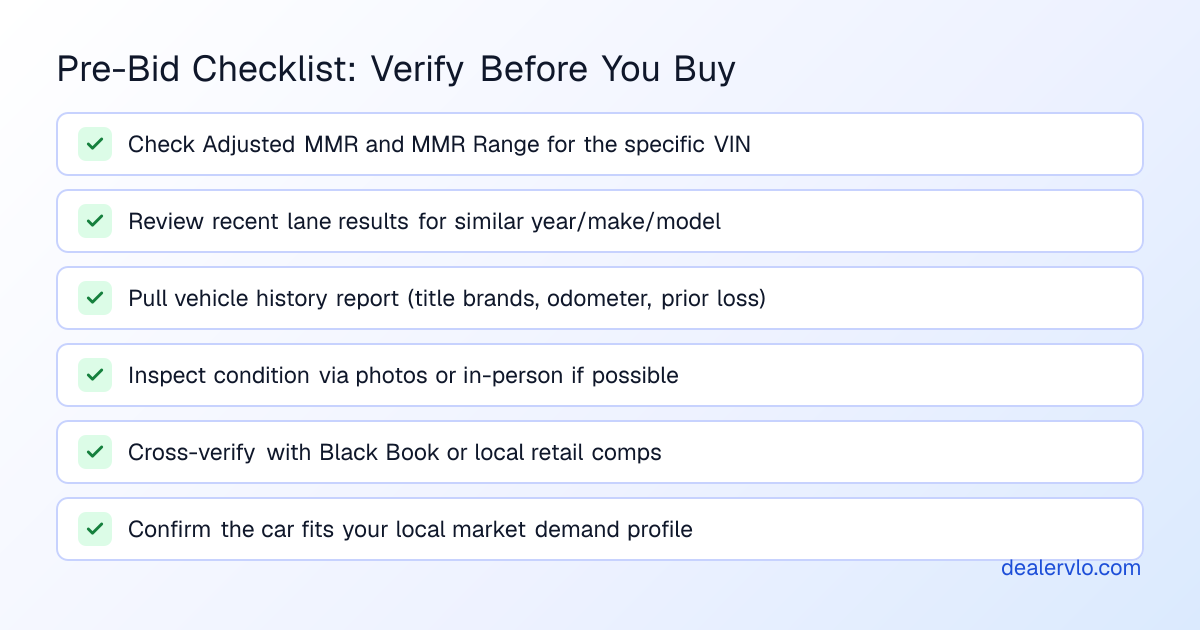
When I'm looking at a listing, the first number I check is the Adjusted MMR. That's the system's best estimate of wholesale value for that specific VIN, accounting for mileage, region, condition, and color. I treat that figure as my floor — the absolute baseline of what the car should go for in a normal wholesale transaction. Then I check it against my own retail-back math, which is laid out step by step in how to determine the wholesale value of a car.
If the seller is asking at or below Adjusted MMR, I'm interested. If they're asking above MMR but within the MMR Range, I evaluate the condition and demand to see if the premium is justified. If they're asking above the top of the range, I need a very good reason — rare options, exceptional condition, or proof that recent sales are trending higher — before I'll bid.
Here's a worked example: say a midsize SUV shows a Base MMR of fifteen thousand five hundred, with a typical range of fourteen to seventeen thousand. The listing I'm looking at has lower-than-average mileage and is in your region, so the Adjusted MMR comes back at seventeen thousand six hundred. That adjustment tells me the system thinks this particular unit is worth a premium over the average. The seller has it listed at seventeen thousand eight hundred.
Now I ask: is that two-hundred-dollar premium over Adjusted MMR justified? I check condition grade, look at the photos, pull the vehicle history, and review recent lane results for similar units. If the last three sales averaged ninety-eight percent of MMR and this one is priced at one hundred and one percent, the seller is testing the market. I might bid at Adjusted MMR and see if they'll take it, or I'll pass and wait for the next one.
The MMR Range is your confidence interval. If seventy percent of sales fall inside that range, that means thirty percent are outliers — either exceptionally clean examples that brought a premium, or rough units that sold cheap. Your job is to figure out which side of that distribution the car in front of you belongs to, and price your bid accordingly.
For a deeper dive into auction strategy and what to watch for when you're bidding, see our dealer auction buying guide.
Cross-verifying MMR with lane data and transaction history
I've learned not to trust one data source, no matter how current it is. MMR is excellent, but it's still a model, and models smooth over the noise. Lane data and recent transaction history show you the noise, and sometimes the noise is the signal.
When I see a vehicle listed at one hundred and three percent of MMR, I ask myself: is this a seasonal spike, strong local demand, or just overconfidence? So I dig into recent sales. Most auction platforms let you see the last several transactions for a given year, make, model, and trim. If the last three sales averaged ninety-eight percent of MMR, I know this seller's pricing is inflated and I can wait them out or bid lower.
If recent sales are clustering at one hundred and two to one hundred and five percent of MMR, that tells me the model is hot right now and the market is ahead of the nightly update. That happens with trucks in spring, convertibles in summer, and AWD crossovers before winter. In that case, I adjust my bid upward, but I also know I need to turn it fast before the spike softens.
Supplement MMR with in-person or virtual inspections whenever possible. Photos and condition reports are better than they used to be, but they're not perfect. A vehicle with a clean AutoGrade and average MMR can still have interior wear, paint touch-ups, or deferred maintenance that drops its retail appeal. I run a vehicle history report on every car I'm serious about, checking for title brands, odometer issues, prior total-loss claims, and frame damage that might not show up in the auction's disclosure.
Local market demand matters more than any national average. A four-wheel-drive truck might be scarce and command a premium in your market, even if MMR says it's average nationally. Conversely, a luxury sedan that's common in your region might sit longer than the days-to-turn estimate suggests. Use MMR as your starting point, then adjust for what actually sells on your lot and in your ZIP code.
For additional context on wholesale buying and how to evaluate vehicles before you bid, see our guide on buying wholesale cars with best practices.
A free daily game: one used car, three guesses at wholesale and three at retail, then the comps behind the answer.
Open the Daily AppraisalWhen to trust the data and when to trust your gut
MMR and Black Book are powerful tools, but they have limits. Unique vehicles — unusual trims, rare factory options, or low-production colors — can be mispriced by generic references because the sample size is too small. If you're looking at a special edition or a loaded trim that rarely comes through the lanes, treat the MMR as a rough guide and rely more on retail comps and your own experience.
Condition variability is the other big challenge. MMR reflects auction prices across a range of condition grades, but the spread between a clean average car and a rough average car can be a thousand dollars or more. The broad ranges mean you have to accurately assess condition to pick the right price point. If the photos look good but the undercarriage has rust or the interior smells like smoke, that car is not an average example no matter what the grade says.
History risk makes book value irrelevant for some vehicles. A branded title, a mileage discrepancy, or a prior total-loss claim that was never disclosed can sink your ability to finance, sell, or insure the vehicle at a normal price. Run the VIN and check for title brands, odometer anomalies, and major loss indicators before you rely on any valuation tool.
Market timing and seasonal fluctuations show up in MMR faster than they used to, because recent transactions are weighted more heavily and the system recalculates every night. But there's still a lag. If you're buying in the early weeks of a seasonal shift — say, the first warm week in March when convertible demand starts to spike — the data might not fully reflect the change yet. In those situations, your instinct and your knowledge of your local market are worth more than the number on the screen.
Dealers who treat MMR as just a "price reference" leave money on the table. The ones who treat it as a strategic tool — cross-verifying with lane data, tracking trends over time, adjusting for local demand, and combining it with hands-on inspection — win consistently. The data gives you the baseline; your judgment tells you where the opportunity is.
For help managing the vehicles you do buy and tracking their performance once they're on your lot, take a look at our used-car dealer software and dealer paperwork tools.
What to watch for in 2026 and beyond
The inventory challenge in 2026 is real. Supply remains uneven, wholesale pricing stays competitive, and traditional sourcing channels are tighter than they used to be. If you're an independent dealer, you're competing with franchise stores, national buyers, and algorithmic bidders that have access to the same MMR data you do.
The advantage you have is judgment. You know your market, you know what sells on your lot, and you know when a car that looks average on paper is actually a problem. The data tells you what the market thinks a vehicle is worth; your experience tells you whether your customers will pay it.
Use MMR and Black Book as your foundation, cross-verify with recent sales and local comps, inspect everything you can, and run the VIN before you bid. Treat the Adjusted MMR as your floor, the MMR Range as your decision zone, and anything above the range as a red flag that needs proof. Combine the data with your instinct, and you'll buy better than the competition that's just chasing the lowest number on the screen.
And remember: every car you buy is an investment, not just inventory. The tools are there to help you buy right, price right, and turn fast. The dealers who use them that way are the ones still making money when the market gets tight.
For tools that help you manage floor-plan costs and cash flow while you're stocking up, see our dealer floor plan calculator and explainer on how dealer floor plans work.
Frequently asked questions
What does MMR mean when you're buying at auction?
MMR stands for Manheim Market Report, the industry-standard wholesale pricing guide. It's calculated every night from millions of recent auction transactions and tells you what dealers are actually paying for vehicles in the wholesale market right now. When you see an MMR figure on a listing, that's the baseline wholesale value for that year, make, model, and trim, adjusted for mileage, condition, region, and options. Most buyers treat Adjusted MMR as the floor price and use the MMR Range to decide whether a seller's asking price is reasonable.
How is MMR different from Black Book?
Both are wholesale pricing guides, but they pull data differently. MMR is built almost entirely from Manheim's own auction transactions and updates every night. Black Book collects data by attending auctions in person and online, then applies adjustments and compares results to dealer advertised prices; it publishes updates daily, weekly, or monthly depending on the format. MMR tends to be more widely used because of Manheim's transaction volume, but Black Book is strong for trade-in appraisals and VIN-specific valuations. Smart buyers use both as a cross-check.
Should I ever pay above MMR for a vehicle?
Yes, if the vehicle justifies it. The MMR Range represents where roughly seventy percent of sales fall, which means thirty percent are outliers. If the car has lower-than-average miles, is in exceptional condition, has desirable options, or is scarce in your local market, paying at the top of the range or slightly above can still be a good buy. The key is to verify that the premium is real — check recent lane results, inspect the vehicle, and confirm that retail comps support the higher wholesale price. Don't pay above MMR just because the seller is asking it.
How often does MMR update and why does that matter?
MMR recalculates every night based on the most recent wholesale transactions. That means the number you see this morning reflects yesterday's market. Nightly updates allow MMR to track seasonal trends, shifting demand, and regional price swings in near real-time. If a model is heating up or cooling off, you'll see it in the MMR trend data within a few days. That speed matters when you're deciding whether to bid now or wait, and it's why MMR is more current than retail guides that update weekly or monthly.
When should I trust my instinct over the MMR number?
Trust your instinct when the data doesn't account for something you can see. Rare trims, unusual options, and low-production colors often lack enough transaction history for MMR to price them accurately. Condition issues that don't show up in photos or AutoGrade — smoke smell, mismatched paint, deferred maintenance — can make a car worth far less than the average MMR suggests. History red flags like branded titles, odometer discrepancies, or prior total-loss claims make book value irrelevant. And when your local market demand is clearly stronger or weaker than the national average, trust what you know sells on your lot. The data gives you the baseline; your judgment tells you when to adjust.
Do I need vAuto or can I just use free MMR access?
It depends on your volume and how you source inventory. If you're buying a few cars a month at local auctions and you have basic MMR access through the auction platform, that's often enough. If you're sourcing from multiple channels, buying at scale, or competing in tight markets, vAuto's live pricing, demand data, and inventory-management tools pay for themselves by helping you buy smarter and turn faster. Provision and ProfitTime GPS add a layer of precision and automation that free tools don't provide. Evaluate it based on how much margin you're leaving on the table without it.
14-day free trial, then $29/mo · Cancel anytime